
What is AI search visibility?
AI search visibility is the share of AI-generated answers, across the engines your buyers use, in which your brand is named or linked. If a buyer asks ChatGPT "what's the best tool for tracking AI citations?" and ChatGPT names five tools, you are either inside that list or you are invisible to that buyer for that question.
The deliverable is binary per prompt: cited or not cited. Across hundreds of category-defining prompts and five major engines, it becomes a distribution that you can measure, baseline, and grow over time. That distribution is what the rest of this guide is about.
AI search visibility overlaps with three terms you'll see used interchangeably online:
- Generative Engine Optimization (GEO) describes the practice of structuring content, schema, and on-page signals so generative engines cite you. GEO is one of the disciplines that produces AI search visibility.
- Answer Engine Optimization (AEO) focuses on zero-click answers and featured-snippet-style extraction, with heavy emphasis on FAQ structure, schema, and question-answer pairs.
- LLM SEO frames the same problem from the large-language-model angle: how do you become a source that LLMs reach for at inference time.
In practice the three names describe overlapping work. AI search visibility is the outcome; GEO, AEO, and LLM SEO are three lenses on how to produce it. If you want the lineage in detail, the three guides linked above each go deep on their own framing.
Why AI search visibility is the channel that matters in 2026
Three shifts make AI search visibility the highest-leverage growth motion right now, and the gap between brands that build for it and brands that don't is widening every quarter.
1. AI search has crossed from curiosity into default behavior. ChatGPT, Google AI Overviews, Perplexity, and Microsoft Copilot now intercept the commercial-intent queries that used to drive Google clicks. "Best X for Y", "X vs Y", "how to do X" queries increasingly resolve inside the chat. If you only optimize for the ten blue links, you ship traffic to a page Google increasingly answers itself.
2. Each engine builds its citation graph differently. ChatGPT tends to lean on a small, repeated set of trusted sources per category. Perplexity surfaces a wider, more transparent citation list with each answer. Google AI Overviews pulls heavily from on-page structured content and the surrounding link graph. Gemini blends Google's entity graph with web retrieval. Microsoft Copilot leans on Bing's index. Five engines, five citation patterns. A brand that wins one doesn't automatically win the others, which is why a measurement framework that covers all five is the foundation of any serious AI search visibility program.
3. Citation share compounds. LLMs reinforce their own historical citation patterns. A brand that earns repeated mentions in 2026 is the brand engines reach for in 2027. The compounding effect cuts both ways: late entrants spend more for the same share, because the canonical sources for each topic are increasingly entrenched.
The net of all three: brands that ship AI-search-visibility-aware content in the next 12 months establish citation moats that pay back for years. Brands that wait spend more for less.
The 5 engines that matter and how each cites differently
Treating "AI search" as one monolith is the first mistake most teams make. The five engines below all answer buyer questions, but they decide who to cite using different signals. Your optimization plan has to account for which ones drive your category.
ChatGPT (Search)
ChatGPT's search experience leans on a small set of trusted sources per topic, often the same 3 to 7 domains repeated across related prompts. Citations correlate strongly with brand mentions across high-authority sites (editorial, Reddit, Wikipedia, GitHub, YouTube), and with content that's explicitly cited in OpenAI training data lineage. The fastest lever for ChatGPT visibility is earning mentions on the seed sources its retrieval reaches for. See our ChatGPT SEO pillar for the deep playbook.
Perplexity
Perplexity surfaces a transparent citation list with every answer, often 5 to 12 sources per response. It indexes the live web aggressively and rewards fresh, structured content. Comparison tables, definition-led openers, and FAQ blocks extract cleanly into Perplexity's answer cards. The Perplexity audience also skews technical and high-intent, so visibility there over-indexes on commercial outcomes per citation.
Google AI Overviews
AI Overviews appear above the organic results for an increasing share of buyer queries. Google pulls Overviews from on-page structured content, and it weighs the classic SEO signals (E-E-A-T, internal linking, schema) more heavily than the other generative engines. If you already rank organically, you have a head start on AI Overview citation. If you don't, fixing the classic SEO basics first is the unlock.
Gemini
Gemini blends Google's entity graph with live web retrieval. The same content and schema choices that earn AI Overview citations tend to earn Gemini mentions, with one twist: Gemini leans more on Google Knowledge Graph entries, so being recognized as an entity (with a clean homepage, consistent Wikipedia presence where applicable, and tight schema markup) pays double inside Gemini answers.
Microsoft Copilot
Copilot leans on Bing's index, which means Bing Webmaster Tools, Bing IndexNow, and Bing's ranking signals matter again for the first time in a decade. Most teams underinvest in Bing optimization, which makes Copilot visibility one of the highest-leverage levers available to brands willing to do the unglamorous work.
Practical guidance: track all five, but commit serious optimization budget only to the two or three that drive the majority of your category's buyer queries. Picking the engines that matter for your category is the first call to make. RankAI covers ChatGPT citation tracking as part of its execution platform, with broader engine coverage being added as additional engines stabilize their citation surface.
How to measure your AI search visibility
Measurement is the part most teams skip, which is also why most teams have no idea whether their content investment is working. AI search visibility doesn't have a Search Console equivalent that gives you ground truth, so you build the measurement framework yourself out of the five metrics below.
1. Prompt citation share
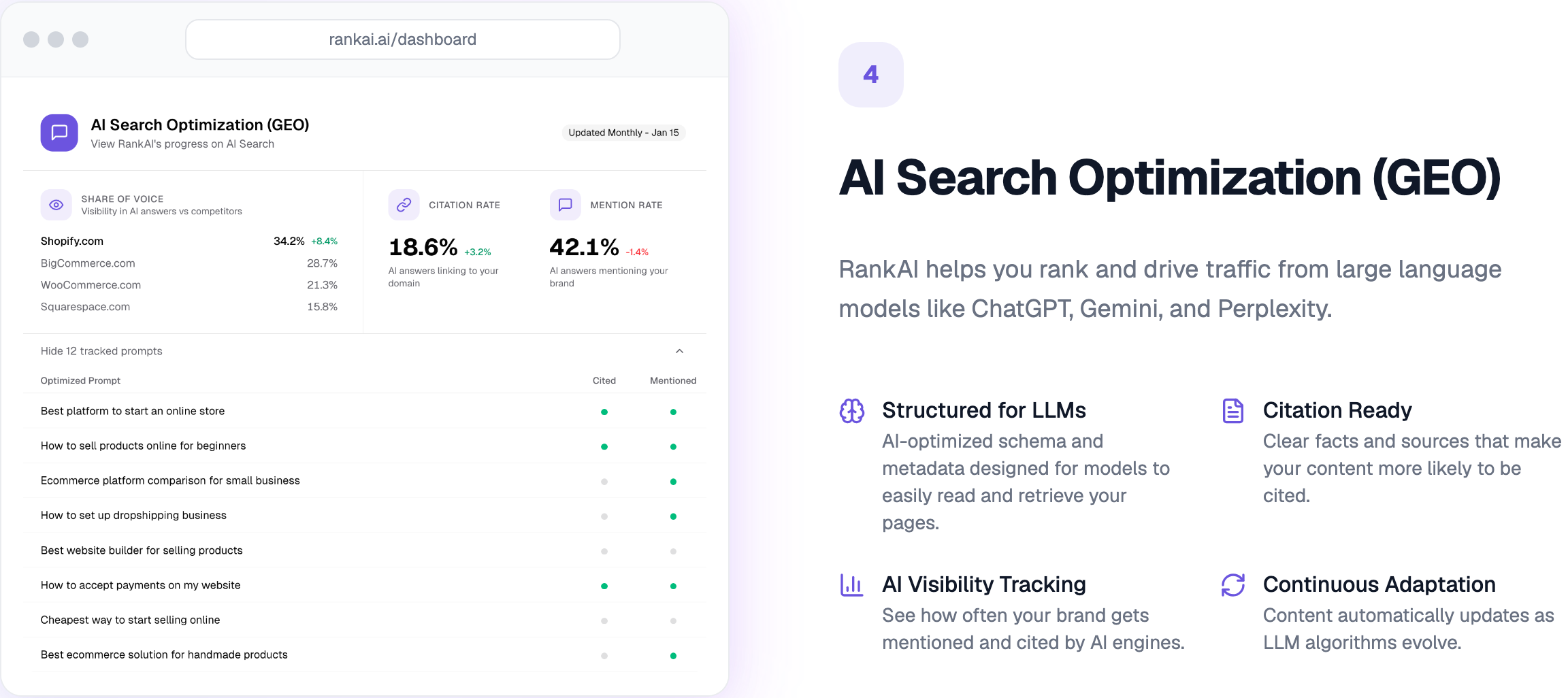
The headline number. Of the 50 to 200 prompts you track across your category, what share of answers cite your brand? Break it down per engine. Track monthly. This is the single metric that correlates most directly with downstream pipeline.
2. Citation position
Being cited as the first source named in an answer captures most of the click and most of the attention. Being cited as source 5 of 7 captures almost none. Track position-weighted citation share, not just binary cited-or-not. A brand cited at position 1 on 20 prompts often outperforms a brand cited at position 5 on 60.
3. Bot crawl frequency
GPTBot, PerplexityBot, ClaudeBot, and Google-Extended crawl your site. Their crawl frequency on a given page is a leading indicator that the page is entering the engine's consideration set. Increasing crawl frequency on a page typically precedes citation lift by 2 to 6 weeks.
4. Branded query volume from AI referrers
Google Analytics and UTM-aware campaigns isolate sessions where the entry path included chatgpt.com, perplexity.ai, or other AI surfaces. Branded query volume from those referrers is a clean leading indicator: when you start being cited, branded searches from those referrers spike before any other dashboard catches up.
5. Self-reported attribution
The most undervalued metric. Add "How did you hear about us?" to demo forms with options that include "ChatGPT recommended you", "Perplexity citation", and "Google AI Overview". The signal is noisy at low volumes but unmatched at predicting which engines are driving real pipeline.
Tie any two of these together (typically prompt citation share + self-reported attribution) and you have a working measurement framework. For a deeper walkthrough, see our how-to on measuring AI search visibility.
The 8 levers that move citation share
These are the levers that show up consistently in citation-lift studies and in the playbooks of the teams that have shipped real AI search visibility programs. None of them are exotic. The leverage compounds when several stack together.
1. Lead every concept with a one-sentence definition
LLMs love clean extractable definitions. The first sentence under a heading should answer the heading like a glossary entry. If an engine needs one sentence, you have handed it the one to use.
2. Ship FAQ blocks with FAQPage schema
Question and answer pairs in a Q/A block are the format LLMs extract most reliably. Add FAQPage JSON-LD so engines can parse the structure unambiguously.
3. Build comparison tables for commercial-intent queries
For "X vs Y" and "best X" queries, tables are the most cited format in AI Overviews and ChatGPT. Each row should be self-contained so it works extracted from context.
4. Earn citations on the sources LLMs already trust
Reddit, YouTube, GitHub, Stack Overflow, and a handful of high-authority editorial sites disproportionately seed LLM retrieval. A coordinated digital PR push that earns one mention in each is often more valuable than ten guest posts on mid-tier blogs. See our guide on earning high-quality backlinks for the modern playbook.
5. Keep entity descriptions consistent across the web
What your homepage says you do, what your LinkedIn description says, what your G2 and Crunchbase listings say, and what third-party mentions describe should all converge on the same one-sentence positioning. LLMs aggregate descriptions across the web. Conflicting descriptions confuse them.
6. Allow the AI bots that matter
GPTBot, PerplexityBot, ClaudeBot, Google-Extended, and Bingbot all need explicit access via robots.txt. The fastest way to lose AI search visibility is to block the engines from crawling you in the first place. Audit your robots.txt before any other tactic. See our walkthrough on how to rank in ChatGPT for the bot-access checklist.
7. Ship at programmatic scale where the keyword universe rewards it
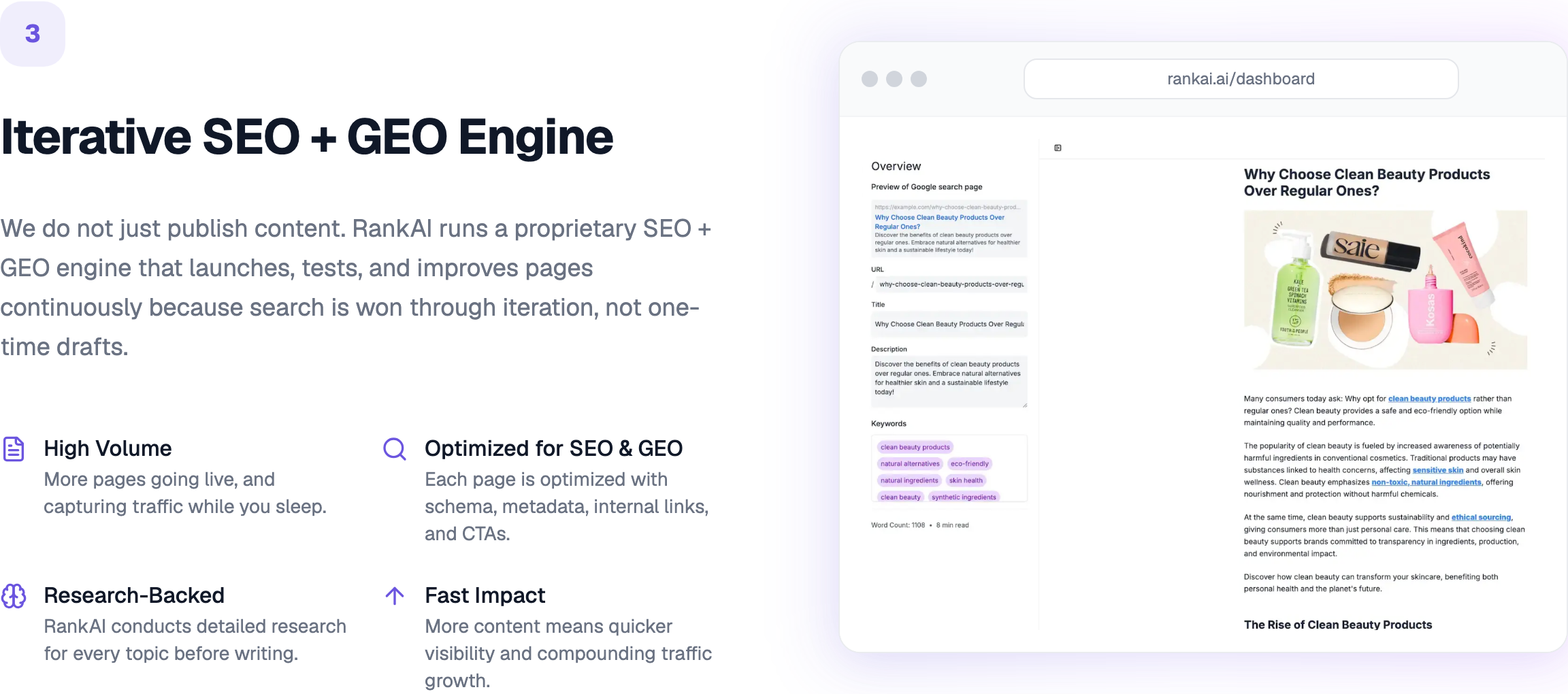
For categories with hundreds of long-tail buyer queries (think "[competitor]-alternatives", "[tool]-for-[use-case]", "[topic]-in-[year]"), one-off articles can't cover the surface. Programmatic page generation is how teams close that gap without an engineering team. RankAI runs that motion as a service. See the best AI SEO tools comparison for the alternatives.
8. Refresh aggressively
Citations to old content decay as fresher sources surface. A quarterly refresh cadence (date stamp, stat update, structure tightening) keeps citation share from sliding. Most teams underinvest here; the upside is real.
The AI search visibility stack: tools, platforms, and agencies
The AI search visibility tool stack splits into four layers. Most teams need two, sometimes three, but rarely all four.
Monitoring tools
Track which engines cite you, on which prompts, and how that share moves over time. Most monitoring tools cover 4 to 9 engines starting at $20 to $25 per month for the entry tier. For the full ranked list see the Best AI Visibility Tools comparison. For a category overview before you compare specific tools, our explainer on what AI visibility tools actually do covers the decision framework.
Execution platforms
Monitoring tells you where the gaps are. Execution platforms close them by shipping content programmatically, rewriting underperformers, and pushing schema and metadata updates to your CMS. This is where single-purpose monitoring stops and integrated platforms like RankAI start. For the ranked alternatives see the Best AI SEO Tools list.
Agencies
For teams that prefer outcomes over operations, specialized agencies run the entire playbook. The agency category has matured fast: there are now agencies focused specifically on GEO, on LLM SEO, and on AI search visibility broadly. See the Best GEO Agencies comparison and the Best LLM SEO Agencies list for the deep dive.
Analytics and attribution
Tying citation share to actual pipeline is the hard part. Most teams stitch together Looker Studio, manual prompt logs, and dashboards from their monitoring tool. As of mid-2026, no single tool nails citation-to-revenue attribution cleanly, so plan to build some of this yourself.
What we recommend
For most teams: one monitoring tool, one execution platform, and a quarterly Looker dashboard. For enterprise: layer in a specialist agency for the digital PR work that earns external citations. For solo founders and small teams: start with the execution platform and add monitoring once you have content to track.
12-week playbook to go from zero to compounding citation share
A practical sequence for teams starting from no AI search visibility today, designed to ship a measurable result by week 12 and a compounding effect by month 6.
Weeks 1 to 2: Baseline and bot audit
Pick a monitoring tool. Track 50 to 100 prompts across your top three product categories. Document the current citation share by engine. In parallel, audit your robots.txt to confirm GPTBot, PerplexityBot, ClaudeBot, Google-Extended, and Bingbot all have access. This baseline is what you measure against in week 12.
Weeks 3 to 4: Fix the structural basics on your top 20 pages
For each of your top 20 commercial-intent pages, fix: definition-led openings, FAQ blocks, schema markup, internal linking, and comparison tables where applicable. Most teams find 60 to 80 percent of pages need restructuring. Start with the highest-traffic ones.
Weeks 5 to 8: Ship the missing pages
For each prompt where you're not cited, identify whether (a) you have a page that should rank but doesn't (fix), (b) you have a page but it's the wrong format (rewrite), or (c) you don't have a page at all (write or ship programmatically). Plan content accordingly. For large surface areas (hundreds of long-tail prompts), programmatic generation through an AI SEO platform compresses this from months to weeks.
Weeks 9 to 10: Earn external citations
Identify the 5 highest-authority third-party sites in your category and pitch one piece each. Reddit, YouTube, GitHub, and Stack Overflow disproportionately seed LLM retrieval. Coordinated digital PR is the fastest external-signal lever, and it's what most monitoring-only programs never get around to.
Weeks 11 to 12: Re-measure and double down
Compare citation share against week 2. Identify the 3 prompts that gained most and the 3 that didn't move. Replicate the winners. Rewrite the losers. Set a quarterly refresh cadence on every page that earned a citation, because citation share decays without maintenance.
Month 6: Compounding effect kicks in
If you ran the playbook honestly, by month 6 you should see citation share growing without proportional new content investment. The engines have learned to reach for your pages on the prompts that matter, and the moat starts compounding. The teams that hit this milestone in 2026 are the ones who will dominate their category in 2027.
Common mistakes that kill AI search visibility growth
The seven we see most often:
- Blocking AI crawlers in robots.txt. Sometimes by accident, sometimes because of a security review that didn't understand the cost. The fastest way to have zero AI search visibility is to make the engines unable to crawl you. Audit before anything else.
- Treating AI search visibility as a replacement for SEO. It's additive. Strip out your existing SEO discipline and you lose the foundation that classic SEO signals (rankings, links, schema) provide to AI Overviews and Gemini in particular.
- Optimizing for the wrong engine. ChatGPT and Perplexity reward different signals. Decide which engine drives most of your category's search behavior and focus there first.
- Hand-optimizing instead of shipping at scale. Long-tail wins are won at hundreds-of-pages scale. One-off optimization tops out fast.
- Ignoring external citations. Most LLM retrieval pulls from sources beyond your own domain. If you only fix on-site, you're leaving the biggest lever on the table.
- Measuring once and stopping. Citation share is volatile across prompts. Monthly cadence at minimum, weekly during active campaigns.
- Letting content go stale. Citations to old content decay as fresher sources surface. A quarterly refresh cadence is the cheap insurance most teams skip.
None of these are technical blockers. They're prioritization mistakes. They also account for most of the gap between teams that build compounding citation moats and teams that don't.
Everything in the AI Search Visibility: How to Get Found by ChatGPT, Perplexity, Gemini, and AI Overviews library
The deep-dive articles that go with this guide — competitor comparisons, tool roundups, and tactical breakdowns.
Engine-specific pillars
Go deeper on the engine or discipline that maps to your priority.
- Generative Engine Optimization (GEO) — The complete GEO guide: what it is, the 7 tactics that move citation share, and the measurement framework.
- LLM SEO — How language models build their citation graphs and what that means for content, schema, and entity signals.
- ChatGPT SEO — The ChatGPT-specific playbook: how OpenAI's search surfaces choose sources, and how to become one.
Tools & agencies
The monitoring and execution stack.
- Best AI Visibility Tools in 2026 — Nine AI visibility tools ranked on engine coverage, execution depth, and price.
- Best AI SEO Tools — Ten AI SEO platforms compared on execution depth, content workflow, and pricing.
- Best AI SEO Agencies — Eight AI SEO agencies ranked for founders and growth teams.
- Best Free AI SEO Tools — Twelve genuinely-free AI SEO tools — no credit card required.
How-to + explainers
Measure citation share and learn what AI visibility tools actually do.
- How to Measure AI Search Visibility — The 5 metrics that actually correlate with pipeline.
- What Are AI Visibility Tools — Category overview: who needs an AI visibility tool, what features matter, and when to skip the tier.