

Welcome to your complete SEO guide for B2B. In the world of business to business marketing, your buyers are researchers. A staggering 71% of them begin their purchasing journey with a simple Google search. They aren’t just looking for products; they’re looking for solutions, expertise, and trustworthy partners. If your business isn’t showing up, you’re invisible.
This guide breaks down everything you need to build a powerful B2B SEO strategy that doesn’t just attract traffic, it drives qualified leads and fuels growth. We’ll cover everything from foundational planning and content creation to technical tune ups and measuring what matters.
B2B SEO Strategy 2026: The Bottom Line To win in 2026, B2B SEO must evolve into Generative Engine Optimization (GEO). This involves shifting from high-volume keywords to high-intent long-tail queries and optimizing for AI Overviews. Successful strategies focus on three pillars: E-E-A-T (Experience, Expertise, Authoritativeness, Trust), Topic Authority through content clusters, and Technical Precision to ensure AI models can crawl and cite your data as a primary source.
Part 1: Building Your B2B SEO Foundation
Success in SEO starts with a solid plan. Before you write a single blog post, you need to understand who you’re talking to and what they’re looking for. This is the strategic core of any effective SEO guide for B2B.
Define Your B2B SaaS SEO Strategy
A B2B SaaS SEO strategy is a specific plan designed for software companies with long sales cycles and niche audiences. The goal isn’t just traffic; it’s attracting qualified leads who are actively researching solutions to their business problems. This is critical because 85% of B2B decision makers trust organic search results more than paid ads. A strong organic presence builds immediate credibility. Your strategy should focus on creating content that addresses specific pain points, targets technical keywords, and guides users through a complex buyer journey.
Identify Your Target Audience
First, you need to know exactly who you’re trying to reach. Target audience identification is the process of defining the specific group of professionals you want as customers. What are their job titles, industries, and company sizes? What challenges keep them up at night? Getting this right ensures your entire strategy, from the keywords you choose to the tone of your content, resonates with the people most likely to buy from you.
Comparison: B2B vs. B2C SEO Objectives
Feature | B2B SEO Focus | B2C SEO Focus |
Primary Goal | Lead Quality & Pipeline | Transaction Volume |
Sales Cycle | Long (4–12 months) | Short (Minutes–Days) |
Content Type | Technical, Visionary, ROI-focused | Emotional, Trend-based, Urgent |
Decision Maker | Buying Committee (6–10 people) | Individual Consumer |
AI Visibility | Citation in Research-heavy AIOs | Quick Product Comparisons |
Develop Detailed Buyer Personas
Once you know your audience, bring them to life with buyer personas. These are semi fictional profiles of your ideal customers. A great persona includes details like job responsibilities, goals, pain points, and the types of questions they ask Google. This process is worth its weight in gold. In fact, 71% of companies that exceed their revenue goals have documented buyer personas. Why? Because personas transform your marketing from company focused to customer centric, making your website and content far more effective for your target users.
Master Keyword Research
Keyword research is the cornerstone of SEO. It’s the process of finding the search terms your ideal customers are using. A modern approach goes beyond just looking at search volume. It considers searcher intent (what someone really wants), keyword difficulty, and business relevance. Remember, nearly 74% of all search queries are long tail, meaning they consist of three or more words. These longer, more specific phrases often have lower search volume but much higher conversion rates because they signal a user is further along in their buying journey. A good seo guide for B2B must emphasize finding these high value queries.
Map Everything to Searcher Intent
Targeting a keyword isn’t enough; you must satisfy the why behind the search. Search intent mapping is the process of aligning your content with the user’s goal. The main intents are:
Informational keywords: The user wants to learn something (e.g., “how to reduce customer churn”).
Commercial: The user is researching solutions (e.g., “best crm for healthcare”).
Transactional: The user is ready to act (e.g., “hubspot pricing”).
Google is incredibly good at understanding intent. If you create a product page (transactional) to target an informational query, it probably won’t rank. Look at the current search results for a keyword. Are they blog posts, comparison guides, or product pages? That’s your clue. Matching intent leads to lower bounce rates and higher user satisfaction, which are powerful ranking signals.
Part 2: Creating Content That Converts and Commands Authority
With a solid strategy in place, it’s time to create the content that will attract and engage your audience. This section of our SEO guide for B2B focuses on building a content engine that establishes expertise and guides prospects through the funnel.
Organize with Topic Clusters and Pillar Content
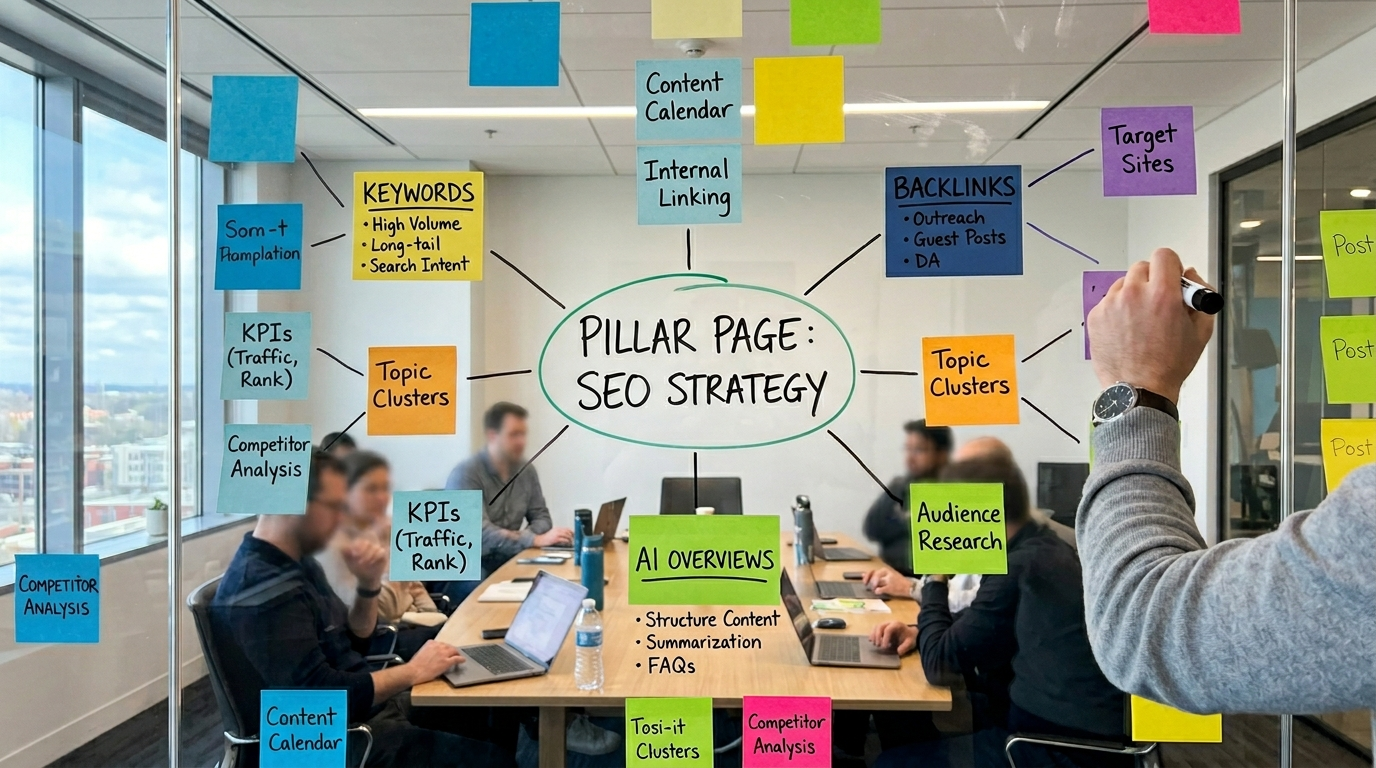
A topic cluster is a modern way to organize your content to signal expertise. It involves creating a central “pillar” page on a broad topic (like an ultimate guide) and then surrounding it with multiple “cluster” pages that dive deep into related subtopics. For example, your pillar could be “The Ultimate Guide to Email Marketing,” with cluster posts on “Subject Line Best Practices” and “Email Automation Workflows.” Each cluster piece links back to the pillar, creating a tightly organized content hub. This structure helps search engines see your site as an authority on the entire topic, which can boost rankings for all related pages.
Build a Funnel Aligned Content Library
Funnel aligned content means creating assets for every stage of the buyer’s journey: top (awareness), middle (consideration), and bottom (decision). A potential customer needs different information as they move from identifying a problem to choosing a vendor. Consider that 47% of B2B buyers consume 3 to 5 pieces of content before ever speaking to a salesperson. Your job is to provide that content.
Top of Funnel (TOFU): Attract a broad audience with blog posts, infographics, and ebooks.
Middle of Funnel (MOFU): Nurture leads with webinars, case studies, and comparison guides.
Bottom of Funnel (BOFU): Convert prospects with demos, free trials, and detailed product pages.
Leverage a Long Tail Keyword Strategy
A long tail keyword strategy focuses on those longer, highly specific search phrases we mentioned earlier. While a broad term like “CRM software” is incredibly competitive, a long tail query like “cloud crm software for small real estate teams” is much less so. More importantly, the person searching that phrase has a very specific need and is likely a high quality lead. These long tail queries make up the vast majority of all searches and their conversion rates are significantly higher. Creating niche blog posts and FAQ pages that answer these specific questions is a powerful way to attract qualified traffic.
Craft Conversion Focused Content
Every piece of content should have a purpose. Conversion focused content is designed not just to inform, but to guide the reader toward a specific action, like requesting a demo, downloading a whitepaper, or signing up for a trial. This type of content strategically includes persuasive elements and clear calls to action (CTAs). Remember, 75% of B2B buyers say the winning vendor’s content had a significant impact on their decision. By creating content that directly addresses pain points and presents your solution compellingly, you turn readers into revenue.
Winning the Zero-Click Search
As search engines provide more answers directly on the results page, your goal is to become the Featured Entity.
Definitions: Use H3 headers for "What is [Industry Term]?" followed by a concise 40-word definition.
Bulletized Lists: Use lists for "Step-by-Step" processes or "Top 5 Benefits." Google and AI agents favor these for snippet extraction.
Unique Data: Publish proprietary benchmarks. If you own the data, AI models must cite your site as the origin, driving high-authority traffic even if total click volume drops.
Become a Thought Leader
Thought leadership means publishing authoritative, insightful content that positions your brand as an expert. This isn’t about chasing keywords; it’s about shaping the conversation in your industry. Think original research, strong opinion pieces, or visionary guides. This type of content is SEO gold because it naturally attracts high quality backlinks and social shares. According to a LinkedIn study, 58% of decision makers said that thought leadership directly led them to award business to a company. It builds trust and authority, which aligns perfectly with Google’s E-E-A-T (Experience, Expertise, Authoritativeness, Trust) guidelines.
Part 3: Mastering On Site and Technical Optimization
You can have the best content in the world, but if your website is slow, confusing, or broken, your SEO efforts will fail. This part of the SEO guide for B2B covers the critical on site optimizations that make your website a winner for both search engines and users.
Perfect Your On Page SEO
On page SEO involves optimizing individual page elements to improve rankings. For a step-by-step walkthrough, see our on-page SEO checklist. Key elements include:
Title Tags: The clickable headline in search results. Make it compelling and include your primary keyword.
Meta Descriptions: The short summary under the title. While not a direct ranking factor, a good one boosts clicks.
Headings (H1, H2, H3): These structure your content for readability and help search engines understand the page hierarchy.
URL Structure: Use short, clean, descriptive URLs. A URL containing a keyword has a 45% higher click through rate.
Image Alt Text: Describe your images for accessibility and to give search engines more context.
Nail Technical SEO
Technical SEO is the work done “under the hood” to ensure search engines can crawl and index your site efficiently. If you’re not sure where to start, use this technical SEO audit guide. Key areas include:
Site Speed: This is a critical ranking and user experience factor. A 1 second delay in mobile page load can reduce conversions by up to 20%.
Mobile Friendliness: With Google’s mobile first indexing, your site must work flawlessly on mobile devices.
Crawlability: Use a clean site structure, an XML sitemap, and a correct
robots.txtfile to help search engines find all your important pages.Security (HTTPS): A secure site is a must have. It’s a minor ranking signal and a major trust signal for users.
Implement a Smart Internal Link Strategy
Internal links are links from one page on your site to another. If you’re wondering about optimal counts, see this guide on how many internal links per page. A smart internal linking strategy helps users discover more of your content and helps search engines understand your site’s structure and which pages are most important. Adding a few relevant internal links from high authority pages on your site to a new page can give it an immediate ranking boost. It’s one of the most powerful and underutilized tactics in this SEO guide for B2B.
Continuously Optimize Your Content
Content optimization is the process of improving existing content to make it more search friendly and user friendly. This can involve updating information, improving readability, adding new keywords, or embedding multimedia. The average top 10 Google article is about 1,447 words long, indicating that comprehensive content often performs best. Don’t just publish and forget; regularly review and enhance your content.
Refresh Old Content for a Traffic Boost
A content refresh involves updating and republishing older posts. Over time, content can become outdated and lose traffic. Refreshing it with new stats, insights, and examples can bring it back to life. HubSpot found that updating old blog posts can increase their organic traffic by as much as 106%. This is one of the highest ROI activities in SEO. For a startup or SMB, a service that continuously rewrites underperforming pages, like the one offered by Rankai, can be a game changer for maintaining momentum.
Optimize Your Product Pages
For B2B SaaS or e commerce companies, product pages are where the magic happens. Product page optimization involves using descriptive titles, writing unique and benefit focused descriptions, using high quality images with alt text, and encouraging customer reviews. Including structured data (schema markup) can also help you get rich snippets like star ratings in search results, which can dramatically increase click through rates.
How to Optimize for AI Overviews and Chatbots
By 2026, nearly 95% of B2B buying journeys begin within a large language model or AI-powered search. To ensure your brand is cited as a source in these summaries, follow the S.T.A.R. framework:
S - Structured Data: Implement comprehensive Schema markup (Organization, Product, and FAQ) so AI agents can parse your facts without ambiguity.
T - Transparent Sourcing: Cite original research and verified data. AI models prioritize "citation-worthy" content that isn't just a rehash of existing web text.
A - Answer-First Formatting: Place direct, 1-3 sentence answers to complex industry questions at the very top of your sub-sections.
R - Real-World Proof: Incorporate case studies and "Experience" signals. AI systems are increasingly trained to distinguish between generic AI-generated filler and firsthand professional insight.
Part 4: Building Authority and Measuring Success
Getting your website and content in order is half the battle. The other half is building a strong reputation across the web and meticulously tracking your results to prove ROI.
Build Authority with Quality Link Building
Link building is the process of acquiring hyperlinks from other websites to your own. These links, or backlinks, act as “votes of confidence” and are a major Google ranking factor. The key is quality over quantity. A single backlink from a high authority website is more valuable than many from low quality sites. Pages ranking #1 on Google have, on average, 3.8 times more backlinks than those ranking in positions #2 through #10.
To build links, you can create link worthy content (like original research), engage in digital PR, or guest post on relevant industry blogs. This is a core pillar of authority building, which is about increasing your website’s overall credibility in the eyes of search engines. A strong backlink profile makes your entire site more resilient and more likely to rank for competitive terms.
Track Your SEO KPI Measurement
You can’t improve what you don’t measure. SEO KPI (Key Performance Indicator) measurement is how you track success and justify your investment. Key metrics to watch include:
Organic Traffic: The number of visitors from search.
Keyword Rankings: Your position for target keywords.
Click Through Rate (CTR): The percentage of people who click your result.
Conversion Rate: The percentage of organic visitors who become leads.
Organic Revenue: The sales generated from organic search.
Focusing on the right KPIs is a vital part of this SEO guide for B2B. While traffic is great, leads and revenue are what really matter to the business.
Understand Attribution Modeling
The B2B buyer journey is rarely linear. A prospect might first find your blog via organic search, later see a social media ad, and finally convert after clicking an email link. Attribution modeling is the method of assigning credit to these different touchpoints. Instead of a simple “last click” model, many companies use multi touch models to understand how different channels, including SEO, contribute to the final sale. This ensures SEO gets credit for its crucial role early in the funnel.
Combine SEO with CRO
CRO, or Conversion Rate Optimization, is the practice of improving your website to convert more visitors into customers. Combining CRO with SEO is a powerhouse move. You’ve worked hard to get organic traffic; now make sure your landing pages are optimized to capture those leads. Simple changes like improving page speed, simplifying forms, or testing different CTAs can have a huge impact. Remember, SEO leads have a 14.6% close rate, compared to just 1.7% for outbound leads. Optimizing for conversions maximizes the value of that high quality traffic.
Part 5: Navigating the Future with AI
The world of search is changing rapidly, driven by artificial intelligence. A modern SEO guide for B2B must address how to adapt to this new landscape.
Understand AI Overview Impact
AI Overviews are the AI generated summaries that now appear at the top of many Google search results. This has a massive impact on SEO. On the one hand, roughly 60% of all searches now result in no click to any website, as users get their answers directly on the results page. This is a challenge. On the other hand, companies are adapting; nearly 70% of businesses report higher ROI after integrating AI into their SEO workflows. The game is no longer just about ranking; it’s about being visible within these new AI powered features.
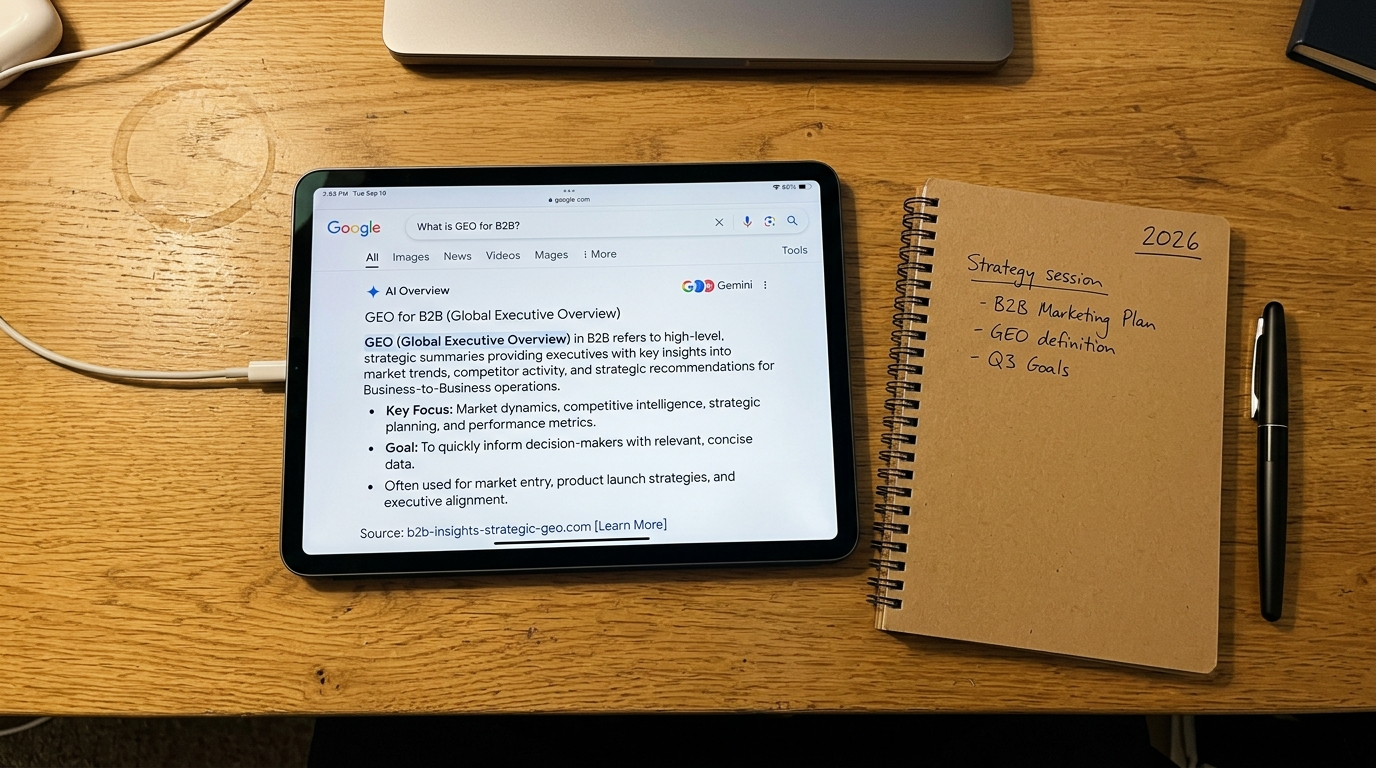
Embrace Generative Engine Optimization (GEO)
Generative Engine Optimization (GEO) is the new practice of optimizing your content to be cited and featured within these AI answers. The goal is to become a trusted source for the AI. While it may lead to fewer direct clicks, being cited in an AI overview can increase a page’s click through by 35% because it establishes your brand as the authority. Strategies for GEO include using clear, factual language, structuring content with schema markup, and building overall domain authority. It’s about ensuring your content is so clear and trustworthy that the AI chooses you.
This is a complex, fast moving space. Working with an agile team that blends AI tools with human experts, like the monthly service from Rankai, can help you stay ahead of the curve and adapt your strategy as search evolves.
Frequently Asked Questions
What is the first step in a B2B SEO strategy?
The first step is always deep audience research. Before you do anything else, you must identify your target audience and develop detailed buyer personas. This foundational work informs every subsequent decision in your SEO strategy, from keyword selection to content creation.
How is B2B SEO different from B2C SEO?
B2B SEO typically involves a much smaller, more specialized audience with a longer and more complex sales cycle. The focus is on generating qualified leads rather than driving a large volume of direct sales. Content is often more technical and informational, aimed at solving specific business problems for a buying committee, not an individual consumer. This makes a tailored seo guide for B2B essential.
How long does it take for B2B SEO to show results?
SEO is a long term strategy. While you might see some quick wins from technical fixes, it generally takes 4 to 12 months to see significant results in terms of traffic and lead generation. Consistency in content creation and authority building is key to achieving and maintaining rankings.
What are the most important KPIs for a B2B SEO campaign?
While organic traffic and keyword rankings are important, the most critical KPIs for B2B are business focused. These include Marketing Qualified Leads (MQLs) from organic search, organic lead conversion rate, and ultimately, the pipeline and revenue generated from the SEO channel.
Is link building still important for B2B SEO?
Absolutely. High quality backlinks from relevant, authoritative websites remain one of the strongest ranking signals for Google. For B2B companies, earning links from industry publications, partners, and respected blogs is a powerful way to build credibility and improve search visibility.
How does AI change the approach in this seo guide for B2B?
AI changes the game in two ways. First, tools can be used to scale content creation and keyword research. Second, the rise of AI Overviews in search results requires a new strategy called Generative Engine Optimization (GEO). The focus is now shifting from just ranking in the top 10 to also being the trusted source cited within AI answers.