
Getting your new business noticed online can feel like shouting into the void. You have a great product, a killer team, and a vision to change the world, but if no one can find you on Google, it’s an uphill battle. This is where search engine optimization (SEO) comes in. SEO is the art and science of getting your website to show up higher in search results, driving free, organic traffic your way. For a startup with a tight budget, mastering SEO can level the playing field against industry giants. This comprehensive SEO guide for startups will walk you through everything you need to know.
Startup SEO at a Glance: 2026 Strategy
To succeed in startup SEO today, focus on Topical Authority over individual keywords. The goal is to build a "moat" of high-quality, expert-led content that satisfies user intent across the entire funnel.
1. Primary Goal: Establish Trust and Expertise (E-E-A-T).
2. Technical Priority: Pass Core Web Vitals and ensure mobile-first indexing.
3. Growth Lever: Create "Linkable Assets" (original data or unique tools) to earn high-authority backlinks.
4. Timeline: Expect initial indexing in 2–4 weeks, with significant organic growth typically occurring at the 6–9 month mark.
What is Startup SEO?
Startup SEO refers to the specific strategies new and growing businesses use to improve their search engine rankings. It’s all about making your new company discoverable when potential customers are searching for solutions you offer. Unlike paid ads that vanish the moment you stop paying, SEO is a long term investment. A well optimized article can bring in traffic for years. In fact, organic search drives over half of all website traffic, making it a channel you can’t afford to ignore.
The Importance of SEO for a Startup
Why should a new business care so much about SEO? Because if people can’t find you, you don’t exist online. Organic search is the largest single source of web traffic for most businesses, accounting for about 53% of all visitors. To put that in perspective, paid search only brings in around 15%. SEO also drives over 1,000% more traffic than organic social media. Showing up on the first page of Google not only brings you visitors but also builds brand credibility. People inherently trust Google’s top results, seeing them as industry leaders.
Key SEO Benefits for Startups
Investing in a solid SEO strategy brings a ton of benefits for a growing company.
Sustainable Traffic: An article you publish today can attract customers for months or even years to come, creating a compounding return on your initial effort.
High Quality Leads: People finding you through search already have a problem and are actively looking for a solution. This means leads from SEO have a much higher close rate (around 14.6%) compared to outbound leads (1.7%).
Improved User Experience: Many SEO best practices, like fast load times and clear navigation, naturally make your website more user friendly, which helps with conversions and customer satisfaction.
Enhanced Brand Trust: Ranking well in search results positions your startup as a credible and trustworthy authority in your field.
Feature | Organic SEO | Paid Search (PPC) |
Cost | High upfront effort, low long-term cost | Pay-per-click; costs scale with traffic |
Timeline | 6–12 months for peak results | Near-instant visibility |
Sustainability | Traffic continues if budget stops | Traffic stops immediately when budget ends |
Trust Level | Higher (Organic results are trusted more) | Lower (Labeled as "Sponsored") |
Scalability | Compounding returns over time | Linear growth (Requires more budget to grow) |
Types of Startup SEO
SEO isn’t just one thing. It’s a combination of different practices working together. A complete SEO guide for startups must cover the core types.
On Page SEO
On page SEO involves optimizing elements directly on your website. This includes the quality of your content, the keywords you target, your page titles, headers, images, and internal links. It’s the foundation of your SEO efforts and ensures both users and search engines can understand what your pages are about.
Off Page SEO
Off page SEO refers to actions taken outside of your own website to impact your rankings. This is primarily focused on building your site’s authority and reputation, mainly by earning backlinks (links from other websites). Think of backlinks as votes of confidence from other sites.
Technical SEO
Technical SEO is all about optimizing your website’s backend and infrastructure. It ensures search engines can crawl and index your site without any issues. This includes things like site speed, mobile friendliness, security, and having a clean site structure. A step-by-step technical SEO audit will help you prioritize quick wins.
Local SEO
If your startup serves customers in a specific geographic area, local SEO is critical. It involves optimizing your online presence to show up in local search results, like Google’s map pack. This is huge because a staggering 90% of consumers have used the internet to find a local business in the last year.
International SEO
For startups targeting a global audience, international SEO is the process of optimizing your site for different countries and languages. This involves using specific tags (like hreflang) to tell Google which version of your site to show to users in different regions, ensuring a seamless experience for your global customers.
Crafting a Powerful Content Marketing Strategy
A content marketing strategy is your plan for creating and sharing valuable content to attract customers. For SEO, this means producing blog posts, guides, and videos that answer your audience’s questions and rank for relevant keywords. To keep this strategic, use content mapping to plan topics by funnel stage. Content marketing costs 62% less than traditional marketing but generates three times as many leads. Companies that maintain a blog generate 67% more leads than those that don’t, making it an incredibly effective way for startups to build an audience.
Keyword Research
Keyword research is the process of finding the search terms your potential customers are using. This is the bedrock of any SEO guide for startups. It helps you understand what people are looking for, so you can create content that meets their needs. It’s often smart for startups to target long tail keywords (longer, more specific phrases) because they usually have less competition and higher purchase intent. As you expand, group related terms into a keyword cluster to cover a topic comprehensively.
Content Mapping by Search Intent
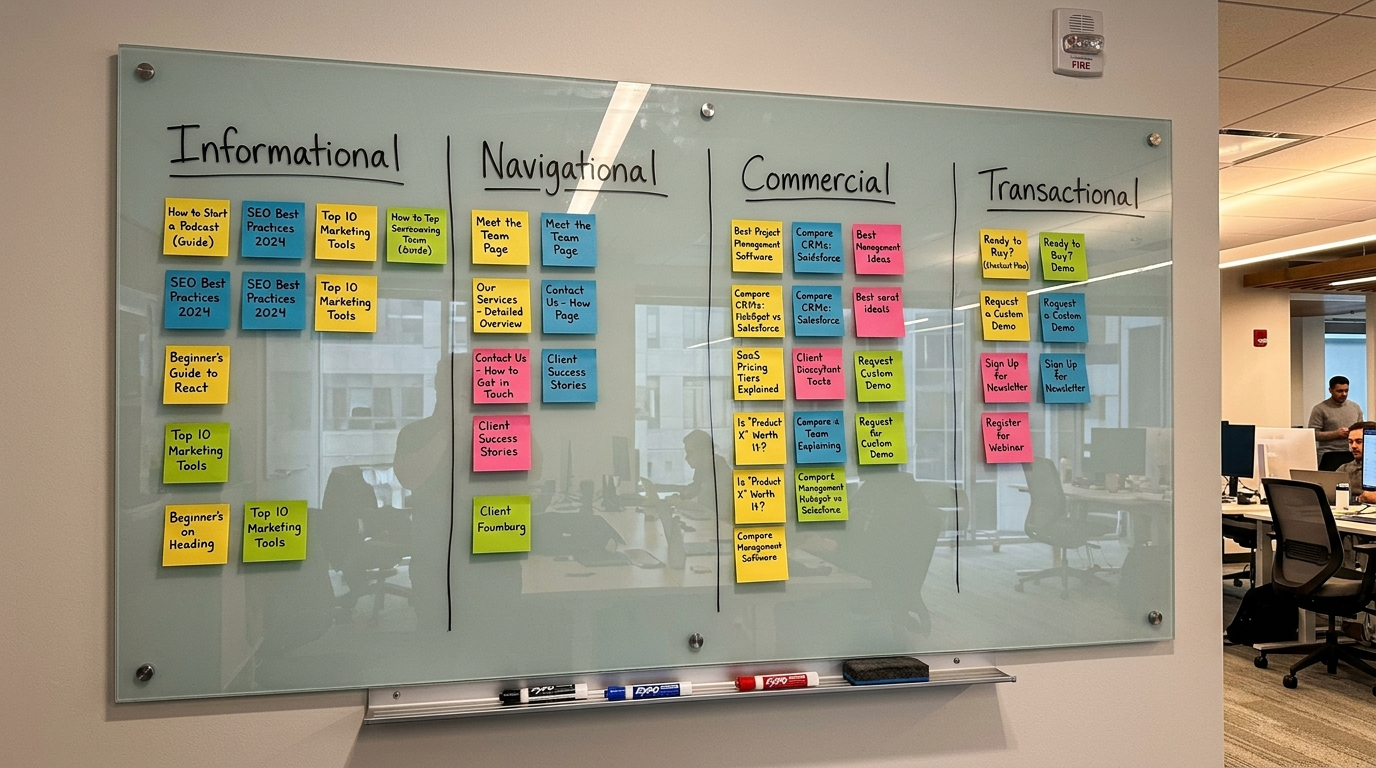
To maximize conversions, your startup must create content for every stage of the buyer's journey. Use this framework:
Informational (Top of Funnel): "How to solve [Problem]" or "What is [Industry Term]." Goal: Brand awareness.
Navigational (Middle of Funnel): "[Startup Name] reviews" or "[Startup Name] vs [Competitor]." Goal: Consideration.
Commercial (Middle/Bottom): "Best [Software Category] for startups." Goal: Comparison/Evaluation.
Transactional (Bottom of Funnel): "Buy [Product Name]" or "Sign up for [Service]." Goal: Conversion.
Search Intent Matching
Search intent matching is about making sure your content aligns with what the user is trying to accomplish. Are they looking for information, trying to buy something, or comparing options? For a deeper primer, read this guide to keyword intent. Google is very good at figuring this out. To rank, your page must satisfy the user’s intent. For example, if someone searches “best project management tools”, they want a comparison article, not a single product page.
Mastering On Page SEO Elements
Getting the details right on your website pages can make a huge difference in your rankings.
Title Tag Optimization
The title tag is the clickable headline that appears in search results. It’s one of the most important on page SEO factors. A good title should be around 50 to 60 characters, include your target keyword, and be compelling enough to make someone click.
Meta Description Optimization
The meta description is the short snippet of text under the title in search results. While not a direct ranking factor, a well written meta description acts like ad copy, convincing users to click on your result over a competitor’s. Keep it around 155 characters and include a call to action.
URL Structure Optimization
A clean, descriptive URL helps both users and search engines understand what a page is about. Good URLs are short, use hyphens to separate words, and include the primary keyword. For example, yourstartup.com/blog/startup-seo-guide is much better than yourstartup.com/p?id=789.
Heading Structure Optimization
Use heading tags (H1, H2, H3) to create a logical outline for your content. Your page should have one H1 tag for the main title, followed by H2 tags for main sections and H3 tags for subsections. This improves readability and helps search engines understand the page’s structure and key topics.
Internal Linking
Internal linking is the practice of linking from one page on your website to another. It helps search engines discover your content, spreads authority throughout your site, and guides users to related information. Every important page on your site should have internal links pointing to it. Not sure how many internal links per page to use? This practical guide breaks it down.
Structured Data and Schema Markup
Structured data, often implemented with Schema.org markup, is code you add to your site to help search engines better understand your content. It can enable rich snippets in search results, like star ratings, prices, and FAQ dropdowns. These eye catching features can boost your click through rate by 20 to 30%. At minimum, implement author schema on editorial content to reinforce credibility.
Building a Strong Technical SEO Foundation
A technically sound website is essential for SEO success. Even the best content won’t rank if Google can’t access it properly.
Site Speed and Core Web Vitals
Site speed is a critical ranking factor and user experience element. A slow website will frustrate visitors and cost you conversions; in fact, 53% of mobile users will leave a page that takes more than three seconds to load. Google’s Core Web Vitals (CWV) are specific metrics that measure loading performance, interactivity, and visual stability. Aim to pass the CWV assessment for a better user experience and a potential ranking boost.
Mobile Friendliness
With over half of all web traffic coming from mobile devices, having a mobile friendly website is non negotiable. Google uses mobile first indexing, meaning it primarily ranks the mobile version of your site. Ensure your website has a responsive design that looks and works great on any screen size.
Crawlability and Indexing
Crawlability is how easily search engine bots can navigate your site, and indexing is the process of adding your pages to their database. If a page isn’t crawled and indexed, it can’t rank. You can use a robots.txt file and an XML sitemap to guide search engine crawlers.
Robots.txt Optimization
Your robots.txt file is a simple text file that tells search engine crawlers which parts of your site they should or shouldn’t access. It’s useful for blocking private areas or duplicate pages, helping to focus Google’s crawl budget on your most important content.
XML Sitemap
An XML sitemap is a file that lists all the important URLs on your website. It acts as a roadmap for search engines, helping them discover and index your content more efficiently. Submitting your sitemap to Google Search Console is a fundamental SEO best practice.
HTTPS and SSL
HTTPS is the secure version of HTTP, encrypting data between a user’s browser and your website. It’s essential for building trust and is also a minor Google ranking factor. A site without the little padlock icon looks outdated and untrustworthy, so make sure your startup’s site uses HTTPS from day one.
Duplicate Content Resolution
Duplicate content is when the same or very similar content appears on multiple URLs. This can confuse search engines and dilute your ranking power. Use canonical tags or 301 redirects to tell Google which version of a page is the primary one you want to be indexed.
Site Structure Optimization
A logical site structure makes it easy for both users and search engines to navigate your website. Important pages should be accessible within a few clicks from the homepage. A well organized site, often built around content clusters, helps distribute link authority and establishes your topical relevance.
Essential Technical SEO Specs
Metric/Element | Targeted Performance | Tool to Check |
LCP (Loading) | Under 2.5 seconds | PageSpeed Insights |
Security | Valid SSL (HTTPS) | Browser Padlock Icon |
Crawlability | Dynamic XML Sitemap | Google Search Console |
Mobile Ease | No horizontal scrolling/large text | Google Mobile-Friendly Test |
Broken Links | 0 (Redirect 404s to relevant pages) | Screaming Frog / Ahrefs |
Advanced Content and Authority Strategies
Once your foundation is set, you can move on to more advanced strategies to build authority and dominate your niche.
Topical Authority and Content Clusters
Topical authority is about becoming a recognized expert on a specific subject. You can achieve this by creating content clusters. This involves a main “pillar” page covering a broad topic (like this SEO guide for startups) and multiple “cluster” pages that dive deeper into specific subtopics, all linking back to the pillar.
Content Calendar
A content calendar is a schedule for when and what you’ll publish. Consistency is key for SEO. A regular publishing cadence signals to Google that your site is active and fresh. Businesses that publish 16 or more blog posts per month get around 3.5 times more traffic than those that publish fewer than four. A service can help with this; for instance, a solution like Rankai can manage a high volume content calendar for you, ensuring consistent output.
Content Refresh Cadence
Content can become outdated. A content refresh cadence is your schedule for updating old posts with new information, stats, and images. Refreshing and republishing old content can increase its organic traffic by over 100%. It’s a high ROI activity because you’re improving existing assets rather than starting from scratch.
Building Your Site’s Authority with Off Page SEO
Authority is a huge part of SEO. Here’s how to build it.
Backlink Building
Backlink building is the process of getting other websites to link to yours. These links act as endorsements and are one of the strongest ranking signals. The number one result in Google has, on average, 3.8 times more backlinks than the results in positions two through ten. Focus on earning high quality, relevant links.
Guest Post Outreach
Guest posting is writing an article for another website in your industry. In exchange, you usually get an author bio with a link back to your site. It’s a great way to build high quality backlinks, reach a new audience, and establish yourself as an expert.
PR and Influencer Collaboration
Leveraging public relations and collaborating with influencers can earn you powerful backlinks from news outlets and popular blogs. Getting featured in a major publication not only sends a strong authority signal to Google but also drives significant referral traffic and boosts your brand’s credibility.
Citation Building
For local businesses, a citation is any online mention of your business’s Name, Address, and Phone number (NAP). Building citations on directories like Yelp and industry specific sites helps Google verify your business information and is a key ranking factor for local search.
Google Business Profile Optimization
Your Google Business Profile (GBP) is a free listing that appears in Google Search and Maps. Optimizing it is essential for local SEO. Fill out your profile completely, add photos, encourage customer reviews, and use the Posts feature to share updates. A well managed GBP can directly drive calls and website visits. If you need help, services like Rankai often include local SEO optimizations to ensure your profile is set up for success.
Understanding EEAT
EEAT stands for Experience, Expertise, Authoritativeness, and Trustworthiness. It’s a concept from Google’s quality guidelines. While not a direct ranking factor, Google’s algorithms are designed to reward content that demonstrates these qualities. Show your expertise by creating high quality, well researched content written by credible authors.
Content Collaboration
Collaborating with other experts or businesses on content, like a joint webinar or an expert roundup post, is a great way to create higher value content and expand its reach. Each collaborator will promote the content to their audience, amplifying your message and often earning you natural backlinks.
Planning, Measuring, and Executing Your SEO Strategy
A successful SEO program requires a clear plan and consistent measurement. This section of our SEO guide for startups covers the strategic framework.
SEO Goal Setting
You can’t improve what you don’t measure. Set SMART (Specific, Measurable, Achievable, Relevant, Time-bound) goals for your SEO efforts. This could be increasing organic traffic by 30% in six months or ranking on page one for five key commercial keywords. Marketers who set goals are 376% more likely to report success.
SEO Strategy Planning
An SEO strategy is your roadmap for achieving your goals. It should include keyword targeting, a content plan, a link building approach, and a technical SEO audit. A documented strategy ensures your efforts are focused and aligned with your business objectives.
Competitor Analysis
Analyze what your competitors are doing in search. What keywords are they ranking for? Where are they getting their backlinks? What kind of content are they creating? This analysis can reveal valuable opportunities and help you create a strategy to outperform them.
Rank Tracking and Organic Traffic Measurement
Use tools to track your keyword rankings and monitor your organic traffic in Google Analytics. This allows you to measure the impact of your work, identify what’s working, and spot any potential issues, like a sudden drop in rankings. Here’s a practical guide on how to tell if your SEO strategy is working.
Essential Setup for Any Startup
Before you start, make sure you have the right tools configured.
Google Search Console Setup
Google Search Console is a free tool from Google that helps you monitor your site’s performance in search. It provides data on clicks, impressions, and indexing issues. Setting it up is a crucial first step for any website owner.
Bing Webmaster Tools Setup
While smaller than Google, Bing still represents a significant volume of searches. Bing Webmaster Tools is their equivalent of Search Console. Setting it up is quick and provides valuable data and tools for optimizing your presence on the Bing network.
A Quick SEO Startup Checklist
Feeling overwhelmed? Here’s a simplified checklist to get you started. This is not the full SEO guide for startups, but a quick reference.
Foundation: Set up Google Analytics and Google Search Console.
Keywords: Do initial keyword research to find your core topics.
On Page Basics: Optimize title tags, meta descriptions, and headers for your main pages.
Technical Basics: Ensure your site is mobile friendly, loads quickly, and uses HTTPS.
Content: Create a high quality homepage and at least one valuable blog post or resource.
Local (If Applicable): Create and optimize your Google Business Profile.
Structure: Submit an XML sitemap to Google Search Console.
Start Early and Stay Consistent
The single most important takeaway from any SEO guide for startups is this: start now and be consistent. SEO is a marathon, not a sprint. The efforts you put in today will build upon themselves, creating a powerful, long term growth engine for your business. The earlier you start, the faster you’ll see the compounding results that drive sustainable success. Don’t have the time? A partner like Rankai can help you maintain the consistency required to win.
How to Optimize for AI Overviews and SGE
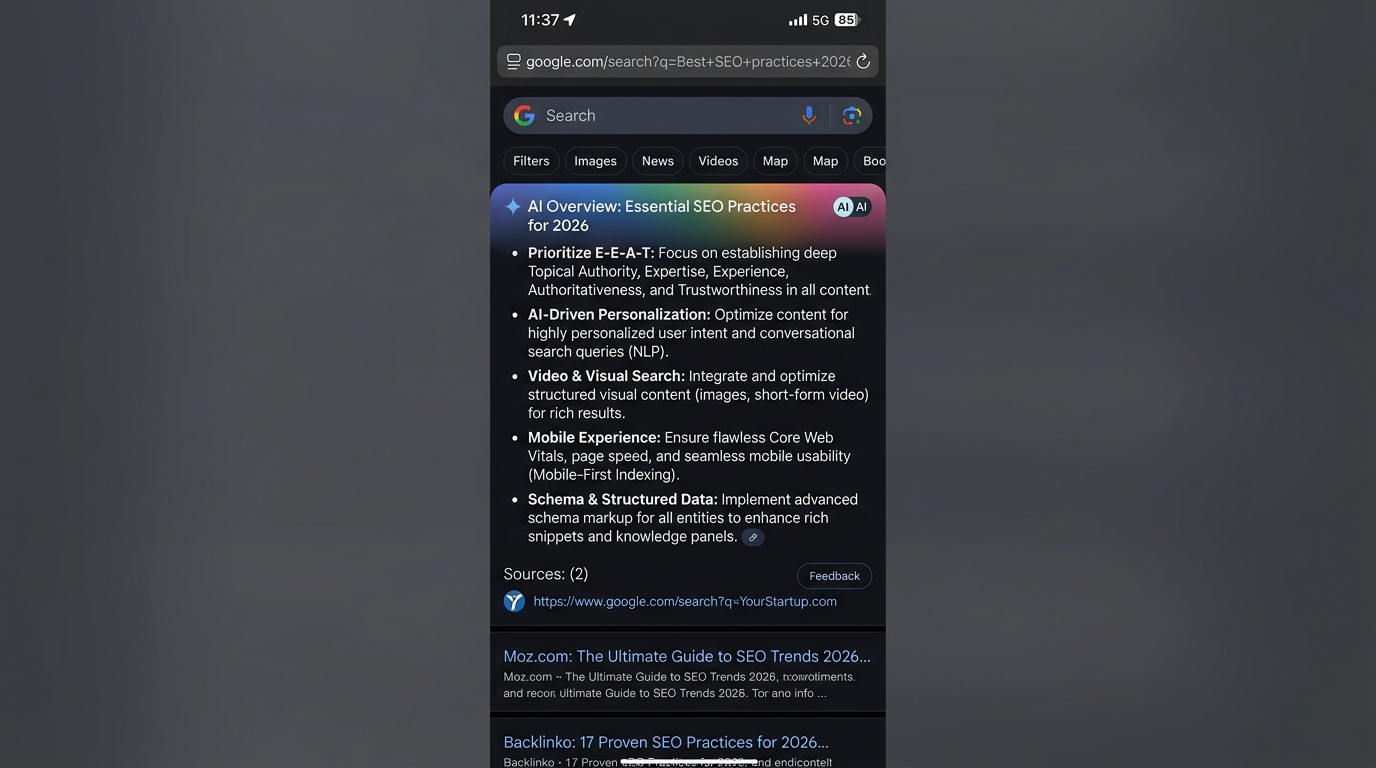
In 2026, Google often provides the answer directly in the search results via AI. To ensure your startup is cited:
Use Clear Definitions: Start sections with " [Term] is..." to help AI parsers identify your definitions.
Original Data: AI cannot "hallucinate" new data yet. Conduct surveys or share internal case studies to become a primary source.
Entity Association: Link to your founders' LinkedIn profiles and professional bios to strengthen the "Experience" part of E-E-A-T.
Bulleted Summaries: Use bullet points (like this one) at the top or bottom of long-form guides.
Frequently Asked Questions
How long does it take for startup SEO to work?
SEO is a long term strategy. While you might see some minor results in a few weeks (like getting indexed), it typically takes 6 to 12 months to see significant, meaningful results in terms of traffic and rankings. Consistency is the most important factor.
Can a startup do SEO without a big budget?
Absolutely. Many foundational SEO activities, like on page optimization and creating great content, primarily require time and effort, not a huge budget. Focus on creating valuable content for a specific niche to compete effectively.
What is the most important part of this SEO guide for startups?
If you can only focus on one thing, make it creating high quality, helpful content that matches user search intent. Excellent content is the foundation upon which all other SEO efforts (like link building and technical optimization) are built.
Should I hire an SEO agency for my startup?
It depends on your resources and expertise. If you have the time to learn and execute, you can do a lot yourself. However, an agency or a service can accelerate your results by providing expertise and consistent execution, which is often a challenge for busy startup teams.
What are the most common SEO mistakes startups make?
The most common mistakes include targeting keywords that are too competitive, neglecting technical SEO basics like site speed, creating content that doesn’t match search intent, and not being patient enough to see results.
Is SEO better than paid ads for a startup?
They serve different purposes. Paid ads (PPC) deliver immediate results but stop when you stop paying. SEO takes longer but builds a sustainable, long term asset that generates “free” traffic over time. A good strategy often uses both, with PPC for initial traction and SEO for scalable growth. This SEO guide for startups focuses on the long term play.
How do I choose the right keywords for my startup?
Start by brainstorming terms related to your product and your customers’ problems. Use keyword research tools to find related terms, check their search volume, and assess their difficulty. Focus on keywords with clear commercial intent and long tail keywords that have less competition.
Is creating a blog necessary for startup SEO?
While not strictly mandatory, a blog is one of the most effective tools for SEO. It allows you to consistently publish fresh content, target a wide range of keywords, build topical authority, and attract backlinks. For most startups, a blog is a cornerstone of their content and SEO strategy.