

Welcome to the definitive SEO guide for ecommerce. If you’re running an online store, you know how competitive it is to get your products in front of the right customers. While paid ads can deliver quick traffic, search engine optimization (SEO) builds a sustainable, long term asset that brings in high intent shoppers for free.
How important is it? Organic search drives about 43% of all traffic to ecommerce websites and is responsible for nearly a quarter of all orders. Investing in a solid ecommerce SEO strategy means you continuously attract customers without paying for every click, building cost effective growth over time. This guide covers everything you need to know.
Quick Takeaway: What is Ecommerce SEO in 2026?
Ecommerce SEO is the process of optimizing an online store’s technical structure, content, and brand authority to rank in traditional search results and AI-driven summaries (AI Overviews). To succeed in 2026, stores must focus on three pillars:
Technical Precision: Achieving sub-2-second load times and flawless mobile usability.
Semantic Depth: Using structured data (Schema) to help AI understand product "entities" (price, SKU, material).
User-Centric Content: Matching high-intent "Transactional" keywords with helpful, unique product insights that AI can easily cite as a source.
The Foundations: How Ecommerce SEO Works
Before you can optimize your store, you need to understand the basics of how search engines operate.
1. How Search Engines Work
Search engines like Google perform three main functions: crawling, indexing, and ranking.
Crawling: Automated bots, often called spiders or crawlers, travel across the web, following links to discover new and updated pages.
Indexing: After crawling, the search engine analyzes and stores the information from these pages in a massive database called an index. If a page isn’t in the index, it can’t show up in search results.
Ranking: When you type in a search query, the search engine’s algorithms sift through the index to find the most relevant and high quality pages, then rank them in order.
Google handles an incredible volume, processing around 13.6 billion searches per day. About 15% of those queries are brand new, things Google has never seen before, which shows just how dynamic search behavior is.
2. Crawling and Indexing
For your online store to get traffic, its pages must first be found (crawled) and stored (indexed). You can help search engines by creating a clean site structure and submitting a sitemap (more on that later). However, getting indexed doesn’t guarantee traffic. A study found that a staggering 96.5% of all indexed pages get zero organic traffic from Google, usually because they don’t rank high enough for relevant keywords. This is why a complete seo guide for ecommerce focuses not just on getting indexed, but on ranking well.
3. Ranking Factors
Google uses hundreds of signals, or ranking factors, to determine page order. While the exact formula is a secret, we know the most important ones. Google has confirmed its top three ranking signals are:
Content: The quality, relevance, and helpfulness of the information on your page.
Backlinks: Links from other reputable websites pointing to your site, which act as votes of confidence.
RankBrain: An AI system that helps Google interpret search queries and user intent.
Studies consistently show that pages ranking number one have significantly more backlinks, on average 3.8 times more than pages in positions two through ten. This highlights the incredible importance of high quality content and a strong backlink profile.
On-Page SEO: Optimizing Your Store’s Content
On page SEO involves optimizing the elements on your website that you have direct control over. This is a critical part of any seo guide for ecommerce.
1. Keyword Research
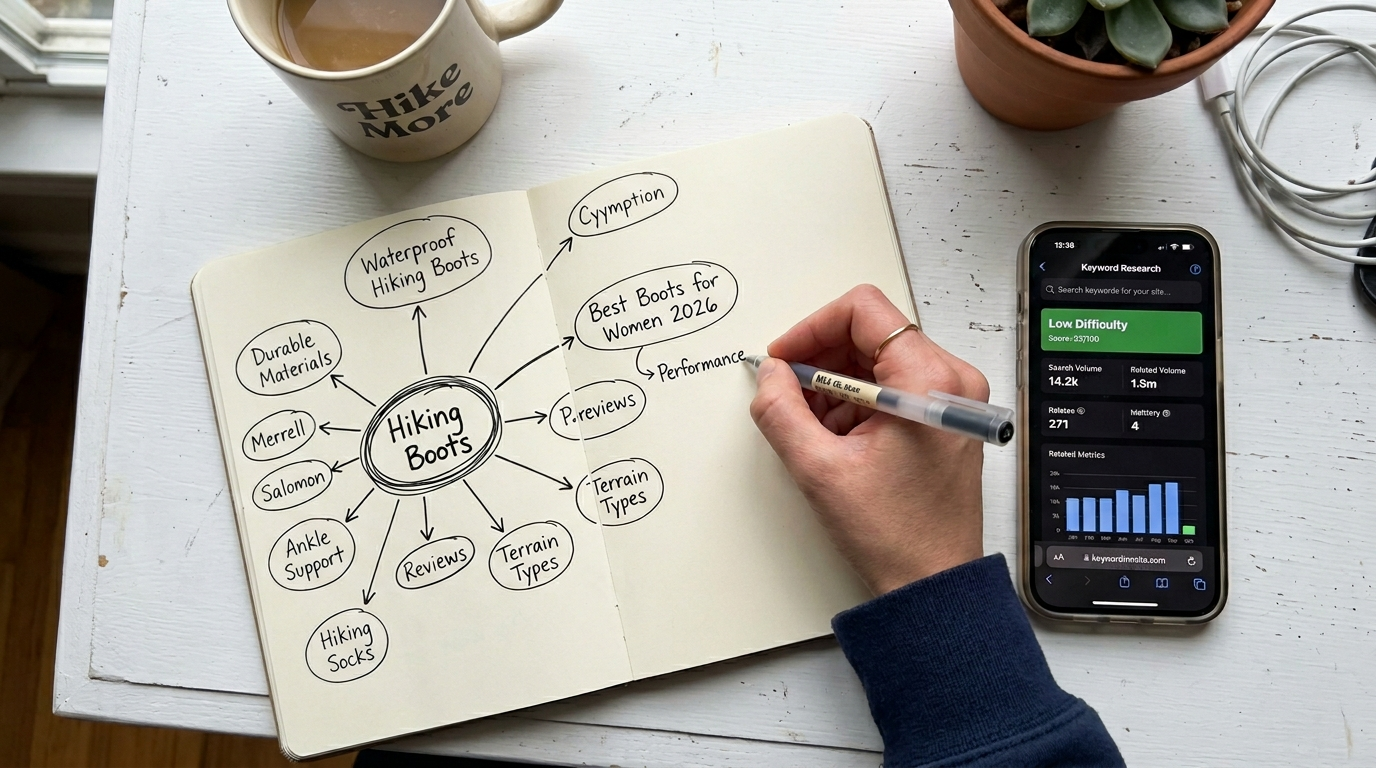
Keyword research is the process of finding the search terms your potential customers are using. Instead of guessing what people search for, you use tools to find keywords with good search volume and achievable difficulty. To organize topics, build a keyword cluster around your primary terms. Remember that half of all searches are four words or longer. These are called long tail keywords. While a term like “shoes” is too competitive, a long tail keyword like “waterproof hiking boots for women” is specific, shows clear buying intent, and is easier to rank for.
2. Search Intent Mapping
Search intent is the why behind a search. You need to match your content to the user’s intent. The main types are:
Informational: The user wants to learn something (e.g., “how to clean leather boots”).
Navigational: The user is looking for a specific site (e.g., “zappos”).
Commercial: The user is researching before a purchase (e.g., “best running shoes 2024”).
Transactional keywords: The user is ready to buy (e.g., “buy nike air max”).
If your page content doesn’t match the intent (like showing a product page for an informational query), it’s unlikely to rank.
3. Where to Place Keywords
Once you have your keywords, you need to place them strategically on your page. The most important spots are:
Title Tag: The main headline in search results.
H1 Heading: The on page title visible to readers.
URL: The web address of the page.
Body Content: Naturally within your product descriptions, category text, and blog posts.
Image Alt Text: The text description of your images.
4. Title Tag Optimization
The title tag is arguably the most important on page SEO element. A good title tag should include your primary keyword (ideally near the beginning) and be around 50 to 60 characters to avoid getting cut off in search results. Every page on your site should have a unique, descriptive title tag.
5. Meta Description Optimization
The meta description is the short blurb of text under the title in search results. While not a direct ranking factor, a compelling meta description acts like ad copy, encouraging users to click. Include your keyword (Google bolds it when it matches the query) and a clear value proposition. Keep it under 160 characters.
6. Heading Tag Optimization
Heading tags (H1, H2, H3) structure your content. Use a single H1 for your main page title. Use H2s and H3s for subheadings to break up content and make it scannable for both users and search engines. Including keywords in your headings reinforces your page’s topic.
7. URL Structure Optimization
A clean, descriptive URL helps users and search engines understand what a page is about.
Good URL:
yourstore.com/womens-shoes/running-sneakersBad URL:
yourstore.com/cat/prod?id=8219
Keep URLs short, use lowercase letters, and separate words with hyphens (the only kind of hyphen we’ll mention).
8. Image Alt Text Optimization
Alt text is a written description of an image. It’s crucial for accessibility (screen readers use it for visually impaired users) and for SEO. Search engines read alt text to understand what an image contains, helping your products rank in Google Images. Describe the image accurately and include a relevant keyword if it fits naturally.
9. Content Quality Optimization
Beyond keywords, Google wants to rank content that is helpful, reliable, and people first. If you’re unsure what that looks like, see our guide to creating authoritative content for Google. For ecommerce, this means writing unique and compelling product descriptions (not just copying the manufacturer’s), creating helpful buying guides, and providing detailed information that truly helps the user make a decision.
Optimizing for AI Overviews (GEO)
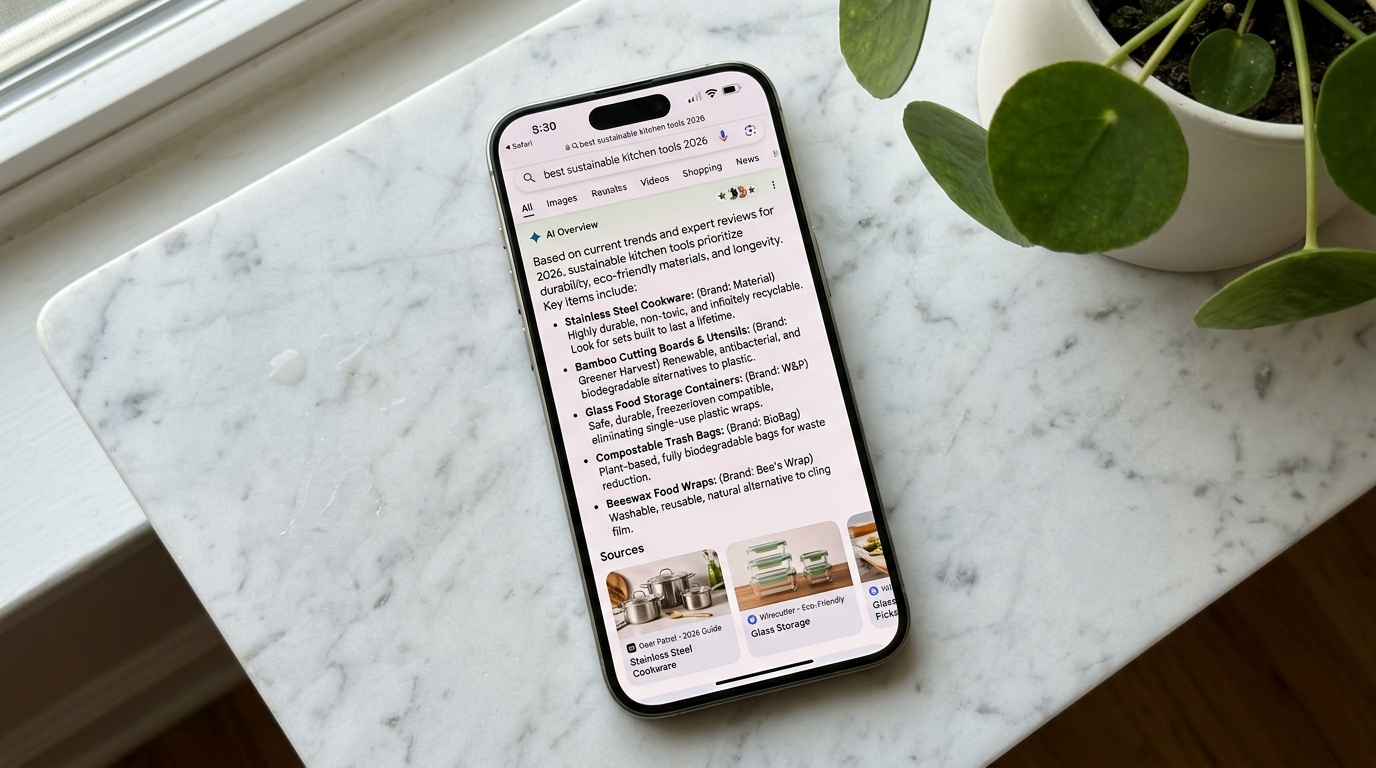
In 2026, over 60% of informational queries result in an AI-generated summary. To ensure your products are featured in these "Zero-Click" results, you need to practice Generative Engine Optimization (GEO).
Modular Content Blocks: Use clear
<h2>headers followed by concise 40–60 word paragraphs. AI models prefer "nuggetized" information they can easily extract.The Shopping Graph: Ensure your store is connected to the Google Merchant Center. Google’s AI uses the Shopping Graph to pull real-time pricing and availability directly into search results.
Brand Citations: AI trusts sites that are mentioned across the web. Focus on getting your brand mentioned in "Best of" lists and niche forums (like Reddit) to build your "Entity" authority.
Structuring Your Ecommerce Site for Success
A logical site structure is essential for a good user experience and for helping search engine crawlers find all your pages. This part of our seo guide for ecommerce is foundational.
1. Site Architecture and Navigation
Your site architecture is how your pages are organized and linked together. A good ecommerce architecture is usually shallow, meaning users can get from your homepage to any product page in just a few clicks. As you connect pages, be mindful of how many internal links per page you use to keep equity flowing naturally. Your main navigation menu should be clear and link to your most important category pages.
2. Breadcrumb Navigation
Breadcrumbs are secondary navigation links that show users where they are on your site (e.g., Home > Men’s Clothing > Shirts). They improve user experience and help search engines understand your site structure.
3. Product Page Optimization
Your product pages are where conversions happen. To optimize them:
Write unique, descriptive product descriptions.
Use high quality images with optimized alt text.
Include customer reviews and ratings.
Use schema markup to enable rich snippets (price, availability, etc.).
Have a clear call to action.
4. Category Page Optimization
Category pages are crucial for ranking for broader terms. Optimize them by:
Writing a helpful introduction at the top of the page.
Ensuring easy filtering and sorting options.
Featuring your best selling products prominently.
Using clear H1s and optimized title tags.
5. Blog Content Strategy
A blog is a powerful tool for ecommerce SEO. You can create informational content that targets keywords your customers are searching for at the beginning of their buying journey. For example, a store selling kitchen supplies could write a blog post on “how to choose the right chef’s knife.” This attracts top of funnel traffic and allows you to naturally link to your product pages.
6. Duplicate Content and Canonicalization
Duplicate content is a common issue in ecommerce, often caused by product variants (different colors or sizes) or filtered navigation creating multiple URLs for the same content. You can solve this by using a canonical tag (rel="canonical"), which tells search engines which version of a page is the master copy that should be indexed.
Technical SEO: The Engine Room
Technical SEO ensures your website can be efficiently crawled and indexed. It’s the foundation upon which your content and links are built.
1. Technical SEO Checklist
A quick technical audit should check for the following. For a step-by-step walkthrough, use our technical SEO audit guide.
Mobile friendliness.
Site speed.
Secure connection (HTTPS).
Clean URL structure.
No broken links or crawl errors.
Proper use of canonicals and redirects.
A well configured robots.txt file.
2. Core Web Vitals and Site Performance
Core Web Vitals are Google’s metrics for measuring user experience, focusing on loading speed (LCP), interactivity (INP), and visual stability (CLS). They are a confirmed ranking signal. Improving these metrics is a win win, as it helps your SEO and your conversion rate. For example, ecommerce sites that load in 1 second have a 2.5x higher conversion rate than those loading in 5 seconds.
3. Page Speed Optimization
Beyond Core Web Vitals, overall page speed is critical. You can improve it by:
Compressing images.
Using a fast web host or ecommerce platform.
Leveraging browser caching.
Minimizing heavy scripts and plugins.
The Business Impact of Speed (2026 Data)
SEO isn't just about traffic; it's about revenue. Modern search engines prioritize sites that provide an instant experience. Use the table below to benchmark your performance:
Page Load Time | Bounce Rate Increase | Conversion Rate (Avg) |
Under 1 Second | 0% | 4.8% - 6.0% |
2 Seconds | +12% | 3.0% - 3.5% |
4 Seconds | +63% | 1.5% - 2.0% |
6+ Seconds | +120% | < 1.0% |
4. Mobile First User Experience
Google primarily uses the mobile version of a site for indexing and ranking (this is called mobile first indexing). Your online store must provide a seamless experience on smartphones and tablets. A responsive design that adapts to any screen size is essential.
5. Structured Data and Schema Markup
Structured data (or schema markup) is code you add to your site to help search engines understand your content better. For ecommerce, Product schema is vital. For blogs and guides, implementing Author schema can reinforce trust and improve how your content appears in search. It can enable rich snippets in search results, showing information like price, availability, and review ratings directly on the results page, which can significantly boost your click through rate.
6. Website Security and HTTPS
HTTPS encrypts the connection between a user’s browser and your server, protecting sensitive data like payment information. It’s a must have for any ecommerce site for both security and trust. Google also uses HTTPS as a small ranking signal.
Execution, Measurement, and Off-Page SEO
A great strategy is nothing without execution and a way to measure success. This is a practical component of our seo guide for ecommerce.
1. Google Search Console Setup
Google Search Console is a free tool from Google that helps you monitor your site’s performance in search. You can use it to find and fix technical errors, submit sitemaps, and see which keywords are driving traffic to your store. It’s an indispensable tool.
2. Sitemap Creation and Submission
An XML sitemap is a file that lists all the important pages on your website. Creating one and submitting it through Google Search Console helps ensure that search engines can find and crawl all of your product and category pages.
3. Indexing Status Check
You can check if your pages are indexed by using the Coverage report in Google Search Console or by performing a site:yourdomain.com search on Google. This helps you spot any indexing issues quickly.
4. Off-Page SEO and Link Building
Off page SEO refers to actions taken outside of your own website to impact your rankings. The most important part of this is link building, the process of acquiring backlinks from other websites. If you prefer to outsource, here are top link building services vetted for results. As mentioned, backlinks are a top ranking factor. For ecommerce, you can build links through guest blogging, digital PR, supplier relationships, and creating shareable content like buying guides.
5. Local SEO
If your ecommerce store also has a physical location, local SEO is important. This involves optimizing your Google Business Profile, building local citations (mentions of your business name, address, and phone number), and gathering local customer reviews. About 46% of all Google searches have local intent, so this is a huge opportunity if you have a brick and mortar presence.
Modern Ecommerce SEO: Tools and Trends
The world of SEO is always changing. Here’s what you need to know now. This section makes our seo guide for ecommerce truly current.
1. AI in SEO
Artificial intelligence is transforming SEO. AI tools can help with keyword research, content creation, and technical audits. However, AI generated content often requires human oversight for quality, accuracy, and strategic alignment. A blended approach, where AI handles the heavy lifting and human experts provide strategy and editing, is often most effective. Services like Rankai combine powerful AI with human SEO strategists to deliver consistent results for businesses.
2. Shopify and WordPress SEO Tools
Most ecommerce stores are built on platforms like Shopify or WordPress (with WooCommerce). These platforms have powerful SEO tools and apps to help you manage on page elements.
For WordPress: Yoast SEO and Rank Math are popular plugins that help with title tags, meta descriptions, sitemaps, and more.
For Shopify: The platform has good built in SEO features, and the Shopify App Store has many apps for image optimization, schema markup, and technical audits.
3. Avoid Keyword Stuffing
A quick but important note: never “stuff” your pages with keywords. Keyword stuffing is the practice of unnaturally repeating keywords in an attempt to manipulate rankings. Here’s a practical guide on how to avoid keyword stuffing without hurting readability. Google’s algorithms are smart enough to spot this, and it will harm your rankings and create a terrible user experience. As Google says, “filling pages with keywords results in a negative user experience and can harm your site’s ranking.”
4. A Final Word on This SEO Guide for Ecommerce
Implementing a thorough SEO strategy takes time and consistent effort, but the payoff is enormous. By focusing on creating a technically sound site with high quality, user focused content, you can build a powerful engine for organic growth. For many store owners, executing this full seo guide for ecommerce can feel overwhelming. If you need a hands off solution that handles everything from keyword research to content creation and technical fixes, consider a managed service. A partner like Rankai can implement this entire strategy for you, delivering consistent content and SEO improvements every month.
Frequently Asked Questions (FAQ)
1. How long does ecommerce SEO take to show results?
SEO is a long term strategy. You may see minor improvements in a few weeks, but significant results like increased traffic and sales typically take anywhere from 4 to 12 months of consistent effort.
2. Can I do ecommerce SEO myself?
Yes, you can. Using this seo guide for ecommerce, you can implement many of these strategies yourself, especially if you’re using a user friendly platform like Shopify or WordPress. However, it requires a significant investment of time and continuous learning.
3. What is the most important part of ecommerce SEO?
It’s hard to pick just one, but a strong foundation starts with a well structured website and high quality product and category pages. Without these, other efforts like link building will be less effective.
4. Is blogging necessary for an ecommerce store?
While not strictly necessary, a blog is one of the most effective ways to attract customers at the top of the sales funnel, build authority, and earn backlinks. It’s highly recommended for competitive niches.
5. How does this SEO guide for ecommerce apply to my Shopify store?
All the principles in this guide apply directly to Shopify. Shopify has built in features to help you with title tags, meta descriptions, URLs, and alt text. You can use apps from the Shopify App Store to handle more advanced tasks like schema markup and image compression.
6. What’s the difference between on page and off page SEO?
On page SEO includes all the optimizations you do on your own website, like content, keywords, and site structure. Off page SEO refers to actions taken off your site, primarily building backlinks from other websites to yours. Both are essential for a successful strategy.