

In the crowded Software as a Service market, getting noticed is half the battle. Paid ads can feel like a money pit, and social media buzz is often fleeting. This is where a solid SEO strategy comes in. SEO, or search engine optimization, is your engine for sustainable, cost effective growth. It’s how you connect with customers who are actively looking for a solution just like yours.
This comprehensive seo guide for saas will walk you through everything you need to know, from foundational concepts to advanced tactics. We’ll cover strategy, content, technical fixes, and how to measure success, turning your website into a reliable lead generation machine.
SaaS SEO in 2026: The 30-Second Summary SaaS SEO is a long-term growth strategy focused on capturing high-intent software buyers throughout their lifecycle. Unlike traditional SEO, it prioritizes Monthly Recurring Revenue (MRR) over raw traffic by targeting three specific areas:
Programmatic SEO: Scaling landing pages for integrations and use cases.
Comparison Content: Capturing "Alternative to [Competitor]" searches.
Technical Health: Ensuring high Core Web Vitals to satisfy AI-driven search crawlers.
The Bottom Line: In 2026, winning at SaaS SEO means providing the most friction-free path from a search query to a product demo.
Foundations of SaaS SEO
Before diving into tactics, it’s crucial to understand the what, why, and how of SEO in the unique context of a SaaS business.
What is SaaS SEO?
SaaS SEO is the process of optimizing a software company’s website to rank higher in search engines for relevant queries. Unlike e-commerce SEO, which targets immediate product sales, the primary goal here is to generate qualified leads. This usually means driving sign ups for free trials, demo requests, or consultations.
The strategy hinges on educating your audience over a longer sales cycle. Because organic search drives roughly 53% of all website traffic, mastering this channel is non negotiable for scalable growth. A strong SaaS SEO plan builds recurring revenue by attracting and converting customers, reducing your reliance on expensive ad campaigns.
SaaS SEO vs. Traditional SEO
Not all SEO is the same. An effective seo guide for saas must highlight the key differences between optimizing for a subscription service and, say, a local plumber or an online shoe store.
Business Goals: Traditional SEO often aims for a one time transaction. SaaS SEO is about acquiring long term subscription customers, focusing on metrics like Monthly Recurring Revenue (MRR) and Customer Lifetime Value (LTV).
Customer Journey: The SaaS buying process is longer and more complex, often involving weeks of research and multiple decision makers. This requires content that addresses every stage of the funnel, from initial problem awareness to final vendor comparison.
Content Strategy: While a retailer relies on product pages, a SaaS company builds an entire educational ecosystem. Content includes in depth blog posts, comparison pages (e.g., “YourTool vs. Competitor”), and detailed use case articles.
Conversion Points: A traditional conversion might be a sale. For SaaS, it’s often a micro conversion like a free trial sign up or a whitepaper download that moves a lead further down the funnel.
Why SaaS Companies Need SEO
In the SaaS world, SEO isn’t just a nice to have, it’s a mission critical growth lever. Here’s why:
Your Customers Are Searching: Around 32% of people start their buying research on a search engine when they know what kind of product they need. You have to be there when they look.
It’s Cost Effective: Paid ads for SaaS keywords can be incredibly expensive, with B2B Google ads costing around $5.14 per click on average. SEO offers a way to acquire users without paying for every single visit.
It Supports a Long Buyer Journey: It can take 8 or more touchpoints to convert a SaaS prospect. SEO content allows you to engage potential customers at every stage, from educational blog posts to bottom of funnel comparison pages.
It Delivers Compounding Returns: A paid ad stops working the second you turn it off. A top ranking article, however, can bring in traffic and leads for months or even years.
It Generates High Quality Leads: Leads from organic search are often highly qualified. In fact, inbound leads (like those from SEO) have been shown to close at a 14.6% rate on average, compared to just 1.7% for outbound leads.
Essential SaaS SEO Tech Stack for 2026
Tool Category | Recommended Software | Primary Use Case |
Rank Tracking | Semrush / Ahrefs | Monitoring keyword positions and competitor gaps. |
Content Intelligence | Clearscope / Surfer | Aligning content with NLP (Natural Language Processing) entities. |
Product-Led SEO | Hull.io / Segment | Mapping search data to actual product user behavior. |
Technical Monitoring | Screaming Frog / Lumar | Auditing JavaScript-heavy SaaS sites for crawlability. |
Building Your SaaS SEO Strategy
A successful SEO campaign doesn’t happen by accident. It requires a clear, documented plan.
SaaS SEO Strategy Framework
A SaaS SEO strategy framework is your structured blueprint for improving organic search presence. It’s a roadmap that covers every major pillar, turning the broad goal of “improving SEO” into a systematic plan of attack. A typical framework includes:
Discovery & Goal Setting: Defining business objectives (e.g., increase organic demos by 30%).
Keyword & Market Research: Finding the terms your customers use and analyzing competitors.
Content & On Page Strategy: Planning what to create and how to optimize it.
Technical SEO Foundation: Ensuring your site is fast, crawlable, and error free.
Off Page & Authority Building: A plan to earn quality backlinks and build trust.
Analytics & Iteration: Monitoring results and continuously refining your approach.
The Five Pillar Approach to SaaS SEO
To build a holistic strategy, it helps to think in terms of pillars. One popular framework expands beyond just blog posts and backlinks:
The Blog: The cornerstone of SaaS content marketing, used to publish helpful articles that solve customer problems.
The Podcast: Audio content is increasingly searchable and can tap into a new audience, building authority and earning links.
The YouTube Channel: Video content can capture searchers on the world’s second largest search engine, perfect for tutorials and webinars.
The Support Knowledge Base: Publicly accessible help articles can rank for very specific, long tail keywords and reduce support tickets.
User Generated Content (UGC): Harnessing user created content like templates, public profiles, or galleries can create thousands of indexable pages at scale.
Discovery Workshop
An SEO discovery workshop is a structured kickoff session where your team and SEO strategists get on the same page. It’s a deep dive into your business, target audience, unique value proposition, and customer pain points. This alignment ensures that your SEO strategy targets the right keywords and supports real business goals, preventing wasted effort on vanity metrics.
Keyword Research
Keyword research is the process of finding and analyzing the search terms your audience uses, from primary keywords to long‑tail queries. It’s the foundation of any good seo guide for saas. It tells you what topics to create content about, how many people are searching for them, and how difficult it might be to rank. A surprising fact: about 94.7% of all keywords get 10 or fewer searches per month. This means a winning strategy often involves targeting hundreds of specific, long tail keywords that, when combined, drive significant traffic.
Competitor Analysis
SEO competitor analysis involves studying your rivals’ search strategies to find insights for your own. The goal is to see what’s working for them, which keywords they rank for, what content drives their traffic, and where their backlink profile is strong. This allows you to identify gaps, find new content ideas, and essentially reverse engineer their success to build a better plan.
Keyword Prioritization
You can’t target every keyword at once, so you have to pick your battles. Keyword prioritization is the process of ranking your list of potential keywords based on relevance, search volume, difficulty, and business impact. The 80/20 rule often applies here: a small subset of keywords will likely drive the majority of your results. Prioritization helps you focus your limited resources on the opportunities with the highest potential return on investment.
Buyer Journey Mapping
Buyer journey mapping means aligning your content with the stages a customer goes through before buying. For SaaS, this typically involves:
Top of Funnel (Awareness): The customer has a problem but doesn’t know about solutions. Content here is educational (e.g., “how to manage remote teams”).
Middle of Funnel (Consideration): The customer is evaluating different types of solutions. Content here includes comparison guides and “best of” lists.
Bottom of Funnel (Decision): The customer is ready to choose a vendor. Content here includes pricing pages, demo requests, and case studies.
Since a B2B buyer consumes an average of 13 pieces of content before making a decision, you need assets for every stage.
Finding Low Hanging SEO Opportunities
Low hanging SEO opportunities are quick wins that require relatively little effort for a significant return. These are the high ROI fixes you can tackle right away. Common examples include:
Optimizing pages that are already ranking on page two (positions 11 to 20).
Adding strategic internal links from high authority pages to pages you want to boost.
Refreshing old or outdated blog posts with new information.
Fixing broken links (404 errors) and redirecting them to live pages.
Content Creation and On Page SEO
Content is the fuel for your SaaS SEO engine. Here’s how to create and optimize it effectively.
Content Strategy for SaaS
A content strategy is the master plan that guides your content creation. It outlines what you will create, for whom, and how it will help you achieve your business goals. For SaaS, this strategy is built on keyword research and buyer journey mapping, ensuring every article, guide, or video serves a specific purpose. Consistency is key; studies have shown that companies publishing 16 or more blog posts per month get about 3.5 times more traffic than those publishing fewer than four.
Executing a high velocity strategy can be a challenge, which is why many SaaS companies turn to scalable solutions. For instance, a service like Rankai’s done for you SEO program can handle the entire content pipeline, from keyword vetting to publishing over 20 pages a month.
Topic Clusters
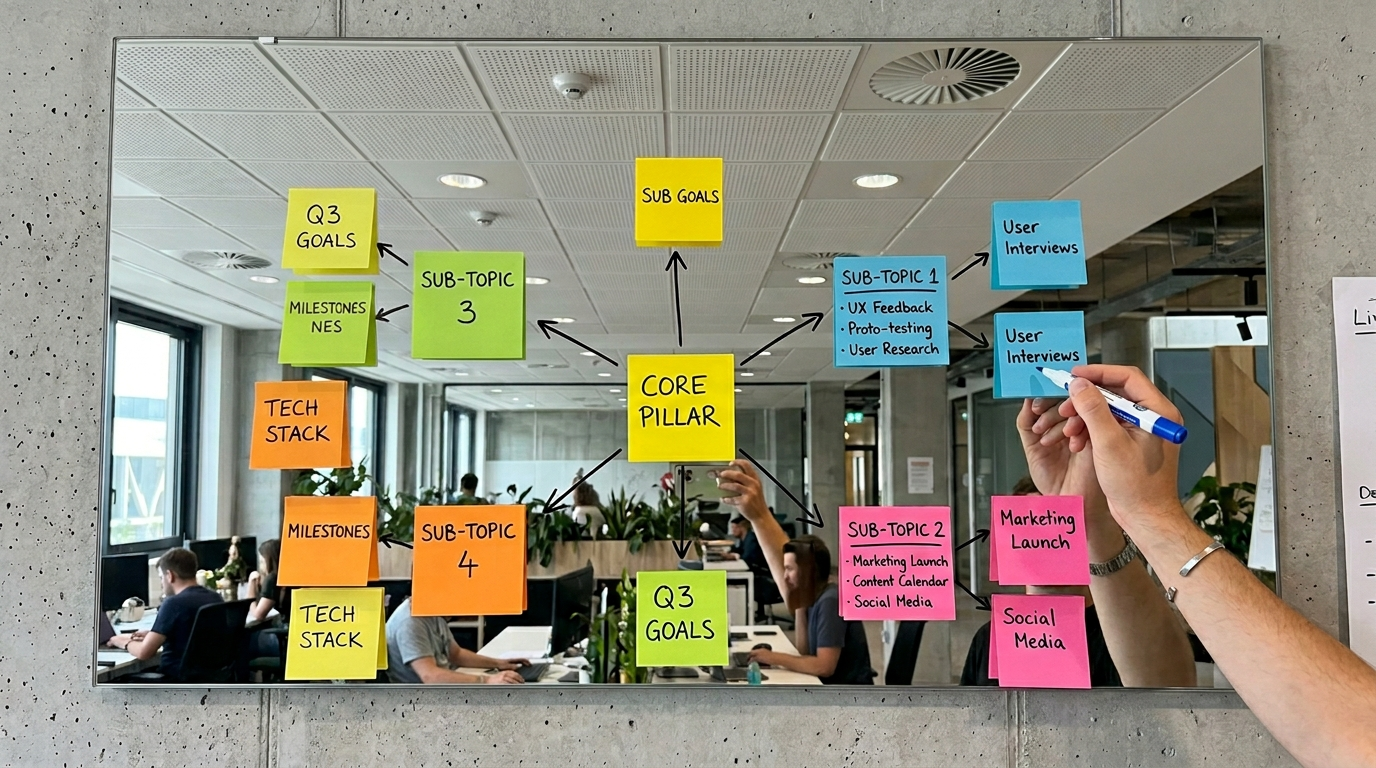
A topic cluster (or keyword cluster) is a modern SEO strategy where you create a central “pillar” page on a broad topic and surround it with multiple “cluster” pages on related subtopics. All cluster pages link back to the pillar, and the pillar links out to the clusters. This tightly knit structure signals to search engines that you have deep authority on a subject, which can help you rank for competitive keywords.
Scaling Growth with Programmatic SEO
In 2026, manual content creation isn't enough. SaaS companies are winning by using Programmatic SEO to generate hundreds of high-quality pages based on a single template.
Integrations: "[Your App] + [Popular Tool] Integration" pages.
Use Cases: "[Your App] for [Industry]" pages.
Calculators/Tools: Embedding free tools (e.g., "ROI Calculator") to earn high-intent backlinks.
Keyword Gap Analysis
Keyword gap analysis is the process of finding valuable keywords that your competitors rank for, but you don’t. It’s a powerful way to uncover missed opportunities and expand your content plan. By using SEO tools to compare your domain against your rivals, you can identify entire topic areas you may have overlooked, giving you a clear path to capturing more market share.
On Page SEO
On page SEO involves optimizing the elements on a webpage itself to improve its ranking. This is a fundamental part of any seo guide for saas and includes:
Content Quality: Creating comprehensive, valuable content that satisfies user intent.
Keyword Optimization: Naturally including your target keyword in the page title, headings, and body copy.
Title Tags & Meta Descriptions: Crafting compelling titles and descriptions that earn clicks in search results.
Headings (H1, H2, H3): Using a logical heading structure to improve readability and signal topic hierarchy.
Internal linking: Linking to other relevant pages on your own website.
Images & Alt Text: Using optimized images with descriptive alt text for context and accessibility.
Content Brief
A content brief is a document that provides a writer with all the instructions needed to create an SEO optimized piece of content. It typically includes the target keyword, a suggested title, an outline with key subheadings, internal link suggestions, and competitor examples. Using a detailed brief ensures that every article aligns with your strategy and requires fewer revisions.
Content Publishing Checklist
A content publishing checklist is a final quality assurance step before hitting “publish”. It ensures that every piece of content is polished, error free, and fully optimized. Common checklist items include:
Proofreading for grammar and spelling.
Verifying on page SEO elements (titles, headings, alt text) using an on-page SEO checklist.
Checking that all internal and external links work correctly.
Ensuring a clear call to action (CTA) is present.
Previewing the post on mobile devices.
Content Refresh
Content can decay over time. A content refresh involves updating older blog posts with new information, stats, and examples to keep them relevant and maintain their search rankings. This is a powerful, low effort tactic, especially since a huge portion of blog traffic comes from older posts. In one famous example, HubSpot found that 76% of their monthly blog views came from old posts. Continuously improving underperforming content is essential for long term success, which is why it’s a core part of the Rankai methodology.
The Technical SEO Foundation
Technical SEO is the backbone of your website. If search engines can’t properly crawl and understand your site, even the best content will fail to rank.
Technical SEO Setup
Technical SEO refers to website and server optimizations that help search engines crawl and index your site more effectively. This foundation includes ensuring you have a logical site structure, fast page load times, a mobile friendly design, and no crawl errors. It’s the first thing you should get right, ideally via a technical SEO audit.
Sitemap
An XML sitemap is a file that lists all the important URLs on your website, acting as a roadmap for search engines. Submitting a sitemap to Google helps ensure that all of your content gets discovered and indexed, especially for new or large websites.
Schema Markup
Schema markup is a type of code (structured data) that you add to your website to help search engines better understand your content. For a SaaS company, this can include schema for your software product, FAQs, reviews, or author schema. This can help you earn “rich results” in search, like star ratings or expandable Q&A sections, which can improve click through rates.
Canonical Tag
A canonical tag is an HTML element that tells search engines which version of a URL is the main one when you have duplicate or very similar content across multiple URLs. This helps consolidate your ranking signals and prevents issues with duplicate content.
301 Redirect
A 301 redirect is a permanent instruction that sends users and search engines from one URL to another. It’s crucial for preserving SEO value when you change a URL, move content, or migrate your website. A 301 redirect passes the vast majority of the original page’s ranking power to the new one.
Mobile Optimization
With Google now using mobile first indexing, having a mobile friendly website is absolutely essential. Mobile optimization means ensuring your site provides a great experience on smartphones and tablets, with responsive design, fast load times, and easy to tap buttons and links.
Core Web Vitals
Core Web Vitals (CWV) are a set of specific metrics Google uses to measure a page’s user experience. They are:
Largest Contentful Paint (LCP): Measures loading performance.
Interaction to Next Paint (INP): Measures the overall responsiveness of your page to user interactions (replaced FID in 2024).
Cumulative Layout Shift (CLS): Measures visual stability.
While content relevance is still king, having good CWV scores can give you a slight ranking edge and improve user engagement.
Off Page SEO & Authority Building
What happens off your website is just as important as what happens on it. Building authority and trust is key to long term success.
Backlinks

A backlink is a link from another website to yours. Search engines view backlinks as votes of confidence. Generally, the more high quality, relevant backlinks a site has, the more authoritative it appears. The correlation is strong: one study found that the number one result in Google has, on average, 3.8 times more backlinks than the results in positions 2 through 10.
Link Building Strategy
A link building strategy is your proactive plan for acquiring backlinks. It’s not about spammy tactics but about earning links through value. Common strategies for SaaS include:
Creating linkable assets: Publishing original research, data studies, or free tools that people naturally want to cite.
Digital PR: Reaching out to journalists and bloggers with compelling stories or data (see our guide to top link building services).
Guest blogging: Writing valuable articles for other reputable websites in your industry.
Authority and Trust (EEAT)
Google wants to rank content that is credible and reliable. They use a framework known as EEAT to evaluate this, which stands for:
Experience: The creator has firsthand experience with the topic.
Expertise: The creator is a knowledgeable expert on the subject.
Authoritativeness: The creator or website is a known authority in the field.
Trustworthiness: The site is secure, transparent, and provides accurate information.
Demonstrating EEAT through author bios, cited sources, and high quality content is critical for building trust with both users and search engines.
Measurement and Optimization
An effective seo guide for saas must include a plan for tracking results and making data driven improvements.
Conversion Rate Optimization (CRO) for SaaS
Conversion rate optimization is the process of increasing the percentage of website visitors who take a desired action, like signing up for a trial. For SaaS, this involves analyzing user behavior, running A/B tests on elements like headlines and calls to action, and continually improving your website’s conversion funnel. CRO helps you get more value from the traffic you already have.
Monitoring and Analytics
SEO monitoring and analytics involves tracking your website’s performance to see what’s working and what isn’t. By keeping an eye on your rankings, organic traffic, and user engagement, you can make informed decisions to refine your strategy over time.
Google Search Console
Google Search Console is a free tool that gives you direct insight into how Google sees your website. You can use it to monitor your site’s indexing status, check for technical errors, see which keywords are driving clicks, and submit sitemaps. It’s an indispensable tool for any SEO effort.
GA4 Analytics
Google Analytics 4 (GA4) is a powerful platform for understanding how users interact with your website. You can track organic traffic, see which content is most popular, analyze conversion funnels, and gain deep insights into your audience. This data is crucial for measuring the ROI of your SEO campaigns. If you need help making sense of your data, a partner like Rankai can provide clear reporting that focuses on the metrics that matter most.
Content Marketing for SaaS
Content marketing is the engine of a great SaaS SEO strategy, a cornerstone of any successful seo guide for saas. It’s the practice of creating and distributing valuable content to attract, engage, and convert your target audience. It’s about becoming a trusted resource, not just a product vendor. By consistently publishing helpful articles, guides, and videos, you build an audience that trusts your brand and is more likely to become a customer when the time is right.
Frequently Asked Questions (FAQ)
What is the most important part of this SEO guide for SaaS?
While every part is important for a holistic strategy, the foundation is high quality content that is aligned with your customers’ search intent. Without valuable content that solves a user’s problem, technical optimizations and backlinks will have a limited impact.
How long does SaaS SEO take to show results?
SEO is a long term strategy. While you might see some quick wins from low hanging fruit in the first 1 to 3 months, it typically takes 6 to 12 months of consistent effort to see significant, compounding results in organic traffic and leads.
What are the most important SEO metrics for a SaaS company?
Instead of just tracking keyword rankings, SaaS companies should focus on business outcomes. Key metrics include organic traffic growth, the number of organic trial sign ups or demo requests, the conversion rate from organic traffic to lead, and ultimately, the MRR generated from the organic channel.
Can I do SaaS SEO myself?
Yes, it’s possible to manage SaaS SEO in house, especially if you have a dedicated marketing team. However, it requires expertise across content, technical SEO, and link building. Many startups and SMBs find it more efficient to partner with a specialized agency or use a done for you service like Rankai to handle execution, allowing their team to focus on product and customers.
What’s the difference between SaaS SEO and B2B SEO?
They are very similar, and there is a lot of overlap. Most SaaS companies are B2B, so the principles of a longer sales cycle, educating prospects, and targeting decision makers apply to both. SaaS SEO is simply a more specific version of B2B SEO that is tailored to a software subscription model.
Is an SEO guide for SaaS only about content?
No. While content is a massive component, this seo guide for saas shows that a successful strategy requires a multi faceted approach. Technical SEO ensures your site is accessible, off page SEO builds authority through backlinks, and analytics provide the data needed to make smart decisions. All these elements must work together.