
What is Answer Engine Optimization?
Answer Engine Optimization is the practice of writing and structuring content so search engines and AI systems extract specific passages as direct answers. Think featured snippets, ChatGPT's inline quotes, Google AI Overviews' cited paragraphs, Perplexity's answer cards.
The output of AEO is concrete: a piece of your content appears inside the answer interface, often with attribution. Sometimes the user clicks; often they don't. Either way, your brand is now associated with the question.
The mechanics differ from classic SEO. Where SEO is page-level optimization for rankings, AEO is passage-level optimization for extraction. A 2000-word article might earn an AEO win on a single 80-word block that answers a specific question cleanly.
Why AEO matters now
Three converging shifts:
1. Zero-click search dominates. A large share of Google searches now end without a click, because the user got their answer from the SERP itself. AI Overviews accelerated this. Optimizing only for the ranked link means optimizing for a shrinking slice of demand.
2. AI engines reward extractable structure. ChatGPT, Perplexity, and Gemini all extract concrete answer passages from retrieved content. Pages written as flowing essays are harder to extract from; pages written with crisp Q/A and definition-led headings are easier. The format wins.
3. The answer is the new ad. Being "the answer" on a commercial query is the closest thing to brand-first positioning that organic search offers in 2026. Brands that earn this status compound it, because the engines keep returning to known-good sources.
AEO vs SEO vs GEO: what overlaps and what differs
The three terms collide constantly. Quick taxonomy:
SEO (Search Engine Optimization)
Optimizing a page to rank on a search results page. The traditional discipline: keyword targeting, on-page optimization, backlinks, technical SEO. Endpoint is a ranked link the user clicks.
AEO (Answer Engine Optimization)
Optimizing for extracted answers like featured snippets, AI Overviews paragraphs, and ChatGPT inline citations. Endpoint is your content being shown directly inside the engine, often without a click.
GEO (Generative Engine Optimization)
Optimizing for inclusion in generative AI answers across every LLM engine. Endpoint is being cited as a source inside ChatGPT, Perplexity, Gemini, etc. (see our GEO pillar guide).
In practice the work overlaps heavily. The same well-structured FAQ block earns featured snippets (AEO win), gets cited in ChatGPT (GEO win), and still benefits page rank (SEO win). Use whichever framing focuses your team, then execute all three.
The 6 AEO tactics that actually work
1. Question-first headings
Frame H2/H3s as questions a user might literally type or ask. "What is X?" and "How do I do Y?" outperform "Understanding X" or "A guide to Y" for answer extraction.
2. Definition-led first sentence
The first sentence after each heading should answer the heading in 1-2 lines, the way a glossary entry would. Engines extract the first answer-shaped sentence they find under a question.
3. FAQ blocks with FAQPage schema
Discrete question/answer pairs in an explicit FAQ block, marked up with FAQPage JSON-LD, are the single most reliable AEO format. Add 5-10 questions per page covering the long-tail intent variants.
4. Comparison tables for "X vs Y" queries
For commercial-intent "best X", "X vs Y", and "X alternatives" queries, tables are the most extracted format. Each row should be self-contained, because engines often quote a single row.
5. Step lists with numbered ordering
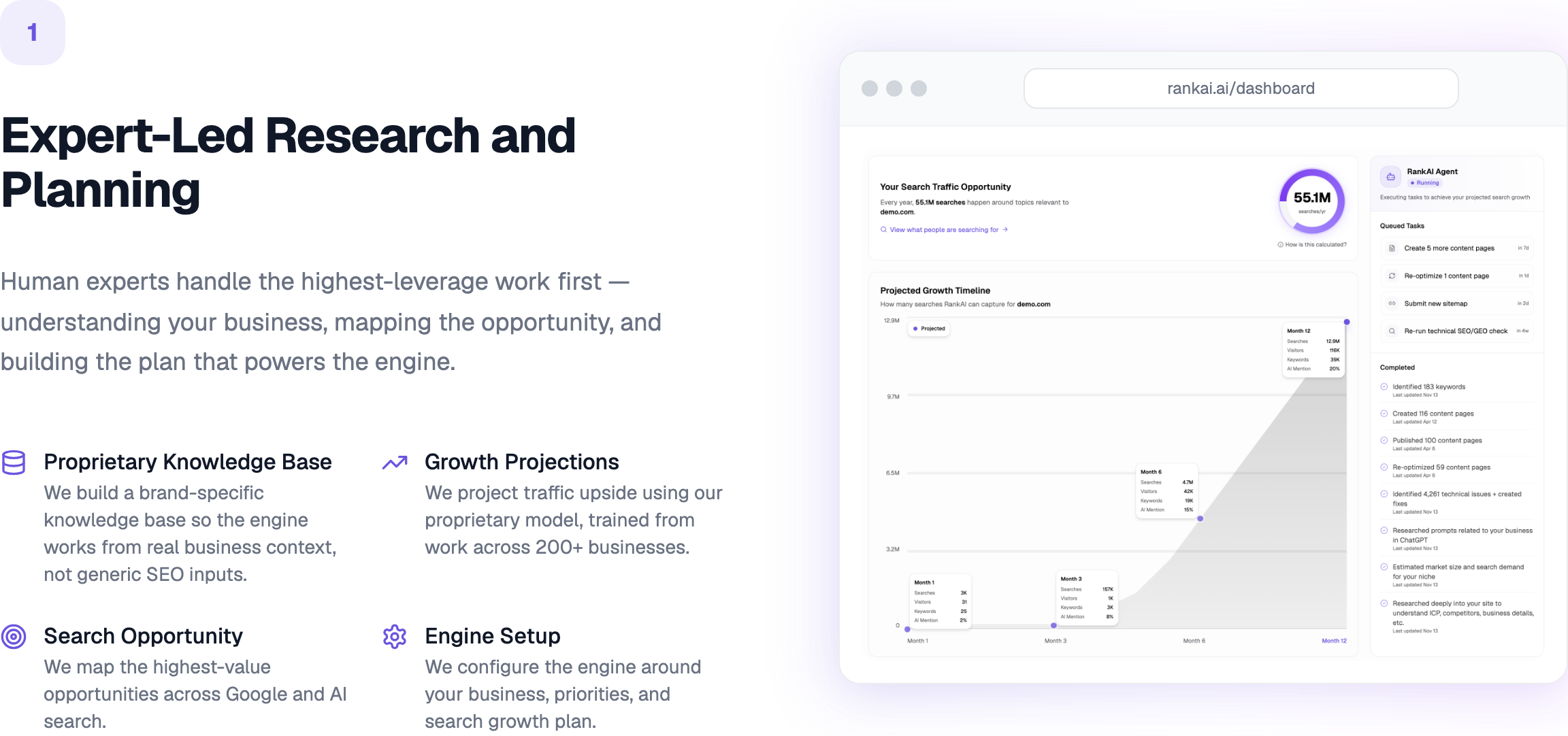
For "how-to" queries, numbered ordered lists with concise step descriptions outperform paragraph-form instructions. Add HowTo schema where applicable. Platforms like RankAI generate these structures programmatically so the format work happens at scale rather than article by article.
6. Bold and italics for key facts
LLMs and Google's extraction systems weight emphasized text slightly more. Don't overdo it, but bolding the actual answer phrase inside a longer paragraph genuinely helps extraction.
Schema markup essentials for AEO
Schema turns ambiguous prose into machine-readable structure. The four schema types that move the needle for AEO:
FAQPage
For dedicated FAQ blocks. Every question/answer pair should be tagged. Featured snippets, AI Overviews paragraphs, and ChatGPT extraction all favor FAQPage-marked content disproportionately.
HowTo
For step-by-step instructions. Each step gets a name and description. Engines extract these as numbered answer cards.
Article + Author
Foundational. Provides date, author, organization context that engines use to decide whether to cite. Without Author markup, attribution is weaker.
Product or SoftwareApplication
For commercial pages. Adds pricing, reviewCount, aggregateRating that engines use in commercial-intent answers. Specifically improves citation odds for "best X" and "X vs Y" queries.
Test every schema implementation in Google's Rich Results Test before shipping. Mis-implemented schema can be worse than no schema.
How to measure AEO success
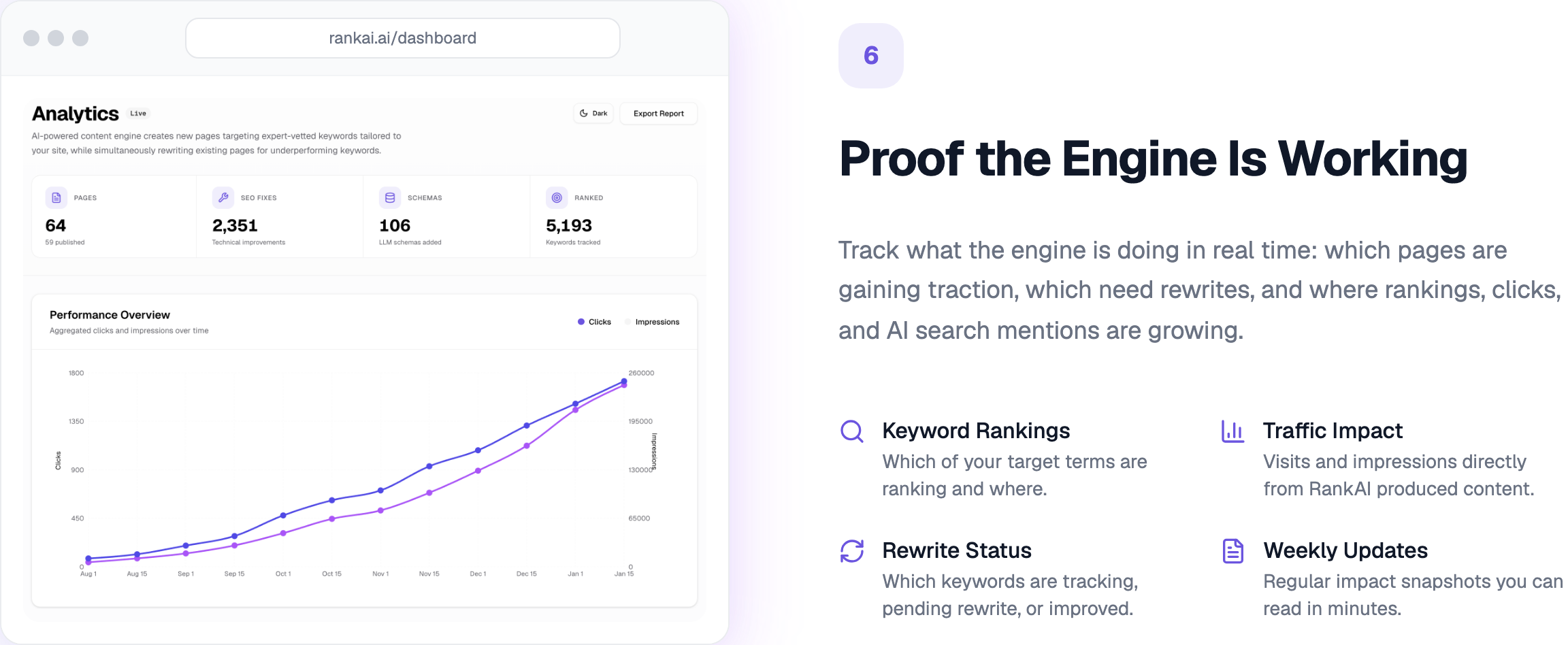
AEO measurement is harder than SEO because the user doesn't click. You have to track presence inside the answer, not visits to your page. Five metrics:
- Featured snippet share. For tracked keywords, what percentage earn you a featured snippet on Google? Ahrefs, Semrush, and Search Console all expose this.
- AI Overviews citation share. Newer; tools like Surfer's Monitor AI Search Visibility and Ahrefs Brand Radar track this.
- ChatGPT / Perplexity / Gemini citation share. See our AI Visibility Tools roundup for the dedicated platforms that measure this.
- Zero-click impressions vs clicks. Search Console shows impressions and clicks separately. A growing impression/click gap typically means your AEO is working (you're being shown without earning the click).
- Branded query lift. When you become "the answer" on a category query, branded search volume for your name lifts a few weeks later.
Common AEO mistakes
- Burying the answer in long prose. If the answer to your H2 isn't in the first 1-2 sentences underneath, engines won't find it.
- Skipping schema because "the content is good enough". Good content + schema beats good content alone, by a significant margin.
- Optimizing only for Google. AEO is multi-engine in 2026. ChatGPT, Perplexity, and Gemini all extract, so your optimization should target all of them.
- Treating featured snippets as a vanity metric. They're a leading indicator of AI-Overviews citations. Earning the snippet typically precedes earning the citation by weeks.
- Forgetting to track. AEO wins are invisible if you only watch click traffic. Set up the measurement first, then optimize.
Everything in the Answer Engine Optimization (AEO): The 2026 Guide library
The deep-dive articles that go with this guide — competitor comparisons, tool roundups, and tactical breakdowns.
AEO tools & services
Dedicated AEO rankings.
- Best AEO Tools in 2026 — Eight AEO tools ranked on engine coverage, execution depth, and pricing for zero-click answer optimization.
- Best AEO Services for B2B Brands — Seven AEO services compared on operating model, pricing, and execution depth.
How-to + comparisons
- How to Do AEO — A six-stage AEO playbook covering FAQ structure, schema, and direct-answer optimization.
- GEO vs AEO — How GEO and AEO differ, where they overlap, and which to optimize for first.
Adjacent topic guides
- Generative Engine Optimization (GEO) — How to win citations across all generative AI engines, covering content, schema, and measurement.