
Why AEO is urgent in 2026
Three numbers force the issue. AI Overviews now hit 48% of all Google queries (Averi citing 2026 industry research), so "ranking #1 on Google" without earning the extracted answer means seeing the impression without the click. Semantic completeness is the #1 ranking factor for AI Overview citations: content scoring 8.5/10 or higher on semantic completeness is 4.2× more likely to be cited (Wellows + Stackmatix research, May 2026). And 47% of AI Overview citations come from pages ranking below position #5 in traditional results (ConvertMate 2026 GEO benchmark) — meaning AEO opens a real path even for pages that can't crack the top 5.
The implication: AEO is the fastest path to AI search visibility for pages that are well-structured but not authority-heavy enough to rank #1 on Google. The six stages below are how to operationalize it.
The work, stage by stage
STAGE 1: AUDIT
Find the answers you should be earning
Open Google Search Console and pull queries for your top 20 commercial-intent pages. For each query, manually check whether a featured snippet or AI Overview exists. Three categories to flag:
- Snippet exists, you don't own it. Highest-priority targets. You've already proven topical relevance; you just need extractable structure.
- Snippet exists, you own it. Protect with quarterly refreshes so a competitor doesn't take it.
- No snippet yet. Opportunity: be the first to structure the page for extraction.
STAGE 2: QUESTION-FIRST HEADINGS
Rewrite headings as the questions users actually ask
Frame H2s and H3s as direct questions. "What is X?", "How do I do Y?", "X vs Y, which is better?". AI engines and Google's extraction systems pattern-match user prompts to question-shaped headings, then extract the first answer-shaped sentence below.
What loses: "Understanding X", "A guide to Y", "Exploring Z". Topic-shaped headings get crawled but rarely extracted.
STAGE 3: DEFINITION-LED ANSWERS
Lead each section with the answer in 1-2 lines
The first sentence under each question heading should answer the question directly, glossary-style. The supporting context comes after, not before.
Per ConvertMate's 2026 GEO benchmark, content that "provides a direct, clear answer in the opening paragraph ranks higher than content that buries the answer" was identified as the most impactful single factor. Reading habits don't favour preamble; AI extraction doesn't either.
STAGE 4: SCHEMA MARKUP
Add the four schema types that move AEO
Schema turns ambiguous prose into machine-readable structure. Four schema types move the needle for AEO:
- FAQPage. The single most reliable extraction format. Featured snippets, AI Overview paragraphs, and ChatGPT inline citations all favour FAQPage-marked content disproportionately.
- HowTo. For step-by-step instructions. Each step gets a name and description; engines extract them as numbered answer cards.
- Article + Author. Provides date, author, and organization context. Without proper Author markup, attribution is weaker.
- Product or SoftwareApplication. For commercial pages; adds pricing, reviewCount, and aggregateRating. Specifically improves citation odds for "best X" and "X vs Y" queries.
Test every schema implementation in Google's Rich Results Test before shipping. Broken schema is worse than no schema.
STAGE 5: SEMANTIC COMPLETENESS
Make the answer self-contained
Per the 2026 AI Overview ranking research (Wellows + Stackmatix, May 2026), semantic completeness is the #1 factor. A passage scores well when it answers the question fully without requiring the user to read surrounding context. Three practical patterns:
- Self-contained paragraphs. Avoid "as discussed above" or "see the next section". Each paragraph should be quotable standalone.
- Comparison tables for evaluative queries. Each row self-contained because AI engines often quote a single row.
- Specificity beats generality. Replace "significantly improves" with "3.2× more citations within 30 days". Engines treat specificity as a proxy for authority.
ConvertMate's research also found multi-modal content (text + images + video + structured data) saw 156% higher AI selection rates, with full multimodal plus schema integration delivering up to 317% more citations. Embed video where it fits; add labeled images with descriptive alt text.
STAGE 6: MEASURE AND ITERATE
Track the impression-to-click gap
AEO wins are invisible if you only watch click traffic. Three measurements:
- Featured snippet share. Search Console plus Ahrefs / Semrush expose this per keyword.
- Impression-to-click gap. A growing impression count without a proportionate click increase usually means your AEO is working (you're being shown without earning the click).
- AI engine citation share. See our companion guide on measuring AI search visibility for the cross-engine framework.
From RankAI
How RankAI runs this for you
The six stages above describe roughly 60-100 hours of monthly work for a content team trying to operationalize AEO at scale. RankAI automates the parts that scale.
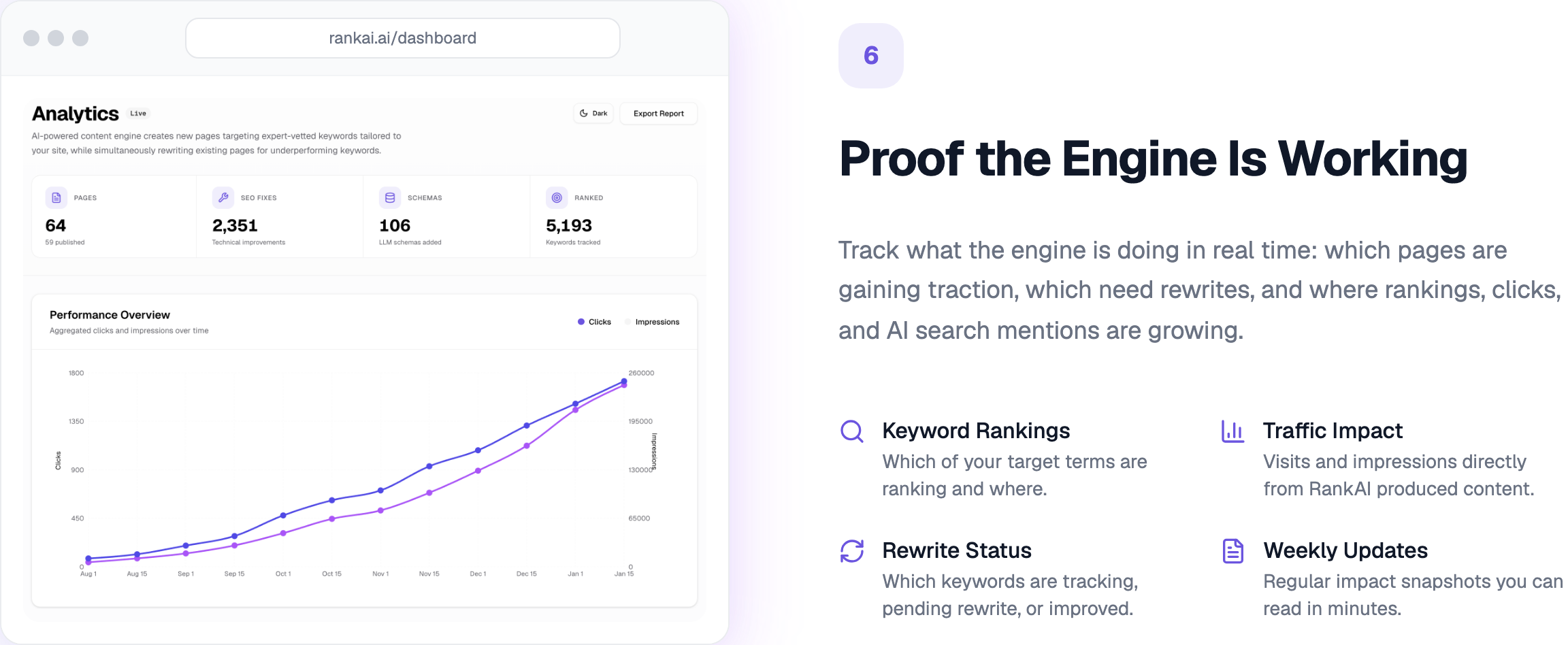
Programmatic page generation produces question-first, definition-led pages at long-tail buyer-query volume. Schema generation handles FAQPage, HowTo, Article, and Product markup automatically. The auto-rewrite engine triggers on a 3-week performance threshold, so pages that don't earn extracted answers get queued for structural rewrites. Multi-CMS publishing covers WordPress, Shopify, Webflow, Wix, Sanity, Framer, and custom CMSes.
- Free AI search audit — See where you sit on featured snippet and AI Overview citation share.
- GEO Score Calculator — Estimate your domain's GEO + AEO readiness, free.
- AI Search Visibility Checker — Track brand presence across AI search answers, free.
- Free plan, paid from $199/mo — Programmatic AEO-optimized page generation with schema and auto-rewrites.
Common AEO pitfalls
- Burying the answer. If the answer to your H2 isn't in the first 1-2 sentences underneath, engines won't find it.
- Skipping schema because "the content is good enough". Good content plus schema beats good content alone by a significant margin per the 2026 multi-modal research.
- Optimizing only for Google. AEO is multi-engine in 2026. ChatGPT, Perplexity, and Gemini all extract. Your optimization should target all of them.
- Treating featured snippets as a vanity metric. They're a leading indicator of AI Overview citations. Earning the snippet typically precedes earning the AI citation by 2-6 weeks.
- Not measuring the impression-click gap. AEO wins are invisible if you only watch click traffic. Set up the measurement before optimizing.