
What is Generative Engine Optimization?
Generative Engine Optimization is the discipline of designing content so generative AI engines retrieve, cite, and recommend it inside their answers. The engines in scope are the ones people now use to search: ChatGPT, Perplexity, Gemini, Microsoft Copilot, Claude, Grok, Meta AI, DeepSeek, and Google's AI Overviews and AI Mode.
The deliverable looks different from classic SEO. Where SEO wins by ranking on a results page, GEO wins by becoming the citation inside an AI-generated answer. A buyer asks ChatGPT "what are the best AI visibility tools?" Your brand is either named (with a link) inside the response or it isn't. That binary outcome is the game.
GEO overlaps with two adjacent terms you'll see: AEO (Answer Engine Optimization) focuses specifically on zero-click answers and featured-snippet-style extraction, and LLM SEO describes optimization aimed at language-model citations specifically. In practice the three names describe overlapping work, and the same content, schema, and structure choices benefit all three. If you want the distinctions in detail see our planned overview of GEO agencies and the comparison guides linked in the library below.
Why GEO matters in 2026
Three shifts make GEO the highest-leverage growth channel right now:
1. AI search adoption is past the curiosity phase. ChatGPT, Google AI Overviews, and Perplexity routinely intercept commercial-intent queries like "best X for Y", "X vs Y", and "how to do X" that used to drive search visits to your site. If you only optimize for Google's blue links, you ship traffic to a page Google increasingly answers itself.
2. Each engine builds its citation graph differently. ChatGPT tends to lean on a small set of trusted sources per topic; Perplexity surfaces a wider citation list; Google AI Overviews pulls from on-page structured content. Each requires its own micro-tactics, but the underlying principle (be the source an engine reaches for) is shared.
3. The buyer journey now ends inside the chat. By the time a buyer opens your site, the LLM has already shaped their shortlist. Being inside that shortlist is the actual lead-gen event in 2026. Not being there means you're invisible to a growing share of demand.
The compound effect: brands that ship GEO-aware content in the next 12 months will establish citation moats that compound over time, because LLMs reinforce their own historical citation patterns.
GEO vs. classic SEO: what changes and what stays
Most of classic SEO still applies: crawlable HTML, fast pages, internal linking, quality content, schema markup. GEO doesn't replace SEO; it stacks on top. Here's what shifts:
What changes
- The unit of value moves from rank to citation. You optimize for being quoted, not for clicks.
- Content structure becomes more important than length. LLMs extract concise, fact-dense passages, sometimes 1-2 sentences from a 2000-word article. The clarity of those passages matters more than the surrounding prose.
- Authority is engine-specific. Being trusted by Google's algorithm doesn't guarantee being trusted by Perplexity. Each engine has its own seed sources.
- Brand mentions and entity associations matter more than ever. LLMs learn what you do partly from how often you're mentioned alongside category keywords elsewhere on the web.
What stays the same
- Technical fundamentals: crawl, render, indexability. AI bots also crawl; blocking them is the easiest way to lose.
- Topical depth and editorial quality. Thin content fails everywhere.
- Internal linking and pillar/cluster structure, because LLMs use the same signals about what your site is "about" that Google does.
The 7 GEO tactics that actually move citation share
These are the tactics that show up consistently in measurable citation lifts. Each is cheap to start; the leverage compounds when several stack together.
1. Lead every concept with a one-sentence definition
LLMs love clean extractable definitions. The first sentence under a heading should answer the heading like a glossary entry. Example: under "What is GEO?", lead with "Generative Engine Optimization is the practice of structuring content so generative AI engines cite your brand when answering buyers' questions." If an LLM needs one sentence, you've handed it the one to use.
2. Add FAQ blocks with FAQPage schema
Questions + answers in a Q/A block are the format LLMs most reliably extract. Add FAQPage JSON-LD so engines can parse the structure unambiguously.
3. Build comparison tables for commercial-intent queries
For "X vs Y" and "best X" queries, tables are the most cited format in AI Overviews and ChatGPT. Each row should be self-contained so it works extracted from context.
4. Cite your sources visibly
Brands that link to verifiable third-party data become the "trusted hub" in their topic. LLMs prefer sources that themselves cite, because it correlates with non-hallucinated facts.
5. Maintain consistent entity descriptions across the web
What your homepage says you do, your LinkedIn description, your G2 listing, and mentions on third-party sites should all converge on the same one-sentence positioning. LLMs aggregate; conflicting descriptions confuse them.
6. Earn citations on the sources LLMs already trust
Reddit, YouTube, GitHub, Stack Overflow, and a handful of high-authority editorial sites disproportionately seed LLM training and retrieval. A coordinated digital PR push that earns one mention in each is often more valuable than ten guest posts on mid-tier blogs.
7. Ship at programmatic scale where the keyword universe rewards it
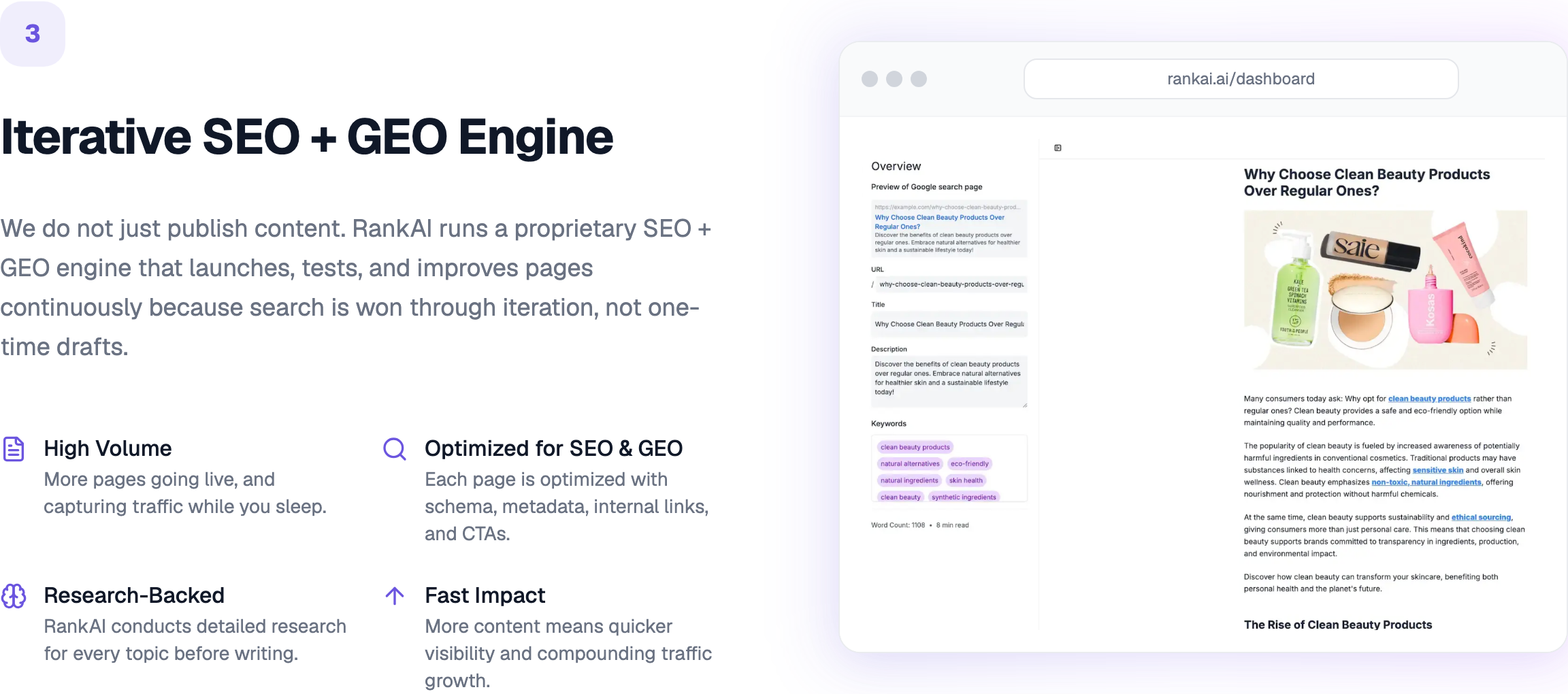
For categories with hundreds of long-tail buyer queries (think "[competitor]-alternatives", "[tool]-for-[use-case]", or "[topic]-in-[year]"), one-off articles can't cover the surface. Programmatic page generation, the kind specialized AI SEO platforms ship for you, is how you close that gap without an engineering team.
Tools you actually need (and which we recommend)
The GEO tool stack splits into three categories: monitoring (where am I being cited), execution (shipping the pages), and analytics (was any of it working).
Monitoring tools
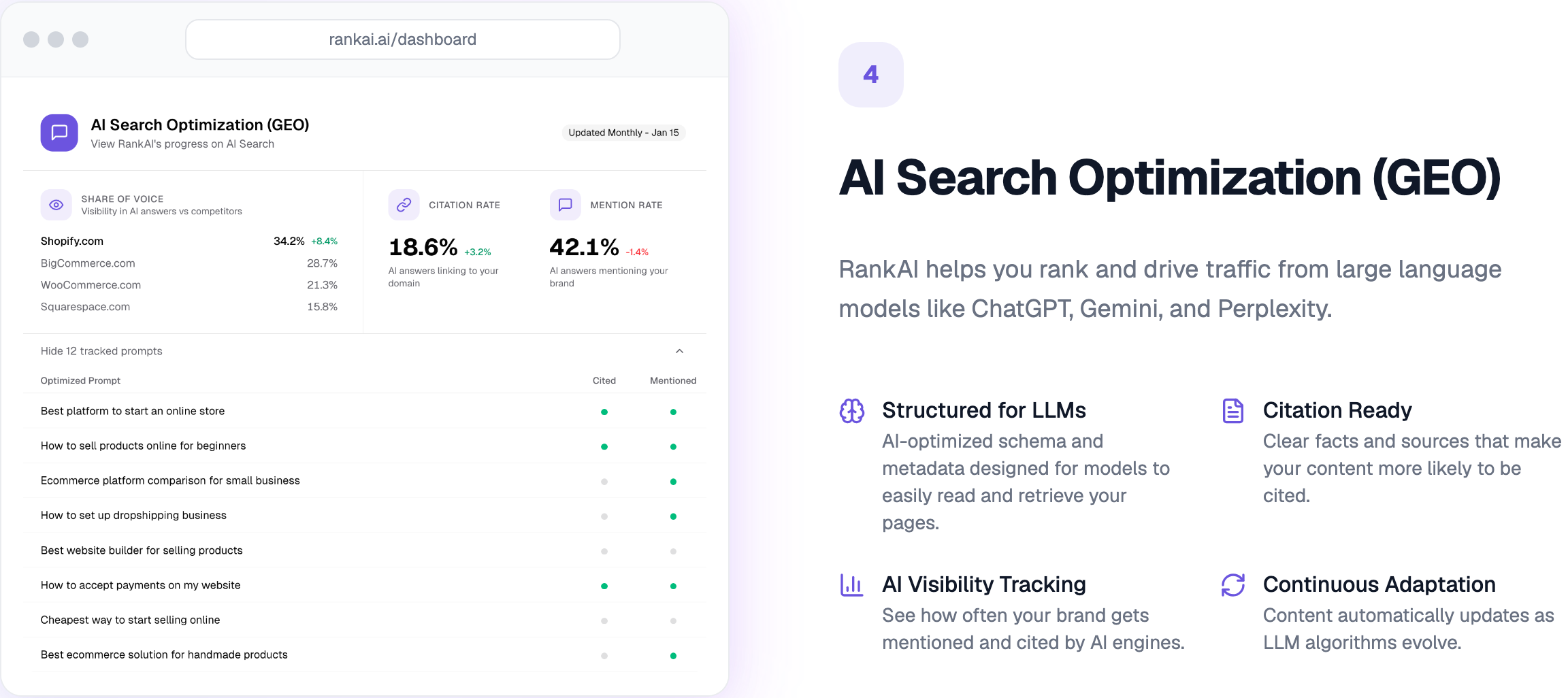
Track which AI engines cite you, on which prompts, and how that share moves over time. Most monitoring tools cover 4-9 engines starting at $20-25/month. See the Best AI Visibility Tools comparison for the full ranking.
Execution platforms
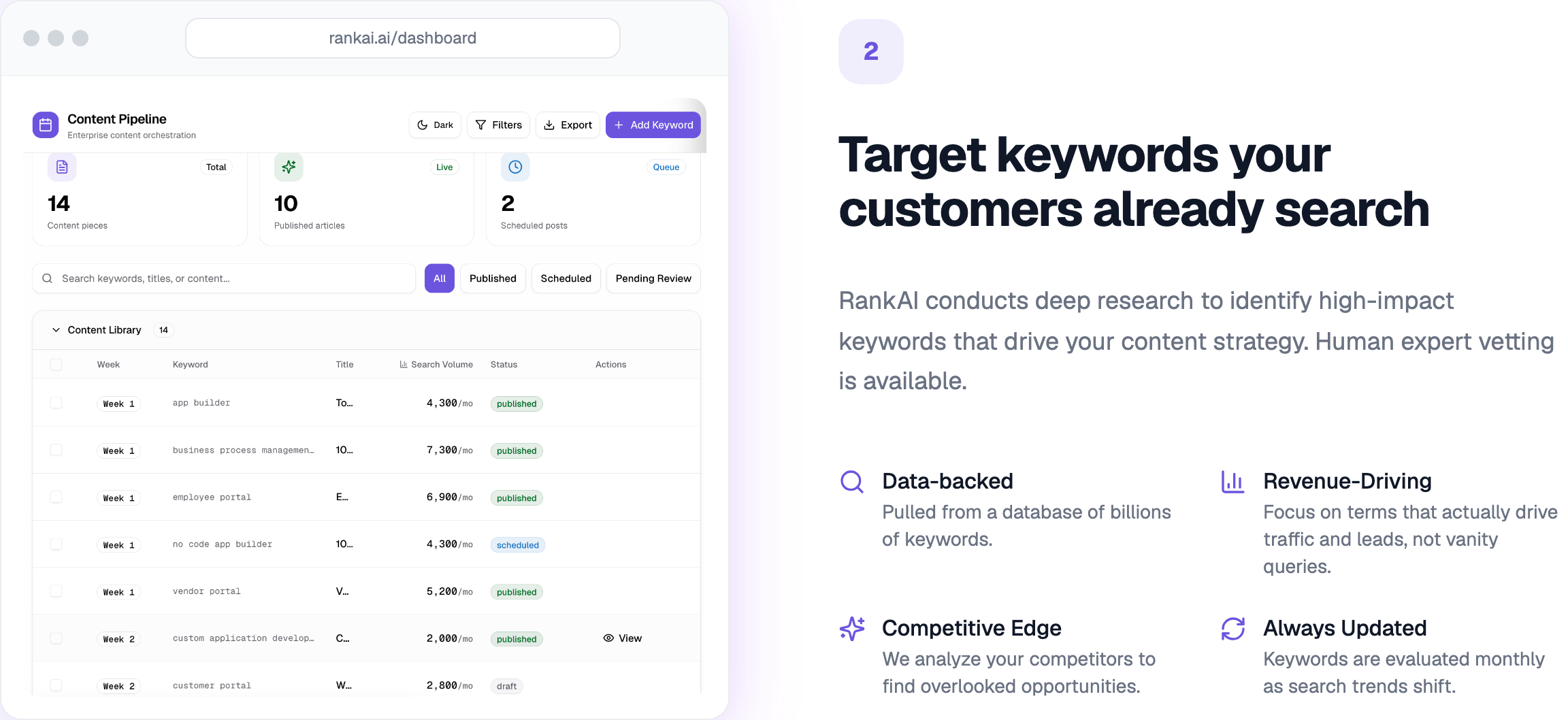
Monitoring tells you where the gaps are. Execution platforms close them by shipping content programmatically and rewriting underperformers. This is where single-purpose monitoring stops and integrated platforms like RankAI start.
Analytics and reporting
Tying citation share to actual pipeline is the hard part. Most teams stitch together Looker Studio, manual prompts, and the dashboards their monitoring tool ships. As of mid-2026, no single tool nails the citation-to-revenue attribution cleanly, so expect to build some of this yourself.
What we recommend
For most teams: one monitoring tool (Otterly $25/mo annual or Rankscale $20/mo if budget; Profound or Peec AI if enterprise), one execution platform (RankAI, self-serve from $49/mo), and a quarterly Looker dashboard. For enterprise: layer in a specialist agency for the digital PR work that earns external citations.
Step-by-step GEO playbook
A practical workflow for getting from zero AI search visibility to compounding citation share, in eight weeks.
Week 1: Baseline audit
Pick a monitoring tool. Track 50-100 prompts across your three top product categories. Document the current citation share by engine. You'll come back to this number in week 8.
Week 2: Fix the structural basics
Audit your top 20 commercial-intent pages for: definition-led openings, FAQ blocks, schema markup, internal linking, and comparison tables where applicable. Most teams find 60-80% of pages need restructuring, so start with the highest-traffic ones.
Weeks 3-4: Ship the missing pages
For each prompt where you're not cited, identify whether (a) you have a page that should rank but doesn't (fix), (b) you have a page but it's the wrong format (rewrite), or (c) you don't have a page at all (write or ship programmatically). Plan content accordingly.
Weeks 5-6: Earn external citations
Identify the 5 highest-authority third-party sites in your category and pitch one piece each. Reddit, YouTube, GitHub, and Stack Overflow disproportionately seed LLM retrieval, so coordinated digital PR is the fastest external-signal lever.
Week 7: Implement the auto-rewrite loop
Pages that don't earn citations within 3-4 weeks usually need a structural rewrite. Some platforms automate this trigger; otherwise schedule a manual review cycle.
Week 8: Re-measure and double down
Compare citation share against week 1. Identify the 3 pages that gained most and the 3 that didn't move. Replicate the winners; rewrite the losers.
How to measure GEO success
GEO measurement is messier than classic SEO because there's no Search Console equivalent that gives you ground truth. Five metrics that actually correlate with outcomes:
- Prompt citation share. Of the 50-100 prompts you track, what percentage cite you? Track per engine; aggregate monthly.
- Citation position. When you are cited, are you position 1 or position 5 in the answer? Position 1 captures most of the click-through.
- Branded queries from AI referrers. Google Analytics and UTM-aware campaigns can isolate sessions where the entry path included ChatGPT, Perplexity, or Gemini. Branded query volume there is a leading indicator.
- Bot crawl frequency. GPTBot, PerplexityBot, and ClaudeBot crawl your site. Increasing crawl frequency on a page typically precedes citation lift by 2-4 weeks.
- Self-reported attribution. "How did you hear about us?" on demo forms catches what dashboards miss. Add the option.
Tie any two of these to your pipeline and you have a working measurement framework for 2026.
Common GEO mistakes (and how to avoid them)
The five we see most often:
- Treating GEO as a replacement for SEO. It's additive. Strip out your existing SEO discipline and you lose the foundation.
- Optimizing for the wrong engine. ChatGPT and Perplexity reward different signals. Decide which engine drives most of your category's search behavior and focus there first.
- Hand-optimizing instead of shipping at scale. Long-tail GEO wins are won at hundreds-of-pages scale. One-off optimization tops out fast.
- Ignoring external citations. 80%+ of LLM retrieval pulls from sources beyond your own domain. If you only fix on-site, you're leaving most of the lever on the table.
- Measuring once and stopping. Citation share is volatile across prompts. Monthly cadence at minimum; weekly during active campaigns.
None of these are technical blockers; they're prioritization mistakes. They're also the difference between teams that hit citation moats by end of year and teams that don't.
Everything in the Generative Engine Optimization (GEO): The Complete 2026 Guide library
The deep-dive articles that go with this guide — competitor comparisons, tool roundups, and tactical breakdowns.
Tools & agencies
The GEO execution stack — tools to ship the work and agencies to run the playbook.
- Best GEO Tools in 2026 — Eight GEO tools compared on citation coverage, execution depth, and pricing.
- Best GEO Agencies for 2026 — Eight Generative Engine Optimization agencies ranked by methodology and execution.
How-to + comparisons
Playbooks and plain-English comparisons.
- How to Do GEO — The complete GEO playbook in execution order, from audit to compounding moat.
- GEO vs AEO — What's the difference, where they overlap, and which to optimize for first.
Adjacent topic guides
- AI Search Visibility — The umbrella guide covering citations across ChatGPT, Perplexity, Gemini, and AI Overviews.