
Why GEO is the highest-leverage move in 2026
Three data points explain the urgency. 83% of AI Overview citations come from pages outside the organic top 10, meaning traditional rank doesn't predict AI citation (ConvertMate 2026 GEO benchmark). AI search traffic converts 4.4× better than traditional organic across e-commerce categories (ConvertMate, May 2026), so the cited pages compound disproportionately. And Princeton's GEO study identified two tactics — "Statistics Addition" and "Cite Sources" — that boost AI visibility by up to 40% (cited across multiple May 2026 GEO guides), which is the kind of lift no other channel offers from a single editorial change.
The implication: a founder who runs the GEO playbook for one quarter has a real shot at establishing citation moats in their category that compound for years. The eight-week sequence below is the path.
The work, stage by stage
STAGE 1: BASELINE
Weeks 1-2: audit citation share and crawler access
You can't improve what you don't measure. Start with a baseline.
- Pick 20-50 buyer prompts from Search Console queries and category subreddits. See our companion guide on measuring AI search visibility for the full framework.
- Run each prompt across ChatGPT, Perplexity, Gemini. Document who's cited and which domain feeds each citation. Save this as your week-1 baseline.
- Audit crawler access. Allow GPTBot, PerplexityBot, ClaudeBot, Bingbot, and Googlebot in robots.txt. Per Forge & Smith (May 2026), blocked crawlers are the single most-overlooked GEO baseline fix.
- Submit sitemaps to both Bing and Google. ChatGPT retrieves live via Bing; Google AI Overviews via Google.
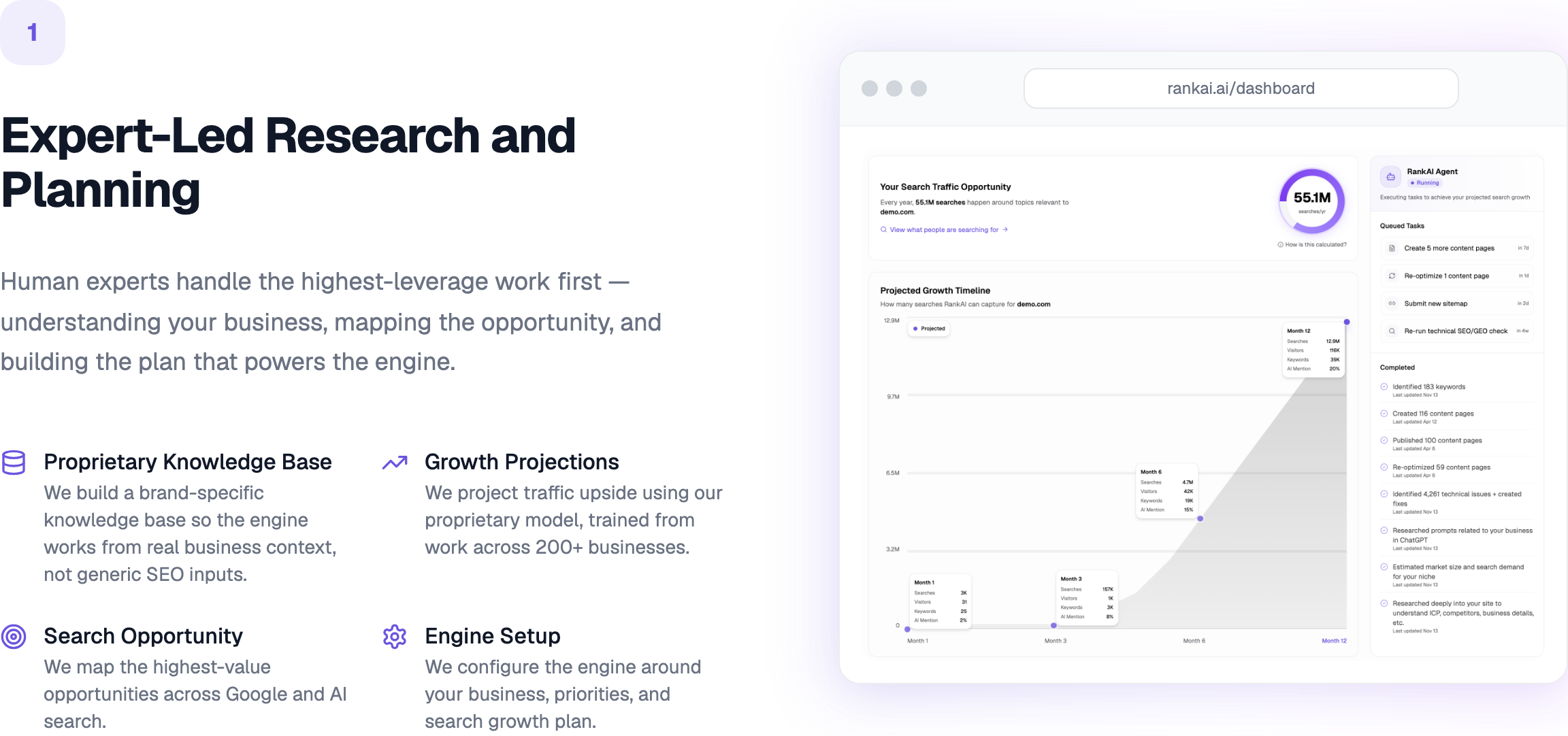
STAGE 2: STRUCTURE
Weeks 3-4: rewrite the top 20 commercial pages
Per ConvertMate's May 2026 GEO benchmark and the Princeton GEO study, the highest-leverage on-site changes are structural and editorial, not technical. Apply them to your top 20 commercial-intent pages.
- Definition-led first sentence. Under each H2, the first line should answer the heading in glossary form.
- Add 5-10 FAQ blocks per page with FAQPage schema.
- Statistics Addition. Replace generic claims with cited numbers. The Princeton study ranked this as the #1 GEO tactic.
- Cite Sources. Link out to verifiable third-party data. The #2 Princeton tactic.
- Add comparison tables for "X vs Y" queries; each row self-contained because engines often quote a single row.
- Update dateModified. Semrush 2026 data: 65% of AI bot hits target content less than 1 year old. E-commerce content updated within 30 days gets 3.2× more citations (ConvertMate, May 2026).
STAGE 3: SHIP
Weeks 5-6: publish missing surfaces
From the week-1 audit, identify prompts where you're not cited because you simply don't have a page on the topic. Ship one. For most categories the highest-ROI surfaces are:
- Competitor alternatives pages. See our 21 shipped alternatives articles for the format that works.
- Best X / Top X lists. RankAI's shipped Best AI Visibility Tools roundup is the reference template.
- How-to and tutorial content answering high-volume buyer questions.
For categories with hundreds of long-tail queries, manual publishing can't keep up. Programmatic page generation is how growth-stage teams cover the surface area their competitors won't.
STAGE 4: EARN
Weeks 6-7: earn the off-site mentions AI engines weight
On-site work has a ceiling. Compounding wins come from external signals.
- Reddit category subreddits. Reddit accounts for 46.7% of Perplexity's top-10 citations and 21% of Google AI Overview citations (Otterly + Wellows, May 2026).
- YouTube transcripts. Lead Google AI Overviews citations alongside Wikipedia and Forbes (Sanbi AI, May 2026).
- G2 / Capterra / TrustRadius. Feed commercial-intent retrieval across all engines.
- Wikipedia presence. If your brand qualifies, a maintained Wikipedia article is one of the highest-authority signals across every engine.
STAGE 5: ITERATE
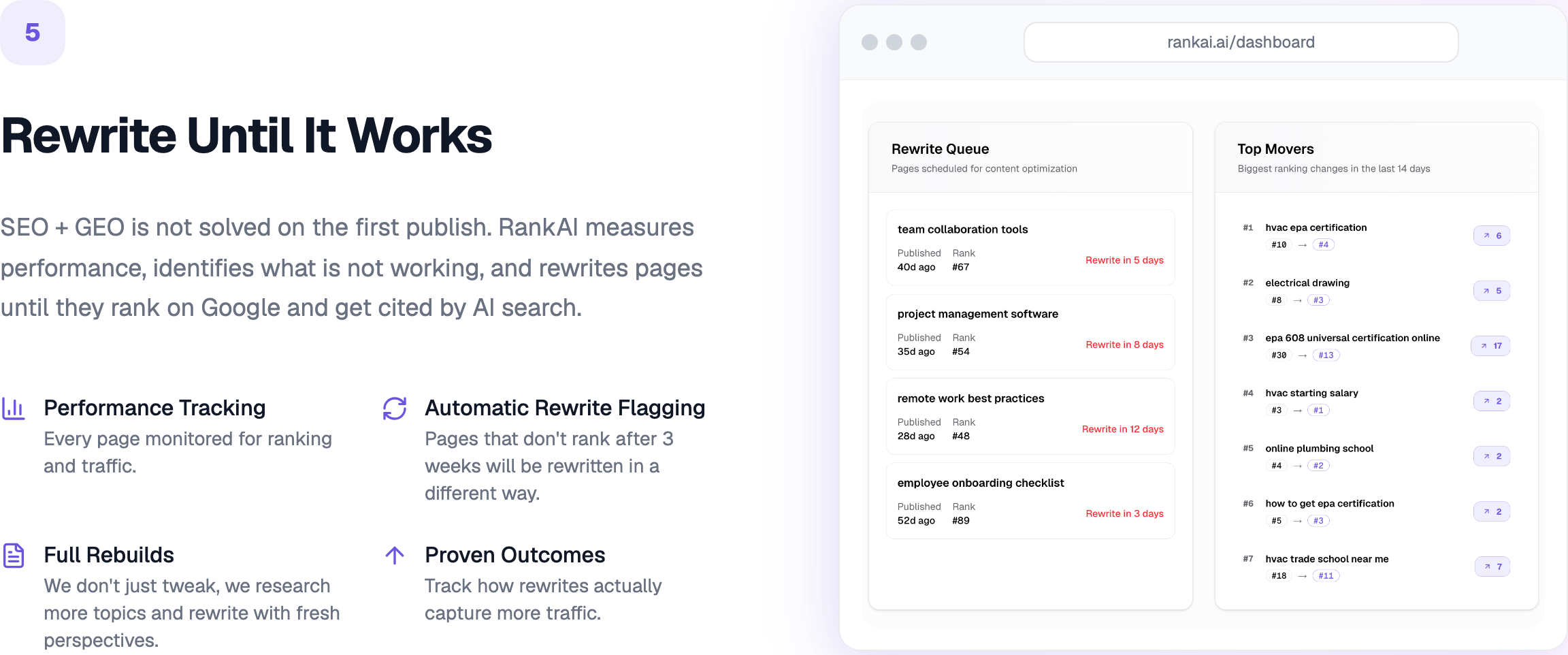
Week 7 onwards: auto-rewrite the underperformers
ConvertMate's research found that pages ranking fifth in traditional search saw a 115.1% visibility increase in AI responses when proper citations were added after initial publication. The implication: publishing isn't the end of the work, it's the start of the iteration loop.
A practical cadence: every 3 weeks, identify pages that haven't earned citations and trigger a structural rewrite. Refresh the dateModified timestamp, re-pitch external mentions, and re-measure citation share four weeks later.
STAGE 6: MEASURE
Week 8 onwards: re-baseline and double down
Re-run the week-1 prompt audit. Compare citation share against the baseline. Two outcomes guide what comes next:
- Pages that gained citation share: identify what they share (FAQ density, comparison tables, external mentions) and replicate across more pages.
- Pages that didn't move: rewrite or re-pitch.
Schedule monthly re-measurement going forward. GEO is an ongoing discipline, not a project.
From RankAI
How RankAI runs this for you
The eight-week sequence above describes ~120 hours of manual work for a founder or a small team. RankAI automates the parts that scale.
Programmatic page generation handles the alternatives, comparison, and best-of content that closes long-tail GEO gaps. The auto-rewrite engine triggers on a 3-week performance threshold, so pages that don't earn citations get queued for structural rewrites without manual intervention. Multi-CMS publishing covers WordPress, Shopify, Webflow, Wix, Sanity, Framer, and custom CMSes. And the measurement loop runs continuously, surfacing share-of-voice deltas vs competitors and routing signal back into the execution layer.
- Free AI search audit — Run the week-1 baseline in 5 minutes instead of two days.
- GEO Score Calculator — Estimate your domain's GEO readiness, free.
- AI Search Visibility Checker — Track brand presence across AI search answers, free.
- Free plan, paid from $199/mo — Programmatic page generation, auto-rewrites, multi-CMS publishing.
Common GEO playbook pitfalls
- Treating GEO as a replacement for SEO. It's additive. Strip out your existing SEO discipline and the foundation crumbles.
- One-and-done publishing. Pages that don't earn citations within 3-4 weeks usually need a structural rewrite, not just more backlinks.
- Ignoring off-site work. Up to 85% of AI citations originate beyond your own domain. On-site optimization alone hits a ceiling.
- Optimizing for the wrong engine. ChatGPT, Perplexity, and Gemini reward different signals. Pick the one driving most of your category's commercial search and focus there first.
- Measuring quarterly instead of monthly. Citation share is volatile. Less-frequent measurement hides which interventions actually worked.