
Why measurement matters now
A growing share of buyer journeys end inside the AI engine. ALM Corp's May 2026 framework draws the same conclusion as Sanbi AI and Wireinnovation: "AI visibility metrics measure how often and in what context a brand appears in AI-generated answers, focusing specifically on brand presence inside AI responses rather than website traffic." If you only watch Google Analytics, you miss most of what's happening.
The cost of not measuring is invisibility you can't diagnose. The cost of measuring badly is optimizing the wrong lever for a quarter. The framework below isolates the metrics that correlate with downstream pipeline so you can act on what you observe.
The work, stage by stage
STAGE 1: SCOPE
Pick 20-50 buyer-intent prompts
Per ALM Corp and Sanbi AI (May 2026), the working sample size is 20-50 buyer-intent prompts covering awareness, consideration, and decision-stage questions. Smaller samples are too volatile; larger samples cost time without proportional insight.
Build the list from three sources:
- Search Console queries showing up in your top commercial pages.
- Sales call recordings — what buyers actually ask in week 1.
- Reddit / G2 reviews / Quora threads in your category.
Cover three intent buckets: awareness ("what is X"), consideration ("best X for Y", "X vs Y"), and decision ("X alternatives", "X pricing").
STAGE 2: METRICS
Track 4 core metrics per engine
Across the May 2026 measurement frameworks (Sanbi, Wireinnovation, Visiblie, Quattr, ALM Corp), four metrics consistently surface as the working set:
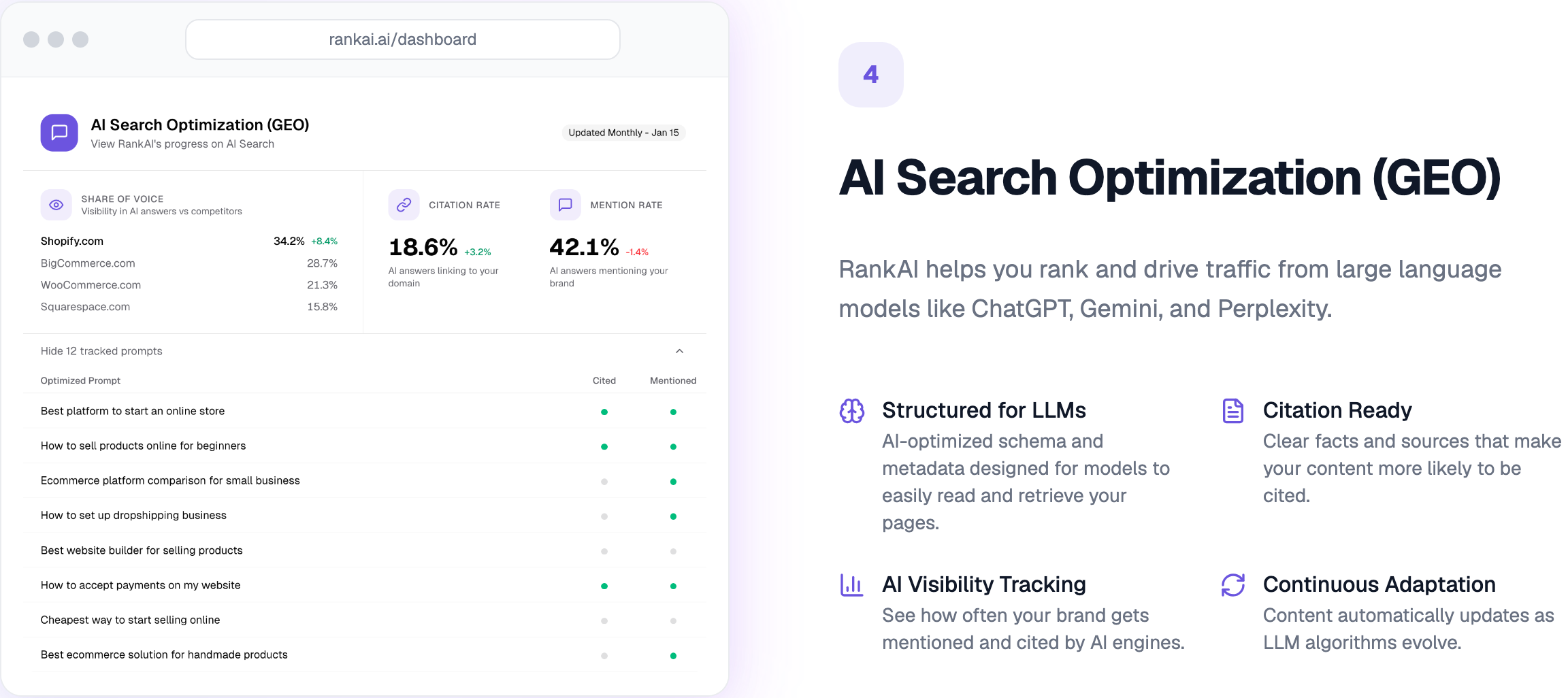
- Mention frequency. What % of your tracked prompts mention your brand at all? Mentions count even without an outbound link.
- Mention position. When mentioned, are you #1 or #5 in the answer? Position 1 captures most of the downstream attention.
- Citation rate. What % of prompts cite you with a clickable link? Citations send actual traffic; mentions build brand recall.
- Share of voice. Of all category brand mentions across your prompt set, what % are yours vs each competitor's? This is the competitive signal that maps to pipeline win rate.
STAGE 3: PLATFORM SPLITS
Track each engine separately because they behave differently
Aggregating across engines hides the strategy. Each AI engine has distinct citation patterns (Sanbi AI, May 2026):
ChatGPT
Top cited domains include Reddit, Wikipedia, Amazon, and Forbes. Expect brand mentions without links. Volatility is driven by which browsing mode is enabled.
Perplexity
Reddit accounts for 6.6% of overall citations and 46.7% of top-10 citations (Otterly, May 2026). If you're not visible inside Reddit threads in your category, you're not visible in Perplexity.
Gemini / Google AI Overviews
YouTube, Wikipedia, Forbes, and Quora lead citations. 59.8% of AI Overview citations go to brand domains (Sanbi AI, May 2026) — the highest brand-domain rate of the three, which means owned-media optimization pays off more directly here.
STAGE 4: CADENCE
Set the right measurement frequency
Citation share is volatile prompt-to-prompt. Single-day snapshots tell you almost nothing. The consensus cadence across the May 2026 frameworks:
- Monthly for standard tracking.
- Weekly during active campaigns.
- Daily only for prompts you're acutely working on (e.g. a competitor launch response).
Aggregate as month-over-month deltas rather than absolute numbers in any single week. The signal is in the trend, not the snapshot.
STAGE 5: BUSINESS LINKAGE
Tie AI visibility to pipeline
The hardest layer. Three working approaches:
- Self-reported attribution. Add "ChatGPT / AI search" as an option in your demo-form "How did you hear about us?" field. Catches what dashboards miss; consistently the single highest-signal pipeline metric.
- AI referral traffic in GA4. Wireinnovation's May 2026 GA4-based framework segments traffic from chat.openai.com, perplexity.ai, gemini.google.com, and AI Overview pageviews. Tag and track separately.
- Branded query lift. When you become "the answer" on a category query in AI engines, branded query volume on Google rises a few weeks later. Track branded volume in Search Console as a lagging confirmation.
From RankAI
How RankAI runs this for you
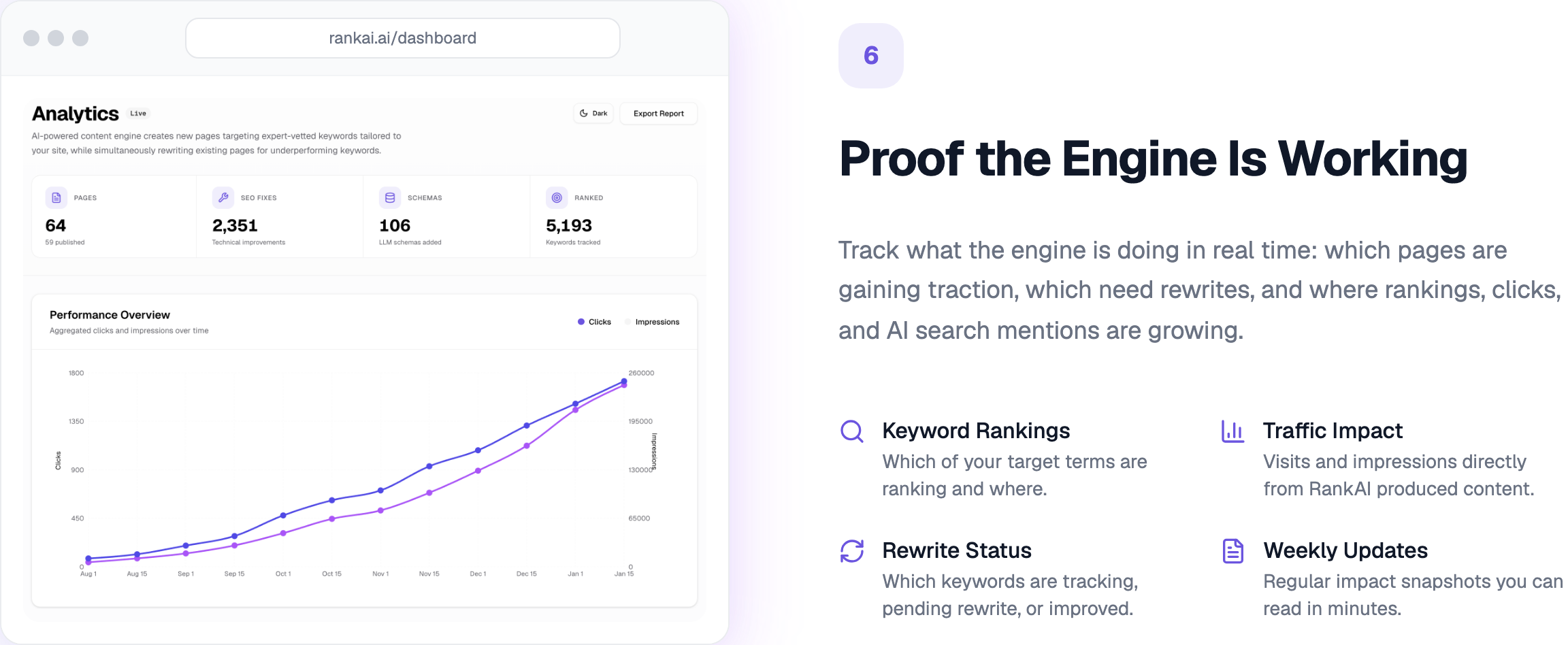
The measurement workflow above is the kind of work most teams stop running after two quarters because it's tedious. RankAI automates the measurement loop so the data keeps flowing without manual effort.
RankAI tracks the prompts you care about across the major AI engines daily, surfaces share-of-voice deltas vs your competitors, identifies which surfaces (your own site, Reddit, G2, etc.) are driving each citation, and routes that signal back into the execution layer so the next batch of pages targets the gaps automatically.
- Free AI search audit — See where you sit before committing budget to optimization.
- AI Search Visibility Checker — Track brand presence across AI search answers in real time, free.
- AI Citation Tracker — See which domains AI assistants cite for your buyer prompts.
- Free plan, paid from $199/mo — Continuous measurement plus the execution layer that closes the gap.
Common measurement pitfalls
- Single-day measurement. Citation share is volatile. One snapshot tells you nothing useful. Aggregate monthly.
- Aggregating across engines. ChatGPT and Perplexity behave differently. Aggregated "AI visibility" numbers hide where to invest.
- Sampling too few prompts. Fewer than 20 buyer-intent prompts and the noise floor swamps your signal.
- Watching only mentions, not source domains. A Perplexity citation from your G2 listing requires different investment than a citation from your own site. Track which surface drove each.
- Skipping self-reported attribution. The cheapest, highest-signal pipeline metric. Add the option to your demo form.