
Why ranking in ChatGPT matters in 2026
Three numbers explain the urgency. ChatGPT now receives over 1 billion daily queries with 300 million weekly active users (Forge & Smith citing Ahrefs, May 2026). 63% of websites already see traffic from AI platforms, though it averages under 1% of total traffic for now (Ahrefs study cited by Forge & Smith, May 2026). And in a Semrush case study, AI-cited pages averaged 19 ranking keywords each, with 85% of ChatGPT-cited pages also ranking for at least one keyword in Google (Semrush Petlibro case study, May 2026).
The implication: traditional SEO is necessary but no longer sufficient. ChatGPT retrieves content via Bing and Google live web search, then synthesises answers that may cite you, mention you, or skip you entirely. The work below covers what actually moves you from skipped to cited.
The work, stage by stage
STAGE 1: BASELINE
Get indexed in both Bing and Google
ChatGPT runs live web searches against Bing primarily, with Google secondary (Semrush ChatGPT SEO guide, May 2026). If your pages aren't in those indexes, ChatGPT can't cite them.
Bing indexing
- Set up Bing Webmaster Tools and submit XML sitemaps.
- Run Site Explorer to surface indexing issues: 404s, robots.txt blocks, and unintentional noindex tags.
- Use IndexNow to push fresh content; Bing rewards freshness on this signal.
Google indexing
- Submit sitemaps via Search Console; review the "Why pages aren't indexed" report.
- Click "Validate Fix" once issues are resolved.
- Avoid JavaScript for critical content; ChatGPT's retrieval layer struggles with JS-rendered pages.
SearchGPT bot crawling
Allow OpenAI's crawler explicitly. Forge & Smith (May 2026) flagged this as the single most-overlooked baseline fix. In robots.txt add:
User-agent: OAI-SearchBot
Allow: /
STAGE 2: STRUCTURE
Write content primed for AI extraction
Per Semrush's analysis (May 2026), ChatGPT extracts cleanly from content with three structural traits: descriptive headings that match user questions, short single-idea paragraphs, and direct answers in the opening sentence under each heading. The same study found AI-cited pages tend to use bullet lists and numbered steps far more than uncited pages.
- Question-first H2/H3. Frame headings as "What is X?" or "How do I do Y?" ChatGPT pattern-matches user prompts to question-shaped headings.
- Definition-led first sentence. The first sentence under each heading should answer the heading in 1-2 lines like a glossary entry.
- Specific facts beat vague claims. Authority Tech's May 2026 study of Perplexity citations applies equally to ChatGPT: pages with specific data points, numbers, and verifiable facts get cited at roughly 2-3× the rate of vague-prose pages.
- Cite your sources visibly. Princeton's GEO study (cited across multiple May 2026 GEO guides) found "Statistics Addition" and "Cite Sources" were the top-performing GEO tactics, boosting AI visibility by up to 40%.
STAGE 3: AUTHORITY
Build the brand mentions ChatGPT looks for
On-page work has a ceiling. The compounding wins come from external signals. ChatGPT weights mentions from a small set of sources disproportionately. ALM Corp (May 2026) identified Reddit, Wikipedia, Amazon, and Forbes as four of ChatGPT's most-cited domains; Reddit alone accounted for 6.6% of all Perplexity citations and 21% of all Google AI Overview citations (Wellows and Stackmatix research, May 2026), and similar over-indexing is documented for ChatGPT.
- Earn Reddit mentions in category subreddits. Genuine participation works; brand-led promotion gets flagged.
- Land on G2, Capterra, TrustRadius. ChatGPT pulls heavily from these for "best X" commercial queries.
- Get a YouTube presence. Transcripts are indexed and surface as ChatGPT citations on tutorial intents.
- Keep entity descriptions consistent. Your homepage, LinkedIn, G2 listing, and third-party mentions should converge on one positioning line. ChatGPT aggregates inconsistent entities into ambiguous descriptions.
STAGE 4: PROGRAMMATIC SCALE
Ship comparison and alternatives content
Two formats dominate commercial-intent ChatGPT citations: comparison tables for "X vs Y" queries, and alternatives lists for "X alternatives" queries. Rankability CEO Nathan Gotch demonstrated this on his channel (May 2026): his agency's comparison content surfaces as ChatGPT citations on the relevant buyer queries with consistent regularity.
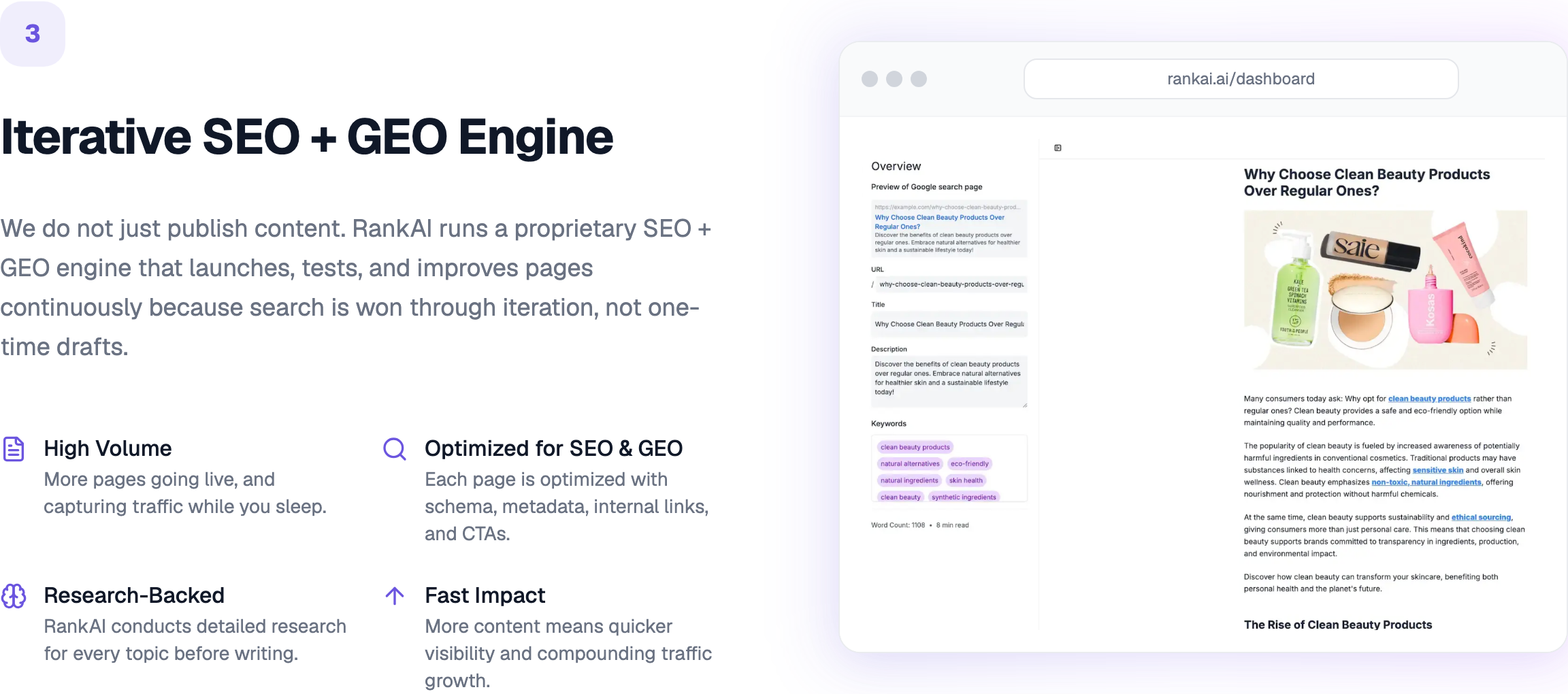
For categories with hundreds of long-tail buyer queries, one-off articles can't cover the surface. Programmatic page generation closes that gap. See our shipped competitor alternatives articles for the format that works.
STAGE 5: REFRESH
Update aggressively
65% of AI bot hits target content less than 1 year old (Semrush 2026 data cited by ConvertMate). E-commerce content updated within 30 days earns 3.2× more citations across platforms (ConvertMate 2026 e-commerce benchmark). ChatGPT's retrieval layer treats stale dateModified timestamps as a negative signal. Quarterly refresh on your top commercial pages, with the date visibly updated, is the cheapest leverage you have.
STAGE 6: TRACK
Measure citation rate and position by prompt
You can't improve what you don't measure. Nathan Gotch's ChatGPT tracking method (Rankability, May 2026): build a list of 50-100 buyer prompts in your category, run each across ChatGPT monthly, record whether your brand is mentioned and at what position. Two metrics matter: mention rate (what % of prompts cite you) and mention position (when cited, are you first or fifth in the answer). See our AI visibility tools roundup for tools that automate this.
From RankAI
How RankAI runs this for you
The six stages above describe roughly 40-80 hours of monthly work for a category team trying to do it manually. RankAI automates the parts that scale.
Programmatic page generation produces comparison and alternatives content at the long-tail volume ChatGPT rewards. The auto-rewrite engine triggers on a 3-week performance threshold, so pages that don't earn citations get queued for a structural rewrite without manual intervention. Multi-CMS publishing covers WordPress, Shopify, Webflow, Wix, Sanity, Framer, and custom CMSes so the shipped pages actually go live.
- Free AI search audit — See where you sit in ChatGPT citation share before committing budget.
- AI Search Visibility Checker — Track your brand presence across AI search answers, free.
- AI Citation Tracker — Discover which sources AI assistants cite for category prompts.
- Free plan, paid from $199/mo — Programmatic page generation, auto-rewrites, multi-CMS publishing.
Common ChatGPT SEO pitfalls
- Blocking GPTBot. Some teams blocked OpenAI's crawler defensively. The trade-off is total invisibility in ChatGPT live retrieval. Unless you have a strong content-protection reason, allow it.
- Optimizing only on-site. Up to 85% of ChatGPT citations originate from external sources (Writesonic homepage, May 2026). On-site work alone hits a ceiling.
- Stale dateModified timestamps. Pages without recent updates fade from retrieval. Quarterly refresh on top pages matters more for ChatGPT than for Google.
- Measuring once and stopping. Citation share is volatile prompt-to-prompt. Monthly cadence minimum; weekly during active campaigns.
- Treating it as Google with extra steps. ChatGPT's extraction format prefers question-first headings, definition-led first sentences, and bullet lists. Pages that rank #1 on Google but bury the answer in flowing prose still don't get cited.