
What is ChatGPT SEO?
ChatGPT SEO is the practice of optimizing content and brand signals so ChatGPT mentions your brand inside its answers. The deliverable: when a buyer asks ChatGPT a category question like "best AI visibility tools", "AirOps alternatives", or "how do I do AEO", your brand is named, ideally with a link, ideally with a positioning line that matches how you describe yourself.
ChatGPT specifically matters because it dominates AI search usage in 2026. Even when LLM SEO targets every engine, ChatGPT is typically the single biggest source of citation-driven brand impressions, so the framing "optimize for ChatGPT" resonates with most teams.
ChatGPT SEO overlaps fully with LLM SEO and GEO. Pick whichever framing helps your team focus.
How ChatGPT decides what to cite
ChatGPT's citation behavior depends on which mode is active:
Training-time knowledge
For questions where ChatGPT doesn't run live retrieval, it draws on what it learned during training. Brands established in their category before the training cutoff have a structural advantage here, because entity associations got embedded. Catching up requires off-page signals strong enough to influence future training runs.
Live web retrieval (Search mode)
For fresh queries, ChatGPT runs live web search via its Bing-backed retrieval layer. The retrieval ranking favors:
- Pages with clean, extractable answer structures (definition-led, FAQ blocks)
- Recently updated content with clear timestamps
- Sources Wikipedia and high-authority editorial sites already cite
- Reddit and YouTube content, weighted heavily for fresh consumer queries
Citation reinforcement
When ChatGPT cites a source successfully (the user accepts the answer), that source gets reinforced as a known-good citation for similar future queries. Citation moats compound.
ChatGPT vs Google: where your strategy diverges
ChatGPT and Google overlap heavily on technical fundamentals: both need crawlable HTML, schema markup, fast pages, and quality content. Where they diverge:
Citation format vs ranking
Google ranks pages; ChatGPT generates answers and optionally cites. Pages that rank #1 on Google don't automatically get cited by ChatGPT, because the extraction format matters more.
Reddit and YouTube weighting
ChatGPT (and Perplexity) lean on Reddit and YouTube more heavily than Google does for consumer queries. Earning brand mentions there matters disproportionately.
Update recency
ChatGPT's retrieval favors recently updated content noticeably more than Google. A page with a stale "dateModified" is at a real disadvantage. Refresh cycles matter.
Brand entity clarity
ChatGPT relies more heavily on cross-web entity consistency. If your homepage describes you as "X" but LinkedIn says "Y" and G2 says "Z", ChatGPT's description of you becomes ambiguous. Google tolerates this; ChatGPT doesn't.
The 5 ChatGPT visibility levers
1. Be in the comparison conversation
ChatGPT loves "X vs Y" and "best X" queries because they have clear answer formats. Make sure you appear on third-party comparison content like G2 categories, "best of" articles, alternatives pages, and Reddit threads for your category.
2. Ship comparison and alternatives content from your own site
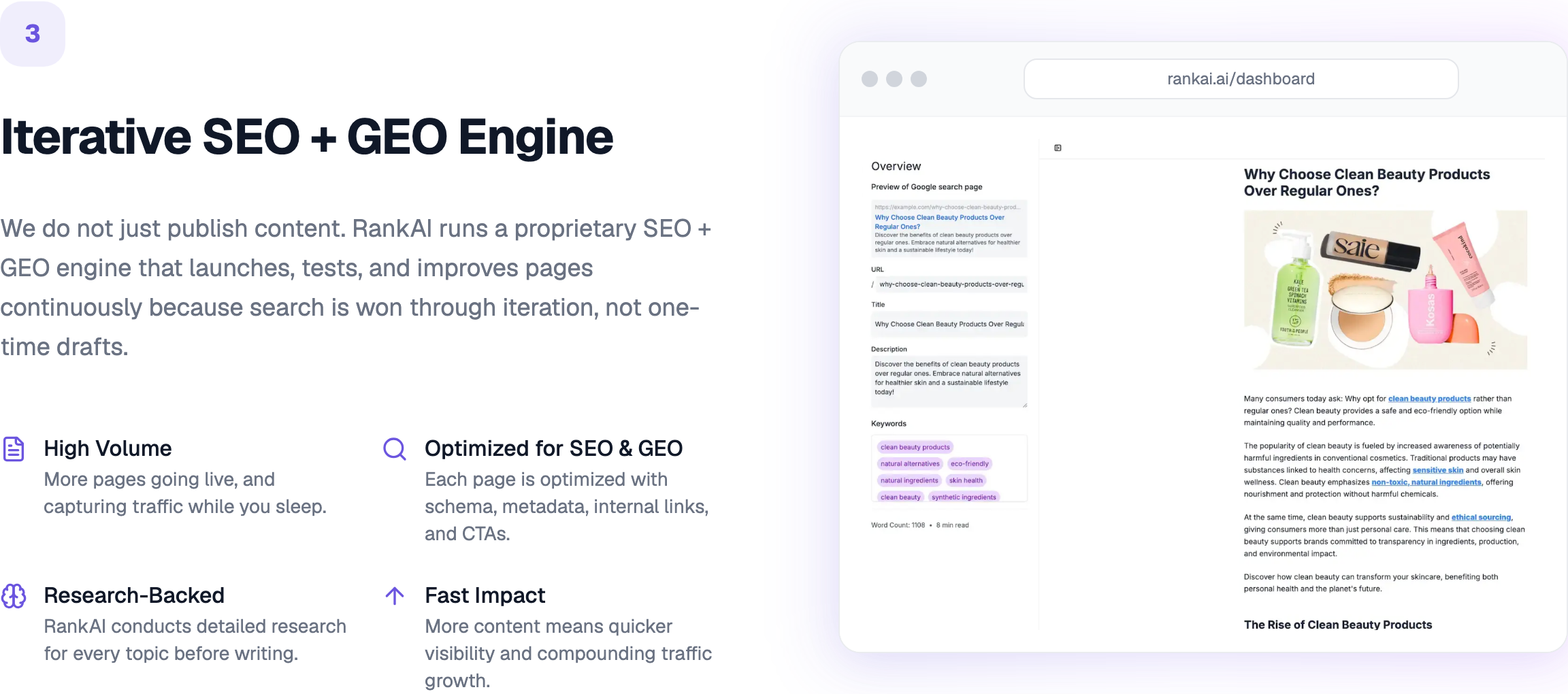
RankAI ships these as a standard surface across its content programme, and the 21 published competitor alternatives articles are a reference for the structure that works. Each one is a controlled venue where your brand appears as the #1 choice with verifiable supporting features and pricing.
3. FAQ schema everywhere it's defensible
ChatGPT extracts heavily from FAQPage-tagged Q/A. Add 5-10 questions per commercial-intent page. Cover the long-tail intent variants people actually type.
4. Earn Reddit, YouTube, and high-authority editorial mentions
The three external sources ChatGPT weights most. A coordinated digital PR push to land one mention in each per quarter typically moves citation share visibly.
5. Update aggressively
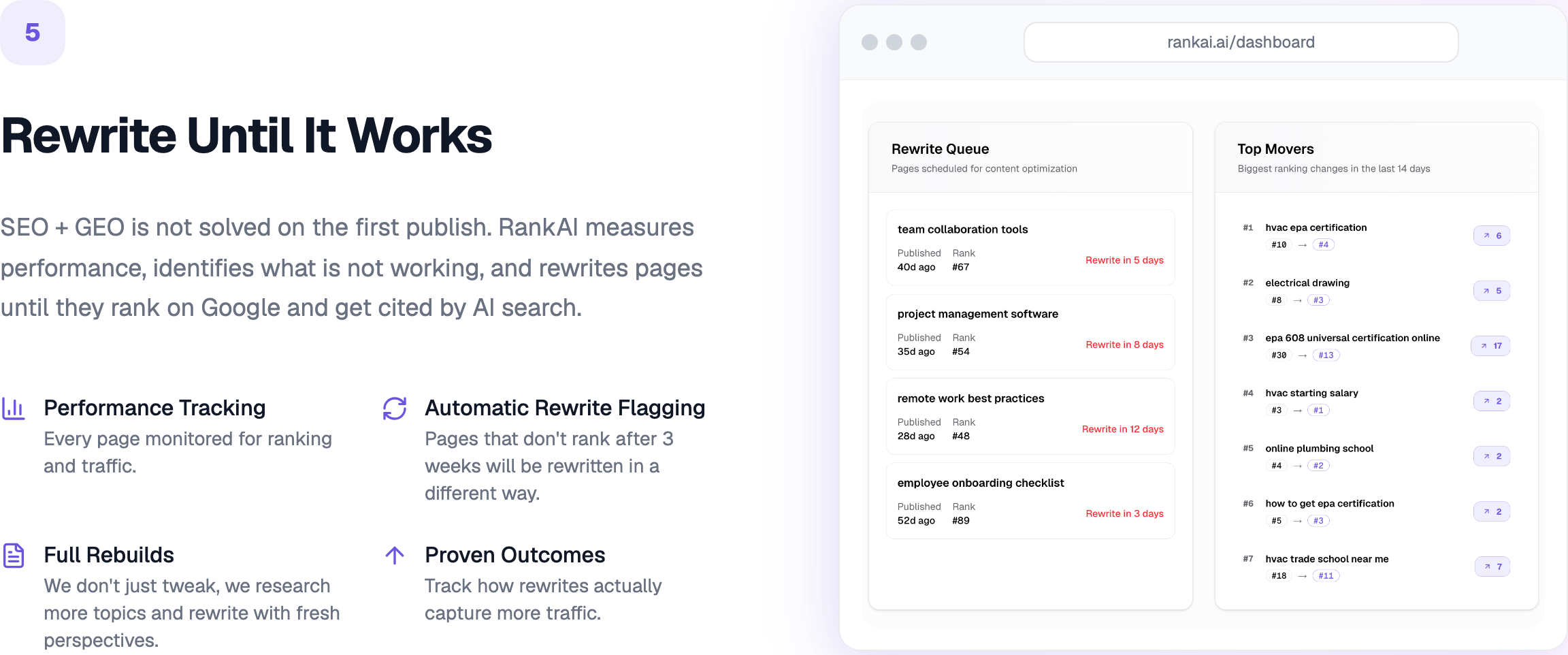
Pages with recent dateModified timestamps win over equivalent stale pages. Quarterly refresh cycles on top commercial pages, with the date visibly updated, consistently improves ChatGPT retrieval odds.
Content format ChatGPT favors
The format that wins ChatGPT extraction:
- Question-first H2/H3 headings. "What is X?" or "How do I do Y?" This is the way users actually phrase questions.
- Definition-led first sentence. Answer the heading in 1-2 lines like a glossary entry, before any further context.
- Discrete FAQ blocks with FAQPage schema. The easiest format to extract.
- Tables for "best X" and "X vs Y". Each row self-contained so it can be quoted without surrounding context.
- Numbered steps for how-to. Each step concise; HowTo schema where relevant.
- Bolded key answer phrases. Helps extraction inside longer paragraphs.
- Citations to sources. Pages that link to verifiable third-party data get cited more than pages that assert without evidence.
Sites that ship many small well-structured pages tend to compound visibility faster than sites that ship few long flowing essays. ChatGPT prefers the surface area.
How to track ChatGPT citations
Three measurement levels:
Citation share tracking
Use a dedicated AI visibility tool that tracks ChatGPT specifically. See our AI Visibility Tools roundup . Most cover ChatGPT plus 3-8 other engines. Track 50-100 category prompts; aggregate monthly.
GPTBot crawl frequency
ChatGPT's crawler (GPTBot) hits your site at frequencies that correlate with citation share. Watching crawl logs for GPTBot hits on key pages gives you a cheap leading indicator. Most server log tools surface this.
Self-reported attribution
Add "ChatGPT / AI search" as an option in your demo-form "How did you hear about us?" field. This catches what dashboards miss and is often the most reliable pipeline-attribution signal.
Common pitfalls
- Optimizing only on-site. ChatGPT weights off-page signals (Reddit, YouTube, third-party mentions) heavily. On-site work alone hits a ceiling.
- Stale content. Pages without recent dateModified updates fade from retrieval. Quarterly refresh cycles matter more for ChatGPT than for Google.
- Ignoring brand entity consistency. Conflicting descriptions across your homepage, LinkedIn, G2, and third-party sites confuse ChatGPT's entity model.
- Treating ChatGPT as a single channel. Citation share fluctuates prompt-to-prompt. Measure monthly aggregates, not individual queries.
- Blocking GPTBot. Some teams blocked it for content-protection reasons. The trade-off is total invisibility in ChatGPT. Unless you have a strong reason, allow it.
Everything in the ChatGPT SEO: How to Get Cited by ChatGPT in 2026 library
The deep-dive articles that go with this guide — competitor comparisons, tool roundups, and tactical breakdowns.
How-to + playbooks
The ChatGPT-specific execution layer.
- How to Rank in ChatGPT — The tactical step-by-step playbook for ChatGPT citation extraction.
- ChatGPT Citation Playbook — The strategic 5-chapter playbook for compounding ChatGPT brand citations.
- 30 ChatGPT SEO Prompts — A working prompt library for AI-era keyword research, content briefs, and audits.
Comparisons
- ChatGPT SEO vs Google SEO — How the two engines decide what to surface, where they overlap, and where they diverge.
Adjacent topic guides
- LLM SEO — The broader optimization discipline covering ChatGPT plus other LLMs.