
TL;DR
Publishing a large volume of content only works when each page is backed by keyword strategy, human editing, technical SEO, internal linking, and ongoing rewrites. AI has made writing cheap, but ranking is still hard. This guide compares 10 services across agencies, marketplaces, AI tools, and hybrid models to help you scale safely. For most SMBs and startups, a done-for-you hybrid service like Rankai ($499/month for 20 pages, technical fixes, and rewrites) offers the best balance of volume, cost, and execution depth.
Why “More Content” Is Not the Same as “Better SEO”
Every marketing team eventually hits the same wall: you need more pages, more topical coverage, more entry points from search. But the gap between needing a large volume of content and actually publishing pages that rank has never been wider.
Here is the reality. Ahrefs analyzed 900,000 newly detected English-language webpages in April 2025 and found that 74.2% contained AI-generated content. AI has flooded the web with words. The bottleneck is no longer production. It is strategy, quality control, technical SEO, internal links, CMS publishing, performance tracking, and rewrites.
Google has not banned AI content. But Google’s March 2024 spam policy update defines scaled content abuse as generating many pages primarily to manipulate rankings, regardless of whether humans or automation produced it. Publishing a large volume of content is fine. Publishing a large volume of unoriginal, low-value content is what gets you in trouble.
This guide compares the best services for producing a large volume of content in 2026, covering agencies, writer marketplaces, AI tools, and hybrid execution partners. The goal is to help you pick the right model for your budget, team size, and SEO maturity.
Explore Rankai’s done-for-you SEO plans if you want to skip the research and start publishing.
What “Large Volume of Content” Actually Means
Most listicles skip this. They talk about “content at scale” without defining what scale looks like for different businesses. Here is a practical framework:
- Steady publishing: 4 to 8 SEO pages per month. Enough to maintain freshness and slowly build topical coverage.
- Growth volume: 10 to 20 pages per month. This is where most startups and SMBs see compounding traffic returns.
- High volume: 20 to 50 pages per month. Requires a reliable execution partner or a strong internal team.
- Programmatic volume: Hundreds to thousands of pages, typically built from structured data and templates. Only safe when every page delivers unique value.
The number matters less than the system behind it. Every page should map to a real query, a buyer pain point, a product category, a service area, or a funnel stage. If you are publishing 30 pages a month and none of them are mapped to keyword clusters, you are doing volume theater, not content marketing.
Why Scaling Content Is Harder in 2026
Three shifts make a large volume of content riskier than it was even two years ago.
Zero-click search is growing. SparkToro’s 2024 clickstream study found that just under 60% of U.S. Google searches ended without a click to any website. Only 360 clicks per 1,000 searches went to non-Google-owned open-web properties.
AI Overviews reduce CTR on informational keywords. Ahrefs found AI Overviews correlated with a 34.5% lower average CTR for the top-ranking page compared with similar keywords without an AI Overview. Since many high-volume content programs focus on informational queries, this is a direct hit.
Measurement is expanding beyond traffic. Clutch and Conductor’s 2026 State of Content Report found that one in four marketers said large language models are the primary audience for the majority of their content. Marketers are tracking brand mentions, citations, and AI-generated response presence alongside traditional organic traffic.
The takeaway is not “stop publishing.” HubSpot’s 2026 data still shows website, blog, and SEO as the number-one ROI-generating channel. The takeaway is that each page in your large volume of content needs to earn its place by being genuinely useful, technically sound, and structured for both traditional and AI-powered search.
At-a-Glance Comparison Table
| Service | Starting Price | Best For | Delivery Model | SEO Strategy Included? | Biggest Tradeoff |
|---|---|---|---|---|---|
| Rankai | $499/mo | SMBs needing 20+ pages/mo with full execution | Done-for-you hybrid (AI + human) | Yes: keywords, technical fixes, rewrites, reporting | Off-page link building not highlighted |
| Brafton | $5,000+ project minimum | Enterprise multi-format campaigns | Full-service agency | Yes | Expensive for most SMBs |
| WriterAccess | $39/mo (platform only) | Teams with internal SEO and editing | Freelance marketplace | Partial, depends on talent | Subscription does not include content cost |
| ContentWriters | Contact for pricing | Steady editorial article volume | Managed writing service | Partial, content-focused | Quality varies by writer assignment |
| Verblio | ~$0.06/word (AI+human) | Recurring blog programs | Marketplace / managed service | Partial | Content only, no technical SEO |
| Byword | ~$100/mo | DIY bulk AI article generation | Self-serve AI tool | No | User owns all strategy and QA |
| Jasper | $59/seat/mo | Brand-consistent marketing drafts | AI writing platform | No | Writing assistant, not execution |
| Surfer | $99/mo | Optimizing drafts against SERPs | Optimization tool | No | Tool, not production |
| Codeless | Contact for pricing | Funded teams needing long-form at scale | High-volume agency | Yes | Not ideal for specialized thought leadership |
| WordAgents | Contact for pricing | Consider with caution | SEO writing service | Partial | 71% one-star reviews on Trustpilot |
The 10 Best Services for a Large Volume of Content
1. Rankai

Best for: SMBs, startups, ecommerce stores, and local businesses that want done-for-you SEO content volume at a flat monthly price.
Pricing: $499/month (Standard Plan, Early Bird). Includes 20 pages per month, human-expert-vetted keyword and topic selection, technical SEO fixes, internal links, metadata, visuals, CTAs, continuous rewrites until pages rank, weekly updates, and reporting. Cancel anytime.
Key features:
- 20 SEO pages published per month with internal links, metadata, and CTAs
- Human-vetted keyword selection updated monthly based on trends and competitor gaps
- Technical SEO fixes included (crawlability, indexation, metadata issues)
- “Rewrite until it ranks” workflow with auto-flagging after approximately three weeks
- Compatible with WordPress, Shopify, Squarespace, Webflow, and Wix
- Weekly reporting focused on rankings, traffic, and rewrite status
Why it is ranked first:
Most services on this list solve one piece of the puzzle. Writer marketplaces give you words. AI tools give you drafts. Optimization tools give you scores. Rankai’s model covers the full chain: topic selection, drafting, editing, publishing, technical fixes, monitoring, and rewrites. For a team that needs a large volume of content without managing five separate vendors, that matters.
Tradeoffs:
- Off-page authority and link building are not highlighted in the service scope
- Public proof is anonymized Google Search Console screenshots rather than named client case studies
- Highly competitive niches may still need complementary authority-building efforts
What practitioners say:
A Reddit founder post described frustration after spending $50,000 with an SEO/GEO agency, then outlined an automated workflow that finds queries, publishes pages, tracks performance, and rewrites pages that do not perform. The same thread also included skepticism from commenters, which is fair. Buyers should always ask for process details and performance timelines, not just promises.
Who should not choose Rankai: Teams that need a full-service enterprise agency with video, ebooks, social, and PR under one roof. Teams that already have a strong in-house SEO strategist and only need writers.
See how Rankai’s publishing workflow works
2. Brafton
Best for: Mid-market and enterprise teams needing multi-format content campaigns (blogs, white papers, video, social, design) under one vendor.
Pricing: Clutch lists Brafton with a $5,000+ minimum project size and $150 to $199 per hour. Reviewed annual costs range from $16,000 to over $300,000 depending on scope.
Key features:
- Full-service content agency covering blogs, ebooks, social, video, and design
- SEO strategy and production combined
- Strong project management and communication (repeatedly cited in reviews)
- 4.9 out of 5 on Clutch from 42 reviews
Tradeoffs:
- Pricing is prohibitive for bootstrapped startups and most SMBs
- Overkill if you only need SEO blog content, not multi-format campaigns
- Longer sales cycles and onboarding compared with flat-fee services
What users say:
One Clutch reviewer noted they liked the quality and communication enough to “triple the amount of volume” they were doing with Brafton. That speaks to retention, but the price floor makes this option realistic only for teams with established content budgets.
Who should not choose Brafton: Any team whose monthly content budget is under $5,000. Founders looking for a lean, fast-start option.
3. WriterAccess

Best for: Marketing teams that already have SEO strategy and editorial QA in place and need access to a flexible pool of freelance writers.
Pricing: Platform subscriptions start at $39 per month (Basic) and $59 per month (Pro) on G2. Content is priced separately, ranging from $0.02 to $1.00+ per word depending on talent level.
Key features:
- Large freelance writer marketplace with talent filtering
- Project management and workflow tools built in
- AI-powered writer matching
- Useful for agencies managing multiple client accounts
Tradeoffs:
- The subscription fee does not include writing costs, so total spend is higher than it looks
- You need someone internally to create briefs, select writers, manage revisions, and handle QA
- No technical SEO fixes, CMS publishing, or performance-based rewrites
What users say:
G2 shows WriterAccess at 4.0 out of 5 from 42 reviews. Users praise ease of use and quality writers. Some mention the subscription model can get expensive for smaller businesses once you factor in per-word rates on top of the platform fee.
Who should not choose WriterAccess: Founders who want hands-off execution. Teams without editing bandwidth. Anyone who expects the subscription to cover the actual writing.
4. ContentWriters
Best for: Brands that need a managed writing service for steady editorial article output without sourcing freelancers individually.
Pricing: Current public pricing was not available in third-party sources during research. Contact ContentWriters directly for quotes.
Key features:
- Managed content writing with writer matching
- Handles blog posts, articles, web copy, and product descriptions
- Revision process included
Tradeoffs:
- This is a writing service, not a full SEO execution partner (no technical fixes, no performance iteration)
- Quality can vary by writer assignment, which is common across managed writing services
- Requires strong briefs from the buyer to get good results
What users say:
Trustpilot shows ContentWriters at 4.4 out of 5 from 74 reviews. One 2025 reviewer said ContentWriters helped produce over 100 articles in six months and learned the brand’s voice from briefs. Another said the writing was choppy even after a rewrite, which reinforces the importance of brief quality and editorial oversight.
Who should not choose ContentWriters: Teams that need technical SEO and ranking iteration. Highly technical niches without subject-matter expert input from the buyer’s side.
5. Verblio
Best for: Agencies and marketing teams that need a recurring pipeline of blog content with the option to choose between AI-assisted and fully human writing.
Pricing: Third-party reviews report approximately $0.06 per word for AI plus human hybrid content, $0.16 per word for 100% human content, and managed service pricing for 50+ articles per month.
Key features:
- Blog and article content production at multiple quality and price tiers
- AI plus human or human-only writing options
- Managed service available for large volume of content needs
- Useful as a backend writing partner for agencies
Tradeoffs:
- Content-only scope: no link building, technical SEO, or performance monitoring
- Per-word pricing adds up quickly at high volumes
- Brand voice takes onboarding time, especially in the marketplace model
- Variable writer quality without strong QA on the buyer’s side
Who should not choose Verblio: Teams that want full-stack SEO execution. Buyers who expect performance monitoring and content rewrites to be part of the service.
6. Byword
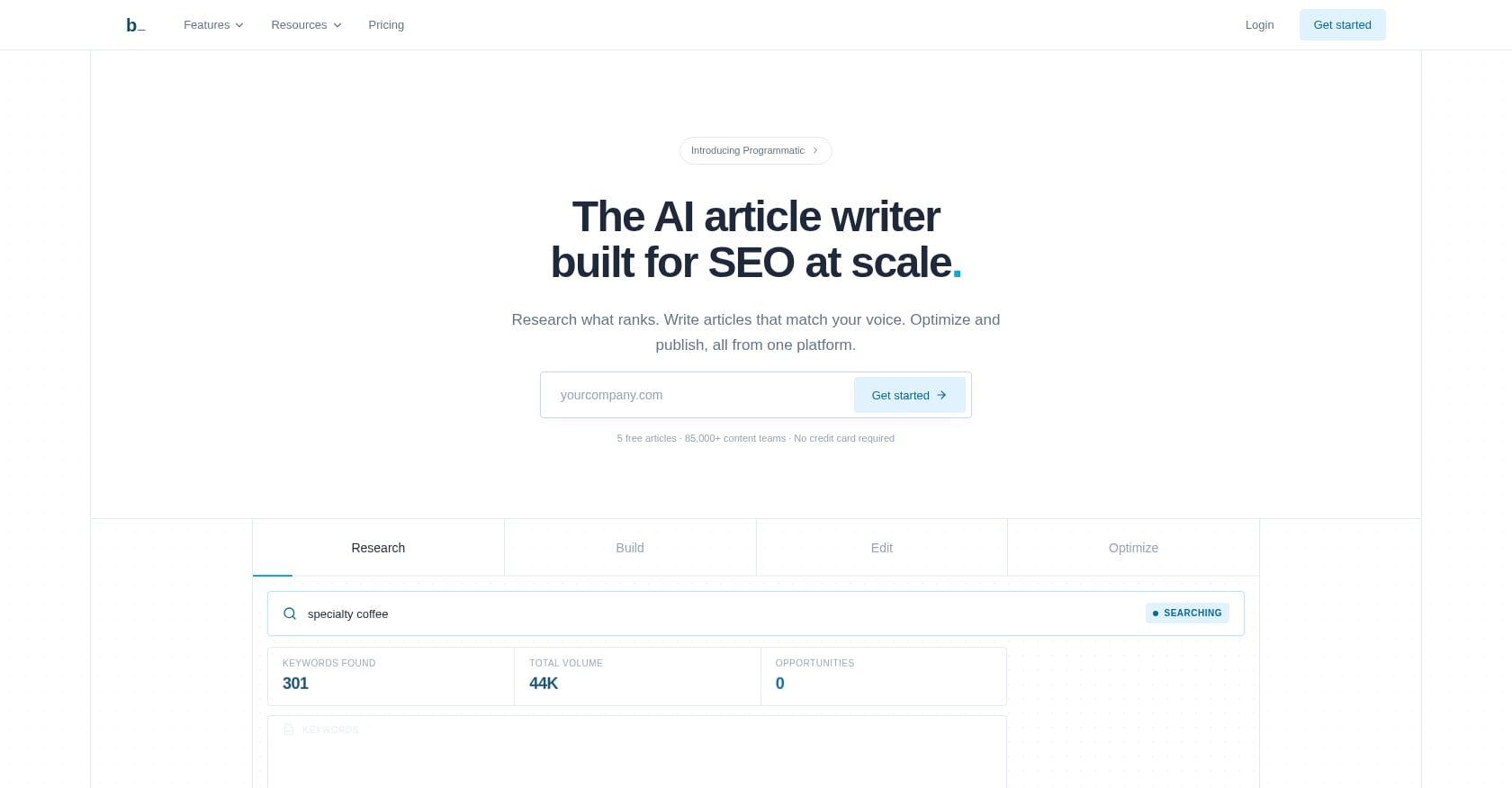
Best for: SEO operators who already know their keyword strategy and want a low-cost AI tool to generate bulk article drafts.
Pricing: One G2 user reported approximately $100 per month for 20+ articles. G2 shows 3.5 out of 5 from 3 reviews, which is too small a sample for strong conclusions.
Key features:
- Bulk AI article generation from keyword or title lists
- WordPress integration for direct publishing
- Internal link support mentioned by reviewers
- Very low cost per article compared with human writing
Tradeoffs:
- No SEO strategy, keyword research, or editorial QA included
- Small review base makes it hard to assess reliability broadly
- One G2 reviewer reported issues with website integration compatibility and transparency
- Output still needs human editing for accuracy, voice, and originality
What practitioners say:
Practitioners on Reddit consistently warn that bulk AI articles without human review create “volume theater.” One discussion about agencies overusing AI noted that a good process should preserve tone of voice, add missing sections based on intent, improve structure, update facts, and strengthen internal linking, not just generate words.
Who should not choose Byword: Businesses without an SEO strategist or editor. Brands with strict voice or compliance needs. Anyone who thinks bulk publishing alone equals rankings.
7. Jasper
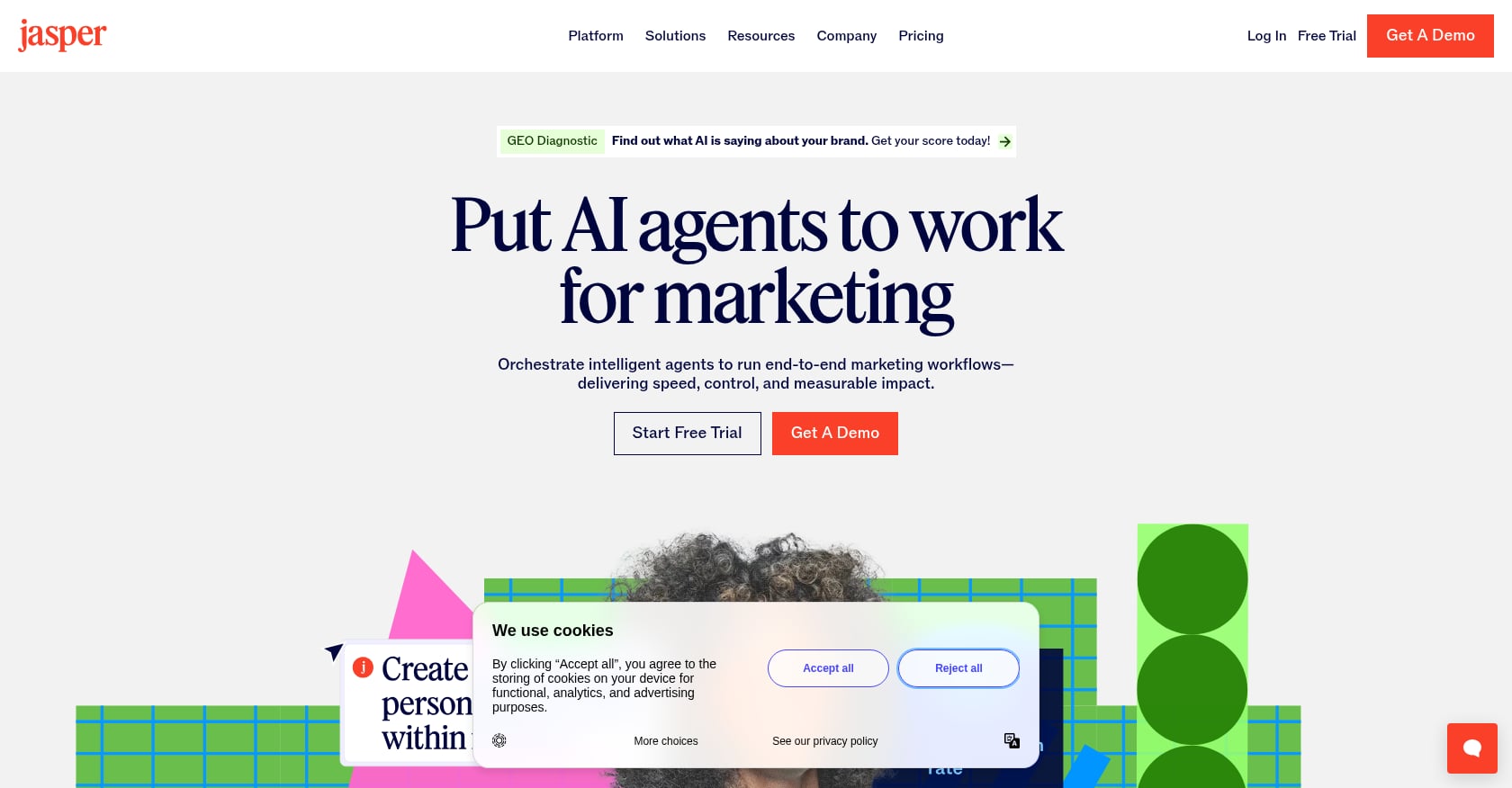
Best for: Marketing teams that need a brand-consistent AI writing assistant for multi-channel drafts (ads, emails, social, blog outlines).
Pricing: G2 lists Jasper Pro starting at $59 per seat per month. Business pricing is custom.
Key features:
- AI content generation with tone and style customization
- Templates for ads, blogs, social posts, and other formats
- Multi-language support
- Integrations with tools like Surfer and Grammarly
Tradeoffs:
- This is a writing assistant, not a content production service or SEO execution partner
- Output can be generic, repetitive, or superficial on complex topics, requiring extra editing
- Does not handle CMS publishing, technical SEO, or performance-based rewrites
- No keyword research or strategic content planning built in
What users say:
G2 reviewers praise Jasper for speeding up content creation and maintaining consistent tone. The most common complaint is that output on specialized or technical topics requires significant editing to reach publishable quality.
Who should not choose Jasper: Anyone who needs “20 pages per month shipped and tracked” rather than “drafts generated.” Teams looking for done-for-you SEO.
8. Surfer
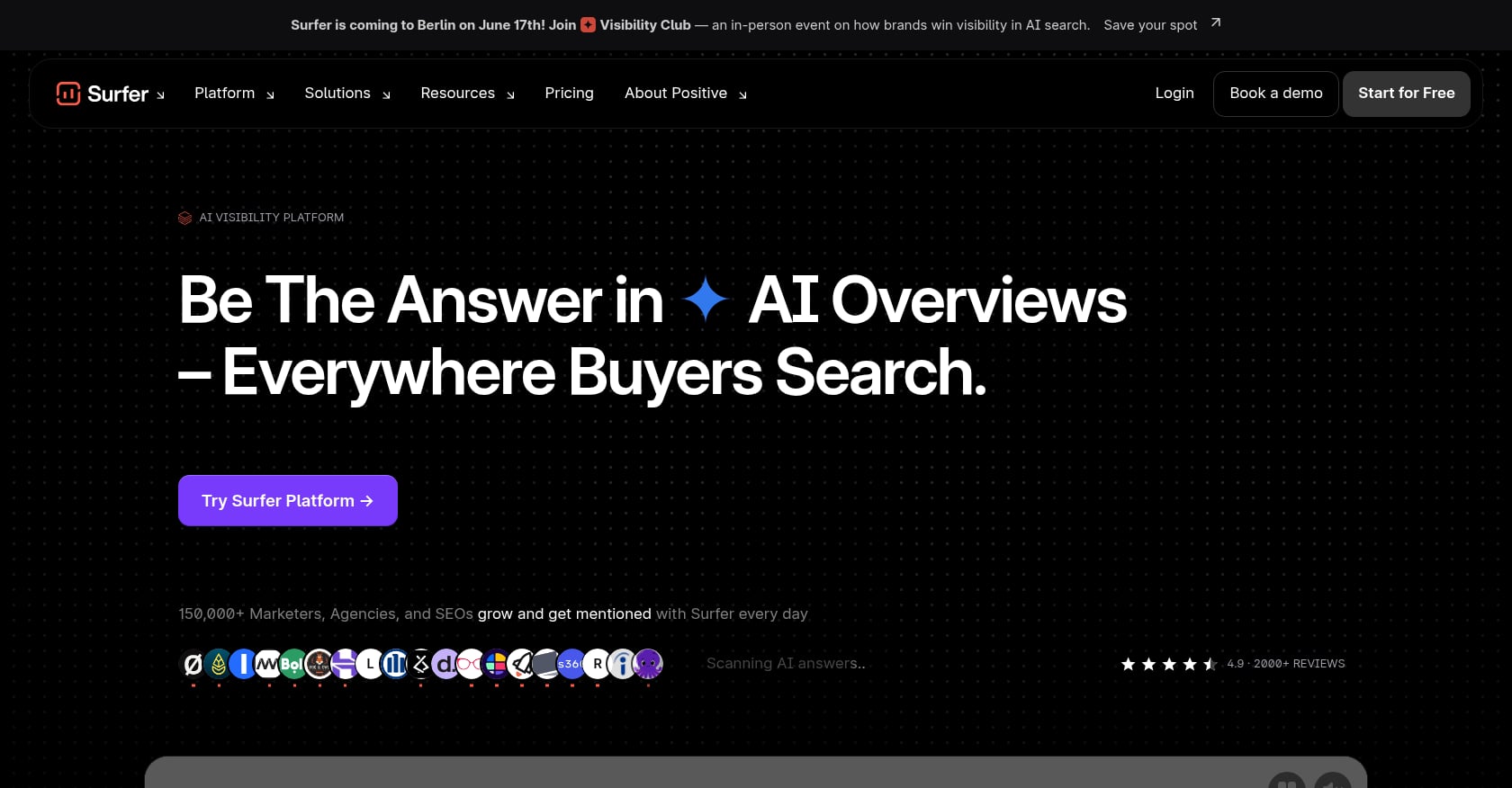
Best for: Content teams and editors who want data-driven on-page optimization guidance when producing a large volume of content.
Pricing: G2 lists Standard at $99 per month, Pro at $182, and Peace of Mind at $299. TechRadar’s 2026 review notes Surfer no longer offers a free trial, replacing it with a money-back guarantee.
Key features:
- Content Editor with NLP and SERP-based recommendations
- Content scoring for keyword usage and structure
- AI writing and outline generation
- AI Tracker for monitoring presence in ChatGPT, Google AI, Perplexity, and Gemini
Tradeoffs:
- This is an optimization layer, not a content production service
- Score-chasing can lead to over-optimized, formulaic content
- Does not handle publishing, technical SEO, or post-publish performance iteration
What practitioners say:
Reddit discussions about Surfer alternatives are revealing. One thread says Surfer can still be useful, but it is easy to overdo it and end up with “optimized but boring” content. Another says learning to read SERPs manually often produces better long-term content than chasing a score. Content scores are guardrails, not editorial strategy.
Who should not choose Surfer: Teams that expect it to replace a content strategist. Anyone who does not already have writers and editors.
9. Codeless
Best for: Funded startups and enterprise teams that need to rapidly scale a long-form content library across competitive niches.
Pricing: Current public pricing was not found in third-party sources. Contact Codeless directly.
Key features:
- High-volume long-form SEO content production (hundreds of articles monthly in some cases)
- Custom graphics and video where appropriate
- Content refresh services
- Agency model with strategy and production combined
Tradeoffs:
- Pricing is opaque, which makes comparison harder for budget-conscious buyers
- Competitor analysis from Campfire Labs notes Codeless optimizes for scale and consistency, which can reduce customization per piece
- Less ideal for highly specialized thought-leadership content
Who should not choose Codeless: SMBs with budgets under $5,000 per month. Teams that need granular, expert-level content on niche topics.
10. WordAgents
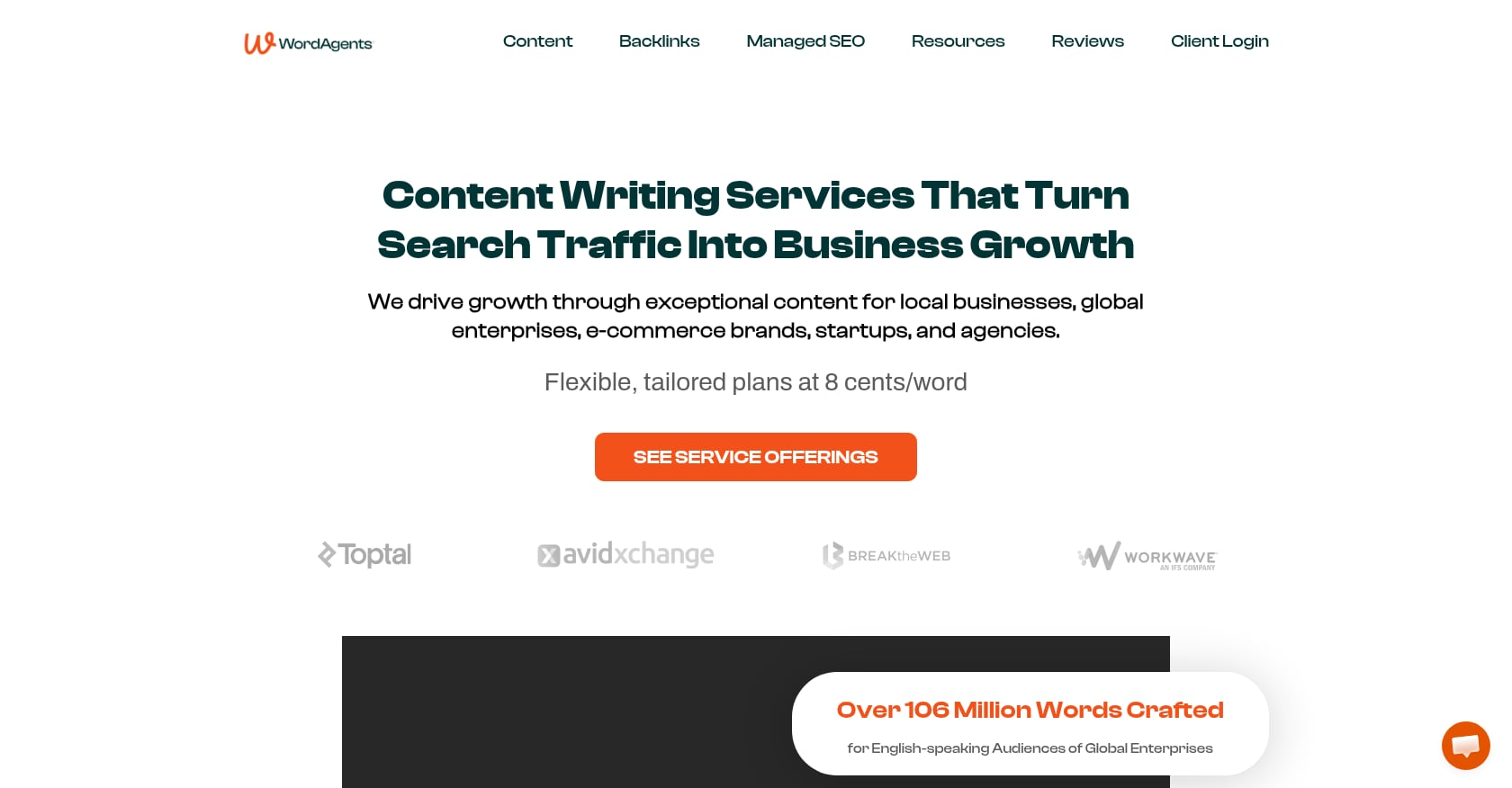
Best for: Consider with caution only. Included here because not every bulk content service delivers what it promises, and knowing what to avoid is as valuable as knowing what to choose.
Pricing: Current reliable pricing was not available in third-party sources.
Key features:
- SEO-focused content writing service
- Blog posts and articles
Tradeoffs:
- Trustpilot shows WordAgents at 3.1 out of 5 from 17 reviews, with 71% one-star reviews
- One detailed 2025 Trustpilot complaint alleges the reviewer lost over 70,000 prepaid words worth more than $4,000 after credits expired
- Reddit posts similarly warn about poor quality and management
- Weak user sentiment across multiple platforms
Why it is included:
Showing a risky option makes this list more honest. Not every service that promises a large volume of content at low prices actually delivers. Always check recent reviews, ask for samples, and start with a small test order before committing thousands of dollars.
How to Tell the Difference Between Volume Theater and a Content Engine
This is the most important distinction in high-volume content. The services above range from full execution partners to raw tools, and the difference shows up in outcomes.
Volume theater looks like this: lots of posts on generic topics, no internal linking strategy, no technical SEO fixes, no performance monitoring, no rewrites, and reporting that shows article count instead of ranking progress.
A content engine looks like this: vetted keywords mapped to clusters and business goals, briefs that specify intent and angle, human editing, CMS publishing with metadata and internal links, technical SEO checks, Search Console monitoring, and rewrites for underperforming pages.
Practitioners on Reddit describe this gap vividly. One post detailed a client paying $5,000 over six months to an SEO agency and receiving 40 AI-generated posts, 200 spammy backlinks, and a templated audit, while the agency failed to fix technical issues or conduct real keyword research. The comment thread noted that $5,000 over six months for 40 posts is cheap, but cheap does not excuse low-quality work.
When Large Volume Becomes Programmatic SEO
If you need hundreds or thousands of pages, you are probably looking at programmatic SEO. This is a specific discipline with its own rules.
A LinkedIn practitioner, Jake Ward, described building 13,000+ programmatic pages in under three hours and growing weekly organic clicks from 971 to 5,500 in 60 days. The key insight was not “publish 13,000 pages.” It was that his team spent more time on niche taxonomy than anything else. Rich, structured context is what turns programmatic content from templated filler into useful pages at scale.
Reddit practitioners reinforce this. One post argues that programmatic SEO is not AI content at scale and warns against swapping keywords into templates, rewriting existing content, fabricating numbers, or publishing junk pages. Programmatic pages survive when they deliver genuinely useful structured data, not templated fluff.
Google’s position is clear: scale is allowed when value scales too. The concern is not bigger-scale content by itself but unoriginal, low-quality content created primarily through automation to manipulate rankings.
Red Flags When Buying High-Volume Content
Before signing with any provider, watch for these warning signs:
They promise specific rankings. Google rankings are competitive and uncertain. Promise-based selling is a trust problem, not a confidence signal.
They only sell article count. “100 articles per month” is not a strategy. Ask how topics are selected, how search intent is validated, and what happens after pages are published.
They cannot explain their AI usage. A good provider should explain where AI is used, where humans review, and how facts are checked. Google recommends giving users context when automation plays a substantial role in content production.
They ignore technical SEO. Content cannot perform if crawlability, indexation, page speed, or site architecture are broken. The Reddit agency-audit story is a perfect example: posts were published while technical fundamentals were neglected.
They treat publishing as the finish line. The first draft is not the final SEO asset. Pages need monitoring and updates after Search Console data comes in. If a provider does not include rewrites or refreshes, you own all performance risk.
Questions to Ask Before Buying
Use this checklist when evaluating any service for producing a large volume of content:
- How do you choose keywords and topics?
- Who edits the content before publishing?
- Where does AI fit in your workflow, and where do humans take over?
- Do you publish directly to my CMS?
- Do you handle internal links, metadata, visuals, and CTAs?
- Do you fix technical SEO issues that block rankings?
- What happens if a page does not rank after three months?
- What does your reporting include?
- Is link building part of the service, or separate?
- Can I cancel monthly?
If a provider cannot answer these clearly, they are probably selling words, not outcomes.
Final Recommendation
Your choice depends on your team, budget, and how much of the content workflow you can handle internally.
If you need enterprise multi-format content: shortlist Brafton or Codeless.
If you need writers only and have internal SEO and editing: shortlist WriterAccess, ContentWriters, or Verblio.
If you want AI drafts and can manage strategy, QA, and publishing yourself: shortlist Byword or Jasper. Pair with Surfer for optimization guidance.
If you want done-for-you SEO content volume at SMB pricing: start with Rankai. It covers keyword selection, publishing, technical fixes, and rewrites in a single flat monthly plan, which eliminates the operational overhead that makes high-volume content hard for small teams.
Get started with Rankai’s $499/month plan
FAQ
What is a large volume of content?
There is no universal threshold, but here is a practical framework. Publishing 4 to 8 SEO pages per month is steady. Ten to 20 pages is growth volume. Twenty to 50 pages is high volume. Anything above 100 pages per month typically requires programmatic SEO workflows with structured data and template governance. The right volume depends on your niche, competition, and ability to maintain quality.
Does publishing more content help SEO?
It can, if every page targets a real query, provides unique value, is technically indexable, includes internal links, and gets updated based on performance data. Publishing more low-value pages can waste crawl budget and potentially trigger Google’s scaled content abuse policies.
Is AI content bad for SEO?
Not by default. Google says AI can be useful for research and structure, but generating many pages without adding value may violate spam policies. The risk is not that AI exists in your workflow. The risk is publishing generic, unedited, unoriginal content at scale. Ahrefs found 87% of content marketers already use AI in their workflow, so the question is how you use it, not whether you use it.
What is the cheapest way to produce a large volume of content?
DIY AI tools like Byword (approximately $100 per month for 20+ articles) are cheapest in cash cost but shift strategy, editing, publishing, and performance responsibility entirely to you. For SMBs that want execution handled, Rankai’s $499 per month plan covers 20 pages with keyword vetting, technical fixes, and rewrites included.
Should I use a writing service or an SEO execution partner?
Use a writing service if you already have keyword strategy, content briefs, an editor, and CMS publishing handled internally. Use an SEO execution partner if you need keyword selection, content mapping, technical fixes, publishing, reporting, and rewrites managed for you.
How many articles per month should a small business publish?
Enough to cover focused topic clusters consistently without sacrificing quality. For many small businesses, 4 to 8 pages per month is sustainable with limited resources. Ten to 20 is aggressive but achievable with the right partner. Going above 20 requires either a strong internal team or a service built for high-volume execution.
What are the hidden costs of high-volume content?
The biggest hidden costs are keyword strategy (targeting the wrong queries wastes everything downstream), brief creation, editing and fact-checking, CMS formatting and publishing, technical SEO maintenance, internal linking, and post-publish rewrites. A service that only charges per word is rarely the full cost of getting a page to rank.