TL;DR
The best alternatives to Surfer SEO for content optimization depend on what part of the workflow you need to fix. NeuronWriter (from €19/mo) is the cheapest Surfer-style editor. Frase ($45/mo) is strongest for briefs and AI drafting. Clearscope ($129/mo) wins for premium editorial teams. And if you want the entire content optimization workflow handled for you, including keyword selection, publishing, technical fixes, and rewrites, Rankai (from $199/mo) replaces the need for a tool altogether.
Why People Look for Surfer SEO Alternatives
Surfer SEO popularized real-time content scoring. You paste in a draft, it compares your page against top-ranking competitors, and it tells you which terms to add, how long to write, and how your content stacks up. For many writers and SEO teams, that workflow is genuinely useful.
But people leave Surfer for predictable reasons. Pricing keeps climbing. Article limits force tough choices about which pages to optimize. The Content Editor is strong, yet it still requires someone to pick keywords, write the draft, edit it, publish it, build internal links, track rankings, and rewrite the page if it underperforms. Practitioners on Reddit describe Surfer and similar tools as “doc-in, doc-out” systems that leave the hardest parts of the workflow untouched.
The right alternative to Surfer SEO for content optimization depends on which part of that workflow is actually broken. Some people need a cheaper editor. Others need better briefs. Some need a full SEO suite. And a growing number of teams realize they don’t need another tool at all; they need someone to execute.
Explore Rankai’s done-for-you SEO
Quick Picks: Best Surfer SEO Alternatives by Use Case
- Rankai, best done-for-you alternative (execution, not another dashboard)
- NeuronWriter , best budget Surfer-style editor
- Frase, best for briefs plus AI writing
- Clearscope, best premium content optimizer
- MarketMuse, best for topical authority strategy
- Content Harmony, best for agency content briefs
- SE Ranking, best all-in-one SEO suite
- Semrush, best for existing Semrush users
- Scalenut, best AI-first content workflow
- WriterZen, best for keyword clustering
- PageOptimizer Pro, best for technical on-page SEOs
- Dashword, best simple brief-and-score tool
How We Evaluated These Alternatives
We compared Surfer SEO alternatives across six dimensions: content optimization depth, pricing transparency, workflow coverage (from research through publishing and refreshes), user sentiment from G2 and practitioner communities, team-size fit, and whether the product helps after publication. We separated tools that replace Surfer’s editor from tools and services that solve the broader content workflow.
At-a-Glance Comparison Table
| Alternative | Starting Price | Best For | Execution Included? | G2 Rating | Biggest Tradeoff |
|---|---|---|---|---|---|
| Rankai | Free; from $199/mo | SMBs wanting SEO done for them | Yes | N/A | Not a self-serve optimizer |
| NeuronWriter | €19/mo | Budget Surfer-style optimization | No | 4.4/5 | Less polished, credit limits |
| Frase | $45/mo | Briefs, research, AI writing | No | 4.8/5 | Article limits at lower tiers |
| Clearscope | $129/mo | Editorial teams, content quality | No | 4.9/5 | Expensive for small teams |
| MarketMuse | Free tier available | Topical authority, content strategy | No | 4.6/5 | Overwhelming for simple tasks |
| Content Harmony | $50/mo | Detailed SEO content briefs | No | 4.8/5 | Not a full AI writer |
| SE Ranking | ~$103/mo | All-in-one SEO suite | No | 4.8/5 | Content tools are secondary |
| Semrush | $139.95/mo (Pro) | Existing Semrush users | No | 4.5/5 | Overkill for content-only needs |
| Scalenut | $59/mo | AI content at scale | No | 4.7/5 | AI output needs editing |
| WriterZen | $27/mo | Keyword clustering, planning | No | 4.7/5 | AI writing is weak |
| PageOptimizer Pro | $34/mo | Granular on-page optimization | No | 4.9/5 | Steep learning curve |
| Dashword | $99/mo | Simple briefs and scoring | No | N/A | Too pricey for solo users |
What Part of Surfer SEO Are You Actually Replacing?
Before picking a tool, figure out what you’re really trying to fix. Most people frame this as “I need a Surfer alternative,” but the actual pain is usually more specific.
Your content scores are fine, but nothing ranks. The problem isn’t your editor. It’s keyword selection, publishing cadence, technical SEO, internal linking, or post-publish iteration. A done-for-you service like Rankai solves this better than another optimization tool.
Surfer is too expensive for how often you use it. You need a budget optimizer. NeuronWriter and WriterZen cost a fraction of Surfer and cover the basics.
Your writers don’t know what to write about. You need a briefing system, not just a content scorer. Content Harmony and Dashword are built for this. Learning to write effective content briefs matters more than which tool generates them.
You want AI drafting and optimization in one place. Frase and Scalenut combine research, AI writing, and content scoring into a single workflow.
You need a broader SEO platform. SE Ranking and Semrush include content optimization alongside rank tracking, audits, backlink analysis, and competitor research.
You want your content strategy mapped, not just individual pages scored. MarketMuse helps you decide what to create and what to update across an entire site.
The 12 Best Alternatives to Surfer SEO for Content Optimization
1. Rankai

Best for: SMBs, startups, and ecommerce brands that want SEO content executed, not just optimized.
Rankai is not a Surfer clone. It’s a YC-backed AI SEO agency that replaces the need for a content optimization tool by handling the entire workflow: keyword selection, content creation, technical SEO fixes, publishing, and continuous rewrites until pages rank.
Where Surfer helps a writer optimize a draft, Rankai helps a business ship up to 20 articles per month without managing writers, editors, or SEO software. The Growth plan is $499/month, includes human-expert-vetted keyword selection, technical fixes, internal linking, metadata, visuals, CTAs, weekly reporting, and a rewrite-until-it-ranks policy. It works with WordPress, Shopify, Squarespace, Webflow, and Wix.
Key features:
- Up to 20 articles published per month
- Human-vetted keyword and topic selection
- Technical SEO fixes included
- Continuous rewrites for underperforming pages
- Weekly updates and performance monitoring
- Flat monthly pricing, cancel anytime
Tradeoffs:
- Not a self-serve content editor for writers who want to control every score
- Off-page authority building (link building, PR) is not a highlighted part of the service
- Case studies on the site are anonymized, which may matter for enterprise buyers
Who should choose this: Teams that have bought SEO tools before but never had time to use them consistently. Founders who want organic growth without hiring an SEO team. Businesses where the bottleneck is execution, not another content score.
If your real problem is getting content planned, written, optimized, published, and improved, learn more about done-for-you SEO services.
2. NeuronWriter
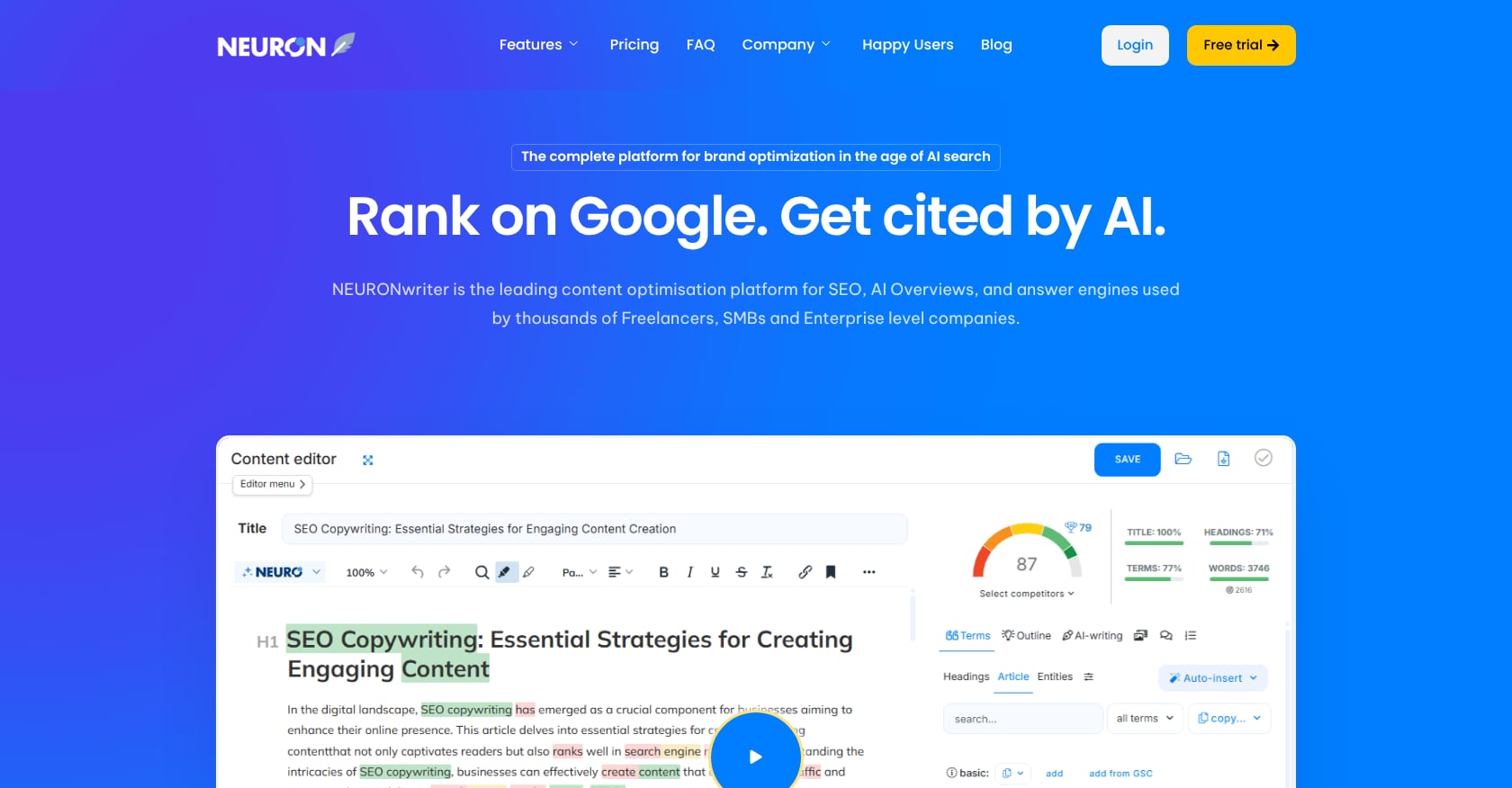
Best for: Freelancers and bloggers who want a low-cost Surfer-style editor.
NeuronWriter is the most direct budget alternative to Surfer SEO for content optimization. It analyzes top-ranking pages, recommends NLP terms, scores your content in real time, and costs a fraction of Surfer’s price. The Bronze plan starts at €19/month, with Silver at €37/month.
On G2, NeuronWriter holds a 4.4/5 rating from 31 reviews. Users praise the SERP analysis and real-time feedback. One reviewer noted that NeuronWriter “reduces guesswork by analyzing top-ranking pages, structure, terms, and gaps” but flagged a learning curve and said AI credits get used up quickly.
Key features:
- SERP and competitor content analysis
- NLP keyword recommendations
- Real-time content scoring
- AI writing support
- WordPress integration
Tradeoffs:
- Less polished interface than Surfer
- AI-generated output needs significant editing
- Credit limits on lower tiers can feel restrictive
- No rank tracking, technical audits, or post-publish workflow
Who should choose this: Solo content creators who mainly need a content score and keyword suggestions. Skip it if you need briefs, publishing, or rank tracking.
3. Frase
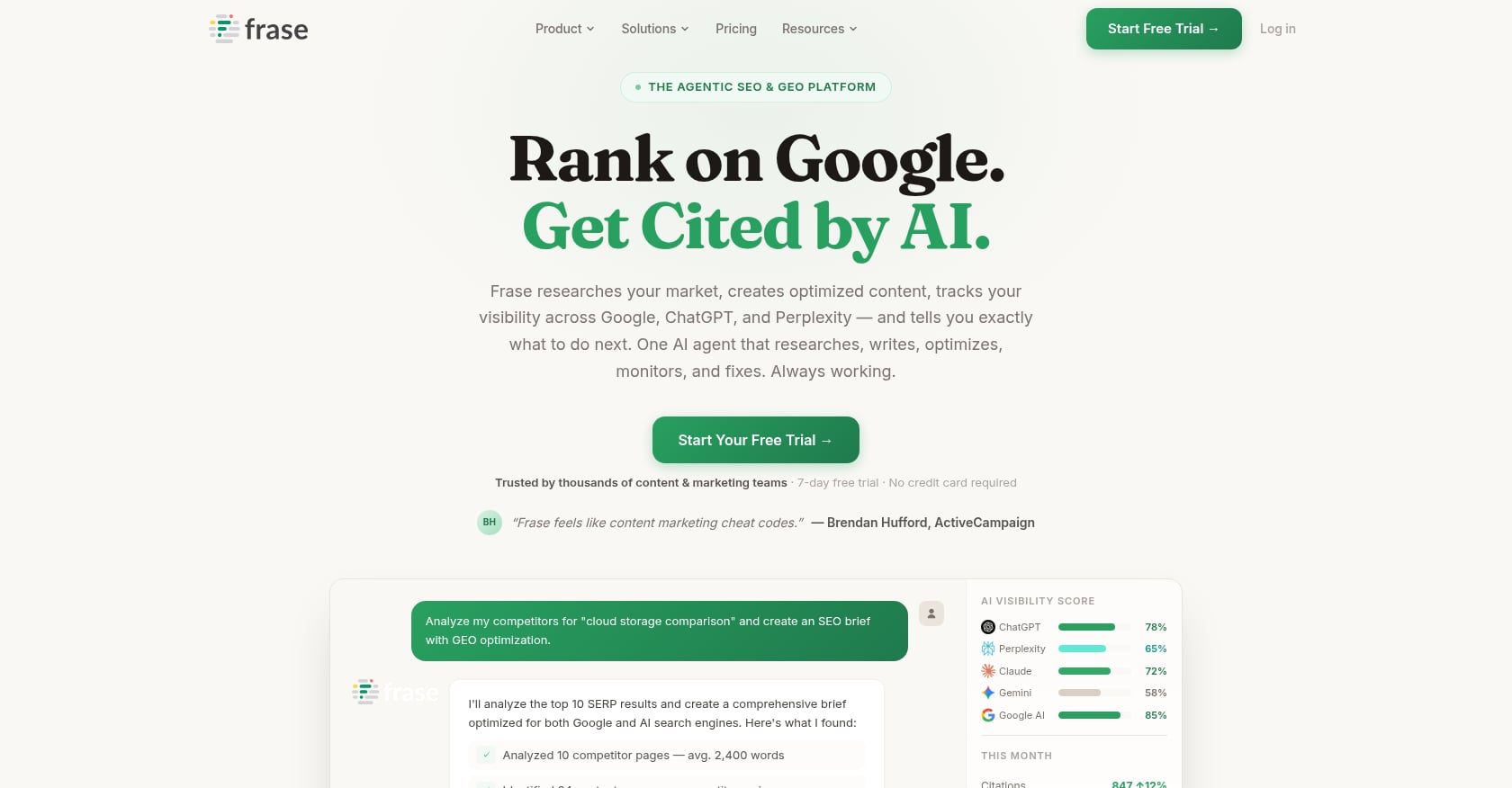
Best for: Teams that want content briefs, AI drafts, and optimization in one workflow.
Frase bridges the gap between a content optimizer and a research tool. It pulls SERP data to build content briefs, generates AI drafts, and scores your content against competitors. It’s the best Surfer SEO alternative for teams that want more than a content score but less than an enterprise platform.
On G2, Frase holds a 4.8/5 rating from 301 reviews. The Starter plan is $45/month and the Professional plan is $115/month. A March 2026 G2 reviewer praised using Frase’s MCP integration with Claude to audit AI visibility and spot content opportunities.
Key features:
- SERP-based content briefs
- AI writing and rewriting
- Content optimization scoring
- AI visibility and GEO-oriented features
- Multi-language support
- Research-to-writing-to-optimization workflow
Tradeoffs:
- Article limits vary by tier and can constrain teams at scale
- Historical data and AI visibility tracking are limited on lower plans
- Still requires human editing, publishing, and performance follow-up
Who should choose this: SMB content teams, marketing managers who want research baked into their writing workflow, and users who find Surfer too narrowly focused on scoring.
4. Clearscope
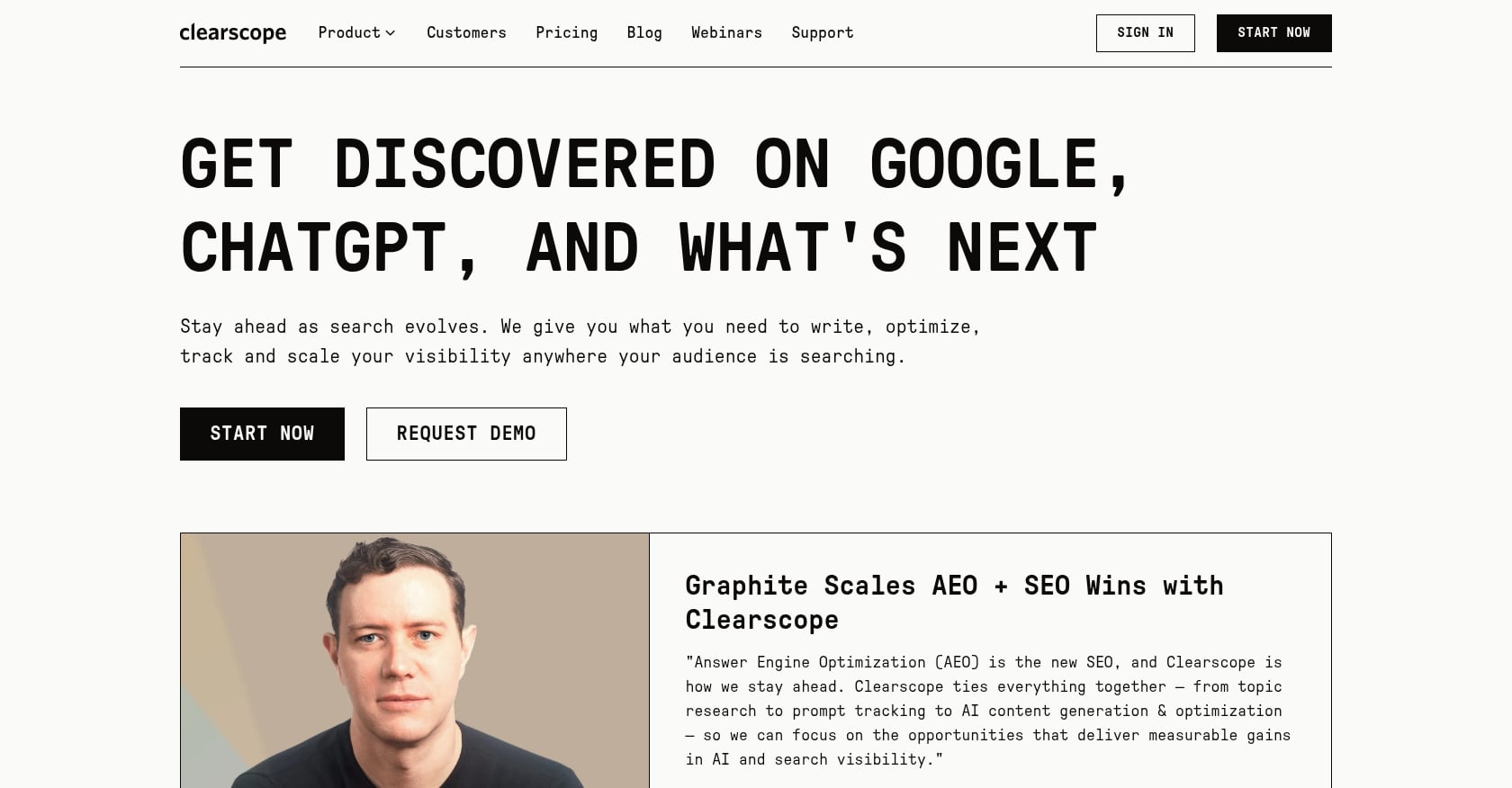
Best for: Editorial teams that care about content quality above all else.
Clearscope is the premium alternative to Surfer SEO for content optimization. It grades content on keyword relevance and topical completeness, integrates with Google Docs, and gives writers clear, simple direction. It’s not cheap. The Essentials plan starts at $129/month and Business runs $399/month.
Clearscope holds a 4.9/5 on G2 from 92 reviews, one of the highest ratings in the category. Users praise its clean interface and real-time feedback but consistently flag pricing as a barrier. One January 2026 reviewer said the keyword recommendations were straightforward but “the pricing structure felt high for smaller teams or occasional users.”
Key features:
- Content grading with keyword and topical relevance
- Google Docs integration
- Content inventory and monitoring
- AI drafting and topic exploration on current tiers
Tradeoffs:
- Too expensive for freelancers and small teams
- Not a full SEO suite (no rank tracking, audits, or backlinks)
- Not a high-volume content production tool
- You still need writers and editors to do the actual work
Who should choose this: In-house content teams at companies that already have skilled writers. Skip it if budget is your primary reason for leaving Surfer.
5. MarketMuse
Best for: Content strategists building topical authority across large sites.
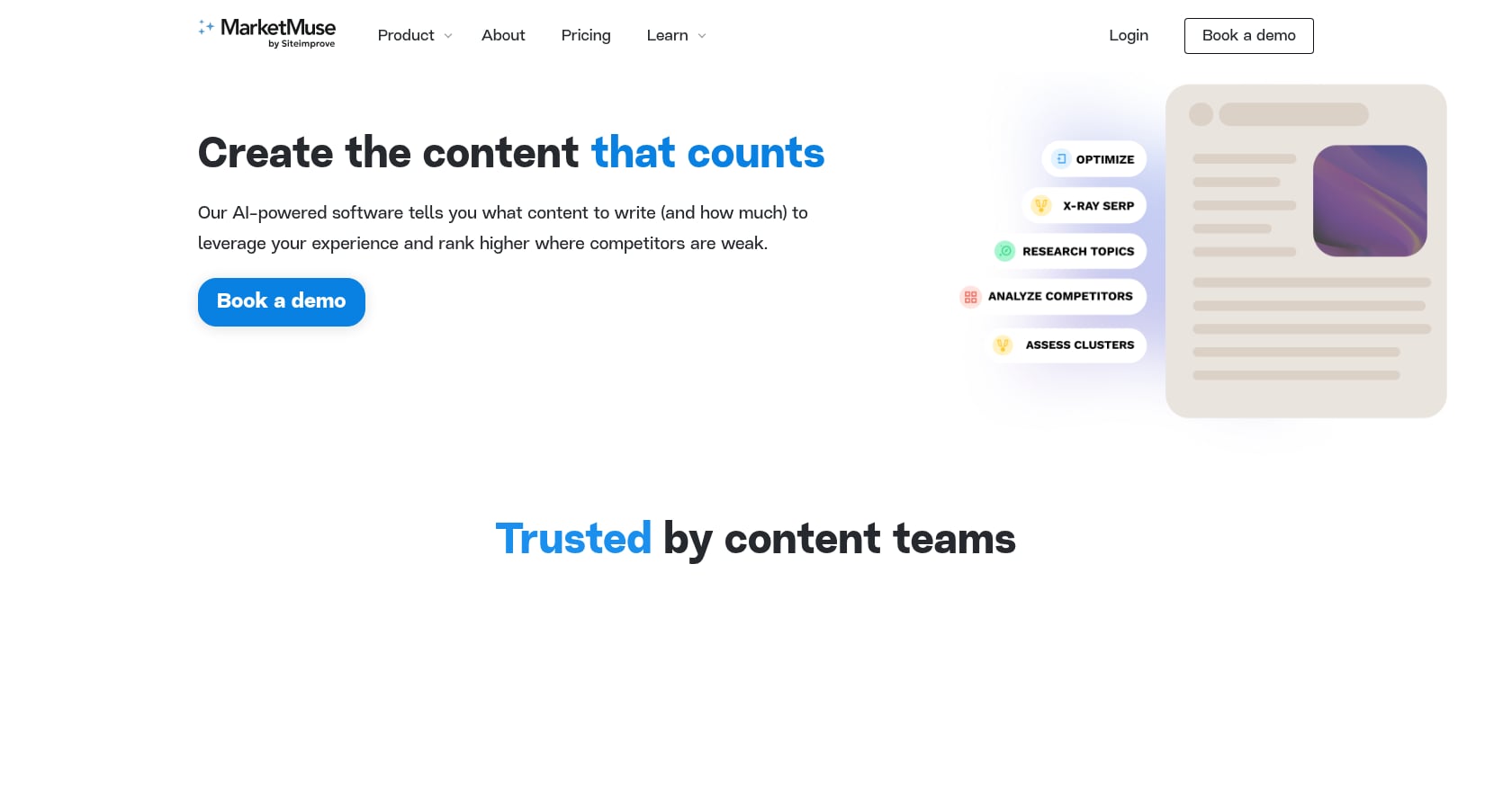
MarketMuse approaches content optimization from a strategic angle. Instead of scoring one page at a time, it uses topic modeling to identify gaps across your entire content library, map competitive advantages, and plan what to create or update next. It helps you decide what your content system should look like, not just how a single draft should read.
G2 lists MarketMuse at 4.6/5 from 216 reviews. Users praise its actionable insights for identifying content gaps, but some find the platform overwhelming. A pricing reviewer called the concept strong but said the subscription can be expensive.
Understanding topical authority is key to getting value from MarketMuse. Without that strategic lens, the tool can feel like overkill.
Key features:
- Topic modeling and content gap analysis
- Competitive content analysis
- Content planning and prioritization
- Optimization and brief workflows
- Existing-content opportunity discovery
Tradeoffs:
- More strategic than tactical, which can slow down execution
- Can be expensive or overwhelming for teams that just need page-level optimization
- Requires writers and editors to act on the strategy
- Slower to generate value than lightweight editors
Who should choose this: SEO teams managing 100+ pages that need to know what to create, update, or consolidate. Not the right pick for someone who just wants to optimize a blog post.
6. Content Harmony
Best for: Agencies that need consistent, detailed briefs for freelance writers.
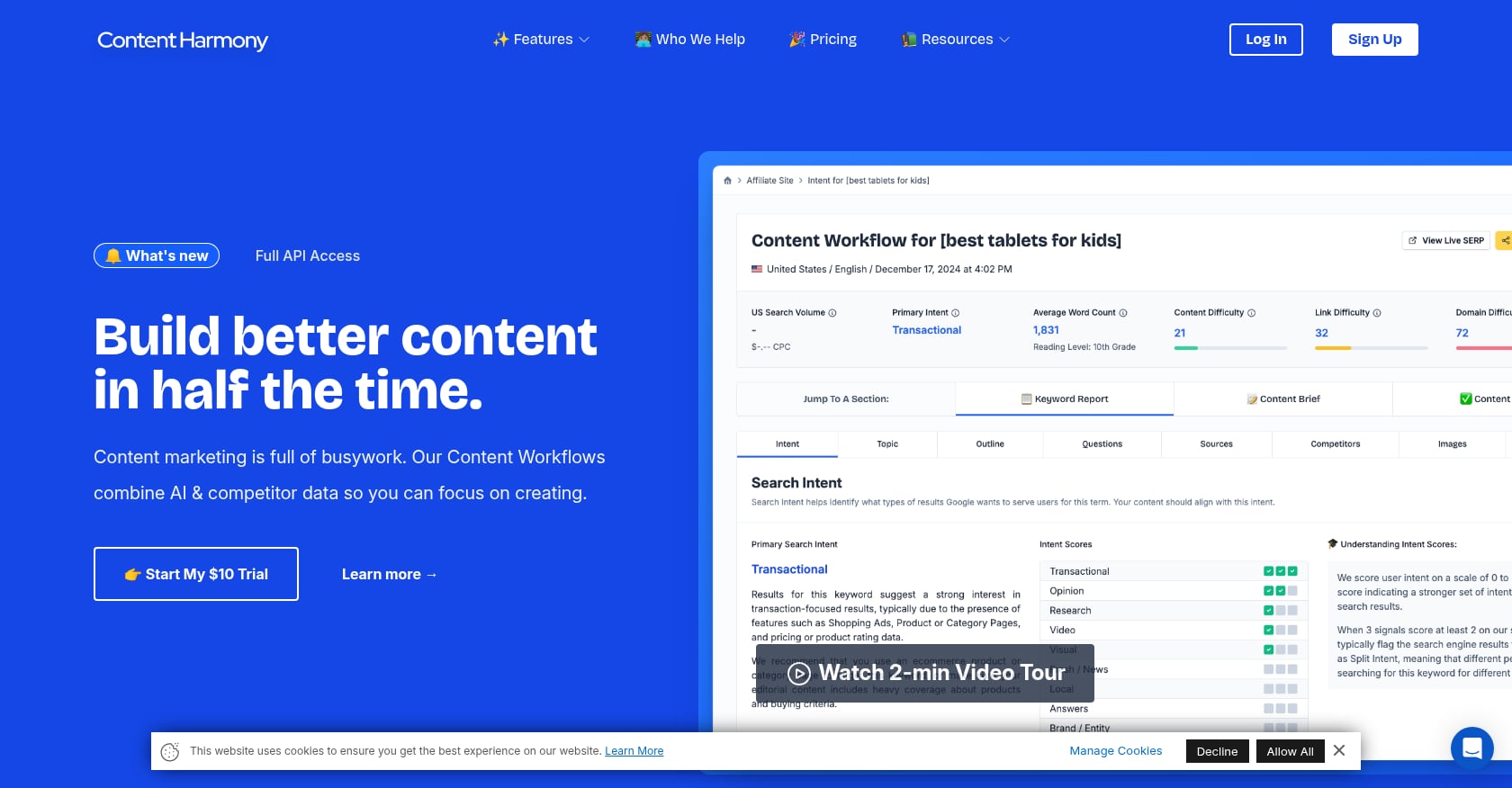
Content Harmony is built around the briefing workflow. It generates keyword reports, classifies search intent, pulls competitor outlines, surfaces questions from SERPs, and creates structured briefs that writers can follow without guessing. The Standard plan starts at $50/month, Pro is $299/month for 50 content workflows, and Enterprise starts at $1,000/month.
G2 reviewers (4.8/5 from 22 reviews) consistently praise it for saving time on briefs and keyword research. One reviewer noted it “creates strong briefs without encouraging bad habits like over-focusing on word count or keyword density.” Another said the Content Grader feels slower and less powerful than Surfer’s optimization scoring.
Key features:
- Keyword reports with search intent classification
- Competitor outline analysis
- Question research from SERPs
- Brief templates with visual content guidelines
- Content grader
- Internal link suggestions
Tradeoffs:
- Not a full AI writer
- Content optimization scoring is less deep than Surfer or Clearscope
- Per-workflow pricing can get expensive at high volume
Who should choose this: Content managers who hand briefs to writers and want consistency across multiple projects. Skip it if you need AI drafting or real-time scoring as your primary feature.
7. SE Ranking
Best for: Teams that want rank tracking, audits, and content optimization in one subscription.
SE Ranking is a full SEO suite that happens to include content optimization tools. If you’re currently paying for Surfer plus a separate rank tracker plus a site audit tool, SE Ranking consolidates everything. G2 lists it at 4.8/5 from over 1,500 reviews, with 2026 pricing starting around $103/month.
Reddit users often frame SE Ranking as solid value for teams that want broad coverage, though some question rank-tracking consistency in specific niches. If you want to explore broader SEO tools, SE Ranking belongs on the shortlist.
Key features:
- Rank tracking
- Technical site audits
- Keyword research
- Backlink analysis
- Competitor research
- Content marketing tools
- AI visibility features in current product messaging
Tradeoffs:
- Content optimization is not as specialized as Surfer, Clearscope, or Frase
- Pricing varies by tracked keywords and usage
- Can feel too broad for users who only need content scoring
Who should choose this: Teams consolidating multiple SEO subscriptions. Not the best pick if content optimization depth is your only priority.
8. Semrush
Best for: Existing Semrush users who want writing guidance inside their SEO stack.
Semrush offers its SEO Writing Assistant and a separate Content Toolkit ($60/month according to Semrush’s own blog). The Writing Assistant checks readability, tone, originality, and SEO keyword coverage. If you’re already paying for Semrush Pro ($139.95/month), adding writing guidance into that workflow is logical.
G2 lists Semrush at 4.5/5 from over 3,300 reviews. Reddit discussions from 2026 show mixed sentiment: some users say Semrush keeps getting more expensive, while others say teams return to it because the ecosystem and data completeness are hard to replace.
Key features:
- SEO Writing Assistant with real-time checks
- Content Toolkit for ideation, briefing, and optimization
- Topic research and content templates on higher plans
- Keyword and competitor data from Semrush’s database
Tradeoffs:
- Expensive if you only need content optimization
- Platform can be overwhelming for beginners
- Best value comes from using the full Semrush ecosystem, not just the writing tools
Who should choose this: Teams already invested in Semrush. Skip it if Surfer’s price was your reason for switching.
9. Scalenut

Best for: Teams that want AI drafting and optimization in one place, fast.
Scalenut combines AI writing, keyword research, content briefs, and content scoring. It’s designed for speed: research a topic, generate a draft, optimize it, and publish. The Starter plan is $59/month, Plus is $89/month, and Professional is $199/month.
G2 gives Scalenut a 4.7/5 from 315 reviews. Users praise the ease of getting started and the integrated workflow. But multiple reviewers warn that AI-generated content can be repetitive and needs editing. One negative review described coherence issues and repeated keywords.
Key features:
- AI writing and content generation
- Keyword research and clustering
- Content briefs and optimizer
- Internal linking on higher tiers
- WordPress/Shopify auto-publishing on higher tiers
Tradeoffs:
- AI output needs significant human editing
- Starter tier article limits can feel restrictive
- Less ideal for teams with strong writers who only need scoring
- Quality control requires active oversight
Who should choose this: Small agencies scaling content production who value speed over editorial polish. Not for teams that need precise, brand-controlled content.
10. WriterZen
Best for: Bloggers and niche site owners who need keyword clustering before writing.
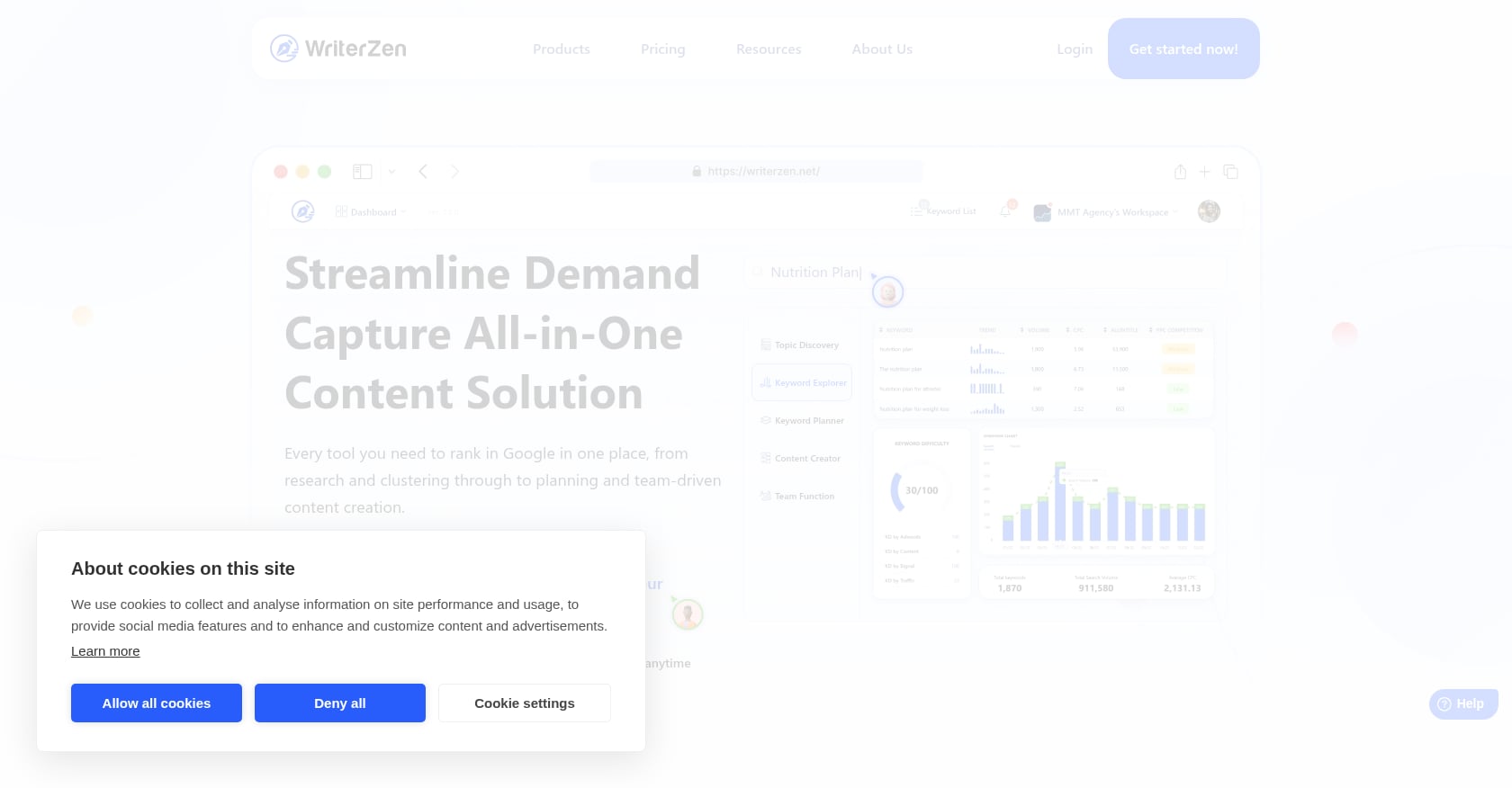
WriterZen focuses on the planning stage: topic discovery, keyword research, and clustering related keywords into content groups. It includes a content editor, but the real value is in organizing what to write before you start drafting. Basic starts at $27/month, Standard at $41/month.
G2 lists WriterZen at 4.7/5 from 201 reviews. Users praise the intuitive keyword research and clustering. Reddit practitioners say WriterZen is strong for topic clustering and identifying content gaps, though some mention trial bugs and uncertainty about how it compares to Surfer or Frase for actual optimization.
Key features:
- Keyword Explorer and Topic Discovery
- Keyword clustering
- NLP recommendations
- Content Creator with AI writing credits
- Plagiarism checks
Tradeoffs:
- Not as polished for real-time optimization as Surfer
- AI writing is weak compared to Frase or Scalenut
- Credit and limit system needs careful evaluation before buying
Who should choose this: SEOs planning content calendars and organizing topic clusters. Skip it if you mainly need a real-time content editor.
11. PageOptimizer Pro
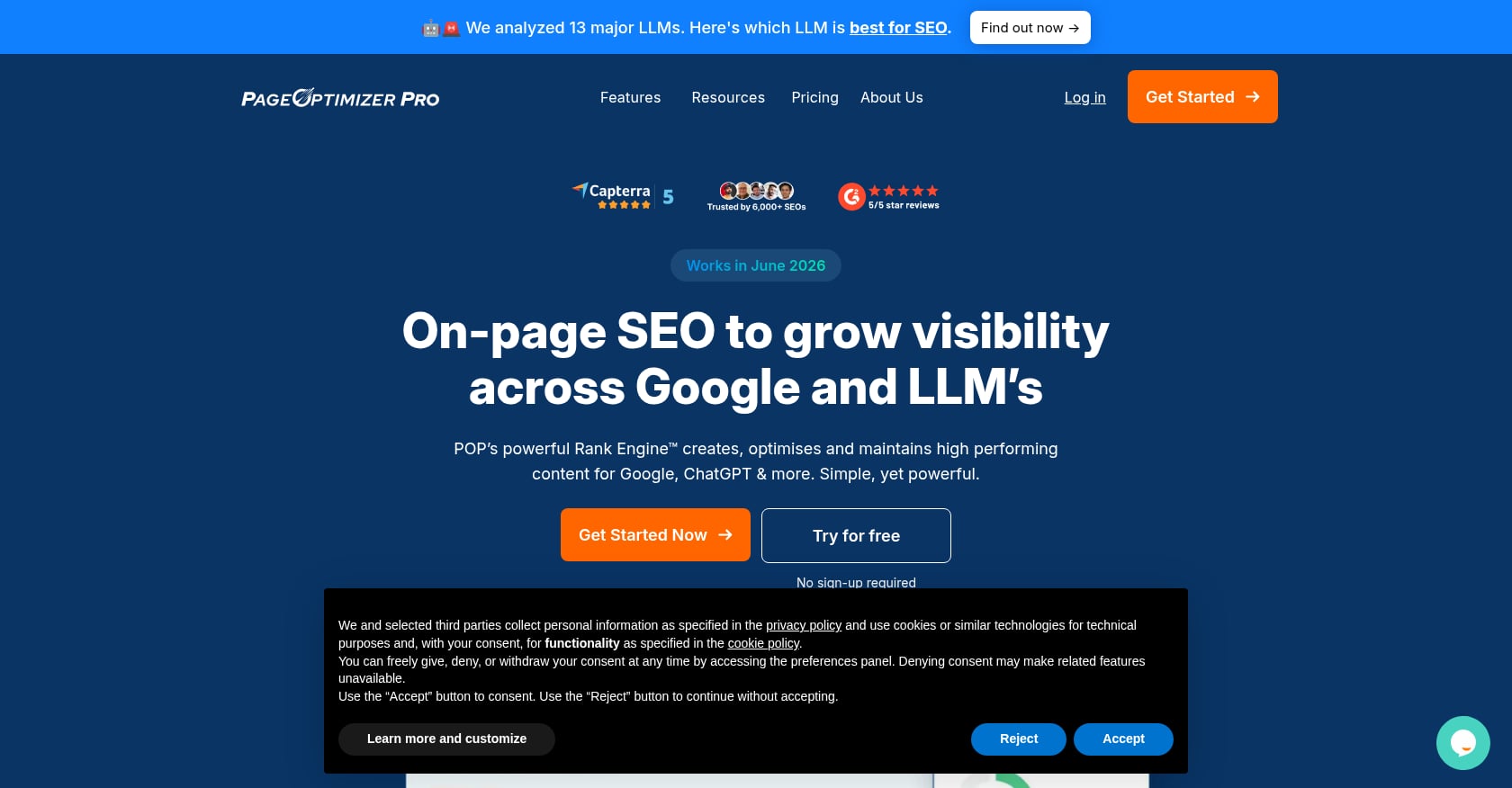
Best for: Technical SEOs who want granular, data-driven on-page recommendations.
PageOptimizer Pro (POP) takes a methodical, rule-based approach to on-page optimization. It analyzes SERP competitors, provides specific content-level recommendations, and includes NLP analysis, E-E-A-T optimization features, and SERP monitoring through its Watchdog tool. Basic starts at $34/month.
G2 lists POP at 4.9/5, though from only 5 reviews. One reviewer praised the keyword analysis and optimization score. Another reported significant ranking improvements on affiliate content after using POP, though individual results vary.
Key features:
- Content brief and editor
- Google NLP dashboard
- E-E-A-T optimizer
- Schema recommendations
- POP Watchdog SERP monitoring
- Chrome extension
Tradeoffs:
- Small public review base makes it harder to evaluate at scale
- Less intuitive for non-SEOs
- Some recommendations require SEO interpretation to act on
- Not a strategic planning or publishing tool
Who should choose this: Hands-on SEOs who want precise on-page direction and are comfortable interpreting technical recommendations.
12. Dashword
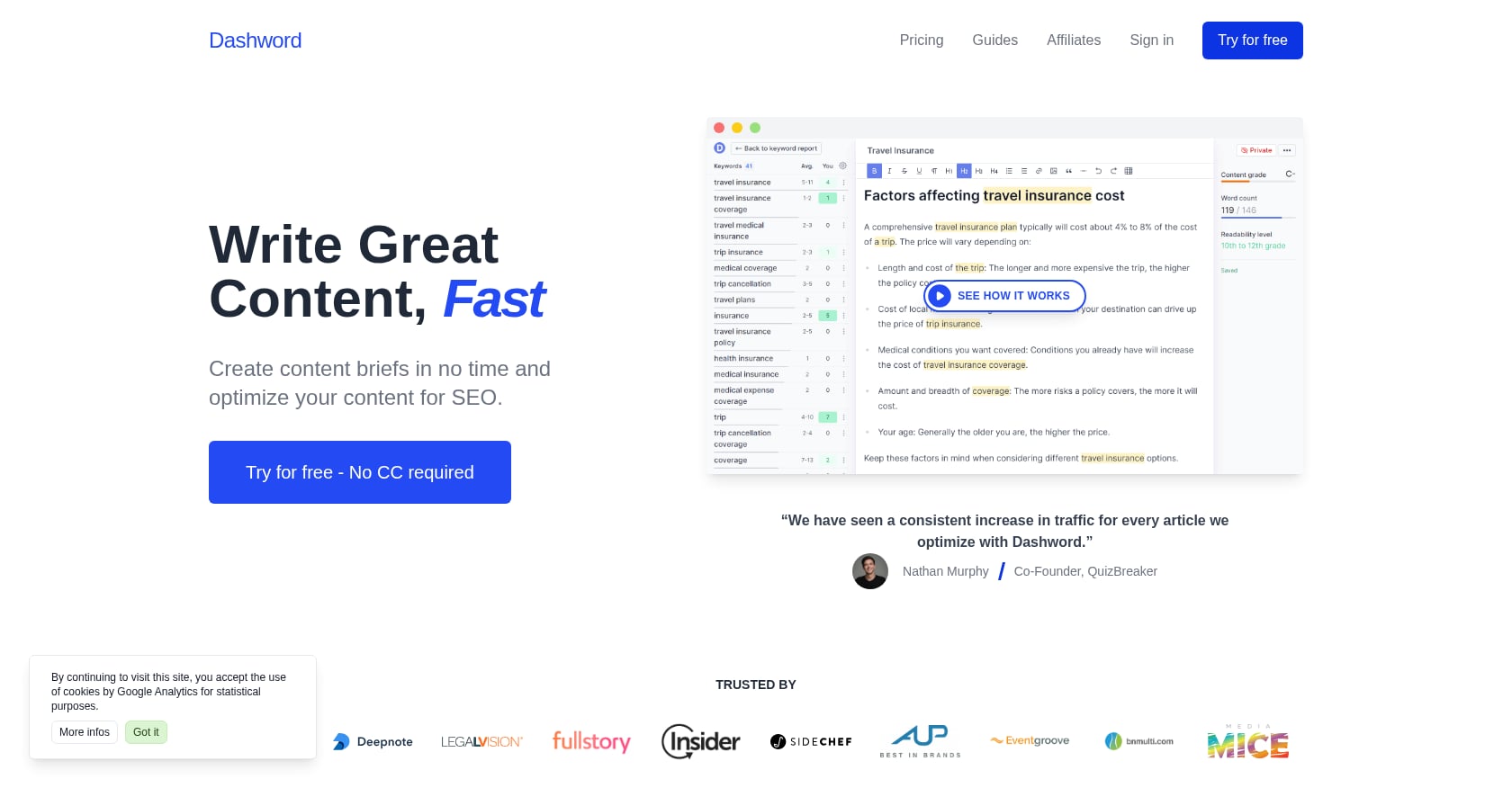
Best for: Content teams that want a clean, simple briefing and scoring tool.
Dashword analyzes SERP data to build briefs and score content in real time. It’s simpler than Surfer or Clearscope, which can be a feature for teams that don’t want complexity. Starting price is $99/month, with team tiers around $349/month.
Independent reviews describe Dashword as easy to use with strong content briefs, but less deep than Surfer or Clearscope. The $99/month minimum makes it more team-oriented than hobbyist-friendly.
Key features:
- SERP-based content briefs
- Real-time content scoring
- NLP term recommendations
- People Also Ask integration
- AI outline and writing support
Tradeoffs:
- Not cheap for solo users or freelancers
- No backlink analysis, technical audits, or broader SEO tools
- Less advanced AI search visibility features than newer platforms
Who should choose this: Content teams producing regular SEO articles who want simplicity. Skip it if you’re a solo blogger looking for the cheapest option.
What Does a Surfer SEO Alternative Really Cost?
Starting prices are misleading. A $27/month tool looks cheap until you realize you also need a writer ($0.10-0.30/word), an editor, someone to handle keyword research, someone to publish and build internal links, a rank tracker, and time to rewrite pages that underperform.
Here’s a more honest formula:
True monthly SEO content cost = tool subscription + writer/editor cost + SEO strategist time + publishing work + rank tracking + refresh/rewrite cycles.
NeuronWriter’s €19/month is attractive, but if you’re paying a freelance writer $200 per article and producing 8 articles a month, you’re already at €1,619 before anyone tracks rankings or rewrites anything. Content Harmony’s per-workflow pricing scales from $50/month to $1,000/month as volume grows. Semrush’s writing tools only make sense if you’re already paying for the broader platform.
This is where the done-for-you model changes the math. Rankai’s $499/month Growth plan includes keyword selection, 20 articles per month, technical SEO fixes, publishing, monitoring, and continuous rewrites. For teams without an in-house SEO function, that flat cost replaces multiple tools and people.
See what a flat monthly plan delivers
Do Surfer SEO Alternatives Help with AI Overviews and ChatGPT?
Many content optimization tools now market AI visibility and GEO (generative engine optimization) features. Frase, Scalenut, SE Ranking, and even Surfer itself have added AI-related positioning. But content scores alone are not enough for AI search visibility.
A 2026 academic study found that AI Overviews appeared for 51.5% of representative real-user queries, fundamentally changing how content gets surfaced. Understanding how AI Overviews work matters more than chasing a content score.
AI-generated content is also no longer a differentiator. Ahrefs found that 74.2% of newly created pages analyzed in April 2025 contained AI-generated content. A separate Ahrefs survey found that 87% of content marketers use AI, but 97% of companies edit or review AI content and only 4% publish it unedited.
Google’s own guidance is clear: ranking systems prioritize helpful, reliable, people-first content, and automation used primarily to manipulate rankings violates spam policies.
What does this mean for choosing a Surfer alternative? Tools that only optimize against the top 10 blue-link results are incomplete for AI-era search. Visibility in AI Overviews, ChatGPT, and Perplexity also depends on direct answer formatting, entity clarity, original examples, structured comparisons, and third-party validation. Practitioners on Reddit increasingly emphasize that AI citations are driven by brand mentions in trusted sources, review consistency, and content that gets referenced by others, not just on-page term coverage.
A content score is a diagnostic, not an SEO strategy. The best Surfer SEO alternative for AI search is one that helps you create genuinely useful content and keeps improving it after publication.
A Warning About Content Score Chasing
Several Reddit discussions raise a problem worth mentioning: the “content score trap.” Optimization tools can push writers toward satisfying a number instead of writing the most helpful page. A score of 90 does not guarantee rankings if the page lacks originality, experience, or a good search-intent match.
Use content scores as guardrails, not as the goal. The best content optimization happens when refreshing older content is part of a continuous loop, not a one-time scoring exercise.
Which Surfer SEO Alternative Should You Choose?
Here is the short version:
Choose Rankai if you want SEO content execution handled for you, from keyword selection through publishing and rewrites. Best for SMBs, startups, ecommerce brands, and agencies without an in-house SEO team.
Choose NeuronWriter if price is the main issue and you just need a content editor.
Choose Frase if you want briefs, AI writing, and optimization in one workflow.
Choose Clearscope if editorial quality matters most and budget is not a constraint.
Choose MarketMuse if you need to plan what to write across an entire site, not just optimize individual pages.
Choose Content Harmony or Dashword if your bottleneck is briefing writers consistently.
Choose SE Ranking or Semrush if you want content optimization bundled with rank tracking, audits, and competitor research.
Choose Scalenut if speed of AI content production matters more than editorial control.
Choose WriterZen if you need keyword clustering and topic planning before writing.
Choose PageOptimizer Pro if you’re a technical SEO who wants granular on-page direction.
The cheapest tool is not the cheapest path if nobody on your team has time to use it. For many businesses, the real Surfer SEO alternative is not another editor. It’s a service that gets content live, tracked, and improved.
Compare AI SEO agencies for startups
FAQ
What is the best alternative to Surfer SEO?
It depends on your needs. For done-for-you execution, Rankai is the strongest option. For a cheap content editor, NeuronWriter. For briefs and AI writing, Frase. For premium editorial teams, Clearscope. There is no single “best” without knowing your team, budget, and workflow.
Is there a cheaper alternative to Surfer SEO?
Yes. NeuronWriter starts at €19/month, WriterZen at $27/month, and PageOptimizer Pro at $34/month. All three are significantly cheaper than Surfer, though each has limits in features, credits, or polish.
Can I use ChatGPT instead of Surfer SEO?
ChatGPT can draft, rewrite, and brainstorm content, but it does not provide live SERP-based content scoring, competitor structure analysis, NLP term recommendations, rank tracking, or content refresh workflows. It’s a writing assistant, not a content optimization platform.
Is Frase better than Surfer SEO?
Frase is better if you value research, content briefs, and AI writing workflow in one tool. Surfer is often preferred for real-time optimization depth and content scoring precision. They solve overlapping but different problems.
Is Clearscope better than Surfer SEO?
Clearscope is generally better for editorial simplicity and content quality workflows. It’s also more expensive and less suited to budget-conscious users. Teams with experienced writers tend to prefer Clearscope; solo creators tend to prefer Surfer.
Do content optimization scores guarantee rankings?
No. Scores are directional indicators. Rankings also depend on search intent match, domain authority, backlinks, internal linking, technical SEO health, content freshness, and whether the page actually helps the searcher. A perfect score on a page that misses intent will still underperform.
What is the best Surfer SEO alternative for small businesses?
Rankai if the business wants SEO handled without hiring a team. NeuronWriter or Frase if someone in-house will manage the content workflow. The deciding factor is whether you have someone to use the tool consistently.
Which Surfer alternative helps with AI search optimization?
Frase, Scalenut, SE Ranking, and Surfer itself are adding AI visibility features. But AI search visibility also depends on factors outside any content editor: entity clarity, direct answers, third-party mentions, structured data, and original proof. No single tool fully solves AI search optimization yet.