

TL;DR
AI content generators range from free chatbots to full-service SEO execution platforms. ChatGPT and Claude are the cheapest options for writing, but they leave keyword strategy, optimization, publishing, and content refreshes entirely to you. Tools like Frase, Surfer, and Writesonic add SEO depth but still require human editing and workflow management. For businesses that want content planned, published, and rewritten until it ranks, Rankai offers a done-for-you service starting at $499/month that handles the entire operation.
Quick Comparison: Best AI Content Generators at a Glance
Pricing verified from third-party review platforms and vendor pages in May 2026 where available. Always confirm current pricing before purchasing.
| Tool / Service | Best For | Starting Price | SEO Depth | Human Editing Included | Key Tradeoff |
|---|---|---|---|---|---|
| Rankai | Done-for-you SEO execution | $499/mo | High | Yes | Not a self-serve writing tool |
| ChatGPT | Brainstorming, drafts, rewriting | Free; Plus $20/mo | Low | No | No built-in SEO workflow |
| Claude | Long-form writing and voice | Free; Pro $20/mo | Low | No | Usage limits during peak hours |
| Jasper | Brand-consistent marketing teams | $59/mo (annual) | Medium | No | Expensive for casual users |
| Writesonic | SEO/GEO content suites | $249/mo | High | No | High price floor |
| Frase | SEO briefs and SERP research | $45/mo | High (briefs) | No | AI writer needs heavy editing |
| Surfer | On-page SEO optimization | $99/mo | High (optimization) | No | Can push toward keyword stuffing |
| Scalenut | All-in-one for smaller teams | $59/mo | High | No | AI output can be repetitive |
| Anyword | Conversion-focused copy scoring | $39/mo | Low-Medium | No | Not built for blog SEO |
| Byword | Bulk SEO article generation | $99/mo | Medium-High | No | Very thin review base |
What Is an AI Content Generator?
An AI content generator is any tool or service that uses large language models to create text from prompts, templates, keywords, or source material. That definition covers everything from ChatGPT answering a “write me a blog outline” prompt to a managed service that plans keywords, drafts articles, optimizes for search, and publishes to your CMS.
The category has gotten broad enough to be confusing. A chatbot and an SEO content service both count as AI content generators, but they solve very different problems. Understanding the spectrum matters before you pick one.
The 4 Levels of AI Content Generation
Level 1: General AI writing assistants (ChatGPT, Claude). Strong for brainstorming, first drafts, rewriting, and research synthesis. No built-in SEO strategy, SERP analysis, or publishing workflow.
Level 2: Marketing copy generators (Jasper, Copy.ai, Anyword). Built for ads, emails, landing pages, and product descriptions. Stronger on brand voice and campaign templates, weaker on organic search execution.
Level 3: AI SEO content platforms (Frase, Surfer, Scalenut, Writesonic, Byword). These add keyword research, SERP analysis, optimization scoring, and sometimes bulk generation. They still require strategy, editorial judgment, and CMS execution from the user.
Level 4: Done-for-you AI-assisted SEO execution (Rankai). Combines AI-assisted content production with human SEO strategists and editors. Handles keyword selection, publishing, technical fixes, and rewrites. Less self-serve control, more actual output.
If you’re starting to explore AI SEO fundamentals, knowing which level you need will save you from buying the wrong tool.
How to Choose the Right AI Content Generator
Decide Whether You Need Drafts, Optimization, or Full Execution
Most people searching for AI content generators think they need a writing tool. Some do. But if the goal is organic traffic growth, a writing tool covers maybe 20% of the work. Keyword research, content briefs, editorial review, internal linking, CMS publishing, technical SEO, performance tracking, and content refreshes all sit between “AI generated a draft” and “this page ranks.”
Before comparing features, answer one question: Do you have the people and process to handle everything after the draft? If yes, a Level 1 through 3 tool will probably work. If not, a done-for-you option is worth evaluating.
Check the Real Monthly Cost, Not Just the Advertised Price
A $20/month chatbot can become the most expensive option on this list if it takes four hours of skilled labor to turn each draft into a published, optimized page. Practitioners on Reddit report that AI tools are useful starting points but rarely produce publish-ready content without significant editing. One agency practitioner who tested 12 AI content tools over six months estimated actual time savings at roughly 20% after accounting for editing time.
A more honest cost formula:
Real monthly cost = tool subscription + editor time + SEO research + CMS publishing + technical SEO + content refreshes + opportunity cost of targeting the wrong keywords.
SaaS review discussions also flag hidden costs like credit limits, AI feature add-ons, consumption-based pricing, and annual-first billing that obscures the true monthly rate.
Look for Human Review and Fact-Checking
According to Content Marketing Institute’s 2025 B2B research, 81% of B2B marketers now use generative AI, but only 4% report high trust in AI outputs. Only 17% rated AI-generated content quality as excellent or very good. That gap between adoption and trust explains why every serious option on this list still needs a human in the loop.
On the bright side, CMI found that 51% of those marketers noticed fewer tedious tasks, 45% reported more efficient workflows, and 42% saw improved content optimization. AI is useful. It just isn’t autonomous.
Prioritize SEO Workflow if Organic Traffic Is the Goal
If you want blog traffic (not just blog drafts), evaluate AI content generators on their SEO capabilities: SERP research, keyword clustering, optimization scoring, internal linking support, rank tracking, and content refresh workflows. Building topical authority requires a keyword cluster strategy, not just isolated articles.
The Best AI Content Generators in 2026
1. Rankai

Best for: SMBs, startups, ecommerce stores, and local businesses that want SEO content planned, published, and improved without building an in-house team.
Pricing:
- Standard Plan: $499/month (Early Bird)
- 20 pages created per month
- Continuous rewrites until pages rank
- Technical SEO fixes included
- Cancel anytime
Key features:
- Human-vetted keyword and topic selection, updated monthly
- 20+ pages/month with internal links, metadata, visuals, and CTAs
- Technical SEO fixes for crawlability, indexation, and metadata
- CMS compatibility with WordPress, Shopify, Squarespace, Webflow, and Wix
- Weekly progress reports focused on rankings and traffic impact
- Rewrite-until-it-ranks workflow: pages are monitored and rebuilt when underperforming
Limitations:
- Not a self-serve writing tool. If you want direct prompt control and creative flexibility, ChatGPT or Claude will feel more suitable.
- Off-page authority building (link building, digital PR) is not highlighted as a core offering.
- Published case studies show anonymized Google Search Console data (a creative agency saw +400% traffic; a SaaS platform reached six-figure visitors in under a year; a local business grew from zero to 70k visitors), but client names are not disclosed.
User perspective: Rankai’s founder shared on Reddit that the company initially built a fully automated AI SEO agent, onboarded 300+ clients, then discovered the tool handled about 60% of the tedious SEO work but missed roughly 40% of strategic decisions. That led to a pivot toward a hybrid model where human SEO experts guide the AI, which is the current service.
Rankai is not the cheapest AI writing tool on this list. It is the most complete option if what you actually need is an AI-assisted SEO team: strategy, content, publishing, technical fixes, and rewrites bundled into one flat monthly fee.
Book a Rankai demo to see how the done-for-you model works.
2. ChatGPT
Best for: Flexible brainstorming, first drafts, rewriting, outlines, and research synthesis across content types.
Pricing:
- Free plan available
- Plus: $20/month
- Pro tiers: $100 and $200/month with higher usage limits
Key features:
- Conversational drafting and iteration on any topic
- Search, data analysis, deep research, file uploads, and custom GPTs (depending on plan)
- Works across blogs, emails, social posts, landing pages, and product descriptions
- Constantly updated model access
Limitations:
- OpenAI’s own guidance acknowledges ChatGPT can produce incorrect or misleading information, including fabricated citations and confidently wrong answers.
- No built-in keyword strategy, SEO scoring, internal linking, CMS publishing, or rank tracking.
- Output quality depends entirely on your prompts, source material, and editorial process.
User perspective: Reddit users consistently treat ChatGPT as a strong brainstorming and outlining tool, but not as a complete content production system. In one content marketing discussion, multiple users said ChatGPT helps with ideas and first drafts but outputs require heavy editing before they’re ready to publish.
Choose ChatGPT if you need a flexible AI writing partner and already have the rest of the content workflow sorted out.
3. Claude
Best for: Natural long-form writing, structured documents, and maintaining voice consistency across longer pieces.
Pricing:
- Free plan available
- Pro: $20/month
- Max: starting at $100/month with higher capacity per session
Key features:
- Strong long-context writing and analysis
- Useful for style consistency across 2,000+ word pieces
- Good at turning large notes, transcripts, and source documents into structured drafts
- Projects and persistent context on higher plans
Limitations:
- Not an SEO platform. No keyword research, optimization scoring, or publishing workflow.
- Usage limits can interrupt long content sessions. TechRadar reported in March 2026 that Anthropic was reducing message limits during peak hours for free, Pro, and Max subscribers.
- Strong prose can still feel AI-generated without real examples, customer language, and editorial direction.
User perspective: A Reddit user who compared Claude Pro and ChatGPT Plus over four months said Claude produced better writing quality, long-form analysis, and structured documents over 2,000 words. Other writing communities praise Claude’s output but flag frustration with changing usage limits and availability.
Claude is the best general-purpose option for long-form writing quality. Pair it with SEO research tools and a human editing process.
4. Jasper
Best for: Marketing teams that need brand-consistent campaign copy at scale.
Pricing:
- Pro: $59/month (annual) or $69/month (monthly) per G2 pricing data
- Business: custom quote
- G2 rating: 4.7/5 from 1,270 reviews
Key features:
- Brand voice training through Jasper IQ
- Marketing templates for ads, emails, landing pages, social posts, and blog drafts
- Team collaboration and campaign workflows
- Multi-language support
- Business plan for governance at larger organizations
Limitations:
- Expensive for solo users or occasional writing needs.
- SEO depth depends on your integrations and workflow, not Jasper’s native capabilities.
- Trustpilot shows a mixed 3.4 score from 4,000+ reviews, with visible complaints about billing, refunds, and support.
User perspective: Capterra reviewers (4.8 from 1,855 reviews) describe Jasper as a “marketing content factory” that requires upfront brand voice training and editing. Reddit users argue Jasper is useful when guided by strong outlines but pricey compared to ChatGPT or Claude for general writing work.
Jasper makes sense for teams producing repeatable, on-brand marketing content. It is harder to justify if you only need occasional drafts or want deep SEO execution.
5. Writesonic
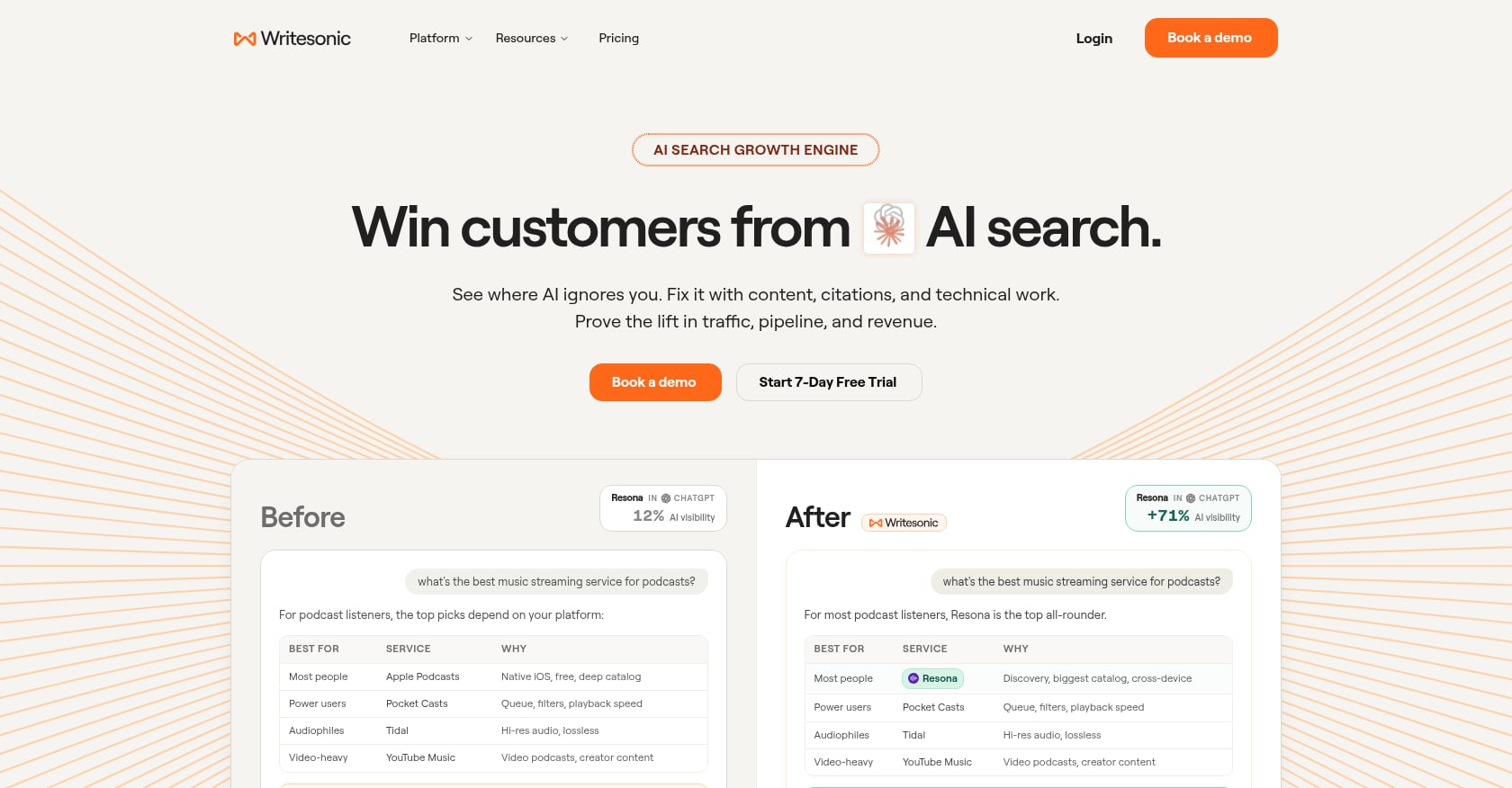
Best for: Content teams that want AI writing combined with SEO and GEO (generative engine optimization) tracking in one platform.
Pricing:
- Basic: $249/month
- Growth: $499/month
- Enterprise: custom
- G2 rating: 4.7/5 from 2,107 reviews
Key features:
- AI SEO content generation with built-in optimization
- GEO and AI visibility tracking
- Site audits
- Integrations with Ahrefs, Google Search Console, WordPress, and Zapier
- Multiple articles per month depending on tier
Limitations:
- Cost is closer to a full SEO platform than a budget AI writer. The free trial is limited to one user, one project, and very restricted features.
- Long-form output still needs manual editing for quality and accuracy.
- Some users on Trustpilot (4.6 overall from 5,809 reviews) flag billing and cancellation friction.
User perspective: Reddit content marketers say Writesonic’s SEO automation features can justify the price, but $249/month is a steep entry point. Content quality still depends on how well you train the tool to follow your writing rules and tone.
Writesonic is a solid pick if you want AI content generation plus SEO/GEO monitoring in one place. It is overkill if you only need a basic writing assistant.
6. Frase
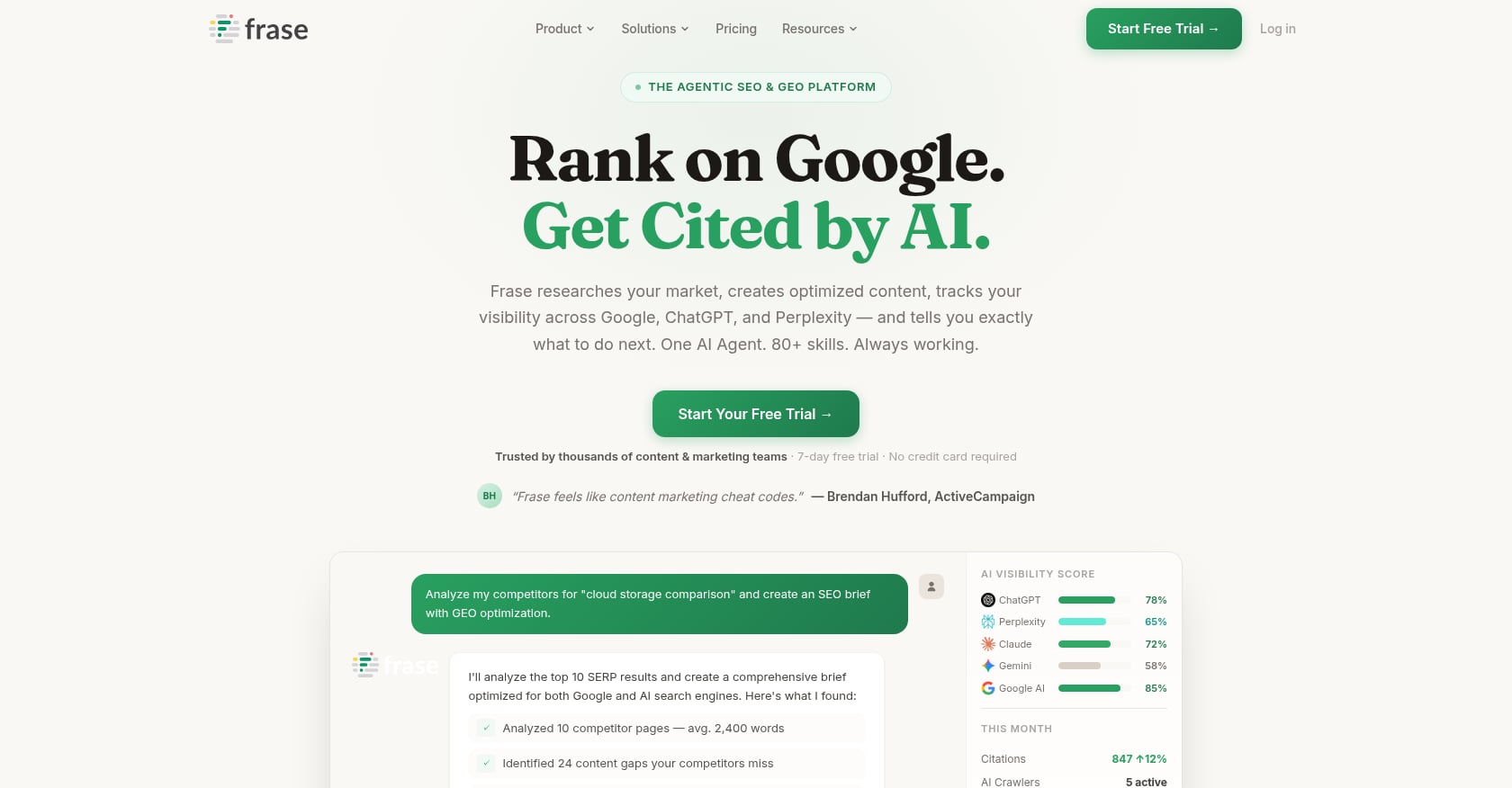
Best for: SEO briefs, SERP research, and question-based content planning.
Pricing:
- Starter: $45/month
- Professional: $115/month
- Enterprise: custom
- G2 rating: 4.8/5 from 301 reviews
Key features:
- Automated content briefs based on SERP analysis
- AI writing assistant
- Content optimization scoring
- Question research and topic gap analysis
- Google Docs plugin and API access on higher plans
Limitations:
- The AI writer output tends to feel stiff and often requires significant reworking.
- Trustpilot sentiment is poor (1.3 from 52 reviews), with complaints about pricing and refunds.
- Not a complete SEO execution service. You still need a strategist, editor, and publishing workflow.
User perspective: G2 reviewers frequently cite 30% to 90% time savings on research and brief creation, which is Frase’s real strength. Third-party reviews consistently conclude that Frase is better for research and briefing than for producing publish-ready content.
Frase is a strong choice when your bottleneck is research and content planning. If your bottleneck is publishing and improving pages after they go live, you may need a fuller approach. Teams comparing their options might also want to evaluate SEO content services that handle the entire pipeline.
7. Surfer
Best for: Real-time on-page SEO optimization for writers and content teams editing existing drafts.
Pricing:
- Standard: $99/month
- Pro: $182/month
- Peace of Mind: $299/month
- Enterprise: $999/month
- G2 rating: 4.8/5 from 541 reviews
Key features:
- Content Editor with SERP-based optimization recommendations
- Content scoring against top-ranking competitors
- Keyword and NLP term suggestions
- Google Docs and WordPress integrations
- AI visibility tracking in newer tiers
- Plagiarism checker on some plans
Limitations:
- No free plan or free trial. Pricing is steep for freelancers and small teams.
- Following Surfer’s recommendations too mechanically can produce keyword-stuffed, generic content. One 2026 G2 reviewer noted that after several rounds of edits, content started sounding duplicative.
- Optimization scores are diagnostic, not strategic.
User perspective: Reddit SEO communities are split on Surfer. Supporters praise the content editor and real-time optimization feedback. Critics warn it can become a “content score trap” when used without editorial judgment, where chasing a number replaces actual thinking about what makes content useful.
Surfer is excellent for optimizing drafts but should not be the brain of your content strategy. Use it as a diagnostic tool, not a creative director.
8. Scalenut

Best for: Small teams and solo creators who want keyword research, AI writing, and SEO optimization in one affordable platform.
Pricing:
- Starter: $59/month
- Plus: $89/month
- Professional: $199/month
- 7-day free trial available
- G2 rating: 4.7/5 from 315 reviews
Key features:
- GEO and AI visibility positioning features
- Keyword planning and clustering
- Content generation and optimization
- Internal linking suggestions
- WordPress and Shopify auto-publishing on higher plans
- AI traffic monitoring and content audits
Limitations:
- AI-generated content can be repetitive and needs editing before publishing.
- Starter tier article limits may restrict output volume.
- G2 reviewers see Scalenut as budget-friendlier than Surfer or Jasper, but freelancers still find the pricing high for what they get.
User perspective: G2 reviewers praise Scalenut for combining keyword research and AI writing into one workflow. The consensus is that it offers a reasonable middle ground between cheap chatbots and expensive enterprise suites.
Scalenut fits teams that want all-in-one AI content generation tools without enterprise-level pricing. Just don’t expect publish-ready output without editorial review.
9. Anyword
Best for: Performance marketers who need conversion-focused copy with predictive scoring.
Pricing:
- Starter: $39/month
- Data-Driven: $79/month
- Business: custom
- G2 rating: 4.8/5 from 1,226 reviews
Key features:
- Predictive performance scoring for copy variations
- Multiple copy options generated quickly
- Audience-focused messaging templates
- Multi-channel marketing copy (ads, landing pages, email, social)
- Useful for A/B test ideation
Limitations:
- Not a full SEO content platform. Not designed for blog strategy, keyword research, or technical SEO.
- Pricing can feel high relative to general-purpose chatbots for users who only need occasional copy.
- Outputs still need manual editing to match brand style.
User perspective: G2 users praise Anyword for rapidly generating multiple copy options and for performance scores that provide directional guidance. The tool shines for conversion-focused work, not organic content operations.
Anyword is a copy-testing and ad-copy tool, not an AI content generator for organic search. Use it for landing pages and paid campaigns, not as your blog engine.
10. Byword
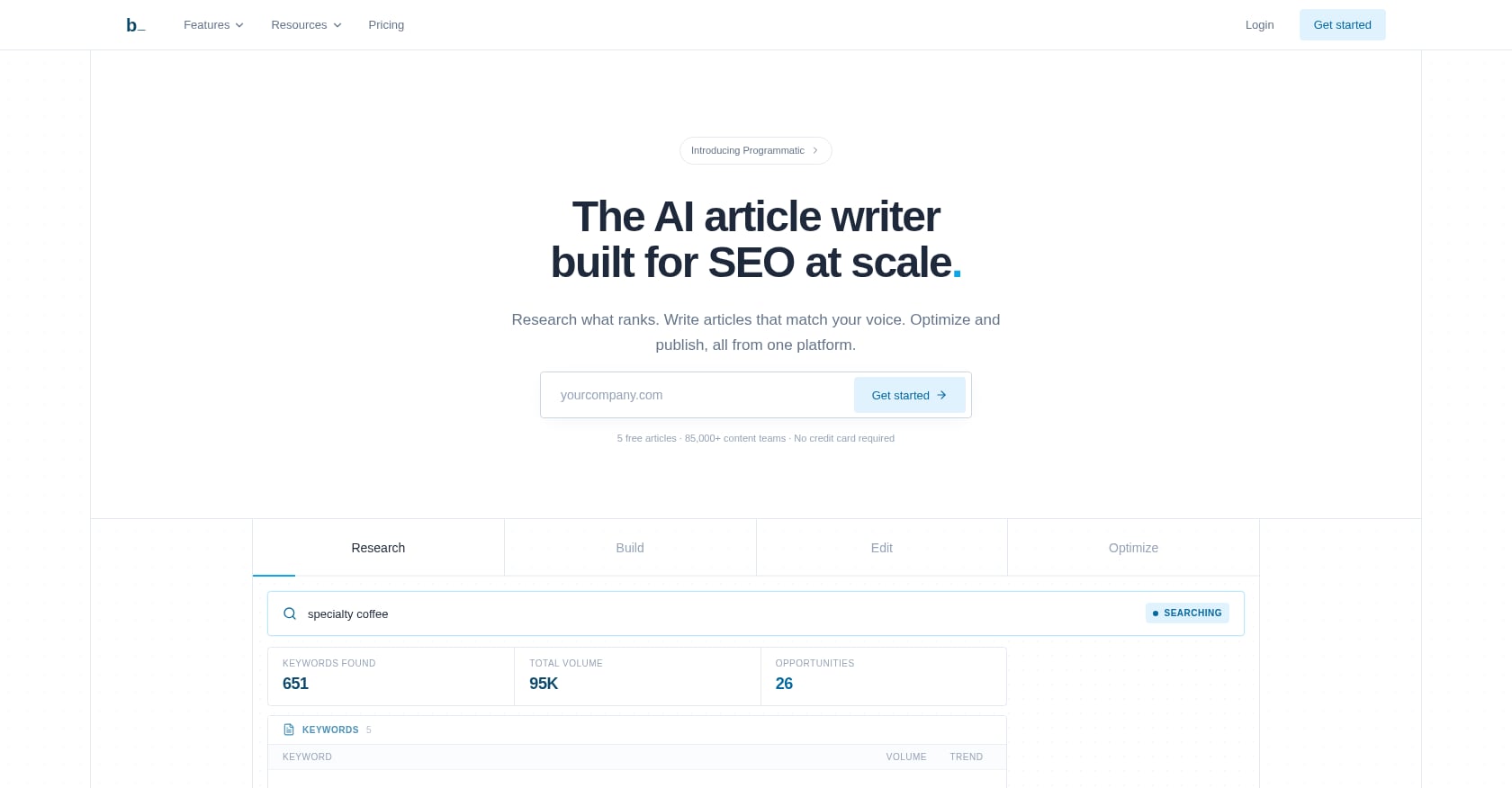
Best for: Agencies and programmatic SEO teams generating many long-tail articles at scale.
Pricing:
- $99 to $1,999/month depending on tier
- WordPress publishing integrations
- G2 has only 3 reviews (not enough for reliable evaluation)
Key features:
- Bulk article generation from CSV keyword and title uploads
- SEO-optimized article output
- WordPress integration for direct publishing
- Built for programmatic SEO workflows
Limitations:
- Extremely thin review base makes independent evaluation difficult.
- Bulk generation without strong editorial QA creates content debt: pages that exist but don’t perform, need constant updating, or dilute overall site quality.
- Not suited for expert-level, high-trust, or brand-sensitive content.
User perspective: One G2 reviewer praised Byword for generating 20+ WordPress-integrated articles at a fraction of manual cost. Another criticized delivery quality and refund policies. Third-party reviewers describe Byword as volume-oriented, best suited for teams that already understand SEO well.
Byword can help with scale, but scale without judgment creates problems. It belongs in the hands of teams that have a strong content refresh strategy and rigorous editorial standards already in place.
AI Content Generators for SEO: What Actually Works?
The most common question about AI content generators and SEO is whether Google penalizes AI-written content. The short answer: no, not automatically.
Google’s guidance states that its ranking systems reward original, high-quality, people-first content demonstrating experience, expertise, authoritativeness, and trustworthiness, regardless of how it was produced. Google’s March 2024 update targeted scaled content abuse and unhelpful content specifically, not AI as a category. For a deeper breakdown, see Google’s AI content policies explained.
The problem is not AI. The problem is content created for search engines instead of people. AI just makes it faster to produce low-value pages at high volume, which is exactly what Google’s systems are built to flag.
What actually works for AI-assisted SEO content:
- Topical depth over keyword volume. Pages backed by genuine expertise and real examples outperform generic AI summaries.
- Intent alignment. Understanding what the searcher actually wants matters more than hitting a content optimization score.
- Internal linking. Connecting related pages builds topical authority and helps Google understand your site’s structure.
- Content refreshes. Publishing is not the finish line. Monitoring performance, spotting decay, and rewriting underperforming pages is where results compound.
- Structured, source-backed answers. With AI search tools (Google AI Overviews, ChatGPT search, Perplexity) citing structured content from authoritative sources, pages that include clear definitions, comparisons, tables, and evidence are more likely to be referenced.
Practitioners on Reddit consistently converge on the same point: AI content isn’t inherently risky for SEO, but it needs editing, real insight, fact-checking, and human judgment to cross the line from “generated” to “genuinely helpful.” Feeding AI tools real customer questions, sales call transcripts, and competitive context produces notably better output than generic prompting.
Run every AI-assisted page through an editorial QA checklist before it goes live.
Tool vs Done-for-You Service: Which Should You Choose?
This is the decision most AI content generator comparisons skip. They compare tools to other tools and ignore the gap between “I have a tool” and “I have a content operation that produces results.”
Choose a tool if:
- You already have a content strategist who knows SEO
- You have an editor who can rewrite AI drafts to publication quality
- You know how to publish content, optimize metadata, and build internal links
- You can track performance and update underperforming pages consistently
- You need help with specific parts of the workflow (briefs, optimization, copy variants)
Choose a done-for-you service if:
- You don’t know which keywords to target
- You can’t publish consistently
- Technical SEO issues are blocking your visibility and you lack someone to fix them
- You need pages monitored and rewritten after launch
- You want predictable monthly content output without hiring a team
Here’s what the workflow gap looks like in practice:
| Capability | ChatGPT / Claude | Frase / Surfer | Writesonic / Scalenut | Rankai |
|---|---|---|---|---|
| Drafting | Yes | Yes | Yes | Yes |
| SEO research | Partial | Yes | Yes | Yes |
| Optimization | No | Yes | Yes | Yes |
| CMS publishing | No | Limited | Some integrations | Yes |
| Content refreshes | No | Partial | Limited | Yes |
| Human editing included | No | No | No | Yes |
The DIY tool stack for SEO content might include ChatGPT for drafts, Frase for briefs, Surfer for optimization, an editor, a CMS, Search Console, and a technical SEO consultant. That works if you have the bandwidth to coordinate everything. For SMBs and startups that don’t, a service packages those functions into one monthly fee.
See how Rankai works if you want SEO content execution without assembling the workflow yourself.
Final Recommendation
HubSpot’s 2026 data shows 80% of marketers already use AI for content creation, and 94% plan to continue in 2026. AI content generators are table stakes now. The competitive advantage isn’t producing more words. It’s building the system around those words: the right topics, real expertise, proper optimization, consistent publishing, and ongoing improvement.
If you want a writing partner, ChatGPT and Claude are the best starting points. If you need marketing copy, Jasper and Anyword are purpose-built. If you need SEO tooling, Frase, Surfer, Writesonic, and Scalenut each handle different parts of the workflow. If you need bulk generation and have strong QA, Byword can help.
If you want the content operation handled for you (keyword selection through publishing through rewrites), that is the gap Rankai fills. Twenty-plus pages per month, human-vetted topics, technical fixes, weekly reporting, and continuous rewrites until pages perform.
The cheapest AI content generator is rarely the cheapest content operation. The winning system is the one that gets the right pages published, improves them after launch, and keeps compounding.
Explore Rankai’s done-for-you approach to see if it fits your growth goals.
FAQs
Are AI content generators bad for SEO?
No. Google’s ranking systems reward helpful, reliable, people-first content regardless of how it was produced. The risk comes from using AI to publish thin, generic, low-value pages at scale. AI-assisted content that includes real expertise, accurate information, and thorough editorial review can rank well.
What is the best AI content generator for blogs?
It depends on the gap in your workflow. For drafting blog posts, ChatGPT and Claude offer the most flexible writing help. For SEO-optimized blogs with briefs and scoring, Frase and Surfer are strong. For teams that want blog content planned, published, and improved without managing every step, Rankai handles the full pipeline.
Can AI content generators replace writers?
They replace parts of drafting and research, but not judgment, expertise, fact-checking, brand voice, or accountability. Content Marketing Institute research found only 17% of B2B marketers rate AI-generated content quality as excellent or very good. The industry reality is that AI accelerates workflows but does not eliminate the need for human oversight.
Which AI content generator is cheapest?
ChatGPT and Claude have free tiers and paid plans starting at $20/month. But the cheapest subscription isn’t the cheapest content. Factor in editing time, SEO research, publishing effort, technical fixes, and content refreshes. A $20/month tool that requires five hours of skilled labor per article can cost more per published page than a service that handles everything.
What is the best AI content generator for SEO?
For SEO briefs and research: Frase. For on-page optimization: Surfer. For AI content plus SEO/GEO suites: Writesonic or Scalenut. For done-for-you SEO execution that includes keyword strategy, publishing, technical fixes, and rewrites: Rankai.
Do AI content generators produce unique content?
AI models generate text based on patterns in training data, so outputs can sometimes echo common phrasing or structures. Most tools produce technically unique text (not copied verbatim from a specific source), but uniqueness alone doesn’t equal quality. The content still needs original insight, accurate information, and editorial polish to stand out from competitors running the same prompts through the same tools.