
In the competitive world of insurance, being visible online isn’t a luxury, it’s a necessity. When potential clients look for a new policy for their car, home, or life, their first stop is usually Google. This is where a strong search engine optimization (SEO) strategy comes in. SEO is the process of making your website more attractive to search engines, helping you show up when local customers search for the coverage you offer.
This comprehensive seo guide for insurance professionals will walk you through 25 essential concepts. We’ll break down everything from local search tactics to advanced content strategy, giving you the knowledge to attract more leads and write more policies.
What is SEO for insurance agents? In 2026, SEO for insurance agents is a digital strategy focused on appearing in Google Search, Maps, and AI Overviews. It involves optimizing your website for local intent (e.g., "independent auto agent near me"), establishing authority through licensed expertise (E-E-A-T), and structuring data so AI models can accurately recommend your agency for specific coverage needs.
Part 1: The Foundations of Insurance SEO
Before diving into specifics, it’s important to understand the three main pillars of SEO. Every tactic in this seo guide for insurance will fall into one of these categories.
1. On-Page SEO
On-page SEO includes all the optimizations you perform directly on your website’s pages. This involves crafting high quality content, using relevant keywords (like “homeowners insurance in Dallas”), and optimizing elements like your page titles and descriptions. It’s about telling both users and search engines exactly what your page is about and confirming it’s a great resource. For a step-by-step list of must-do items, use this on-page SEO checklist.
2. Off-Page SEO
Off-page SEO refers to actions taken outside of your own website to impact your rankings. This is largely about building authority and trust. The most significant part of off-page SEO is link building, which means getting other reputable websites to link to yours. These links act like votes of confidence, telling Google that your agency is a credible source of information.
3. Technical SEO
Technical SEO focuses on the backend of your website to ensure search engines can crawl and index it efficiently. This covers things like site speed, mobile friendliness, and creating a logical site structure. Think of it as the foundation of your house. If the foundation is cracked, it doesn’t matter how nice the furniture is. A technically sound website provides a smooth experience for both search engine bots and human visitors. If you’re unsure where to start, follow this technical SEO audit to identify and fix high-impact issues.
Insurance is classified by Google as a "Your Money or Your Life" (YMYL) topic. This means Google holds your content to a higher standard of accuracy and safety.
Author Bylines: Every article must have a bio for a licensed agent, including their NPN (National Producer Number) and years of experience.
Fact-Checking: Link to official state insurance department websites (.gov) to verify your claims.
Trust Signals: Clearly display your physical office address, license numbers, and professional associations (like Big I or PIA) in your footer.
Part 2: Local SEO for Insurance Agents
For most agents and brokers, the battle for clients is won locally. Local SEO helps you appear in front of prospects in your specific service area. Considering that nearly 46% of all Google searches have local intent, mastering this is nonnegotiable.
4. Local SEO Strategy
A local SEO strategy is your game plan for attracting clients from relevant local searches. This involves optimizing your online presence to show up for queries like “car insurance agent near me” or “business insurance Austin TX”. A good strategy combines everything from your Google Business Profile to getting local citations and reviews, making your agency the obvious choice for searchers in your community.
5. Google Business Profile Optimization
Your Google Business Profile (GBP) is often the first impression a potential client has of your agency. It’s the box that appears in Google search and Maps with your address, hours, reviews, and phone number. Optimizing your GBP means filling out every section, adding photos of your team or office, and actively collecting reviews. A complete profile builds immense trust, as customers are 2.7 times more likely to consider a business reputable if its GBP is filled out.
GBP Feature | 2026 Optimization Strategy | Impact on Rankings |
Primary Category | Use "Insurance Agency" (General) or "Auto Insurance Agency" (Specific). | High |
Google Posts | Update weekly with "Local News" (e.g., "New Florida roof laws & your premiums"). | Medium |
Q&A Section | Pre-populate with common client questions and answer them as the Owner. | High (for AI) |
Product Editor | List each policy type (Home, Auto, Life) with a "Starting At" price if possible. | Medium |
6. NAP Consistency and Citation
NAP stands for Name, Address, and Phone number. NAP consistency means ensuring this information is identical across the web, from your website to directories like Yelp and industry specific sites. A citation is any online mention of your NAP. Inconsistencies confuse Google and erode customer trust. In fact, 80% of consumers lose trust in a local business if they see incorrect contact details online.
7. Service Area Page
If your agency serves multiple towns, cities, or counties, service area pages are essential. These are pages on your website dedicated to a specific location you serve, like “Life Insurance Services in Springfield”. Each page should contain unique content relevant to that area. This tactic helps you rank for location specific searches beyond the city your office is physically in, expanding your digital footprint significantly.
8. Review Management and Social Proof
Review management is the process of encouraging, monitoring, and responding to customer reviews. Positive reviews are a powerful form of social proof, signaling to prospects that others have had a great experience with your agency. Since 87% of consumers read online reviews for local businesses, a steady stream of four and five star reviews can directly translate into new leads. Responding to all reviews, good and bad, also shows you care and can build even more trust.
Part 3: Building Your Website for Search Success
Your website is your digital office. It needs to be professional, easy to navigate, and built on a solid technical foundation to perform well in search.
9. Website Information Architecture
Information architecture is how your website’s content is organized. A logical structure, with clear navigation from your homepage to pages for different insurance types (auto, home, life, business) and then to more specific sub pages, helps users and search engines find what they need. A good rule of thumb is that any page should be reachable within three clicks from the homepage. This clear hierarchy helps spread authority throughout your site and improves the user experience.
10. Internal Linking
Internal linking is the practice of linking from one page on your site to another. For example, a blog post about “Tips for First Time Homebuyers” should link to your homeowners insurance service page. These links guide users to relevant information, keeping them on your site longer, and help search engines understand the relationship between your pages. They also distribute “link equity” or ranking power throughout your site, which can help boost important pages. Not sure how many links is too many? Use this guide on how many internal links per page to calibrate your approach.
11. Page Speed Optimization
How fast your website loads is critical. More than half of mobile users (53% to be exact) will abandon a page if it takes longer than three seconds to load. Page speed is a confirmed Google ranking factor. You can improve it by compressing images, using efficient code, and choosing a good hosting provider. A fast website leads to happier visitors and better rankings.
12. Mobile-Friendly Design
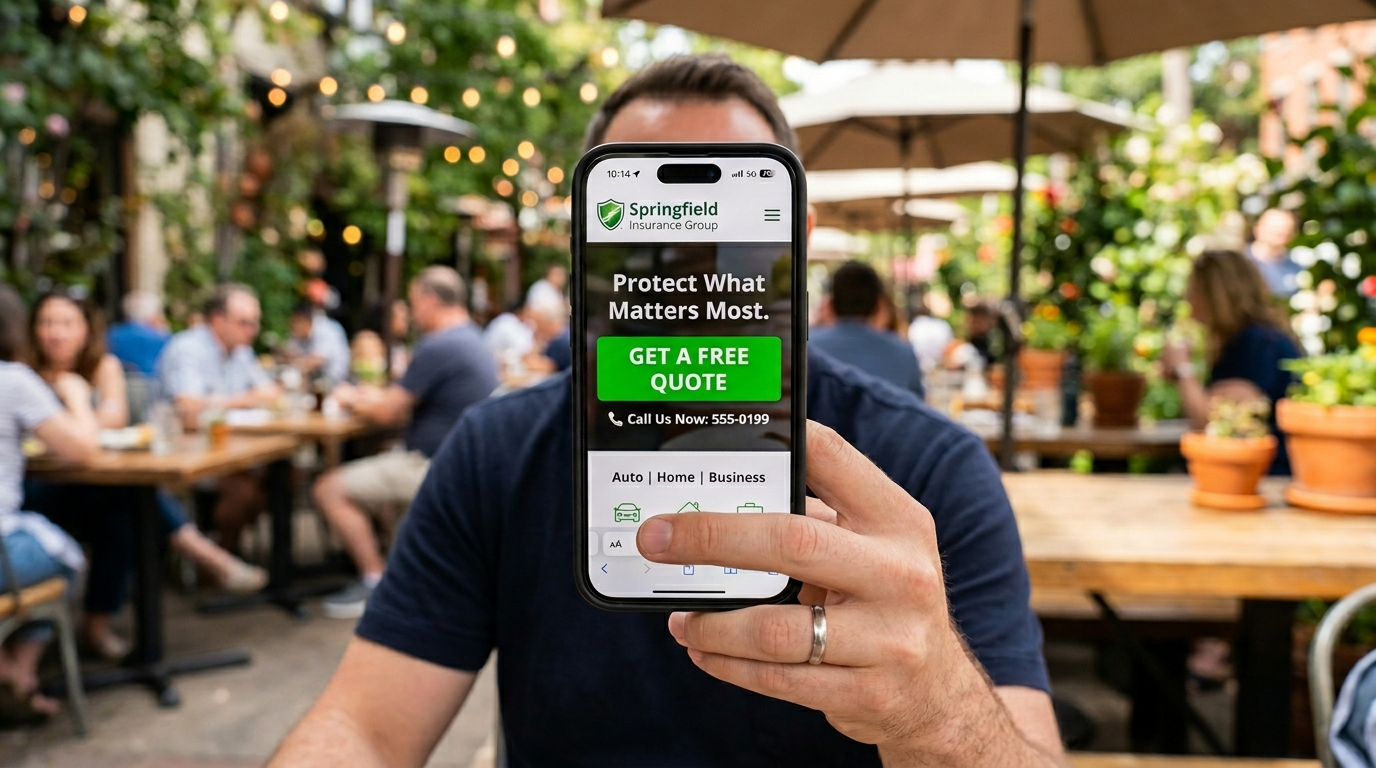
Today, the majority of web traffic comes from mobile devices. Because of this, Google now uses a “mobile first” approach, meaning it primarily looks at the mobile version of your site for ranking. Your website must provide a seamless experience on a smartphone. This means having text that is easy to read without zooming and buttons that are easy to tap. A poor mobile experience will turn away users and hurt your SEO.
13. User Experience (UX) Optimization
User experience encompasses all aspects of a person’s interaction with your website. Is it easy to navigate? Is the information clear? Can they quickly find a button to request a quote? A good UX keeps visitors engaged, while a bad one causes them to leave. Google rewards sites that provide a great experience. Simple things like using clear headings, breaking up text into short paragraphs, and removing annoying popups can make a big difference.
14. Schema Markup and Entity Optimization
Schema markup is a type of code you add to your website to help search engines understand your content in greater detail. For an insurance agency, you can use it to identify your business address, phone number, office hours, and reviews. This can help you get “rich results” in search, like seeing star ratings appear directly under your website link. It’s a powerful way to stand out from competitors on the search results page. Learn which rich results exist and how to earn them in this guide to Google SERP features.
Part 4: Content Strategy, The Engine of Your SEO
Content is the fuel for your SEO efforts. A smart content strategy will attract, educate, and convert your ideal clients. This part of our seo guide for insurance is what separates agencies that grow from those that stagnate.
15. Content Marketing Strategy
A content marketing strategy is your plan for creating and distributing valuable content to attract your target audience. Instead of randomly writing blog posts, a strategy defines who you are trying to reach, what questions they have, and how your content will answer those questions. This ensures every piece of content has a purpose, whether it’s to rank for a keyword like “what is liability coverage” or to generate quote requests.
16. Keyword Research
Keyword research is the process of finding the terms people use when searching for insurance online. It’s the foundation of any good seo guide for insurance. By understanding what your audience is searching for, you can create content that directly meets their needs. This involves identifying not just broad terms like “car insurance” but also more specific “long tail” phrases like “best car insurance for new drivers under 25,” which often have higher conversion intent. Next, group related terms into a keyword cluster to plan pages and internal links intelligently.
17. User Intent Analysis
Beyond knowing what people search for, you need to understand why. This is user intent. Is someone searching “what is an umbrella policy” looking for a definition (informational intent), or is someone searching “get umbrella policy quote” looking to buy (transactional intent)? Aligning your content with the user’s intent is crucial. A blog post is perfect for an informational query, while a service page with a clear quote form is best for a transactional one. For a deeper dive, read this guide to keyword intent and how to map content to it.
18. Content Idea Generation
Consistently coming up with fresh content ideas can be challenging. Good sources of inspiration include common client questions, industry news, and competitor analysis. You can also use free tools that show you what questions people are asking online. You can also mine Google’s Related Searches to expand your idea list and target intent-rich topics. Answering these questions through blog posts, FAQs, or videos establishes your agency as a helpful expert and brings in targeted organic traffic.
19. Meta Title Optimization
The meta title is the blue, clickable headline that appears in a search result. It’s a major ranking factor and your first chance to grab a searcher’s attention. Your title should be compelling, include your primary keyword for that page, and ideally be under 60 characters. For example, a good title would be “Affordable Homeowners Insurance in Miami | Get a Free Quote”.
20. Meta Description Optimization
The meta description is the short snippet of text that appears under the title in search results. While not a direct ranking factor, it heavily influences whether someone clicks on your link. It should act as a mini advertisement for your page, summarizing what the user will find and encouraging them to click through. A great description can significantly boost your click through rate.
With the rise of AI in search, your goal is no longer just a blue link; it’s being the cited source in an AI-generated answer. To win here, focus on:
Direct Q&A Headers: Use H2s or H3s that ask a specific question (e.g., "Is Tesla insurance cheaper than GEICO in Florida?") followed by a concise 40-60 word answer.
Original Data & Tables: AI models love structured data. Compare policy limits or premium averages in table format to increase your chances of being cited.
First-Person Experience: Use phrases like "In our 15 years of helping Miami homeowners..." to signal human experience that AI cannot replicate.
Part 5: Promoting Your Agency and Measuring Results

Creating a great website with excellent content is only half the battle. This final section of our seo guide for insurance explains how to promote your agency and track your performance to ensure your efforts are paying off.
21. Link Building
Link building is the process of getting other websites to link to yours. As mentioned in the off-page SEO section, these backlinks are a top ranking factor. You can earn links by creating valuable content that people naturally want to share (like a guide to hurricane preparedness for homeowners), engaging in local community sponsorships, or being featured in local news. A few high quality links from relevant sites can have a massive impact on your authority and rankings.
22. Social Media Promotion
While social media activity is not a direct ranking factor, it’s a powerful tool for amplifying your content. Sharing your blog posts on platforms like LinkedIn or Facebook gets your content in front of a wider audience. This increased visibility can lead to more traffic, shares, and potentially even natural backlinks from people who discover your resources, indirectly supporting your SEO.
23. Google Search Console
Google Search Console is a free tool from Google that is absolutely essential. It provides a direct line of communication between you and the search engine. You can see which keywords are bringing people to your site, discover technical errors that might be holding you back, and submit your sitemap to help Google find all your pages. Checking it regularly is a key part of any ongoing seo guide for insurance maintenance. For broader KPIs, timelines, and what “good” looks like, here’s how to tell if your SEO strategy is working.
24. Call to Action (CTA) Optimization
A Call to Action is a prompt on your website that tells the user what to do next. Examples include “Get a Free Quote,” “Contact Us Today,” or “Download Our Guide.” Optimizing your CTAs by testing different wording, colors, and placements can dramatically increase the number of visitors who become leads. Every page on your site should have a clear and compelling CTA.
25. Remarketing
Remarketing is a paid advertising tactic that lets you show targeted ads to people who have already visited your website. If someone visits your auto insurance page but doesn’t request a quote, you can show them reminder ads as they browse other sites or social media. This keeps your agency top of mind and brings interested prospects back to your site to convert, maximizing the value of the traffic your SEO efforts generate.
Your Path to SEO Success
Mastering SEO is a marathon, not a sprint. It requires a consistent, strategic effort across all the areas covered in this seo guide for insurance. By building a technically sound website, creating helpful content that answers your clients’ questions, and promoting your agency online, you can steadily climb the search rankings and generate a reliable stream of inbound leads.
For many busy insurance professionals, managing all these moving parts is a significant challenge. Consistently publishing high quality content is especially tough. That’s where a dedicated partner can make all the difference. Services like Rankai specialize in executing these strategies at scale, handling everything from keyword research to creating over 20 pieces of optimized content every month, letting you focus on what you do best: serving your clients.
Frequently Asked Questions About SEO for Insurance
Why is an SEO guide for insurance agents so important?
An effective SEO strategy helps you connect with local clients actively searching for the insurance products you sell. With a strong online presence, you can generate qualified leads 24/7, reducing your reliance on cold calling or expensive traditional advertising. This seo guide for insurance provides the roadmap to achieve that visibility.
How long does it take for insurance SEO to work?
SEO is a long term strategy. While you might see some initial improvements in a few months, it typically takes 6 to 12 months to see significant results in terms of traffic and lead generation. The key is consistency in creating content and building authority over time.
Can I do SEO for my insurance agency myself?
Yes, you can certainly implement many of the basics from this seo guide for insurance yourself, especially local SEO tasks like optimizing your Google Business Profile. However, for more advanced strategies involving high volume content creation and technical fixes, partnering with an expert service like Rankai can accelerate your results and save you a significant amount of time.
What are the most important keywords for an insurance agent?
The best keywords combine the type of insurance with a location. Examples include “commercial auto insurance Dallas,” “renters insurance quotes near me,” or “independent life insurance agent Chicago.” Your keyword research should uncover the specific phrases your local target market is using.
Is a blog necessary for an insurance agency’s website?
A blog is one of the most powerful tools in your SEO arsenal. It allows you to target a wide range of informational keywords (e.g., “how much homeowners insurance do I need?”), answer client questions at scale, and establish your agency as a trusted authority. Companies that blog consistently generate significantly more traffic and leads.
What is the difference between local SEO and general SEO?
General SEO focuses on ranking for broad topics nationally or globally. Local SEO, which is critical for most insurance agents, focuses on appearing in search results for a specific geographic area. It involves location specific keywords and optimizing platforms like Google Maps. A good seo guide for insurance must prioritize local tactics.