AI SEO Agents vs Traditional SEO: What’s the Difference?
TL;DR
AI SEO agents automate repeatable SEO workflows like keyword research, content briefs, internal linking, technical audits, and performance monitoring. Traditional SEO relies on human strategists and writers to plan and execute the same work manually. AI agents are faster at scale, while traditional SEO is stronger on strategy, judgment, and complex decisions. For most businesses, the best model is hybrid: AI for speed and consistency, humans for quality control and accountability.
Quick Definition
AI SEO agents are AI-powered systems that semi-automate SEO tasks across the full workflow, from keyword discovery and content drafting to internal linking, technical checks, and rewrite recommendations. They are not just AI writing tools. They coordinate multiple steps with limited human input.
Traditional SEO is human-led search engine optimization: strategists, writers, editors, and technical SEOs manually research, plan, create, and optimize content to improve organic visibility.
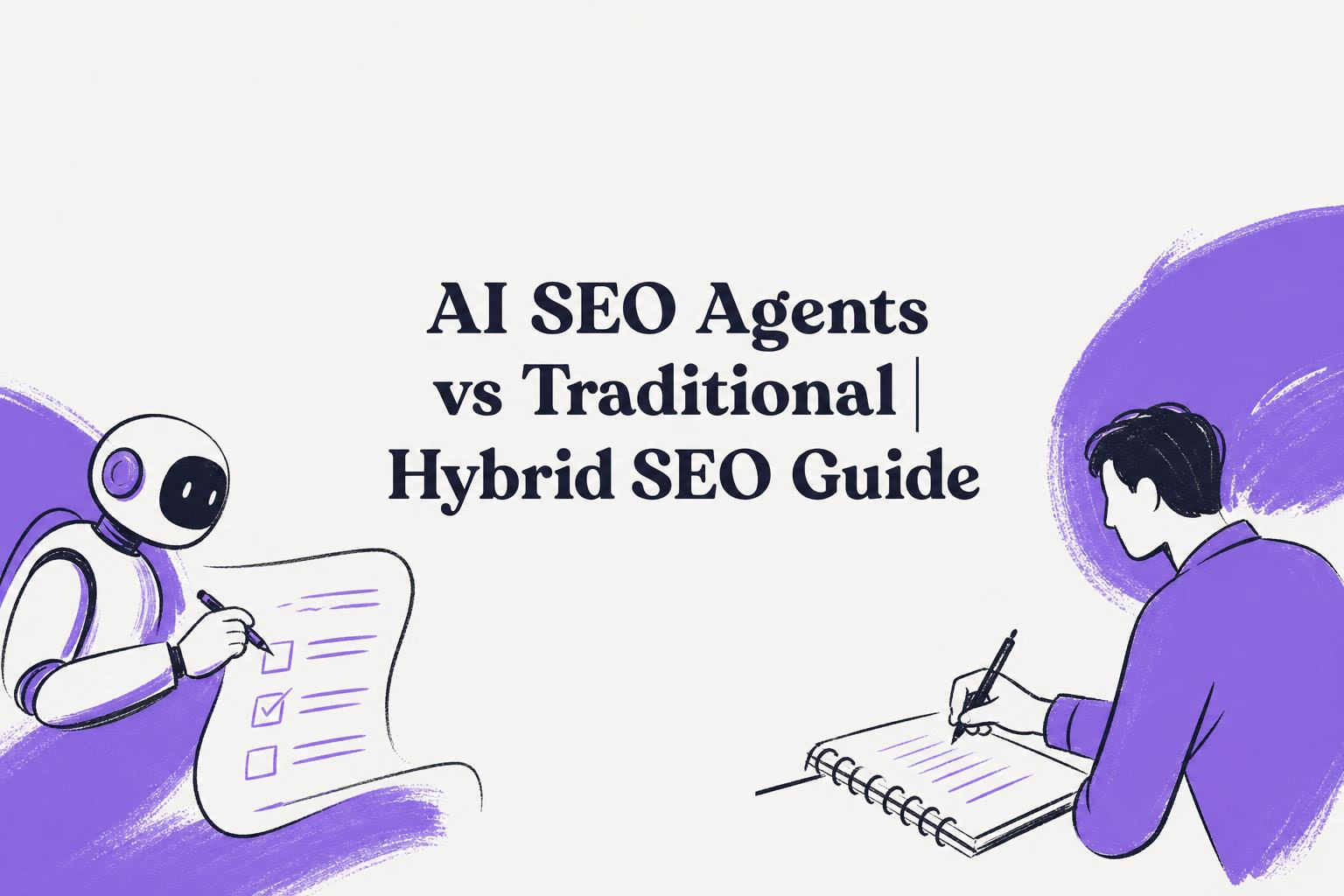
The core difference in the AI SEO agents vs traditional SEO debate comes down to operating model. AI agents scale execution faster. Traditional SEO provides deeper strategy, context, and quality control. The safest and most effective approach combines both.
Want AI speed with human oversight built in? Rankai’s hybrid SEO service combines AI-assisted execution with human keyword vetting, technical fixes, and continuous rewrites until pages rank.
What Is an AI SEO Agent?
An AI SEO agent is a software-based or service-based system that can plan, execute, monitor, or recommend SEO work with minimal human involvement. The word “agent” is important. Unlike a standalone AI writing tool that drafts a single blog post, an agent connects across the SEO workflow.
A typical AI SEO agent might:
- Find keyword gaps and cluster topics by intent
- Create content briefs and draft metadata
- Generate page drafts or rewrite recommendations
- Suggest internal links at scale
- Flag technical issues like broken pages or missing schema
- Monitor rankings and alert when pages drop
- Summarize Search Console trends
The more autonomy an agent has, the more quality control it needs. That is the central tension when comparing AI SEO agents vs traditional methods. For a deeper primer on how AI fits into SEO, see this beginner guide to AI SEO.
Google’s own guidance supports the principle that AI can be useful for “researching a topic” and “adding structure to original content,” but warns that generating many pages without adding real user value may violate scaled content abuse policies source. The tool is not the problem. The workflow is.
What Is Traditional SEO?
Traditional SEO is the human-led practice of improving a website’s visibility through keyword research, on-page optimization, technical SEO, content strategy, internal linking, backlink acquisition, local SEO, and performance reporting.
Traditional SEO is not outdated. Google says SEO fundamentals remain relevant for AI features like AI Overviews and AI Mode. No special AI text files, schema markup, or machine-readable files are required to appear in those features source. Pages still need to be crawlable, indexable, well-linked, and genuinely useful.
The weakness of traditional SEO is not its methods. It is the operating model: human-only execution is slower, more expensive, and harder to scale.
AI SEO Agents vs Traditional SEO: Side-by-Side Comparison
| Category | AI SEO Agents | Traditional SEO |
|---|---|---|
| Core model | Automation-first execution | Human-led strategy and execution |
| Best for | Scale, speed, repeatable workflows, monitoring | Strategy, judgment, brand voice, technical complexity |
| Keyword research | Fast clustering, gap discovery, long-tail coverage | Better prioritization by business value and context |
| Content creation | High-volume drafts, briefs, rewrites, metadata | Stronger original insight, storytelling, expert voice |
| Technical SEO | Flags common issues, prioritizes fixes | Required for migrations, JavaScript rendering, crawl budget |
| Internal linking | Suggests links at scale | Humans decide relevance, conversion flow, hierarchy |
| Link building | Weak unless paired with outreach or PR | Stronger for relationships, digital PR, authority |
| AI search / GEO | Monitors prompts and citation patterns at scale | Humans interpret volatility, decide positioning |
| Main risk | Generic content, hallucinations, scaled low-value pages | Slow output, higher cost, limited testing velocity |
The comparison between AI SEO agents vs traditional approaches is not about picking one side. It is about understanding where each model excels and assigning the right work to the right system.
Where AI SEO Agents Win
Speed and content velocity
AI agents process keywords, generate briefs, and draft pages faster than any human team. For businesses that need to cover dozens of topics quickly, this acceleration matters.
Monitoring and refresh cycles
Instead of monthly manual reviews, AI agents can flag ranking drops within days and suggest rewrites. This feedback loop is where AI SEO agents vs traditional workflows show the starkest difference. Content decay is one of the biggest silent traffic killers, and agents catch it faster.
Cost efficiency
According to Ahrefs’ SEO pricing survey, the average monthly agency retainer is $3,209, and 57.4% of agencies charge at least $1,001 per month. AI-assisted models deliver more output per dollar, which is critical for small businesses priced out of traditional agency rates.
Scale for large sites
Ecommerce stores with hundreds of categories, multi-location businesses, and SaaS companies all benefit from agent-driven scale. AI agents handle the repeatable work so humans can focus on strategy.
But velocity only counts if pages deserve to exist. Ahrefs found that 96.55% of pages get zero organic traffic from Google. Publishing more pages without targeting real search intent just creates dead weight.
Curious what a high-output, human-reviewed program looks like in practice? Read about what to expect from a flat monthly SEO retainer.
Where Traditional SEO Still Wins
AI SEO agents cannot replace human judgment in several critical areas:
- Site migrations. Moving domains, changing URL structures, and consolidating properties require deep technical expertise.
- Information architecture. Deciding how a site is organized is a strategic choice that affects every page.
- Brand positioning. AI can draft copy. It cannot decide what makes a business different.
- Expert and YMYL content. Legal, medical, and financial content needs human review for accuracy and compliance.
- Digital PR and link building. Relationships, outreach, and earned media are inherently human activities.
- Complex technical SEO. JavaScript rendering, crawl budget optimization, and indexation edge cases still need specialists.
An AI agent can draft 100 local service pages. A human has to decide whether those pages are genuinely useful or just doorway pages with swapped city names. Google’s spam policy defines scaled content abuse as generating many pages primarily to manipulate rankings, regardless of whether humans, automation, or both created the content source.
Traditional SEO is becoming the foundation layer that AI SEO agents build on top of. It is not disappearing. For more on how AI agents are reshaping SEO for SMBs while traditional agencies still play a role, that distinction is worth understanding.
AI Search Changes the Goal
The AI SEO agents vs traditional SEO conversation is not only about how work gets done. It is also about what “winning” means.
In traditional SEO, you win when users find and click your result. In AI search, you also need to win when AI systems summarize, cite, compare, or recommend sources before anyone clicks. Google’s AI Overviews reached more than 1.5 billion users globally by May 2025.
The click data tells a real but nuanced story. Pew Research analyzed 68,879 Google searches from March 2025 and found users clicked traditional search results in 8% of visits when an AI summary appeared, compared with 15% when no AI summary was present.
Seer Interactive’s April 2026 study (53 brands, 5.47 million queries) confirmed that AI Overviews suppress CTR, especially for informational queries. But Semrush’s analysis of 200,000+ keywords found the impact is query-dependent rather than universally negative.
AI visibility is an additional surface, not a replacement for SEO fundamentals. Measure rankings, citations, clicks, and conversions together. For help preparing your content for these new surfaces, see this AI Overviews optimization guide.
The Real Risk Is Not AI. It Is Unchecked AI.
Google does not ban AI-assisted content. The risk is publishing large volumes of unoriginal, low-effort content primarily to manipulate rankings.
Practitioners on Reddit confirm this repeatedly. In one r/SEO thread, a business owner described an agency publishing AI rewrites with irrelevant references, prompt artifacts, and zero quality control. Commenters focused not on whether AI was used, but on whether anyone reviewed the output before hitting publish. The consensus: AI should support drafting and analysis, but still needs human fact-checking and brand context.
In another thread, practitioners agreed that AI detectors are unreliable as quality metrics. The meaningful question is whether content is useful, accurate, and unique. One commenter framed the issue as “slop or sloppiness,” regardless of whether a human or machine produced it.
Quality checklist for AI SEO content
Before publishing any AI-assisted page, verify:
- Does the page answer a real query better than existing results?
- Does it add original knowledge, examples, data, or expert review?
- Are all claims fact-checked?
- Is the content specific to the business, product, or audience?
- Did a human editor approve it before publishing?
- Is there a plan to rewrite it if it underperforms?
For a more detailed process, review this editorial QA checklist for AI-assisted content.
AI Visibility Measurement Is Still Unstable
Be skeptical of any AI SEO vendor that guarantees ChatGPT rankings, AI Overview placements, or “AI citations in 30 days.” A 2026 research paper on measuring AI search visibility found that AI-generated answers vary across runs, prompts, and time, making one-off observations unreliable. Visibility in generative engines should be measured as a distribution, not a single snapshot.
Practitioners on Reddit echo this concern. In a thread about finding a reliable AI SEO agency, multiple commenters warned that “prompt tracking” can be flawed because businesses rarely know the exact prompts their customers use. Several users cautioned against vendors selling vague AI visibility guarantees without clear ROI measurement.
How to Choose: AI Agent, Traditional Agency, or Hybrid?
| Your situation | Best choice | Why |
|---|---|---|
| Need lots of content but lack time | Hybrid AI + human service | AI speed with human review |
| Serious technical SEO problems | Traditional expert or hybrid with technical fixes | Complex diagnosis needs expertise |
| Ecommerce with many categories | AI agent + human strategist | Scale matters, but accuracy matters more |
| Legal, health, finance (YMYL) | Human-led or heavily reviewed hybrid | High accuracy and trust risk |
| Need backlinks or PR | Traditional agency or PR specialist | Relationship work is not agent-native |
| Existing site with declining traffic | Hybrid | Needs refreshes, CTR analysis, AI visibility work |
| No SEO foundation at all | Traditional or hybrid first | Crawlability, structure, strategy before scale |
For most small businesses, the AI SEO agents vs traditional question is a false binary. The strongest model uses AI for speed and consistency while keeping humans involved for keyword vetting, editing, technical decisions, and performance-based rewrites.
Wondering if an affordable hybrid approach fits your budget? See whether a $499 monthly SEO plan makes sense for your business.
Red Flags When Evaluating AI SEO Vendors
Before signing with any AI SEO provider, ask:
- Who chooses the keywords: AI, humans, or both?
- Who approves content before publishing?
- How do you prevent generic or duplicated pages?
- How do you handle technical SEO?
- Do you rewrite underperforming pages?
- How do you measure AI visibility, and how often do you retest?
- Do you guarantee rankings or AI citations? (If yes, be cautious.)
- Can you show what changed on each page?
Red flags include: guaranteeing AI Overview placement, using AI detector scores as proof of quality, publishing without human approval, and replacing strong existing pages with generic AI rewrites. To understand what realistic SEO outcomes look like, learn how to measure and forecast SEO ROI before committing to any vendor.
Key Terms to Know
- AEO (Answer Engine Optimization): Structuring content to answer questions directly in search results and AI responses.
- GEO (Generative Engine Optimization): Optimizing content and brand presence to be cited or summarized by generative AI systems. The foundational GEO paper found these methods could boost visibility by up to 40% in generative engine responses.
- LLMO (Large Language Model Optimization): A loose term for improving visibility in LLM-generated answers.
- AI SEO: Broad umbrella covering both using AI to improve SEO workflows and optimizing for AI-influenced search.
For Google AI features specifically, the safest advice is boring: make useful, original, crawlable, well-structured pages that answer specific questions and prove why the reader should trust you. No special “AI hacks” required.
FAQ
Are AI SEO agents the same as AI writing tools?
No. AI writing tools draft copy for a single task. AI SEO agents coordinate across the full SEO workflow: research, briefs, drafts, audits, internal links, monitoring, and rewrites. Think of an agent as an automation layer across many tasks, not just a text generator.
Will Google penalize AI-generated SEO content?
Not because the content is AI-assisted. Google’s concern is low-value scaled content made primarily to manipulate rankings, regardless of who or what created it. The key is adding real value: original insights, accurate facts, expert review, and useful structure. For a detailed breakdown, read about whether Google penalizes AI content.
Is traditional SEO dead?
No. Google explicitly states that SEO fundamentals remain relevant for AI features like AI Overviews and AI Mode. Pages still need to be crawlable, indexable, well-linked, and genuinely useful. Traditional SEO is the foundation that AI agents build on, not something they replace.
Do AI SEO agents work for small businesses?
They can, but only with quality controls. Small businesses benefit from AI-driven speed and cost efficiency. The risk is publishing generic content that does not reflect real business expertise. A hybrid model (AI execution plus human review) is the safest path for smaller teams.
Can AI SEO agents guarantee visibility in ChatGPT or AI Overviews?
No. AI-generated answers vary by prompt, platform, user context, time, and model updates. Any vendor guaranteeing AI citations or AI Overview placement is overpromising. Measure AI visibility repeatedly, not once.
What is the biggest risk of using AI SEO agents?
Publishing too many low-quality pages too fast. Volume without value triggers the exact problems Google’s scaled content abuse policy targets. The best AI SEO agents include human review, performance monitoring, and rewrite processes for underperforming pages.
Should I replace my traditional SEO approach with an AI SEO agent?
For most businesses, the answer is not a full replacement. AI agents handle repeatable tasks faster and cheaper. Traditional SEO provides judgment, strategy, and technical depth. A hybrid approach, where AI SEO agents vs traditional methods each contribute their strengths, consistently outperforms either model alone.
If traditional agencies feel too slow and pure AI tools feel too risky, explore Rankai’s hybrid model: flat-rate, done-for-you SEO with AI-assisted execution, human expert oversight, and continuous rewrites until your pages rank.