
TL;DR: Local business search engine optimization is the process of improving your visibility when nearby customers search Google, Maps, review sites, and AI-assisted tools. The right solution depends on your specific bottleneck: thin website content, weak Google Business Profile, inconsistent listings, poor reviews, or lack of tracking. This guide compares 10 services and tools, starting with Rankai for affordable done-for-you SEO execution, and explains what to pay, what to expect, and what to avoid.
Quick Answer: The Best Option Depends on Your Bottleneck
Most local SEO advice treats every business the same. A dentist, plumber, coffee shop, and multi-location franchise do not need identical setups. Before spending anything, name the problem you are actually trying to solve.
If your website lacks service and location pages, you need content and technical execution. If your Google Business Profile is incomplete, start there for free. If your business name, address, and phone number are wrong across directories, you need a listings tool. If reviews are stale or scarce, no amount of software fixes that. If you cannot tell where you rank block by block, you need a geo-grid tracker.
The table below maps each option to a specific bottleneck. The listicle that follows goes deeper on features, pricing, limitations, and real practitioner perspectives.
Explore Rankai’s done-for-you SEO execution if your main problem is building the pages that should rank.
At-a-Glance Comparison
| Option | Model | Starting Price | Best For | Key Differentiator | Main Tradeoff |
|---|---|---|---|---|---|
| Rankai | Done-for-you AI + human SEO execution | $499/month | SMBs needing content, on-page SEO, technical fixes, and rewrites | 20+ pages/month, rewrite-until-it-ranks workflow | Does not emphasize GBP, citation, or review management |
| Google Business Profile | Free local profile | Free | Every local business | Direct control of Google Search/Maps listing | DIY; does not replace website SEO or reviews |
| BrightLocal | Local SEO platform | ~$39/month | SMBs and agencies needing audits, tracking, citations, reviews | Dedicated local SEO toolkit | Citation building can be add-on; requires someone to execute fixes |
| Semrush Local | Local SEO add-on | $30/location/month | Businesses using Semrush or needing AI-assisted GBP/listings | GBP AI Agent, map rank tracking, 70+ directory listings | Per-location pricing adds up fast |
| Whitespark | Local SEO tools + services | Modular pricing | Citation building, local rank tracking, specialists | Strong practitioner reputation, local ranking research | A la carte model; requires knowing what you need |
| Moz Local | Listings/reputation platform | ~$16/month | Budget-conscious listing management | Affordable directory management | Limited beyond listings; not full SEO execution |
| Local Falcon | Map rank tracker | $24.99/month | Geo-grid rank tracking for Maps visibility | Visual local map grids, AI visibility tracking | Tracks rankings but does not fix causes |
| Synup | Agency platform | $79/month | Agencies managing listings, reviews, social for many clients | Bundled agency OS with client dashboards | More complex than most single-location businesses need |
| Yext | Enterprise listings platform | $199/year (basic) | Multi-location brands needing listings at scale | Broad directory and digital presence management | Often overkill and expensive for single locations |
| Hibu | Bundled local marketing | Custom (unpublished) | Owners wanting one provider for everything | Fully managed marketing bundle | Mixed user sentiment; pricing not transparent |
What Is Local Business Search Engine Optimization?
Local business search engine optimization is the work of making your business visible when people search for nearby products or services. That includes Google Search, Google Maps, the local pack (the map and three-listing box at the top of results), review sites, Apple Maps, Bing Places, and increasingly AI-assisted search tools.
Google says local results depend on three factors: relevance (how well your profile matches the search), distance (how far you are from the searcher), and prominence (how well-known your business is based on links, reviews, and web information). Google’s local ranking guidance also states there is no way to request or pay for a better local ranking.
Why does this matter in practical terms? Google and Ipsos research found that 76% of smartphone users who search for something nearby visit a related business within a day. Local search is not abstract traffic. It drives calls, visits, and purchases on a short timeline.
Local SEO is also not just “add your city name to a keyword.” It includes optimizing your Google Business Profile, earning and responding to reviews, fixing citations across directories, building service and location pages on your website, improving internal linking, handling technical SEO issues, adding structured data, earning local mentions, and tracking conversions. If you want to understand local keywords and how they work, that is a good place to start the learning curve.
One more thing worth noting: the channel mix is growing. BrightLocal’s consumer research found that one in five consumers search directly in maps and 40% actively use AI within search experiences. Darren Shaw of Whitespark wrote on LinkedIn that local SEO agencies in 2026 need to diversify beyond Google Business Profile into YouTube, short-form social, Reddit engagement, AI optimization, and digital PR. Local business SEO is no longer a single-channel game.
How We Evaluated These Options
Every option in this list was evaluated on six criteria:
- Pricing transparency. Is there a public price? Are per-location fees, add-ons, and contract terms clear?
- Execution vs. software. Does it do the work or only show reports?
- Local SEO coverage. How much of the local SEO picture does it address: GBP, citations, reviews, content, technical SEO, tracking, reporting?
- Best-fit customer. Is it built for single locations, service-area businesses, multi-location brands, agencies, or startups?
- User sentiment. What do G2, Capterra, Reddit, and practitioner communities say?
- Honest tradeoffs. What does it not do well?
No tool or service solves every local SEO problem. The goal is matching the right solution to your actual bottleneck.
The 10 Best Local Business SEO Services and Tools
1. Rankai
Best for: Local businesses that need affordable, done-for-you content and technical SEO execution.
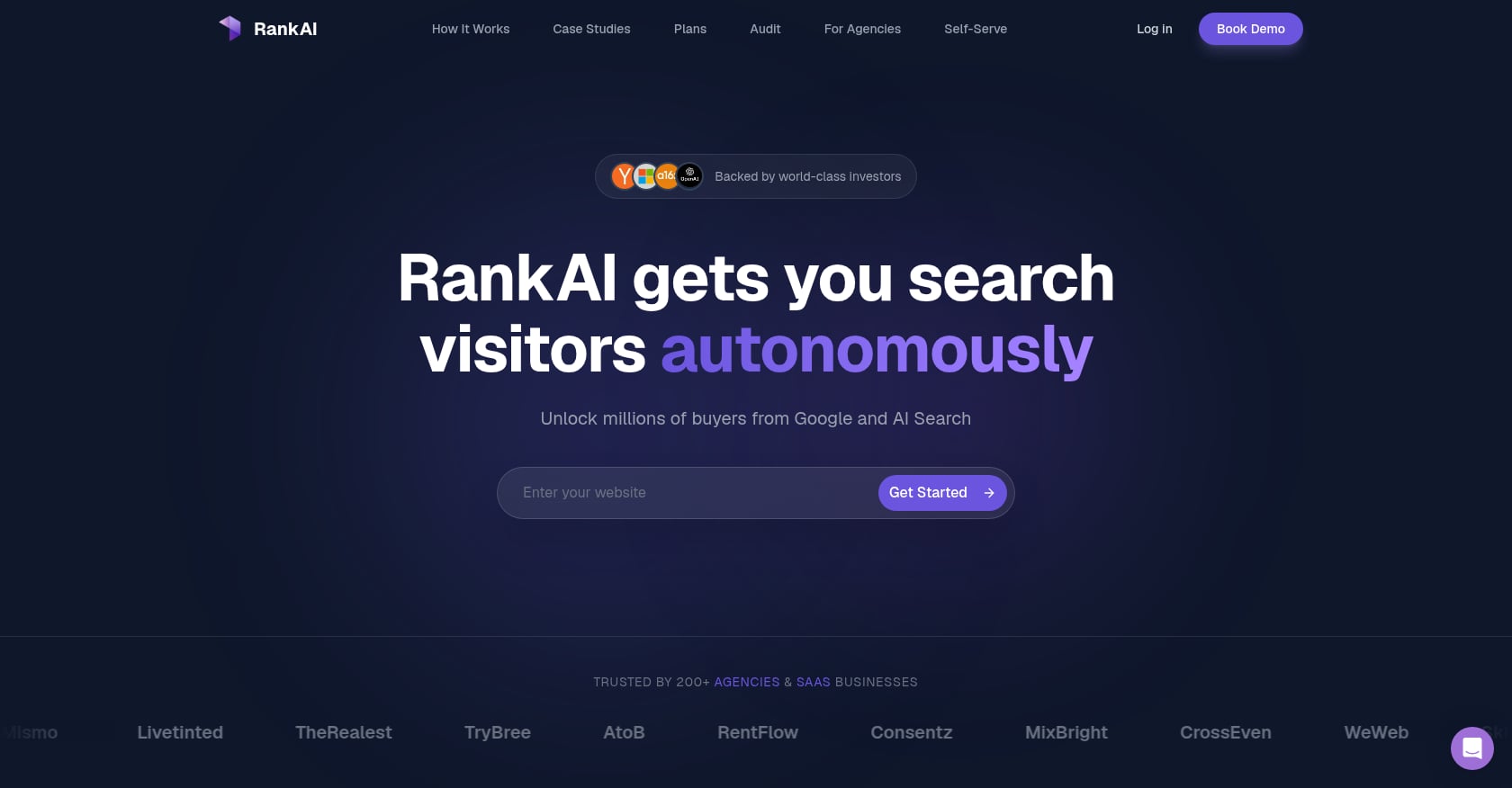
Rankai is a YC S23-backed service that combines AI-assisted content production with human SEO expertise. It is not a dashboard or a rank tracker. It is an execution engine: the team researches keywords, publishes pages, fixes technical issues, and rewrites underperforming content until it ranks.
Pricing:
- Standard Plan: $499/month (Early Bird)
- Includes 20+ pages created per month
- Continuous rewrites until pages rank
- Technical SEO fixes included
- Human-expert-vetted keyword and topic selection
- Cancel anytime; 7-day refund window after purchase
Key features:
- 20+ pages per month with internal links, metadata, visuals, and CTAs
- Performance monitoring with auto-flagging of underperforming pages after roughly three weeks
- Full rewrites and rebuilds when needed
- Weekly updates focused on rankings, traffic, and rewrite status
- CMS compatibility with WordPress, Shopify, Squarespace, Webflow, and Wix
- Technical SEO fixes included in the monthly scope
Where it falls short:
- The service does not emphasize Google Business Profile management, citation building, or review acquisition. Businesses still need to handle those separately.
- Case studies on the site use anonymized Google Search Console screenshots rather than named public examples.
- At 20+ pages per month for $499, prospects may wonder about content quality. The answer is human vetting, editorial review, and iterative rewrites, but it is worth asking about during a demo.
What users say:
A community post on Reddit described Rankai as an AI-powered SEO service with a “rewrite until it ranks” approach and rated it 4.2 out of 5, noting its WordPress/Shopify integrations and startup fit. Independent user reviews remain limited, which is typical for newer services.
Verdict:
Rankai is the strongest fit when your real problem is that nobody is building, optimizing, and improving the local service pages your website needs. A plumber who ranks for nothing because the site has a homepage and a contact page needs execution, not another dashboard. Pair Rankai with a disciplined Google Business Profile and review workflow for a complete local SEO foundation. If you want to understand what a flat-fee SEO retainer looks like in practice, that is worth reading before you buy.
2. Google Business Profile
Best for: Every local business, as the free foundation before any paid tool or service.
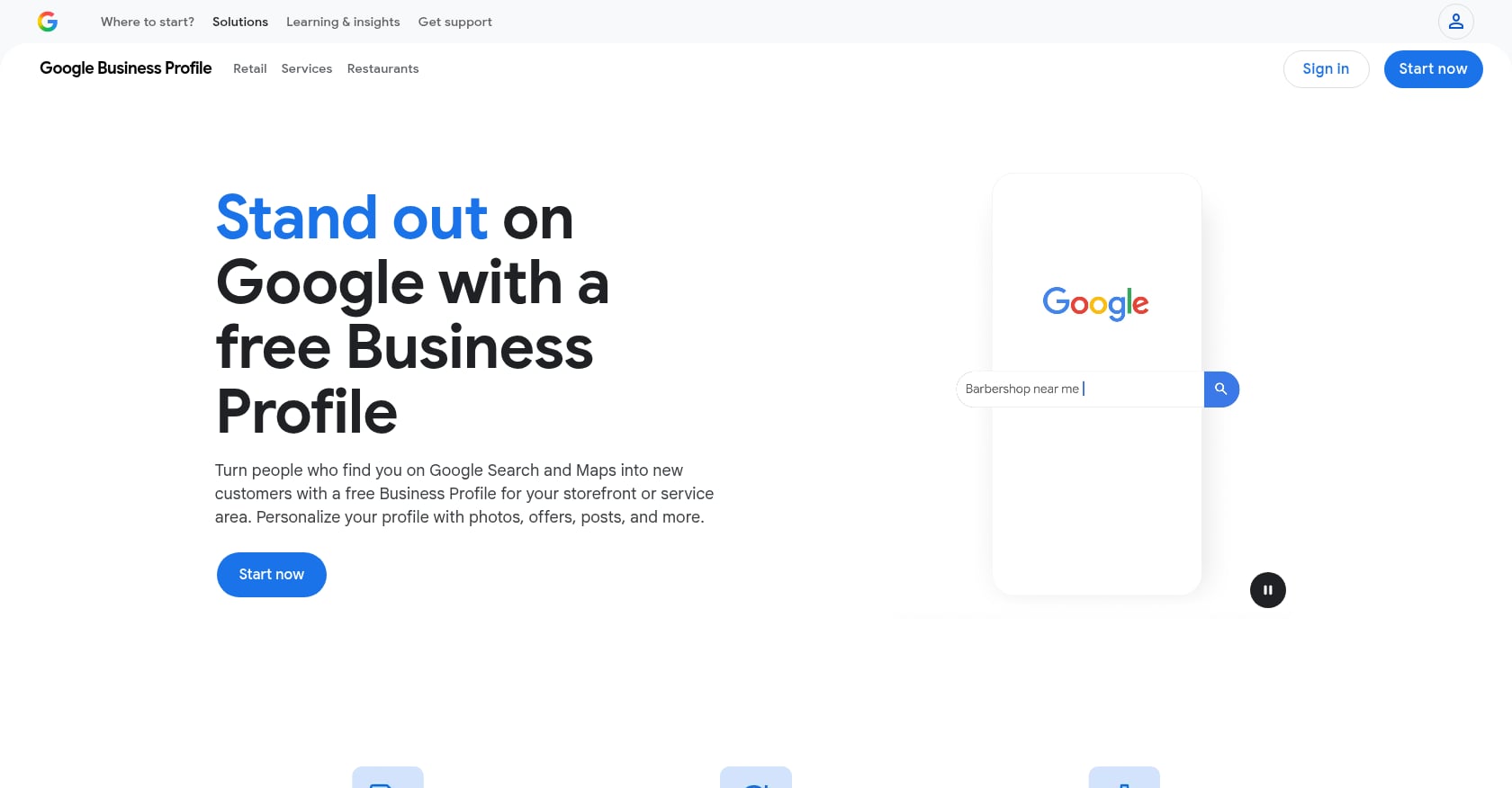
Google Business Profile is the starting point for local business search engine optimization. It controls what shows in Google Search and Maps when someone searches your business name or a relevant local query. It costs nothing to claim and manage.
Pricing:
- Free
Key features:
- Business name, address, phone, hours, special hours
- Categories and services
- Photos, videos, products
- Review management (reading and responding)
- Posts and updates
- Q&A section
- Performance insights (calls, directions, website clicks)
Where it falls short:
- It is entirely DIY. Nobody will optimize it for you unless you hire help.
- It does not replace website content, technical SEO, or a review strategy.
- It cannot make you rank far from your physical location. Practitioners on Reddit consistently remind clients that a business cannot rank number one “everywhere” because Google local rankings depend heavily on proximity.
- It is easy to set up once and forget, which leads to stale information and missed opportunities.
What practitioners say:
Reddit discussions describe GBP as foundational but not magic. One thread explains that effective local SEO combines GBP work with citations, reviews, location-intent keywords on the website, and trust-building activities like review QR codes and follow-up workflows. Several practitioners also debate Google Business Profile posts, with some treating them as freshness signals and customer touchpoints rather than direct ranking factors, and others recommending weekly high-quality posts over daily low-effort ones.
Verdict:
Do this first. If a paid provider does not ask about your Google Business Profile, categories, services, reviews, and profile access, that is a red flag. Spending on SEO tools or agencies before your free profile is complete and accurate is putting the cart before the horse.
3. BrightLocal
Best for: SMBs and agencies that need local SEO audits, rank tracking, citation checks, and review tools in one platform.
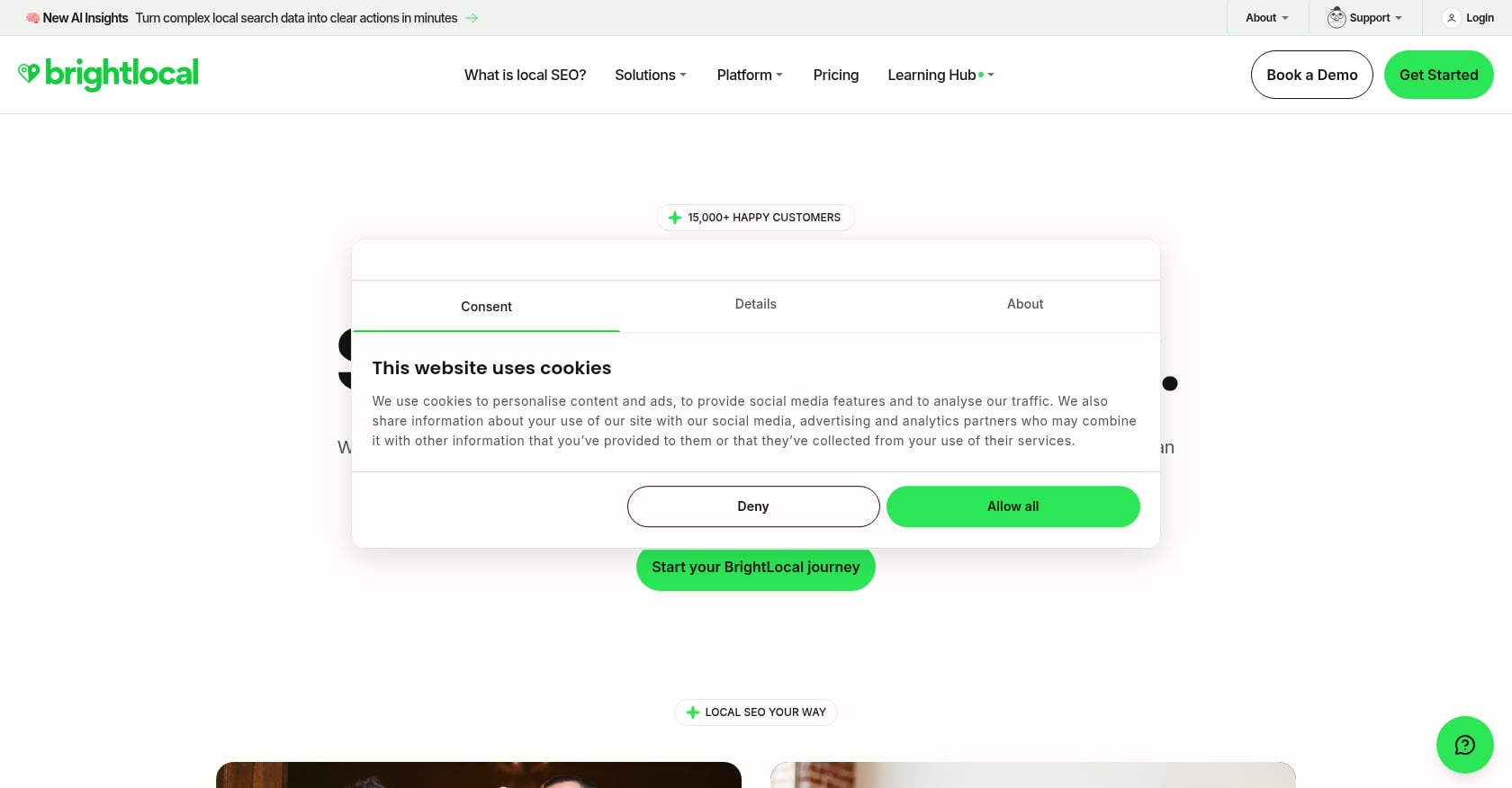
BrightLocal is a dedicated local SEO platform. Unlike general SEO suites, it is built specifically for local search: audits, local rank tracking, citation monitoring, GBP insights, and review management.
Pricing:
- Plans start around $39/month per G2’s pricing data
- Higher tiers (around $59/month) add features like listings management and review generation
- BrightLocal noted a July 1, 2026 pricing increase with annual plan savings available
- No permanent free version, but a trial is available
Key features:
- Local SEO audits and competitor insights
- Local rank tracking
- Citation accuracy monitoring
- GBP audit and post scheduling
- Review generation and management (higher tiers)
- White-label reporting for agencies
Where it falls short:
- It is software, not execution. Someone still needs to act on the audit findings and fix the problems.
- Citation building can be an add-on that surprises users who assume it is included.
- A business owner without SEO experience may struggle to translate audit data into action.
- It does not create or rewrite local service pages.
What users say:
G2 reviewers praise BrightLocal’s value, ease of use, and local data depth. Some note that citation credits and add-ons can create unexpected costs. Reddit discussions often position BrightLocal alongside Whitespark as the serious local SEO tool set, with users preferring it over general suites like Semrush for pure local reporting and citation management.
Verdict:
BrightLocal is one of the best choices for monitoring and managing local SEO work, whether you are doing it yourself or running it for agency clients. It diagnoses problems well. If you need someone to actually build the pages, create local landing pages, and fix technical issues, pair it with an execution service.
4. Semrush Local
Best for: Businesses already using Semrush or needing AI-assisted Google Business Profile and listings management across many locations.
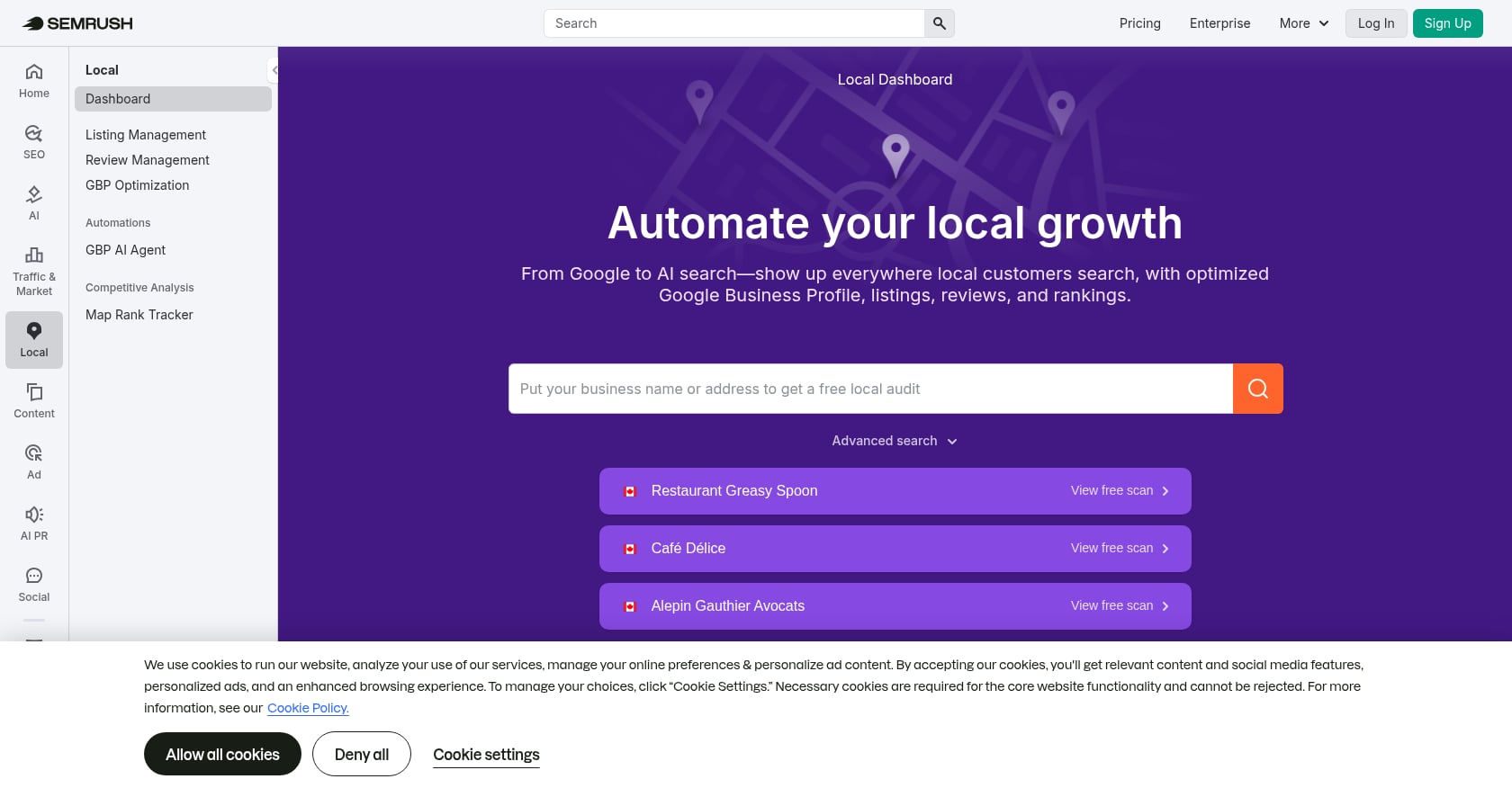
Semrush Local is an add-on (or standalone purchase) within the Semrush ecosystem. It focuses on GBP optimization, listing syndication, review management, and geo-grid rank tracking.
Pricing:
- Local Base: $30/month per location
- Local Pro: $60/month per location
- Custom pricing for 20+ locations
- Semrush pricing documentation outlines the full breakdown
Key features:
- GBP AI Agent for automated post generation and review replies
- Google Business Profile audit and optimization plan
- Geo-grid local rank tracking
- Listing management across 70+ directories (Pro tier)
- Review monitoring and generation (Pro tier)
- Competitor reports
Where it falls short:
- Per-location pricing compounds quickly. A business with five locations on the Pro plan pays $300/month just for this add-on.
- AI-generated GBP posts and review replies still need brand and compliance oversight.
- Local-only small businesses may find the full Semrush ecosystem overwhelming.
- It does not replace local service page creation or website-level technical SEO execution.
What users say:
Reddit practitioners often note that Semrush and Yext listing fees make more sense for enterprise or multi-location businesses. For pure local SEO reporting and citation management at smaller scale, BrightLocal tends to be the community favorite.
Verdict:
Semrush Local is strongest if you already live in the Semrush ecosystem or manage many locations. A single-location business looking for affordable SEO services will probably find it more software than necessary.
5. Whitespark
Best for: Citation building, local rank tracking, and businesses that want specialist local SEO knowledge.
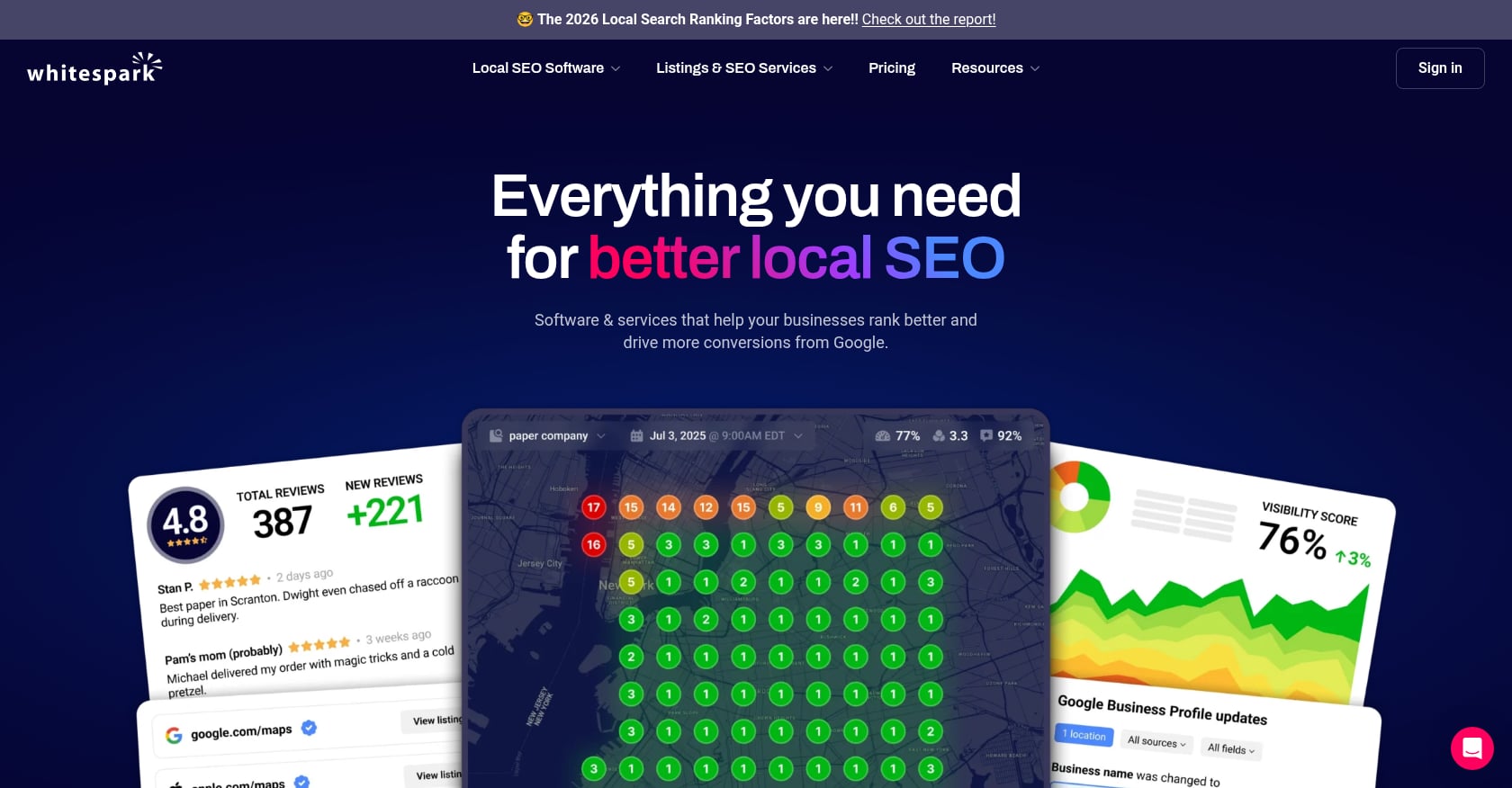
Whitespark has long been a respected name in local search. The company publishes local ranking factor research and offers both software tools and done-for-you services.
Pricing:
- Modular pricing that varies by tool and service
- Includes rank tracking, citation building, reputation tools, and consulting services
- Third-party comparisons describe Whitespark as an a la carte option rather than a single subscription
Key features:
- Local citation finder and building service
- Local rank tracker and ranking grids
- Reputation builder for review generation
- GBP reinstatement service
- Yext replacement service for businesses migrating off Yext
- SEO services and consulting
Where it falls short:
- The a la carte model means buyers need to know which pieces they need.
- Not positioned as a high-volume content publishing service.
- SMB owners without SEO experience may need a consultant to translate data into next steps.
What users say:
One Reddit review of Whitespark’s Local Ranking Grids praised its straightforward interface, speed, and clear pricing for rank checks and ongoing monitoring. Community discussions frequently pair Whitespark with BrightLocal as the two serious specialist tools in the local SEO category.
Verdict:
Whitespark is a strong specialist choice, especially for citation work and local ranking diagnostics. It is best used by someone who understands local SEO or has a consultant guiding the work. For the SEO citations basics, it helps to learn what they are before purchasing a building service.
6. Moz Local
Best for: Budget-conscious businesses that need basic directory and listing consistency.
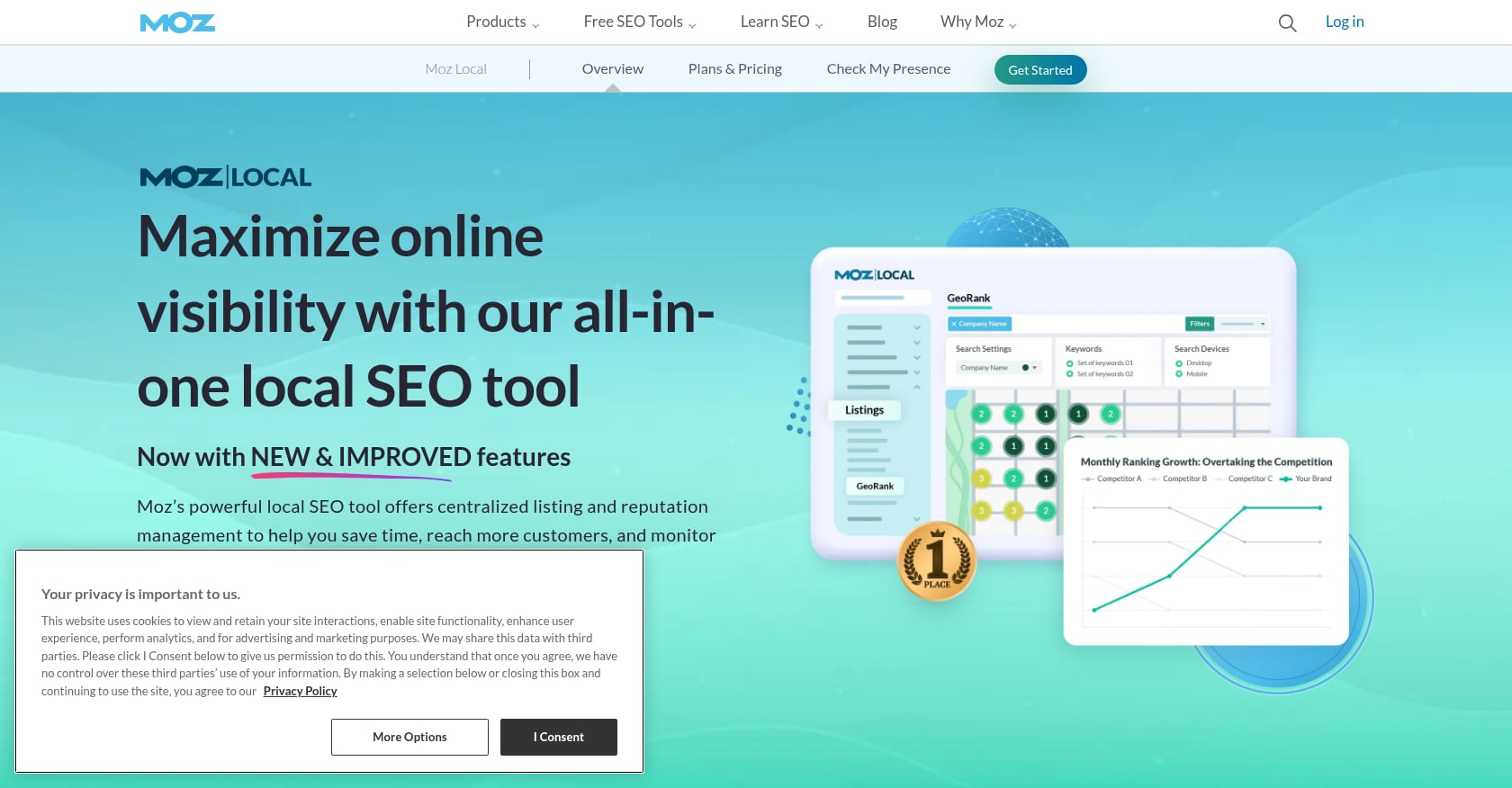
Moz Local keeps things simple. It focuses on listing management and reputation monitoring at a price point that works for single-location businesses and agencies with many clients.
Pricing:
- Plans from roughly $16/month to $33/month per G2’s pricing overview
- Tiers include Lite, Preferred, and Elite
- No permanent free version, though a free listing scan is available
Key features:
- Directory management across major platforms
- GeoRank tracking
- Review monitoring and responding (higher tiers)
- Sentiment analysis
- Social posting (higher tiers)
- Agency permissions
Where it falls short:
- Primarily a listings and reputation tool, not full SEO execution.
- Directory reach and advanced insights may feel limited unless you are on higher tiers.
- Does not create or rewrite local service pages.
- Costs rise with each location added.
What users say:
G2 reviewers generally position Moz Local as good value compared to higher-cost alternatives like Yext. Some mention that directory reach and advanced features may require upgrading beyond the basic plan.
Verdict:
Moz Local is a practical budget choice for fixing listing inconsistencies and getting basic local presence right. It should not be confused with a complete local SEO campaign.
7. Local Falcon
Best for: Businesses and agencies that need to see exactly where they rank on Google Maps, block by block.
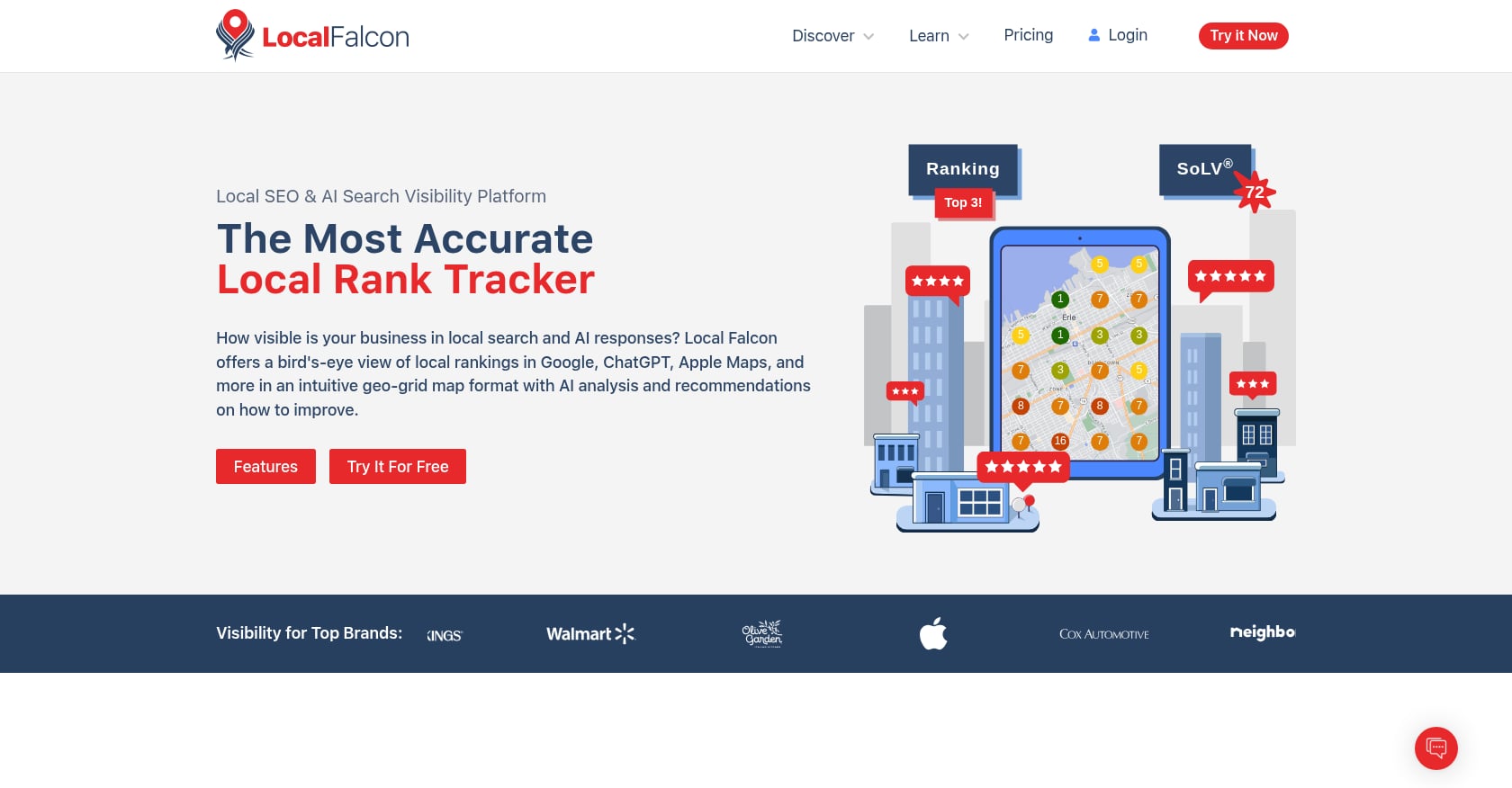
Local Falcon specializes in geo-grid rank tracking. Instead of checking one ranking from one location, it scans a grid across your service area to show where you are visible and where you are not.
Pricing:
- Starter: $24.99/month with 7,500 credits
- Pro: $99.99/month with 31,000 credits
- Free trial with 100 credits available
- Per G2’s pricing page
Key features:
- Geo-grid rank visualizations for Google Maps
- Apple Maps rank tracking
- Service-area business support with variable grid sizes
- Scheduled scans and campaign reports
- AI visibility tracking (ChatGPT, Gemini, AI Overviews, Grok)
- Looker Studio and Zapier integrations
Where it falls short:
- It tracks rankings. It does not fix the underlying causes.
- Credit-based scanning can get expensive if you run frequent scans or track many locations.
- Grid visuals can become vanity reporting if they are not tied to specific actions like improving pages, earning reviews, or updating GBP categories.
What users say:
G2 reviewers describe Local Falcon as reliable, accurate, and flexible. The most common concern is that extra credits and add-ons increase costs for heavy users. Practitioners on Reddit also note that different geo-grid sizes can show dramatically different visibility pictures, so rank tracking should be used to diagnose geography-specific weak spots rather than as a single vanity metric.
Verdict:
Local Falcon is excellent for understanding where your local visibility is strong or weak. Use the data to decide where to invest in better pages, reviews, GBP content, and local authority. A tracking tool paired with an on-page SEO strategy is more effective than either one alone.
8. Synup
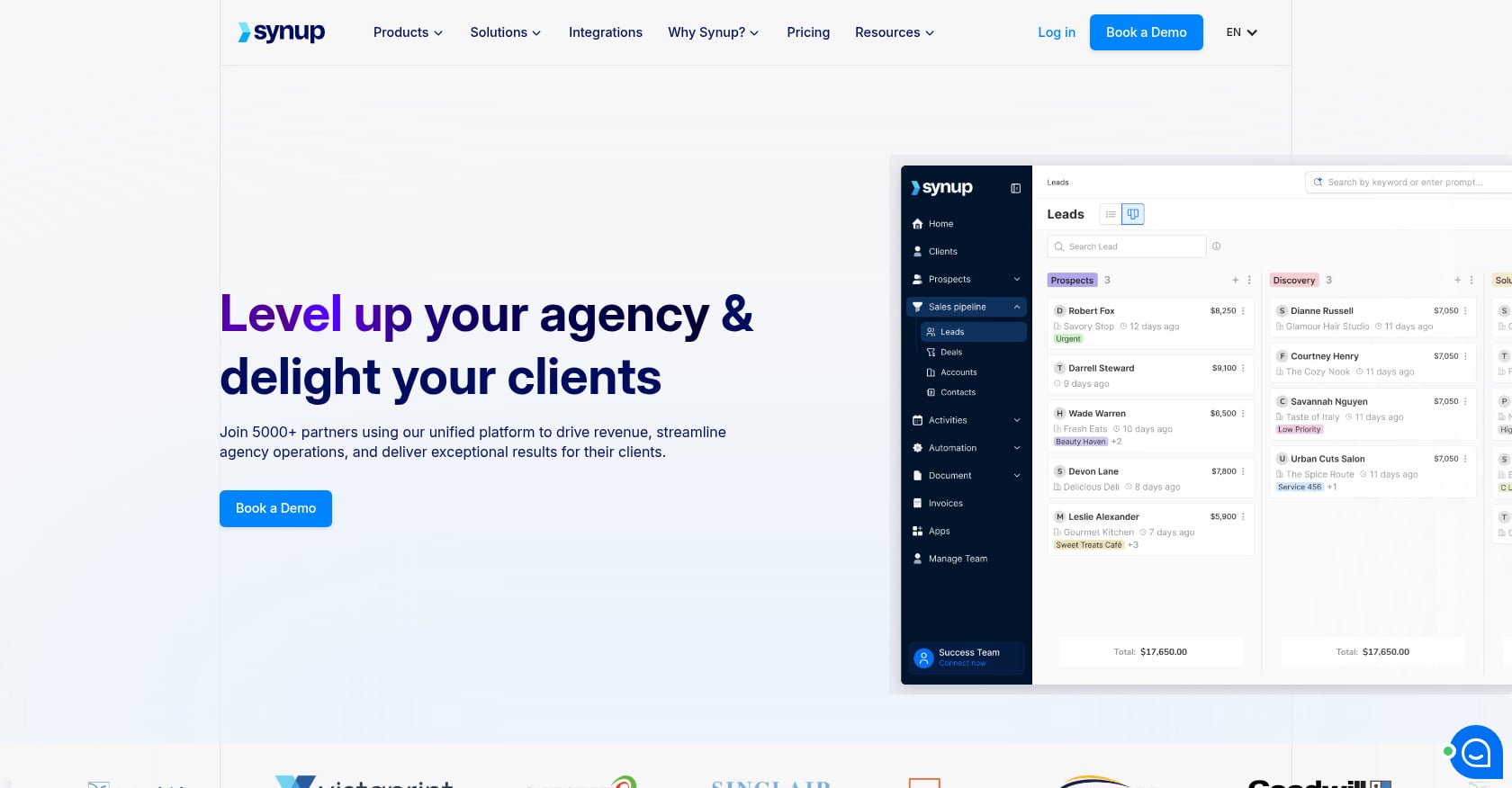
Best for: Digital agencies managing listings, reviews, social, and local SEO across many clients.
Synup is built as an agency operating system. It bundles listing management, review monitoring, social scheduling, SEO grid tracking, and client dashboards into one platform.
Pricing:
- Startup plan: $79/month (up to 5 team members, 25 client accounts)
- Plans go up to $799/month
- Annual billing saves 20%
Key features:
- Listings management across 10+ directories per location
- Review monitoring and review generation
- Social scheduling and posting
- SEO grid rank tracking with credits
- White-labeled client dashboards and emails
- API and MCP access
- Prospecting reports on higher tiers
Where it falls short:
- More agency-oriented than simple SMB software. A single-location business may find it overcomplicated.
- Some G2 users cite occasional sync delays and concerns about pricing at scale.
- Directory coverage on entry tiers may be limited.
- Like most platforms, it still requires someone to create strategy and build content.
What users say:
A G2 reviewer using Synup for over three years praised its support and ability to manage multiple directories, while noting sync delays and that pricing could feel high for smaller operations.
Verdict:
Synup is strongest for agencies that need an all-in-one operating platform for many clients. A single local business looking for straightforward search engine optimization help should probably start with simpler tools or a done-for-you service.
9. Yext
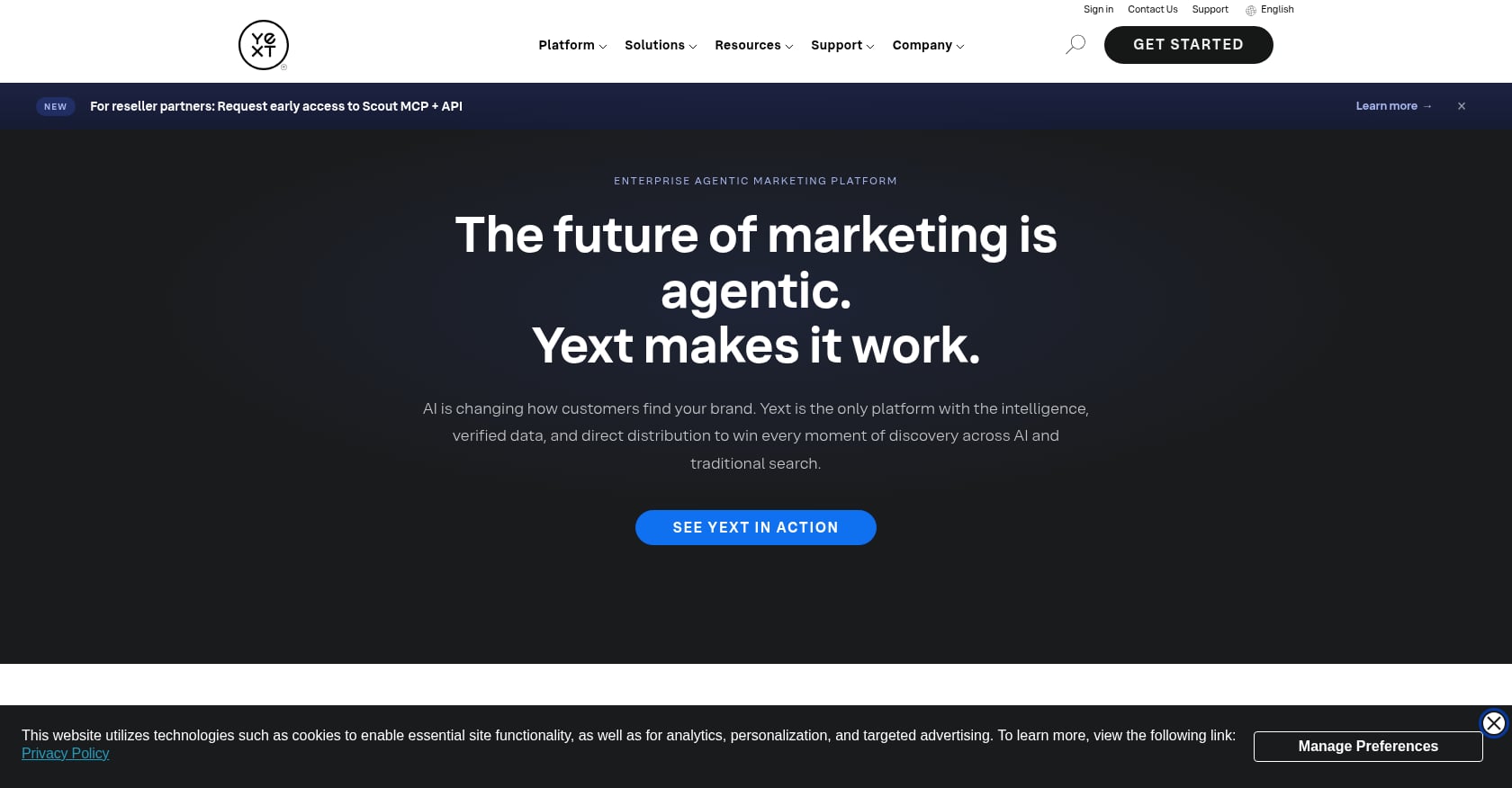
Best for: Multi-location brands (franchises, retail chains, healthcare networks) that need listings and review management at enterprise scale.
Yext is a digital presence platform built for businesses managing dozens, hundreds, or thousands of locations. It handles listing syndication, review monitoring, pages, and analytics across a wide directory network.
Pricing:
- Public PowerListings plans: $199/year (Emerging) to $999/year (Premium)
- Enterprise deployments are typically custom-priced by location count and feature set
- Yext’s plans page shows the public tiers
Key features:
- Listings management across a broad directory network
- Review monitoring (higher tiers)
- Pages and analytics (higher tiers)
- Enhanced content and digital presence management
- In 2026, Yext acquired Places Scout to strengthen local SEO and location intelligence capabilities
Where it falls short:
- Often overkill for a single-location local business. The pricing and feature complexity are built for scale.
- Custom pricing for enterprise reduces transparency for comparison shoppers.
- It manages presence and listings but does not solve content creation, technical SEO, or website conversion on its own.
- Businesses should confirm what happens to their listings and data if they cancel. Asset ownership is a common concern in practitioner discussions.
What users say:
Capterra lists Yext at 4.2 out of 5 from 114 reviews. Reddit discussions frequently mention that Yext makes more sense for businesses with many locations. Single-location businesses often find it expensive relative to alternatives like BrightLocal or Moz Local.
Verdict:
Yext is a serious platform for multi-location presence management. For most small local businesses, it is usually not the first place to spend a limited SEO budget.
10. Hibu
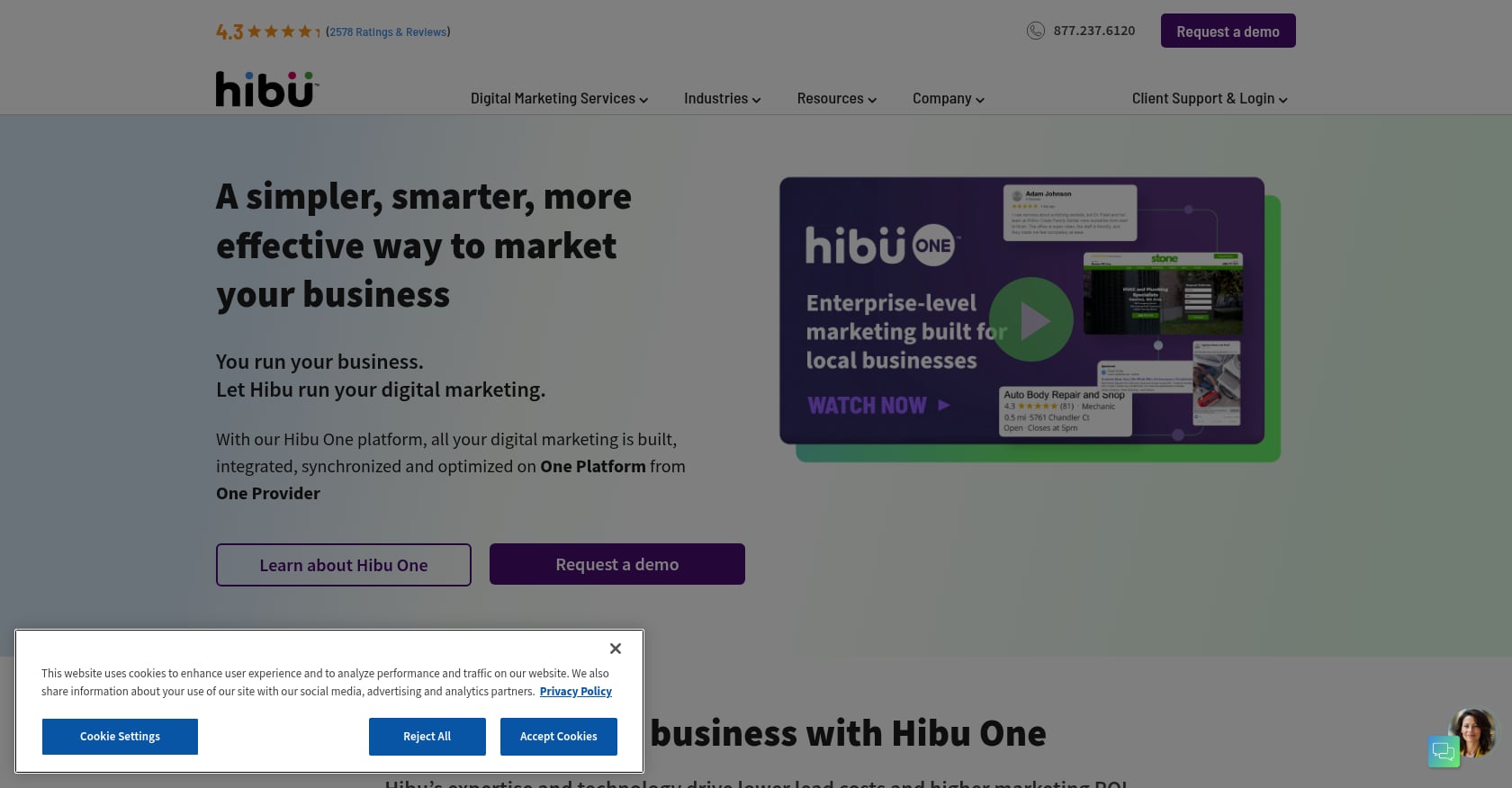
Best for: Business owners who want a single bundled provider for website, ads, SEO, and reputation, and are willing to vet the contract carefully.
Hibu offers an all-in-one managed marketing bundle for local businesses. The pitch is simple: one provider handles everything so you do not have to think about it.
Pricing:
- No public starting price. Hibu does not list pricing because campaigns are tailored to each business.
Key features:
- Integrated digital marketing including website, SEO, SEM, social, reputation, and CRM
- Fully managed by Hibu’s team
- Designed for owners who do not want to coordinate multiple vendors
Where it falls short:
- Pricing is not transparent, making comparison difficult.
- Bundled services can make it hard to attribute ROI to any single channel.
- Capterra’s value-for-money rating is 3.6 out of 5 from 79 reviews, with complaints about execution, wrong-city advertising, website control issues, and unclear reporting access.
- Contract terms, asset ownership, and cancellation details should be reviewed carefully before signing.
What users say:
Mixed to negative sentiment appears in recent Capterra and ConsumerAffairs reviews. Specific complaints include lack of transparency in deliverables, difficulty regaining control of websites, and advertising that targeted the wrong geography.
Verdict:
Hibu may appeal to owners who genuinely want one provider for everything. But the lack of pricing transparency and mixed reviews mean it should not be recommended above more transparent options. Before signing, confirm you own your website, Google Business Profile, call tracking numbers, and all reporting access.
What Should Local SEO Cost?
Pricing is one of the most common questions in local business search engine optimization, and one of the most confusing.
Here are the general ranges in 2026:
- DIY local SEO software: $16 to $100/month depending on the platform and plan.
- Done-for-you SEO execution: $499 to $5,000+/month depending on scope and provider.
- Enterprise local presence platforms: Custom pricing, often per-location, ranging from hundreds to thousands per year.
- Full-service local SEO agencies: Typically $1,000 to $5,000+/month for comprehensive campaigns.
The price alone tells you almost nothing. Practitioners on Reddit repeatedly point out that a $400 package might only include citation submissions and a ranking report, while a $1,200 package might cover GBP category optimization, service page creation, review strategy, and call tracking.
Common pricing traps to watch for:
- Per-location fees that look cheap for one location but multiply fast for franchises
- Citation building listed as an add-on when you assumed it was included
- Credit-based rank tracking that gets expensive with frequent scans
- Annual contracts that lock you in without clear deliverables
- Bundled marketing packages where you cannot tell which channel is driving results
- Custom quotes with no breakdown of monthly work
Rankai’s $499/month plan represents a strong value point for businesses that need content and technical execution without traditional agency pricing. For context on what to expect and what to look for in an SEO contract, it pays to understand billing models before committing.
What Should a Local SEO Provider Actually Do Each Month?
This is where most buyer confusion lives. Practitioners on Reddit consistently advise judging local SEO services by how clearly they explain the actual monthly work, not by “best agency” claims.
Month one setup should include:
- Google Business Profile audit (categories, services, hours, photos, Q&A)
- NAP consistency check across directories
- Review audit (count, recency, rating, response rate)
- Website technical audit (crawlability, indexation, metadata, speed)
- Service page and location page audit
- Google Search Console and GA4 connection
- Baseline map grid rankings
- Baseline calls, forms, and direction requests
Ongoing monthly work should include:
- Creating or improving local service and location pages
- Adding internal links between related pages
- Fixing technical SEO issues as they arise
- Updating GBP where relevant
- Requesting and responding to reviews
- Building or cleaning citations
- Tracking map rankings by area
- Tracking organic rankings and traffic
- Rewriting pages that are not ranking or converting
- Reporting on calls, forms, directions, rankings, and traffic
What is not enough:
- A one-time citation blast with no follow-up
- Generic blog posts with no service or location intent
- Ranking reports without any actual optimization work
- Fake reviews (Google penalizes this)
- Guaranteed number-one rankings (Google explicitly says this cannot be purchased)
- AI-generated content with no human review or local expertise
If you want to understand the technical SEO audit side of this checklist in more detail, that foundation matters for local pages too.
Local SEO Tools vs. Done-for-You Services
This is a distinction most competing articles fail to make clearly.
Choose software if:
- You have someone in-house who can execute the recommendations
- You need tracking, audits, listings, or reporting
- You manage multiple locations and need structured data management
- You want the lowest monthly cost
Choose a done-for-you service if:
- You lack time or expertise to execute SEO work
- Your website has thin or outdated content
- You need steady publishing of service and location pages
- You need technical fixes handled without hiring a specialist
- You are tired of agencies that send reports but do not produce work
Choose both if:
- You want execution (like Rankai for content and technical SEO) plus measurement (like BrightLocal or Local Falcon for audits and tracking)
- You need GBP, review, and listing management alongside website-level optimization
Explore Rankai’s tools to see how AI-assisted execution fits alongside the software platforms listed above.
Local SEO Red Flags to Watch For
Practitioners on Reddit care deeply about avoiding waste. Here are the warning signs that a local business search engine optimization provider is not worth your money:
- Guaranteed number-one rankings. Google says it cannot be done. Anyone promising it is either lying or does not understand how local search works.
- Fake review offers. This violates Google’s policies and risks account suspension.
- No access to your Google Business Profile. You should always own and control your profile.
- No Google Search Console access. If you cannot see your own data, that is a problem.
- No explanation of monthly deliverables. “Trust us” is not a work plan.
- “We build backlinks” with zero details. What kind? From where? Spammy links can hurt more than help.
- Reports that show impressions but never calls, forms, or direction requests. Vanity metrics without conversion data are not useful.
- Long contracts with no clear exit. Month-to-month flexibility protects you.
- The vendor owns your website, phone number, or listings. If you cancel, you should keep everything you paid for.
- No plan for review recency. BrightLocal’s 2026 survey found that 74% of consumers only care about reviews from the last three months, and 47% will not use a business with fewer than 20 reviews. Stale reviews are a liability.
- AI pages published with no human review. Content needs local context, accuracy, and editorial quality to perform.
Recommended Local SEO Stack by Business Type
Single-location service business
- Rankai for service and location pages plus technical SEO
- Google Business Profile (fully optimized)
- BrightLocal or Moz Local for listings
- Local Falcon if map visibility across neighborhoods matters
- A review collection workflow (QR codes, SMS, email follow-ups)
Brand new local business
- Google Business Profile first
- Moz Local or BrightLocal for initial listing distribution
- Start collecting reviews immediately
- Add Rankai once you need service pages and content velocity
Multi-location brand
- Yext, Synup, Semrush Local, or BrightLocal for listings and review operations at scale
- Rankai or an internal content team for location and service page creation
- Grid tracking by market
- Strong governance for hours, categories, and local pages across locations
Agency managing local SEO clients
- Synup, BrightLocal, Whitespark, or Local Falcon for reporting and management
- Rankai as a content execution layer if the agency needs scalable SEO delivery
- Clear per-client reporting tied to calls, forms, and rankings
Local ecommerce or Shopify store
- Rankai for Shopify-compatible SEO content and technical optimization
- Google Business Profile if a physical location or local pickup exists
- Reviews and local product pages
- Local schema markup where applicable
For a deeper guide on building service area pages that rank for local intent, that is a useful next step for any of these business types.
The Local SEO Buying Rule
Do not buy a local SEO package until you can name the bottleneck. Here is a quick diagnostic:
| What you are experiencing | Likely bottleneck | Where to start |
|---|---|---|
| “We do not show up on Maps” | GBP, listings, reviews, or proximity | Google Business Profile + citations + reviews |
| “We rank but do not get leads” | Conversion and landing pages | Service page rewrites, CTAs, phone tracking |
| “We have no pages for our services” | Content and on-page SEO | Done-for-you execution (Rankai) |
| “We rank in one neighborhood but not the next” | Geographic relevance and authority | Grid tracking + localized content + local links |
| “Our info is wrong everywhere” | Citations and listings | Moz Local, BrightLocal, Whitespark, or Yext |
| “We do not know what changed” | Tracking and reporting | Local Falcon, BrightLocal, or Search Console |
This framework makes the difference between spending wisely and buying whatever vendor shouts loudest.
FAQ
What is local business search engine optimization?
Local business search engine optimization is the process of improving a business’s visibility in local search results. That includes Google Search, Google Maps, the local pack, directories, review sites, and AI-assisted search tools like Google AI Overviews and ChatGPT. The goal is to appear when nearby customers search for your products or services.
Is local SEO worth it for small businesses?
Yes, when the business has local demand and can convert calls, visits, or bookings. Research from Google and Ipsos found that 76% of smartphone users who search for something nearby visit a related business within a day. For service businesses, restaurants, healthcare providers, home services, and retail, local SEO often delivers the highest-intent traffic available.
What matters most for local SEO rankings?
Google says local results depend on relevance, distance, and prominence. In practice, the most important levers are a complete and accurate Google Business Profile, strong and recent reviews, consistent NAP across directories, local service and location pages on your website, local links and mentions, and solid technical SEO.
How much does local SEO cost?
DIY tools can start under $50/month. Done-for-you services typically range from $499 to $5,000+ per month. Enterprise platforms often use custom or per-location pricing. The better question is always what work is actually included in the price.
Can I do local SEO myself?
Yes, especially the basics: claim your Google Business Profile, complete every field, add photos, request reviews, respond to reviews, fix NAP inconsistencies, and create pages for your core services. Ongoing content production, technical SEO, and competitive markets often require dedicated help.
How long does local SEO take to show results?
Low-competition markets can see movement within weeks after fixing major issues. Competitive markets often take three to six months. Variables include review velocity, proximity to searchers, website authority, competition density, and how much work needs to be done. Community discussions consistently cite competition level as the biggest variable.
Do I need a local SEO tool, an agency, or both?
Use a tool if you have someone in-house to execute the work. Hire a service if you need someone to plan, publish, fix, and improve pages. Use both if you need execution plus measurement. Most businesses eventually need some combination.
Does every local business need the same SEO setup?
No. A plumber and a dentist in the same city need different work even if the price is identical. Practitioners on Reddit frequently point this out: local SEO is not copy-paste. The right approach depends on your industry, competition, service area, review profile, website strength, and specific bottleneck.
Where to Start
The best local business search engine optimization strategy follows a simple hierarchy:
- Do the free foundation first. Google Business Profile: categories, services, hours, photos, reviews.
- Fix trust. Earn recent reviews. Respond to every one. Fix NAP inconsistencies. Add local proof to your site.
- Build the website layer. Service pages, location pages, FAQs, internal links, technical fixes.
- Track locally. Use map grids, Search Console, and call/form tracking to measure what matters.
- Iterate. Rewrite pages that do not rank or convert. Update strategy as competition and search behavior shift.
If you already have the basics but lack the time or expertise to build and improve local SEO pages every month, Rankai is the most direct option on this list. It gives local businesses a flat-fee execution engine for keyword strategy, content velocity, technical fixes, and ongoing rewrites, without the cost or opacity of a traditional agency.