TL;DR
AI-driven link prospecting tools help SEO teams find, qualify, and reach backlink opportunities faster, but fully automated outreach often produces spam and risky links. The best approach is hybrid: AI handles research, scoring, and drafting while humans approve targets and personalize pitches. This guide compares nine options by use case, pricing, AI features, and honest tradeoffs so you can pick the right stack for your team size and budget.
Link prospecting used to mean grinding through search operators, exporting Ahrefs spreadsheets, hunting for editor emails, and manually following up for weeks. AI can now compress parts of that process. But “AI-driven” does not mean “hands-off,” and the gap between useful automation and generic spam is where most teams go wrong.
Hunter’s 2026 outreach report, based on 31 million emails, found that sequences sent to 21 to 50 recipients outperformed blasts to 500+ recipients by 158%. Manually edited emails beat fully automated ones. And 69% of decision makers said AI use in outreach bothers them unless the output feels genuinely human.
The takeaway: AI-driven link prospecting is valuable when it helps you find better opportunities faster. It becomes risky when teams use it to blast generic emails or chase authority metrics without relevance.
Below are nine AI-driven link prospecting options ranked by use case, from done-for-you SEO execution to backlink intelligence, outreach CRMs, contact enrichment, and PR discovery.
If your real bottleneck is content and technical SEO, not backlink spreadsheets, Rankai handles that execution at $499/month with 20+ pages, technical fixes, and rewrites until pages rank.
At-a-Glance Comparison Table
| Tool | Best For | Starting Price | AI Role | Key Tradeoff |
|---|---|---|---|---|
| Rankai | SMBs wanting SEO execution, not DIY tools | $499/mo | AI content/SEO execution with human vetting | Not a standalone link outreach platform |
| Ahrefs | Competitor backlink gap research | $29/mo (Starter) | Data-layer AI for SEO research and analysis | No native outreach CRM; credits can limit research |
| Semrush | All-in-one SEO with link building workflow | ~$139/mo (Pro) | AI visibility, content tools, competitive data | Broad suite feels expensive and overwhelming |
| Pitchbox | Agency-scale outreach automation | $210/mo (Pro, annual) | AI personalization, templates, conversation agents | Higher cost and setup complexity |
| BuzzStream | Relationship-based outreach CRM | $49/mo (Starter) | Less AI-native; strong CRM/process layer | UI dated; AI depth lags newer tools |
| Respona | AI-assisted outreach with managed options | ~$198/mo or per-placement | AI variables, prospecting, contact discovery | Pricing model confusion; budget unpredictable |
| Postaga | Budget-friendly AI outreach for small teams | ~$84-99/mo | AI outreach assistant, campaign suggestions | Smaller review base; UX limitations |
| Hunter.io | Email finding and verification | Free plan; paid ~$34-49/mo | Email discovery/verification | Not a backlink prospecting engine |
| BuzzSumo | PR-led prospecting and content ideas | $199/mo | Content discovery, journalist/influencer research | Expensive; not a dedicated outreach CRM |
For deeper context on outsourced link acquisition, see our guide to link building services.
How We Evaluated AI Link Prospecting Tools
Transparency matters for a query like this, so here is how each option was assessed:
- Prospect discovery. Can it find relevant pages, competitor backlink gaps, resource pages, broken links, or unlinked mentions?
- AI usefulness. Does AI genuinely improve research, scoring, or personalization, or is it just a template generator?
- Contact data. Does it find and verify emails, or integrate with tools that do?
- Outreach workflow. Does it support sequences, follow-ups, inbox management, and reporting?
- Link-quality controls. Can users filter by relevance, traffic, authority, and spam risk?
- Pricing clarity. Are costs predictable, or do credits and per-placement fees create hidden spend?
- User sentiment. What do practitioners say on G2, Reddit, and Capterra?
- Best-fit buyer. SMB, agency, in-house team, digital PR, or enterprise?
What Counts as “AI-Driven” Link Prospecting?
Not every tool calling itself AI-driven actually uses AI in a meaningful way. It helps to separate them by what they do:
Database tools with AI support (Ahrefs, Semrush) use massive crawl data and increasingly add AI layers for competitive analysis, content suggestions, and visibility tracking.
Outreach CRMs with AI personalization (Pitchbox, Respona) automate prospecting, email personalization, and follow-up sequences with AI assistance.
Relationship and process CRMs (BuzzStream) organize outreach but rely more on workflow discipline than AI automation.
Contact enrichment and verification (Hunter.io) focuses on finding and validating the right email addresses.
Content-led PR discovery (BuzzSumo) helps teams find trending content, journalists, and linkable asset angles.
Done-for-you SEO execution (Rankai) handles the content, technical SEO, and iterative improvement that makes outreach worth doing in the first place.
A tool is not AI-driven just because it writes emails. The useful AI is in scoring relevance, summarizing prospect pages, identifying why your asset fits, and helping a human make faster decisions. For a broader look at automation in SEO, our SEO automation tools guide covers the full category.
The 9 Best AI-Driven Link Prospecting Tools
1. Rankai
Best for: SMBs and startups that want AI-assisted SEO execution instead of managing a link prospecting stack.
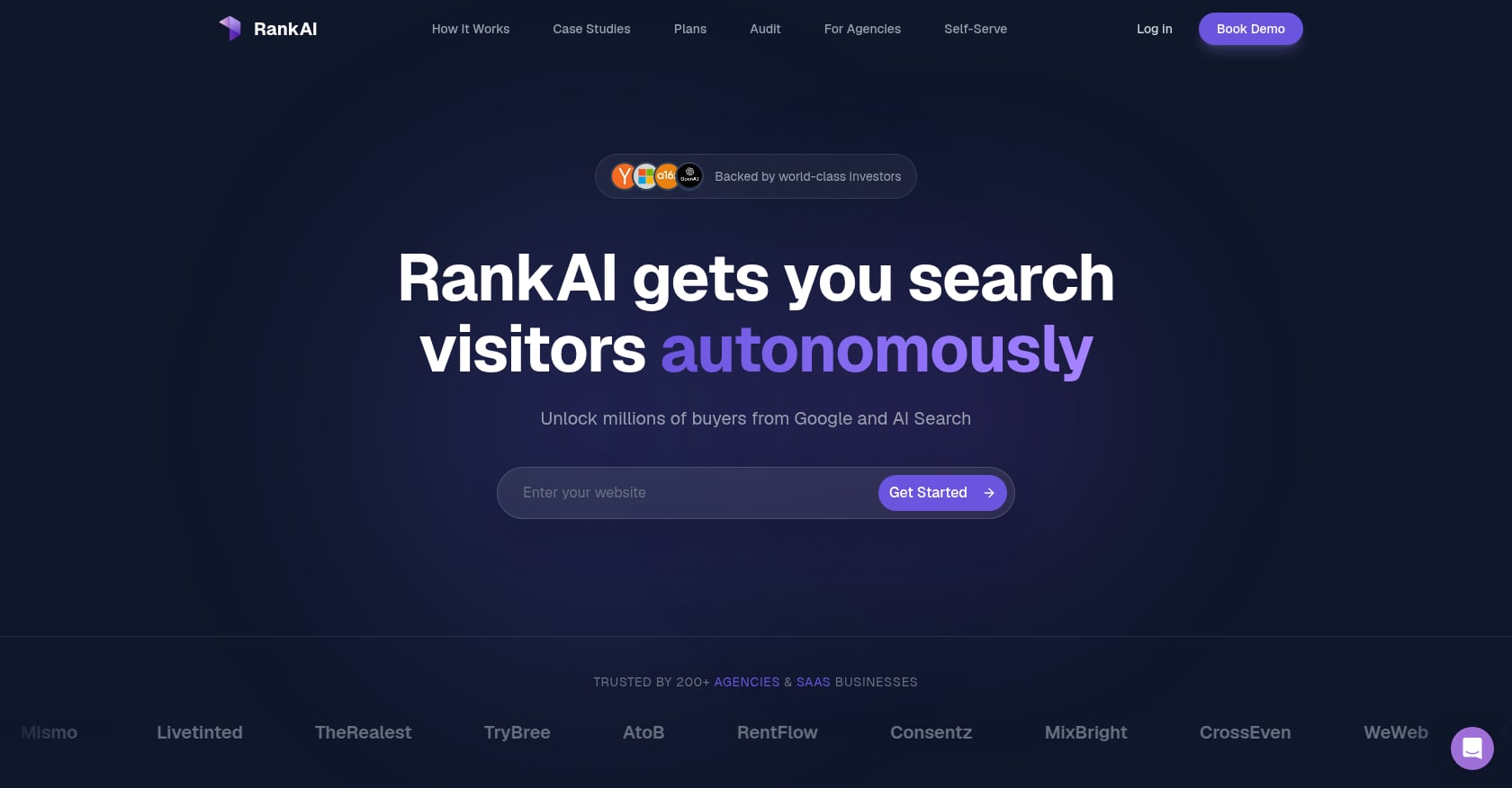
If the real goal is rankings and organic traffic, not collecting backlink prospects in a spreadsheet, Rankai is the stronger starting point. It handles the work that makes link outreach more likely to succeed: keyword strategy, high-volume content, technical fixes, internal links, and continuous rewrites.
Pricing:
- Standard Plan: $499/month (Early Bird)
- 20+ pages per month included
- Continuous rewrites until pages rank
- Technical SEO fixes included
- Human-expert-vetted keyword/topic selection
- Cancel anytime
Key features:
- Smart keyword selection vetted by human SEO experts, updated monthly
- 20+ pages per month with internal links, metadata, visuals, and CTAs
- Rewrite-until-it-ranks workflow with performance monitoring
- Technical SEO fixes covering crawlability, indexation, and metadata
- Weekly reporting focused on rankings, traffic, and rewrite status
- CMS compatibility with WordPress, Shopify, Squarespace, Webflow, and Wix
- YC S23 backed
Tradeoffs:
- Not positioned as a dedicated link prospecting or outreach CRM
- Off-page authority and link building are not highlighted as core services
- For very competitive SERPs, clients may still need dedicated digital PR or backlink outreach alongside Rankai’s on-page engine
The honest angle: If you want to run link outreach yourself, choose one of the dedicated prospecting tools below. If you want the broader SEO engine that makes outreach effective (content worth linking to, technical health, topical depth), Rankai is built for that.
Want to see how it works? Book a demo with Rankai to understand the execution model.
2. Ahrefs
Best for: Competitor backlink gap research and prospect intelligence.
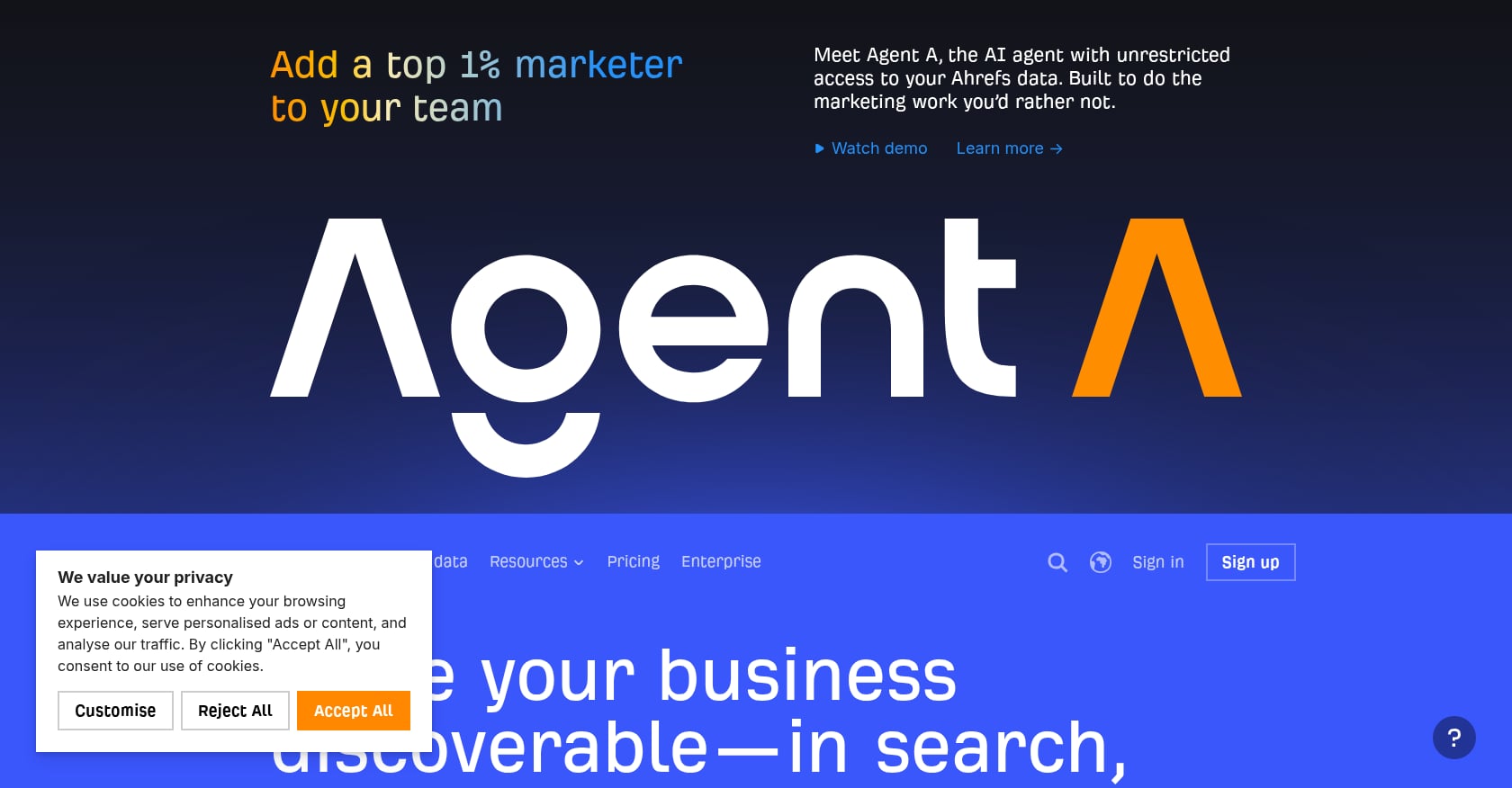
Practitioners on Reddit who tested dozens of AI SEO tools still default to Ahrefs for backlink data. One user in a 2026 thread testing 70 AI tools for SEO said AI-native tools had not matched Ahrefs for link prospecting intelligence yet. That says something: the best AI-driven workflow may start with a non-AI-native backlink database, because AI is only as good as the data it reasons over.
Pricing:
- Starter: $29/mo
- Lite: $129/mo
- Standard: $249/mo
- Advanced: $449/mo
- Enterprise: $1,490/mo
- Annual billing gives two free months on Lite and higher plans
Key features:
- Site Explorer for competitor backlinks
- Content Explorer for finding linked-to content and linkable asset ideas
- Backlink gap and competitor analysis
- Historical backlink data on higher plans
- Brand Radar for AI visibility use cases
- Site Audit, Rank Tracker, Keywords Explorer
Tradeoffs:
- No native outreach CRM or email sequencing
- Pricing and credit limits are painful for small teams
- Organic traffic estimates are third-party approximations, not a replacement for GSC/GA4
- Strong for research, weak for execution
User sentiment: G2 shows Ahrefs at 4.5/5 from 689 reviews. A 2026 reviewer praised it for finding competitor links and checking link quality, but criticized credits and higher-plan costs for link builders. Reddit discussions echo the same: powerful data, but pricing keeps climbing.
Verdict: Ahrefs is the best “brain” for AI-driven link prospecting, but not the whole machine. Pair it with an outreach CRM and a contact verification tool.
3. Semrush
Best for: All-in-one SEO teams that want backlink analytics and a link building workflow inside one platform.
Pricing:
- Pro: ~$139/mo
- Guru: ~$249/mo
- Business: ~$499/mo
- Semrush One: from ~$199/mo
- AI Visibility Toolkit: ~$99/month per domain as a separate add-on
Key features:
- Backlink Analytics and Backlink Audit
- Link Building Tool with built-in outreach workflow
- Competitor backlink research
- Keyword, content, and site audit tools
- AI visibility and AEO features in newer packaging
- Reporting and agency workflows
Tradeoffs:
- Expensive if link prospecting is the only need
- The platform can feel overwhelming because of the number of tools
- Some users prefer Ahrefs for backlink data depth specifically
- Add-ons raise total cost fast
User sentiment: G2 reviews praise Semrush as an all-in-one SEO platform but repeatedly mention high pricing for beginners and feature overwhelm. Reddit users in 2026 note that Semrush is powerful, but upsells frustrate freelancers and small businesses.
Verdict: Good fit for teams already committed to Semrush as their SEO operating system. If you only need backlink intelligence, Ahrefs may be more focused. If you need outreach execution at scale, Pitchbox or BuzzStream may be better.
4. Pitchbox
Best for: Agencies and in-house teams running high-volume AI-assisted outreach campaigns.
Pricing:
- Pro: $210/mo (annual)
- Advanced: $420/mo (annual)
- Scale: $825/mo (annual)
- Enterprise: custom
- Pro includes 2 users, 2 email accounts, 2,000 outreach emails/month, 25 campaigns/month
Key features:
- Prospecting searches with SEO integrations (Ahrefs, Semrush, Moz, Majestic)
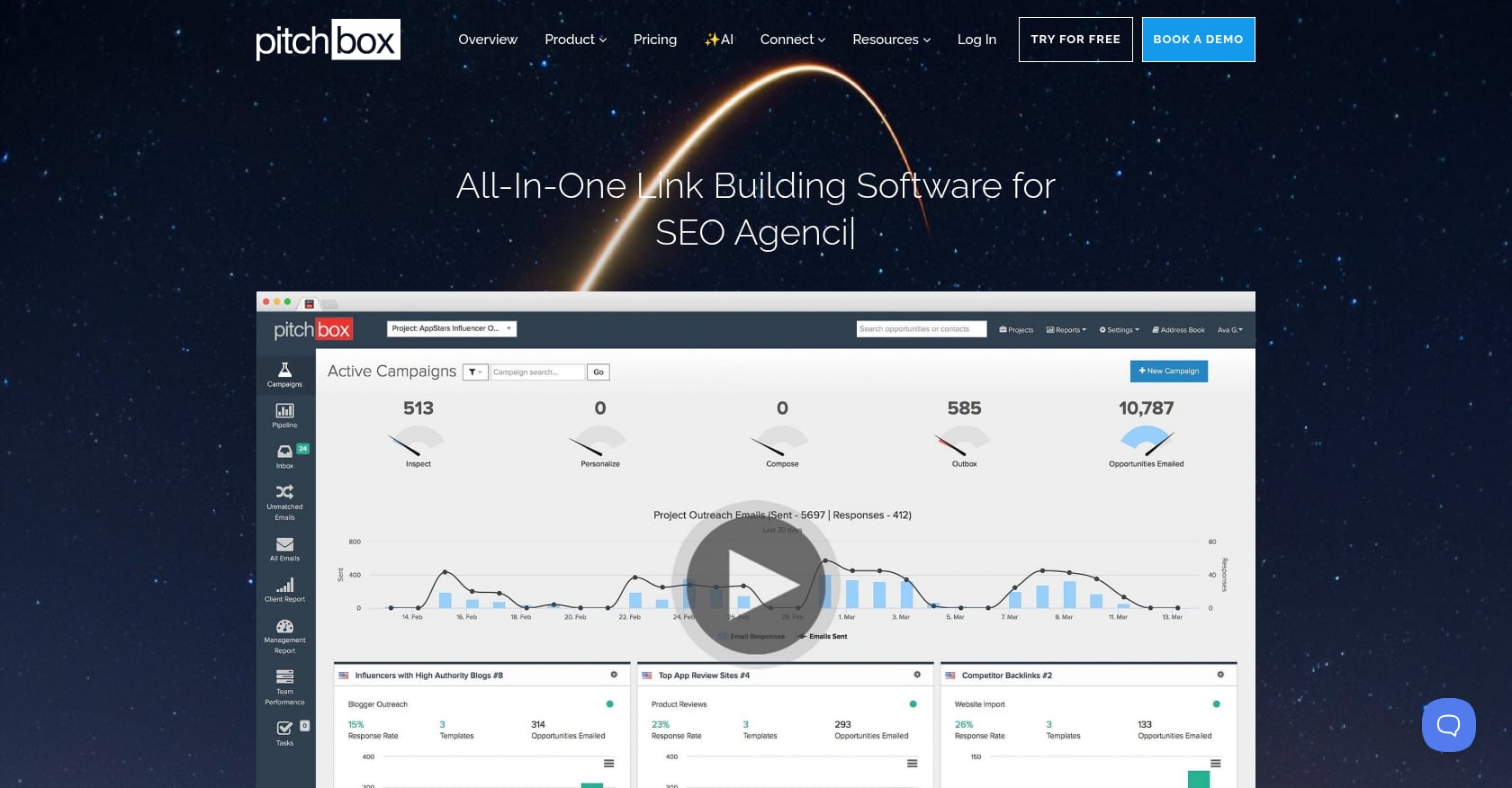
- AI-powered personalization and AI template creation
- AI conversation agents
- Conditional logic templates
- Email sequencing and automated follow-ups
- CRM, inbox management, link monitoring
- Campaign reporting and deliverability tools
Tradeoffs:
- Expensive for small teams or occasional prospecting
- Setup is not trivial, and users may need separate Google Workspace email accounts with SPF, DKIM, and DMARC configuration
- Contact suggestions still need manual review
- Out-of-office replies can distort response metrics
User sentiment: G2 shows Pitchbox at 4.7/5 from 98 reviews. Users praise automation and AI templates. One reviewer liked prospecting capabilities and data quality but noted the added cost of email setup. Another warned that contact suggestions can be poor or spammy.
Verdict: Pitchbox is the strongest option for teams running link outreach as an operation, not a side task. It is not cheap, but it is one of the most complete AI-driven link prospecting and outreach platforms available.
5. BuzzStream
Best for: Relationship-based outreach and digital PR teams that prioritize organization over automation.
Pricing:
- Starter: $49/mo
- Growth: $174/mo
- Professional: $424/mo
- Custom: from $999/mo
- Free trial available; no minimum term
Key features:
- Contact discovery and outreach CRM
- Email templates with open/click/reply tracking
- Follow-up reminders and automated follow-ups on higher plans
- Publisher/influencer metrics
- Chrome extension for prospecting
- Link monitoring and team collaboration
- Ahrefs integration on higher plans
Tradeoffs:
- Less AI-native than Pitchbox, Respona, or Postaga
- Prospect discovery may still require Ahrefs, Google, or BuzzSumo
- UI complaints are common across reviews
- Not a magic prospect-quality filter
User sentiment: G2 shows BuzzStream at 4.2/5 from 165 reviews. Reviewers praise outreach organization and campaign history tracking. A Reddit user who used BuzzStream for years said it may not be worth it unless someone does link building full-time, and complained about low-relevance issues in generated lists.
Verdict: BuzzStream is the best relationship layer for link prospecting, not a full AI engine. Choose it when the main problem is organizing outreach and remembering who was contacted, when, and what happened.
6. Respona
Best for: Teams that want AI-assisted outreach with a more packaged, service-like motion.
Pricing:
- G2 lists Starter from $198/month
- More recent 2026 reports describe a shift toward pay-per-placement pricing, commonly around $90 to $100+ per placement
- Pricing appears to have changed. Verify current pricing before purchase.
Key features:
- Prospect discovery and contact discovery
- AI variables for email personalization
- Outreach automation with follow-ups
- Collaborative inbox
- Campaign tracking
- Blogger outreach, PR, podcast, and link building workflows
Tradeoffs:
- Pricing and model confusion makes budget planning difficult
- Credits may be consumed quickly
- No free trial mentioned in recent reviews
- Human follow-up is still necessary to close good placements
- Not ideal for very budget-constrained SMBs
User sentiment: G2 shows Respona at 4.8/5 from 199 reviews. Positive reviews praise prospect discovery, verified contacts, and AI variables. One reviewer said Respona helped book many podcast appearances and editorial mentions but warned that people still need resources to continue conversations.
Verdict: Respona simplifies AI-driven link prospecting and outreach, but it is not “set and forget.” It starts conversations. Humans still close them.
7. Postaga

Best for: Small teams wanting affordable AI-assisted outreach without enterprise complexity.
Pricing:
- Third-party 2026 reviews place entry pricing around $84 to $99/month
- Verify current plans and credit limits before purchasing
Key features:
- AI Outreach Assistant with campaign suggestions
- Prospect research and contact finding/verification
- Personalized outreach emails
- Follow-up sequences
- Campaign analytics
- Supports link building, PR, sales outreach, and podcast outreach
Tradeoffs:
- Smaller review base and ecosystem
- UX and feature maturity concerns compared to Pitchbox
- Non-English personalization often needs manual editing
- Still requires human judgment on prospect quality
User sentiment: G2 reviewers praise Postaga for launching campaigns quickly and saving significant time. One user said it turns work that used to take weeks into an afternoon. Complaints include clunky UX, occasional bugs, and weaker personalization in non-English languages.
Verdict: Postaga is the “start here if Pitchbox is too much” option for AI-driven link prospecting. It helps small teams get out of spreadsheet mode without a large monthly commitment.
8. Hunter.io

Best for: Email finding, verification, and deliverability hygiene as part of any link prospecting workflow.
Pricing:
- Free plan with limited credits
- Paid plans starting roughly $34 to $49/month depending on billing cycle
- Credit-based: search credits for Domain Search/Email Finder, verification credits for Email Verifier
Key features:
- Domain Search and Email Finder
- Email Verifier with confidence scores
- Data source transparency
- Chrome extension
- Lead lists and basic campaign sending
- Contact enrichment
Tradeoffs:
- Not a backlink prospecting engine; it finds people, not link opportunities
- Not a full outreach CRM with advanced sequences
- Contact data can be stale
- Missing phone numbers and limited enrichment beyond email
User sentiment: G2 shows Hunter at 4.4/5 from 647 reviews. Users praise its speed, simple interface, and confidence scores. Practitioners on Reddit mention using Hunter or similar tools to pull contact info, then manually checking high-value prospects because automated data can miss details.
Verdict: Hunter is the contact-data layer that makes other AI-driven link prospecting workflows work. It is not the whole system.
9. BuzzSumo
Best for: PR-led link prospecting, journalist outreach, and finding content angles worth pitching.
Pricing:
- Plans range from $199/month to $999/month depending on tier
Key features:
- Content Analyzer for discovering high-performing linked-to content
- Trending Feeds and brand/keyword alerts
- Competitor content monitoring
- Influencer and journalist discovery
- Backlink monitoring on higher plans
- Social engagement data
Tradeoffs:
- Not a dedicated link outreach CRM
- Not primarily a backlink gap tool
- Pricing is high for small teams
- Advanced filters and backlink analysis require higher tiers
- Requires a strong content asset to pitch
User sentiment: G2 users praise BuzzSumo for content research and discovering high-performing content. Common complaints include time-consuming feed setup, expensive higher tiers, and limited data for niche topics.
Verdict: BuzzSumo answers the question most AI-driven link prospecting tools ignore: “What would people actually link to?” It is best for digital PR teams and content marketers who earn links through stories and research, not cold link requests.
The Best AI Link Prospecting Stack by Team Type
For SMBs and Startups
Start with Rankai for content velocity, technical SEO fixes, and rewrite loops. Add Hunter for contact verification if doing occasional outreach. Use a short-term Ahrefs subscription when running competitor research.
For Solo SEOs and Founders
Ahrefs Starter or Semrush Pro for research. Hunter for contacts. Google Sheets or a lightweight CRM for early workflow. Use AI to summarize prospects and draft emails, but manually approve every send.
For Link Building Agencies
Ahrefs plus Pitchbox. Hunter as a backup verifier. BuzzStream if relationship memory matters more than automation depth. Use internal QA scoring before any outreach goes out.
For Digital PR Teams
BuzzSumo plus BuzzStream or Pitchbox. Use AI for journalist and topic research. Build linkable assets, not just “please add my link” pitches. Understanding topical authority helps here because editors link to sites that demonstrate genuine expertise.
For Ecommerce and Local Businesses
Rankai for scalable content and technical fixes. Local and niche citation opportunities. Avoid paying for broad enterprise tools unless link outreach is an ongoing, staffed function. Our guide to ecommerce SEO covers the full strategy.
The 7-Factor AI Link Prospect Scoring Model
Most ranking pages for AI-driven link prospecting miss something important: a prospect is not valuable just because it has high DR or DA. Here is a scoring framework that adds the context AI alone cannot provide.
| Factor | What to Check | Why It Matters |
|---|---|---|
| Topical relevance | Does the site/page cover the same niche, audience, or problem? | Relevance beats random authority every time |
| Page-level fit | Would your link genuinely improve that exact page? | Editors respond to useful additions, not generic asks |
| Organic traffic quality | Does the page get real search traffic, and is it stable? | DR without traffic can hide low-value links |
| Editorial likelihood | Does the site update old content, publish guest experts, or cite external sources? | Some pages look good on paper but never add external links |
| Contact confidence | Is there a verified editor, author, or contact? | Poor contact data kills deliverability and wastes outreach |
| Risk footprint | Too many outbound links, casino/pharma links, noindex, PBN signals, thin AI content? | Avoid links that create long-term risk |
| AI visibility potential | Is the site cited or likely referenced in AI Overviews, listicles, or forums? | Mentions and citations increasingly matter beyond classic blue-link SEO |
Score each factor 0 to 2 (0 = reject, 1 = manual review, 2 = strong fit). Maximum score: 14. Only outreach to prospects scoring 10 or above. Manually review anything with high authority but low topical relevance.
This concept of AI visibility potential connects directly to how Google AI Overviews source information. Backlink prospecting should now include brand mentions, list placements, and citations because AI systems pull from trusted third-party sources, not only your owned site.
Where AI Link Prospecting Helps Most
AI adds genuine value in these areas:
- Finding competitor-linked pages across large datasets quickly
- Clustering prospects by niche and topic instead of raw authority
- Summarizing why a page is relevant before a human reviews it
- Drafting one or two personalized lines based on the prospect’s content
- Detecting low-quality domains through pattern matching
- Prioritizing pages likely to update based on publication frequency
- Identifying brand mention and listicle opportunities for broader visibility
- Tracking outreach outcomes and classifying which angles worked
Where AI Link Prospecting Fails
Here is where the process breaks down, and where many teams waste money:
Generic email blasts. Hunter’s data shows that smaller segmented lists dramatically outperform mass sends. Custom-domain sending saw 108% higher reply rates than freemail.
Fake personalization. Inserting “I loved your article about {{topic}}” without context fools nobody.
Overreliance on DR/DA. A DR 70 site with no traffic, hundreds of outbound links, and zero editorial standards is not a good prospect.
No reason for the editor to link. If you have nothing worth citing, no amount of AI prospecting fixes that. Investing in content that drives growth comes first.
Fully automated negotiations. Practitioners on Reddit consistently say AI makes a good link builder faster but does not turn a bad link builder into a good one. One 2026 r/linkbuilding discussion noted the skill gap is in judgment and relationships, not research speed.
Ignoring spam risk. Google’s spam policies define link spam as links created primarily to manipulate rankings, and violations can lead to lower rankings or removal from results. Any AI tool that builds links without relevance checks creates that risk.
A Safe AI-Driven Link Prospecting Workflow
Here is a repeatable process that uses AI without crossing into spam territory:
- Start with a linkable asset. If you have nothing worth citing, fix that first. Content velocity and quality are prerequisites, not afterthoughts.
- Pull competitor backlink gaps. Use Ahrefs or Semrush to identify who links to competitors but not you.
- Find page-level prospects. Resource pages, listicles, comparison posts, citations, broken links, unlinked mentions.
- Score prospects using the 7-factor model. Reject anything below 10 out of 14.
- Apply negative filters. Exclude noindex pages, sites with link-selling footprints, pages with massive outbound link blocks, irrelevant high-DR sites, thin AI-generated blogs, and domains you have already contacted recently. A Reddit builder scaling an AI link building tool said tight negative filters were the biggest win.
- Find verified contacts. Use Hunter, Pitchbox, Respona, or BuzzStream.
- Use AI for research notes, not final approval. Let AI summarize the prospect page and suggest an angle. Have a human confirm it makes sense.
- Write human-edited outreach. Short, relevant, specific.
- Send in small segments. Hunter’s data shows 21 to 50 recipients per sequence is the sweet spot.
- Track replies, links, mentions, and negative signals. Feed outcomes back into scoring so AI can help classify which angles worked.
Red Flags When Choosing an AI Link Prospecting Tool
Walk away if you see any of these:
- Claims of guaranteed rankings
- “Fully automated backlinks” without human review
- No ability to filter by topical relevance
- No deliverability controls or sender reputation guidance
- No transparent pricing or credit structure
- Promotion of PBNs or link farms
- Success measured only by link count, not quality
- No data export or CRM ownership
- No spam-risk checks built into the workflow
Final Recommendation
The right choice depends on what you actually need.
Choose Rankai if you are an SMB or startup and your goal is organic growth, not managing five subscriptions. Rankai handles content, technical SEO, keyword planning, and rewrites, which is the foundation that makes link outreach worth doing.
Choose Ahrefs if your bottleneck is finding and qualifying backlink prospects from competitor data. Choose Pitchbox if your team runs link outreach at scale across multiple clients. Choose BuzzStream if relationship history and outreach organization matter most. Choose Hunter if your main problem is finding and verifying emails. Choose BuzzSumo if your link strategy is PR and content-led.
The future of AI-driven link prospecting is not fully automated link building. It is AI-assisted human judgment, applied to fewer, better prospects that are relevant enough to matter and safe enough to keep.
Before investing in outreach software, make sure your site has content worth pitching. Rankai builds and improves that foundation every month for $499, with human expert vetting and continuous rewrites.
FAQ
What is AI-driven link prospecting?
AI-driven link prospecting uses artificial intelligence and SEO data to find, qualify, prioritize, and personalize outreach to websites that may link to your content. The best workflows use AI for research and drafting while humans approve targets and send outreach.
Can AI fully automate link building?
Not safely for quality links. AI can automate research, enrichment, and first drafts, but good links still require relevance, editorial value, and human relationship-building. Practitioners on Reddit consistently warn that fully automated AI link building often turns into spam or low-quality placements.
Is AI link building against Google’s guidelines?
AI itself is not the problem. Google’s spam policies focus on manipulative practices, including link spam created primarily to manipulate rankings. Any tool or workflow that creates unnatural links at scale without editorial value can create risk. The tool does not matter; the intent and quality of the links do.
What is the best AI link prospecting tool for small businesses?
For small businesses, the priority should be building content worth linking to before paying for outreach software. Rankai is a strong starting point for content velocity and technical SEO. If you need to run outreach yourself, Hunter for contacts and a short Ahrefs subscription for prospect research are enough to get started.
How much does AI-driven link prospecting cost?
Costs vary widely. Contact verification tools like Hunter start around $34 to $49 per month. Outreach CRMs like BuzzStream start at $49 per month. Full-stack outreach platforms like Pitchbox start at $210 per month. Backlink intelligence tools like Ahrefs range from $29 to $1,490 per month depending on data needs.
Should I use one tool or build a stack?
No single tool covers the full AI-driven link prospecting workflow, which spans prospect discovery, scoring, contact finding, outreach, follow-up, and tracking. Most teams need at least two: a research tool and an outreach tool. The exception is teams that outsource SEO execution entirely and focus on professional search optimization services instead.
How do I avoid getting flagged for spam when using AI outreach?
Send from a custom domain with proper SPF, DKIM, and DMARC records. Keep sequences small (21 to 50 recipients). Disable open tracking if possible. Manually edit AI-drafted emails before sending. Segment lists by relevance. Follow up no more than two or three times. And most importantly, only pitch when you have a genuine reason for the editor to link.
How many backlinks do I actually need?
It depends on the competitive intensity of your keywords. Backlinko’s analysis of 11.8 million search results found that the top-ranking result has an average of 3.8x more backlinks than positions two through ten. But the point is not volume. A few relevant, high-quality links from editorially trustworthy sites will outperform dozens of irrelevant placements every time.