A solid long tail keyword strategy is all about targeting those super-specific, less common search phrases to pull in traffic that's ready to act. Instead of throwing your budget at broad, competitive terms, this approach helps you capture people who have a very clear goal in mind.
It’s about being the big fish in a small, profitable pond.
Why Long Tail Keywords Are Your Biggest Untapped Asset
Let’s be honest. Trying to rank for a massive keyword like "CRM software" can feel like yelling into a hurricane. You're up against industry giants with deep pockets, all fighting for an audience that might just be window shopping. Are they students writing a paper? Or are they VPs of Sales with a credit card in hand? Who knows. The intent is a total mystery.
This is where a smart long tail keyword strategy completely flips the script. It's the perfect playbook for businesses that need to outmaneuver, not just outspend, the competition.
The Power of Specificity
Forget "CRM software" for a minute. Now, picture someone searching for "CRM for small real estate agencies." The search volume is obviously much lower, but the person behind that query has a specific problem and is actively looking for a solution. They aren't just browsing—they're on a mission.
This is the magic of long-tail keywords. You stop trying to attract everyone and start focusing on attracting the right one at the exact moment they're ready to make a decision.
This targeted approach lets you sidestep the mosh pit of generic keywords. You’re not just another voice in the crowd; you’re the definitive answer for a clearly defined audience. This is how you build real authority and trust, one specific search query at a time.
This diagram shows how the strategy works in practice, shifting your focus from high-competition, low-intent terms to the high-conversion goldmine of niche queries.
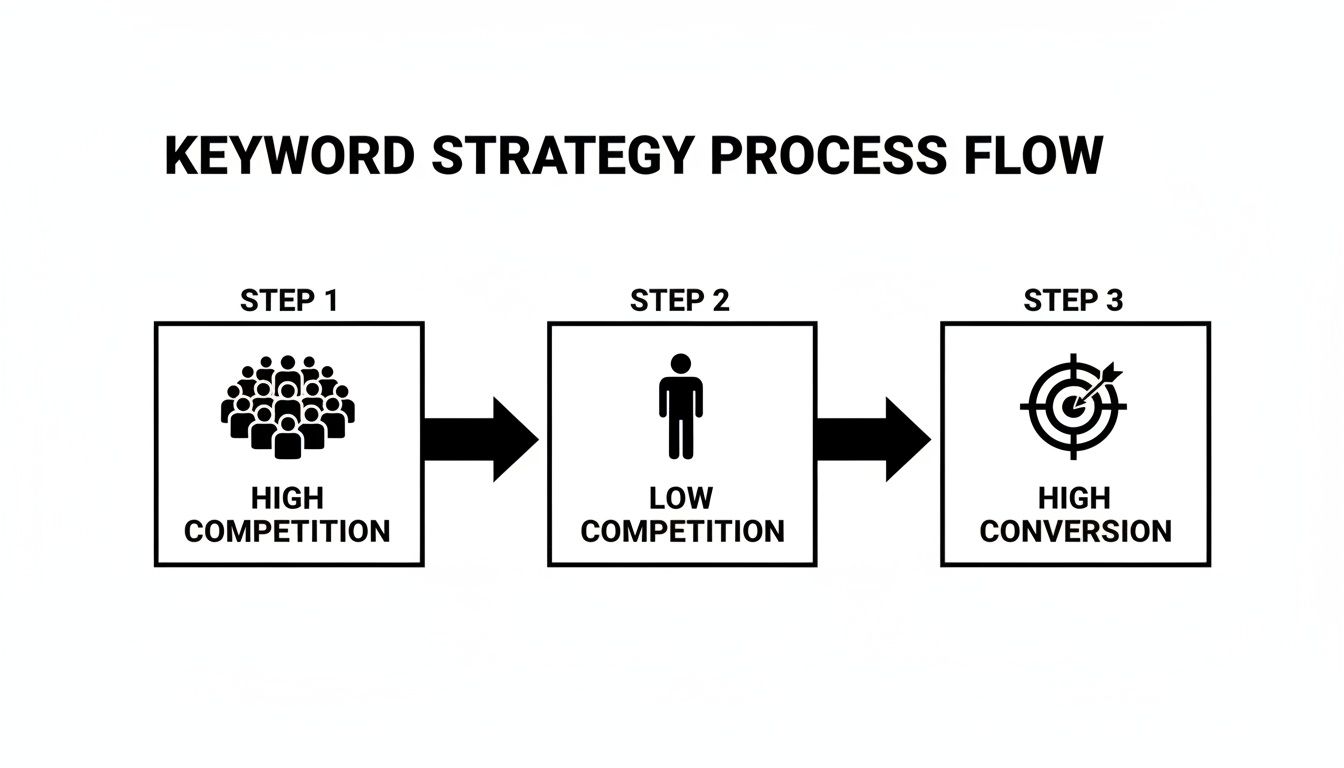
As you can see, the real growth happens when you zero in on those niche audiences. That's where the conversion potential skyrockets.
Head Terms vs. Long Tail Keywords at a Glance
To really understand the strategic difference, it helps to see a direct comparison. Head terms have their place, but long-tail keywords are where the real, measurable action happens for most businesses.
| Attribute | Head Keywords (e.g., 'SEO software') | Long Tail Keywords (e.g., 'AI SEO tool for SaaS content') |
|---|---|---|
| Search Volume | Very High | Low to Medium |
| Competition | Extremely High | Low |
| Conversion Rate | Low (0.5% - 2%) | High (10% - 25%+) |
| User Intent | Broad, often informational | Specific, often transactional or commercial |
| Content Focus | General, top-of-funnel | Niche, bottom-of-funnel |
| Cost (PPC) | Very Expensive | Inexpensive |
The takeaway is clear: long-tail keywords offer a more efficient path to acquiring high-quality leads and customers who are much further down the buying funnel.
Unlocking the Majority of Search Traffic
It's a common misconception that short, popular keywords are the key to traffic. The data paints a completely different picture.
A mind-boggling 70% of all search traffic actually comes from long tail keywords. While those big, one or two-word head terms get all the attention, they only make up about 10-15% of total searches. For a deeper dive into this, you can check out these long tail SEO insights.
This means the biggest growth opportunity isn't in the crowded "head" of the search demand curve. It’s waiting for you in the long, expansive "tail."
Finding the Keywords Your Customers Actually Use
When it comes to keyword research, most people immediately jump into a tool like Ahrefs or Semrush. And while those platforms are fantastic, they shouldn't be your first stop. The most potent, high-intent keywords aren’t found in a database—they’re hidden in plain sight, right inside your own business.
Your goal is to find the exact language people use when they're stuck, confused, or looking for a solution. It’s raw, it's real, and it converts. Your customer-facing teams hear it every single day.
Uncover Keywords in Your Own Backyard
Before you even think about search volume, you need to mine your internal communications. This is where you'll find the authentic voice of your customer, and it's pure gold for your content strategy.
- Customer Service Tickets: Go through your support desk logs. The subject lines are often perfect long-tail keywords. A ticket titled, "how do I connect my sales report to the dashboard," isn't just a support query; it's a content idea with built-in intent.
- Sales Call Notes & Transcripts: Your sales reps are on the front lines, hearing every objection and question imaginable. Look for patterns in their notes. Phrases like, "does your tool work for a distributed marketing team," are bottom-of-the-funnel questions you can answer directly with a blog post or landing page.
- Live Chat Transcripts: Live chats are unfiltered and immediate. People often ask those final, make-or-break questions right before they buy. These are the last hurdles in their decision-making process and are perfect targets for long-tail content.
These internal sources give you the real, messy, human language that forms the foundation of a content plan that actually resonates.
Let Google's Clues Guide Your Content Clusters
Once you have a handful of these real-world phrases, it's time to use Google to see the bigger picture. Google's own search features are designed to understand and predict what users really want, making them an incredible—and free—research tool.
Start with the "People Also Ask" (PAA) box. This feature is a goldmine for mapping out an entire topic cluster from a single seed idea. A simple search can instantly show you four or five related questions people are actively asking.

As you can see, a broad term quickly blossoms into multiple, highly specific long-tail queries. Each one points to a different user need or stage in the buying journey.
And don't forget to scroll to the bottom of the page. The "Related Searches" section shows you where other searchers went next, giving you a glimpse into their thought process. For a deeper dive on this, check out our guide on unlocking SEO insights with Google's Related Searches.
Pro Tip: Here’s a simple workflow. Take a question from a sales call transcript, pop it into Google, and then harvest the PAA and Related Searches. In about five minutes, you can build a list of 5-10 highly relevant long-tail keywords for a single content piece.
Eavesdrop on Online Communities and Forums
Finally, get out of your own bubble and go where your potential customers are having candid conversations. Places like Reddit and Quora are treasure troves of conversational, problem-focused keywords that signal serious intent.
Just search for your core topic—say, "project management software"—and browse the threads. You'll find people:
- Asking for recommendations: "What's the best project management tool for a small nonprofit?"
- Venting about their current tools: "I'm so tired of my current tool's clunky interface, any alternatives?"
- Comparing products head-to-head: "Has anyone used [Product A] vs. [Product B] for agile sprints?"
Every one of these posts is a content opportunity waiting for you. When you build your strategy around these real-world pain points, you attract visitors who aren't just browsing—they're actively looking for a solution. And that's how you win.
Connecting Keywords to Your Customer's Journey
A long list of keywords is just raw data. It's a starting point, but the real magic happens when you connect those phrases to what your customer is actually thinking and feeling at each step of their buying process. This is how you stop chasing random traffic and start building a guided path that leads people straight to your solution.
This process is often called intent mapping, and it’s all about making sure every piece of content you create has a clear job to do. You're meeting your audience exactly where they are—whether they’re just figuring out they have a problem or they're one click away from buying.

Mapping Keywords to the Three Core Stages
Look, every customer goes through a fairly predictable journey. By sorting your long-tail keywords into these stages, you can build a content plan that actually nurtures people from initial curiosity to a final, confident decision.
Let's walk through this with a real-world example. Imagine you're a SaaS company selling project management software.
1. The Awareness Stage (Top of the Funnel)
At this point, people aren't even thinking about buying a product. They’re just trying to put a name to a problem they're having. Their searches are broad, question-based, and focused on symptoms, not solutions.
- Their Problem: "My team keeps missing deadlines and communication is a total mess. What's going on?"
- Their Long-Tail Keywords:
- "how to improve team productivity"
- "common reasons for project delays"
- "tips for managing remote team communication"
- "ways to track employee workload effectively"
Your job here is to be helpful, not salesy. Create content like blog posts, checklists, and guides that offer genuine advice. The goal is to become the trusted resource they remember.
2. The Consideration Stage (Middle of the Funnel)
Once someone understands their problem, the hunt for a solution begins. Their searches get more specific as they start comparing different types of tools, methods, or platforms. They know what they need, but they haven't picked a brand yet.
- Their Problem: "Okay, I definitely need a tool or a system to fix this. What are my options?"
- Their Long-Tail Keywords:
- "best project management tools for remote teams"
- "[Competitor A] vs [Competitor B] comparison"
- "Asana alternatives for small business"
- "project management software with time tracking features"
Now’s the time to introduce your product as a contender. This is where you publish detailed comparison pages, in-depth case studies, and feature breakdowns that show exactly how you solve their problem.
3. The Decision Stage (Bottom of the Funnel)
This is it—the final step. The person is ready to commit. Their searches are now highly specific, often including your brand name or transactional terms. They’re just looking for that last bit of validation before they pull the trigger.
- Their Problem: "I think this is the right tool, but I need to be sure about the price and how it works with our other software."
- Their Long-Tail Keywords:
- "[Your Brand] pricing plans"
- "how to integrate [Your Brand] with Slack"
- "[Your Brand] free trial"
- "reviews for [Your Brand] project management tool"
Content for this stage needs to knock down any final barriers. That means crystal-clear pricing pages, simple implementation guides, compelling customer testimonials, and easy-to-find demo requests. Don't make them hunt for it.
Why This Intent-Driven Approach Just Works
When you align your content with the customer journey, you're speaking directly to a searcher's immediate need. This laser focus is precisely why long-tail keywords are such a conversion powerhouse.
The numbers don't lie. Long-tail keywords have an average conversion rate of 36%, which absolutely demolishes the benchmarks for even the most optimized landing pages. Why? It's all about intent. Someone searching for "best lightweight waterproof hiking boots for women" is miles further down the buying path than someone just typing "hiking boots." You can dig into more of the data behind long tail keyword conversions to see the full picture.
By building a content map that assigns specific keyword groups to each stage, you ensure every article and landing page has a purpose. You aren't just ranking for random terms; you're creating a seamless experience that guides prospects toward becoming customers. This turns your blog from a simple collection of posts into a sophisticated, high-performance conversion engine.
Building Content That Ranks and Converts
You've done the hard work of finding high-intent keywords and mapping them to your customer's journey. That's a huge win. But now comes the real test: turning that strategy into actual content that pulls in traffic and, more importantly, converts.
The goal isn't just to churn out blog posts. It’s about creating a smart, interconnected content ecosystem that Google can’t help but see as an authority in your niche.
So, how do you build this content machine without burning out your team? The secret is the topic cluster model. This is a powerful way to organize your content that makes perfect sense to both your readers and the search engines.
A topic cluster really just has two main parts:
- A pillar page, which is a comprehensive guide covering a broad topic.
- Several cluster pages, where each one drills down into a specific long-tail keyword related to that main topic.
The magic happens when you link all the cluster pages back to the central pillar page and have the pillar page link out to them. This creates a tight-knit web of content that screams expertise.
Designing Your Pillar and Cluster Content
Think of your pillar page as the "definitive guide" to something big, like "Project Management for Startups." It's a meaty piece of content, often 2,000 words or more, that gives a solid overview of the subject. This is the page you're hoping to rank for a competitive, high-volume term.
Your cluster articles, on the other hand, are the specialists. They go deep on the very specific long-tail keywords you found, like "how to choose project management software for a small team" or "best agile project management tools for SaaS." Each one is designed to answer a single, very specific question better than anyone else. For a closer look at this strategy, check out our practical guide to using a keyword cluster for SEO dominance.
This approach completely changes the game. Instead of just writing one-off articles and hoping for the best, you're building a library where every piece supports the others.
A well-executed topic cluster tells Google, "We don't just know a little about this topic—we're the go-to authority." This focused expertise is exactly what modern search algorithms are designed to reward.
Weaving Keywords into Your Content Naturally
When you sit down to write, your first priority has to be the reader. The old days of "keyword stuffing" are thankfully long gone. Today, it’s all about creating valuable, readable content that just so happens to include your target phrases. This is where good on-page SEO comes in.
You'll want your long-tail keyword to pop up in a few key places to signal what the page is about, but it has to feel completely natural.
- Page Title (Title Tag): This is your most important real estate. Get your main long-tail keyword as close to the beginning as you can.
- H1 Heading: The main headline on the page should also feature the keyword, reinforcing the topic.
- Introduction: Try to mention the phrase within the first 100-150 words. This immediately tells readers and search crawlers they're in the right place.
- Subheadings (H2s, H3s): Sprinkle your primary keyword or close variations into some of your subheadings where it makes sense.
- Image Alt Text: Write descriptive alt text for accessibility, and if the keyword genuinely describes the image, use it there.
Let's take the keyword "how to set up an e-commerce loyalty program" as an example.
- Bad Title: Loyalty Programs for E-Commerce
- Good Title: How to Set Up an E-Commerce Loyalty Program: A Step-by-Step Guide
- Good H2: Choosing the Right Rewards for Your Loyalty Program
See the difference? The "good" examples are specific and directly match what someone is searching for. That creates a much better experience from the search results page all the way through your content.
A Simple Content Template for Long-Tail Keywords
To keep your content consistent and high-quality, especially when you're scaling up, it helps to have a basic framework. A simple template ensures every article hits the key points needed to satisfy the user's intent.
Here’s a structural guide I’ve used that works wonders for cluster articles.
Long Tail Keyword Content Template
| Content Section | Purpose & Best Practices |
|---|---|
| Hook Introduction | Grab the reader's attention by speaking directly to their problem. Confirm you have the solution and naturally work in the full long-tail keyword. |
| Quick Answer/Summary | Put a short, direct answer right at the top. This is huge for winning featured snippets and helps people who are in a hurry. |
| Detailed Breakdown | This is the core of the article. Use H2s and H3s to break the topic into easy-to-digest sections where you deliver real value and expertise. |
| Practical Examples | Back up your points with real-world scenarios, screenshots, or even mini-case studies. This makes your advice feel tangible and trustworthy. |
| Internal Links | Strategically link back to your pillar page and any other relevant cluster articles. This builds your site's authority and keeps visitors engaged. |
| Conclusion/CTA | Wrap up the main points and give the reader a clear next step. This could be reading another article, downloading a resource, or trying your product. |
Pairing this kind of template-driven approach with the topic cluster model is how you build a real engine for your long-tail keyword strategy. It’s a system that lets you produce top-tier, optimized content over and over, turning your blog into a serious asset for long-term organic growth.
Optimizing Your Content for Voice and AI Search
The way people search is fundamentally changing. We've moved beyond typing a few keywords into a search bar. Now, we're asking questions—to a smart speaker in the kitchen, our phones on the go, or even an AI chatbot like ChatGPT. This shift to conversational queries makes your long tail keyword strategy more critical than ever.
Think about it. Long-tail keywords are the native language of these new platforms. A person isn't likely to type "CRM software" into an AI chat. Instead, they'll ask something much more specific, like, "what is the best CRM for a small real estate agency with five agents?" That detailed question is a perfect long-tail keyword. By optimizing for these natural phrases, you’re not just preparing for the future of search; you’re meeting it head-on.
This approach positions your content as the go-to source that AI models will cite when they generate answers, giving you a serious competitive edge.

Making Your Content AI-Ready
To win in this new era, your content needs to be structured so AI can easily parse and understand it. This isn't about complicated technical tweaks. It’s about clarity and providing direct answers. The goal is to make it effortless for an AI to see your content as the most credible, useful response to a user's question.
Here are a few practical ways to make your content "AI-ready":
- Embrace a Q&A Format: Structure parts of your content with clear questions as subheadings (your H2s and H3s). This directly mirrors how people search now, making it a breeze for AI to match a user's question to your answer.
- Use Factual, Citable Language: AI models love information that's clear, concise, and backed by data. Weave in statistics and specific facts, and present them in a straightforward way that’s easy to quote.
- Prioritize Direct Answers: Don't bury the lede. Place a short, direct answer to the main question right at the beginning of a section. This "inverted pyramid" style is incredibly effective for grabbing featured snippets and getting cited by AI.
By making these small structural changes, you're creating content that not only performs well in traditional search but is also perfectly formatted for the next wave of search engines.
The core idea is simple: Search engines and AI platforms are built to answer questions. When your content is structured to provide the best, clearest answers to specific, long-tail queries, you are far more likely to be featured as the source of truth.
The Growing Link Between Conversational Search and Long Tail Keywords
The data tells a clear story: search queries are getting longer and more conversational. One study found that search queries triggering AI-generated results grew from an average of 3.1 words to 4.2 words in just six months. This isn't a fluke; it reflects a real shift in user behavior as people get more comfortable asking detailed, natural-language questions.
For content creators, this is fantastic news. It opens up a huge opportunity to sidestep the brutal competition for broad keywords. Instead of trying to rank for "SEO tools," you can create highly specific content for "AI keyword research tools for B2B SaaS" and have a much better shot at being cited in an AI-generated answer. To dig deeper, you can learn more about the best AI keyword research tools and how they shape modern SEO strategy.
This approach helps level the playing field. AI is pulling from a wider pool of sources, which means smaller, niche sites can gain real visibility by providing deep, specific information that solves a particular user problem. That's the essence of a modern long tail keyword strategy—outsmarting, not just outspending, the competition by being the most helpful resource for a very specific need.
How to Measure and Refine Your Strategy
So, you've launched your content. Now what? A strategy without results is just a good idea. The real work starts now—tracking what’s working, what isn’t, and connecting those efforts directly back to your business goals. This isn't about vanity metrics; it's about seeing a real return.
Your best friend in this process is going to be Google Search Console (GSC). It's free, it’s straight from Google, and it shows you exactly how people are finding your site. Forget staring at broad traffic numbers; the gold is hidden inside the "Performance" report.
Tracking What Truly Matters
Inside GSC, you can zoom in on the performance of specific pages targeting your long-tail keywords. Don't get lost in site-wide clicks. Pick a single blog post you published and drill down into the queries sending traffic to that one URL.
What you're looking for is a healthy number of impressions and, more importantly, a growing number of clicks for your target phrase and all its close cousins. This is the clearest signal that your content is hitting the mark.
The goal isn't just to rank; it's to rank for the right queries. A high click-through rate (CTR) for a specific, bottom-of-funnel keyword is far more valuable than thousands of impressions for an irrelevant term. It signals you’ve successfully matched content to user intent.
Turning Data into Smarter Decisions
Once you have this data, you can stop guessing and start making informed decisions. Here are the key signals I always look for:
- High Impressions, Low Clicks: This tells me the page is visible, but the title tag or meta description isn't grabbing anyone's attention. A simple A/B test on a new title can often dramatically boost your CTR.
- Ranking on Page 2 or 3: You're so close! This piece of content is a perfect candidate for a refresh. I'd look at adding more depth, updating old stats, or pointing more internal links its way to give it that final push onto page one.
- No Impressions: If a page still has zero visibility for its target keyword after a few weeks, it's a red flag. You've likely misjudged the search demand or underestimated the competition. It’s time to rethink the keyword or the content's angle entirely.
This constant feedback loop is what transforms a long-tail keyword strategy from a one-and-done project into a dynamic growth engine. By consistently measuring and refining, you make sure every piece of content you create delivers a real, compounding return over time.
Frequently Asked Questions
Even with a solid plan, you're bound to have some questions as you start putting your long-tail keyword strategy into action. Here are a few of the most common ones I hear, along with some straight-shooting answers.
How Long Until I Actually See Results?
Everyone wants to know this, and it's a fair question. While SEO is definitely a marathon, not a sprint, the great thing about focusing on long-tail keywords is that you can often see results much faster.
Because you’re not fighting the entire internet for a single keyword, it's realistic to see some initial traction—think first-page rankings and a trickle of traffic—in as little as 30 to 90 days. This assumes you're consistently publishing content that’s genuinely helpful and targeting keywords with clear user intent and low competition.
Think of it as building momentum. Each small win adds up, creating a compounding effect that boosts your site's overall authority over time.
What’s the "Right" Length for a Long-Tail Keyword?
There's no magic number. A long-tail keyword is usually three or more words, but don't get too hung up on the word count.
What really matters is specificity and intent. A great long-tail keyword tells you exactly what the searcher is trying to accomplish.
For instance, someone searching for "how to integrate HubSpot with Shopify" is much further along in their buying journey—and a much better lead—than someone just typing "CRM integration." The more specific the query, the more qualified the traffic.
A truly effective SEO strategy doesn't choose between head terms and long-tail keywords—it uses both. The long-tail content acts as the foundation, building the topical authority you need to eventually compete for those big, high-volume terms.
Can I Go After Both Broad and Niche Keywords?
Absolutely! In fact, you should. A mature SEO strategy weaves them together. Think of your long-tail content as the supporting cast that makes your star (the head term) shine.
When you create a web of detailed articles answering very specific, long-tail questions, you're sending a powerful signal to Google. You're showing that you're an authority on the entire topic. That accumulated expertise is what eventually helps you rank for the more competitive, broader head terms.
Stop guessing and start ranking. Rankai uses a blend of AI and human expertise to build and execute a complete long-tail keyword strategy for your business, delivering measurable results in weeks, not years. See how Rankai works.