Localized keyword research is all about figuring out the exact words and phrases people punch into Google to find products and services right where they are. This isn't your standard, broad-stroke SEO. It's about getting granular and targeting queries packed with city names, neighborhoods, or the ever-popular "near me."
It's the only way to genuinely connect with customers who are ready to walk through your door or book your service, right now.
Why Localized Keyword Research Matters Now More Than Ever

Think of general SEO as casting a giant net across the ocean, hoping to catch a specific type of fish. Local SEO, on the other hand, is like precision fly-fishing in your town's best stream. It’s no longer some niche tactic; it’s a must-have for any business with a physical storefront or a set service area. The way people find things has completely shifted toward hyperlocal discovery, all thanks to the smartphone in their pocket.
The numbers don't lie. A staggering 46% of all Google searches have local intent. That’s almost half of every search, every day. The results are even more compelling: 76% of mobile users who look for something nearby visit a business within 24 hours. And to top it off, 28% of those visits turn into a sale. You can dig deeper into these local SEO statistics to see the full picture. This isn't just about getting seen—it's about driving real foot traffic and revenue.
Thinking Like a Local Customer
Great local keyword research starts with empathy. You have to get out of your "business owner" brain and put yourself in the shoes of someone in your neighborhood who needs what you offer. This means getting to know the unique slang, landmarks, and quirks of your area.
A roofer in Chicago could target the obvious "roof repair Chicago," but a real local might search for "fix roof leak Lincoln Park" or "emergency roofer near Wrigleyville." These subtle, hyperlocal variations are where your best, most-qualified leads are hiding.
The real goal is to capture the exact words someone would say to a friend or type into their phone when they have an urgent need. This conversational mindset helps you uncover high-intent keywords that generic tools often overlook.
Adapting to Modern Search Behavior
The rise of voice search and AI-powered assistants has thrown another wrinkle into the mix. People aren't just typing short, choppy phrases anymore; they're asking full-on questions.
This shift means your keyword research needs to get smarter. You have to start thinking about and targeting things like:
- Question-Based Queries: "Where can I find the best coffee in downtown Austin?"
- Conversational Modifiers: "Find a plumber near me that's open now."
- Hyperlocal Identifiers: "Pet-friendly brunch spots in the Mission District."
If you're not adapting to this conversational style of search, you're becoming invisible to a huge chunk of your audience. Your competitors are probably still stuck on old-school, generic terms, which gives you a golden opportunity. By mastering localized keyword research, you can connect with customers more directly and build a real, loyal local following.
Finding High-Intent Local Keywords

Alright, this is where the rubber meets the road. It’s time to move past basic brainstorming and get our hands dirty with the techniques that actually uncover what your local customers are typing into that search bar.
Our goal isn’t just to make a long list of keywords. It’s to find the specific phrases that scream, "I'm ready to buy." We're going to dig deeper than just tacking a city name onto a service and instead mine real-world search data to find opportunities your competitors are probably sleeping on.
Tapping into Google's Free Insight Tools
You don't need a massive budget to get started. Honestly, some of the best intel comes directly from Google itself, hiding in plain sight. These features are a direct pipeline into the mind of your local customer because they reflect what people are actually searching for.
Let's start with the obvious one: Google Autocomplete. Begin typing your main service and location into the search bar, but don't hit enter. If you're a plumber in Brooklyn, you might type "plumber brooklyn..." and watch the magic happen. You'll likely see suggestions like:
- "plumber brooklyn ny 24 hours"
- "plumber brooklyn cheap"
- "plumber brooklyn heights"
These aren't just random phrases; they're popular queries. Each one gives you a clue about a specific user need you can target—urgency, price sensitivity, or a focus on a very specific neighborhood.
Next up, scroll down to the "People Also Ask" (PAA) box. This is an absolute goldmine for content ideas. For a query like "emergency plumber Brooklyn," you might see questions like, "how much does an emergency plumber cost in NYC?" or "who is the best 24-hour plumber in Brooklyn?" These are perfect for building out an FAQ on a service page or for creating a genuinely helpful blog post.
Using Professional Tools for Geo-Specific Data
Free tools are great for getting your creative juices flowing, but professional SEO platforms give you the hard data needed to make smart decisions. Tools like Semrush or Ahrefs let you filter keyword data right down to the city level, showing you estimated search volumes and difficulty scores.
This is how you validate the ideas you found earlier. For example, you might discover that "emergency plumber Bushwick" has a low search volume but is way less competitive than the broader "emergency plumber Brooklyn." That's a quick win waiting to happen. These tools help you shift from guesswork to data-backed strategy, so you know which keywords are actually worth your time.
A quick tip from experience: It's all about balance. Of course, you want to go after some high-volume terms to attract a wider audience. But don't ever underestimate the power of those super-specific, long-tail local keywords. They might have lower search volumes, but they often convert like crazy because the searcher's intent is crystal clear.
Understanding the Three Pillars of Local Intent
Not all local searches are the same, and understanding the why behind a query is everything. This is what helps you match the right keyword to the right piece of content on your website. To go even deeper on this, check out our complete guide to understanding keyword intent.
Generally, local searches fall into three buckets:
- Navigational Intent: The user is looking for a specific place. Think "Joe's Plumbing on Flatbush Ave" or "plumber near Barclays Center." They probably already know about you and just need to find you.
- Informational Intent: The user wants to learn something. Searches like "how to fix a clogged drain" or "best plumbers in Brooklyn reviews" fall here. This is prime real estate for blog posts that build trust and authority.
- Transactional Intent: This is the money-maker. The user is ready to pull the trigger. We're talking about phrases like "24/7 plumber Brooklyn," "get a plumbing quote now," or "emergency boiler repair Park Slope."
Decoding Local Keyword Intent
To make this super practical, here’s a simple table breaking down how to think about intent for a local business. This framework will help you categorize keywords and align them with the right assets.
| Intent Type | What the User Wants | Example for a Chicago Bakery | Where to Target This Keyword |
|---|---|---|---|
| Navigational | To find your physical location. | "Sweet Mandy B's on Clark Street" | Homepage, Contact Us page, Google Business Profile |
| Informational | To learn something or get an answer. | "how to decorate a birthday cake for a kid" | Blog post or a detailed guide page |
| Transactional | To buy a product or book a service. | "order custom cake Chicago" | Service/Product pages, "Order Now" landing pages |
By thoughtfully slotting your keywords into these categories, your research becomes a strategic map. You'll know exactly what content to create and where it needs to live to meet customers at every single stage of their journey—from just browsing to whipping out their credit card. This is how you attract not just any local traffic, but the right local traffic.
How to Analyze Your Local Competitors
Having a solid keyword list is a great starting point, but it's really only half the story. The real work begins when you ask the tough question: can we actually rank for these terms? This is where a sharp, honest look at your local competition becomes absolutely critical. It shows you exactly who you're up against and, more importantly, can reveal golden opportunities they’ve completely overlooked.
Before you can even begin to build a strategy, you need to see what your potential customers see. Just Googling from your office computer is a rookie mistake; Google’s results are so heavily personalized based on your history and location that you're not getting a true picture. You need a clean slate to simulate a search from your target area.
Simulating a Local Search
The simplest first step is to pop open an incognito or private browsing window. This immediately strips away your personal search history and cookies, giving you a much less biased view of the search engine results page (SERP).
But to truly step into a local customer's shoes, you have to go further. A VPN is your best friend here, letting you digitally "place" yourself in a specific city or even neighborhood. Many specialized SEO tools also have features that let you set a precise location for any search you run. Don't skip this step—it’s the only way to get accurate intel for your local SERP analysis.
Identifying Your Real Competitors
Once you’re searching like a local, you can start pinpointing who you're actually competing against. And it's not always who you think. Your competition isn't just the other shop down the street; it's anyone taking up valuable real estate on the first page of Google for your most important keywords.
You’ll quickly notice a few different players in the mix:
- Direct Local Businesses: These are your head-to-head rivals—the other plumbers, bakeries, or law firms in your service area.
- Local Directories and Aggregators: Giants like Yelp, Thumbtack, and other industry-specific directories often dominate broad searches like "plumber near me."
- National Brands with Local Pages: Don't underestimate the big players. A well-optimized location page from a national chain like Home Depot can easily outrank local businesses.
Sorting your competitors into these buckets helps you strategize. The tactics needed to outrank another small business are vastly different from what it takes to compete with a massive directory site. For a much deeper dive, our guide on performing a comprehensive SEO competitor analysis covers more advanced techniques.
Decoding What Google Shows You (SERP Features)
Look beyond the standard ten blue links. Pay close attention to all the special features Google sprinkles throughout the results page. These are huge clues about what users want and what Google thinks is the best way to answer their query.
For any local business, the Local Pack is the holy grail—that map with three business listings right at the top. If you see it, that's a massive signal of strong local and navigational intent. If your keywords trigger a Local Pack, optimizing your Google Business Profile isn't just a good idea; it's non-negotiable.
Also, keep an eye out for:
- Review Stars: Seeing those star ratings in both the Local Pack and organic results is a dead giveaway that customer feedback is a major ranking signal.
- "People Also Ask" Boxes: These are a goldmine. They literally show you the follow-up questions people are asking, giving you perfect content ideas for your FAQ pages and blog posts.
- Image and Video Carousels: If you see these, it means visual content is a big deal for that search.
Analyzing these SERP features is like getting a cheat sheet from Google. It's telling you exactly what kind of content and optimization it wants to see to satisfy the user's need.
The explosive growth in mobile search is what's driving all of this. With a staggering 84% of local searches now happening on smartphones and growing 50% faster than other searches, the entire game has changed. Voice search adds another wrinkle, with 58% of users now asking their devices for nearby businesses conversationally. You can discover more insights about these local search trends and how they're shaping user behavior. This mobile-first world makes features like the Local Pack even more crucial, as they deliver the quick, on-the-go answers users demand.
Mapping Keywords to Your Website and Google Business Profile
You've done the heavy lifting—you've found your high-intent local keywords and sized up the competition. Now comes the part where research turns into results. It’s time to strategically assign those keywords to the right places, specifically your website pages and your Google Business Profile (GBP), to build a cohesive and dominant local presence.
Think of it this way: your keywords are like job applicants, and your website pages are open positions. You wouldn't hire a master plumber to run your marketing department. In the same way, you shouldn't waste a high-intent, transactional keyword on a generic blog post. Proper mapping makes sure every keyword has a clear job to do, guiding potential customers from their initial search right through to a sale.
Aligning Keywords with Your Website Structure
Your website is your digital storefront, and every single page has a specific role. The goal here is simple: match the user's intent—what they're really looking for with their search—to the page that best answers their need. When you get this right, it sends a massive signal to Google that your site offers a relevant, helpful experience.
You can boil this whole process down into a pretty straightforward workflow.
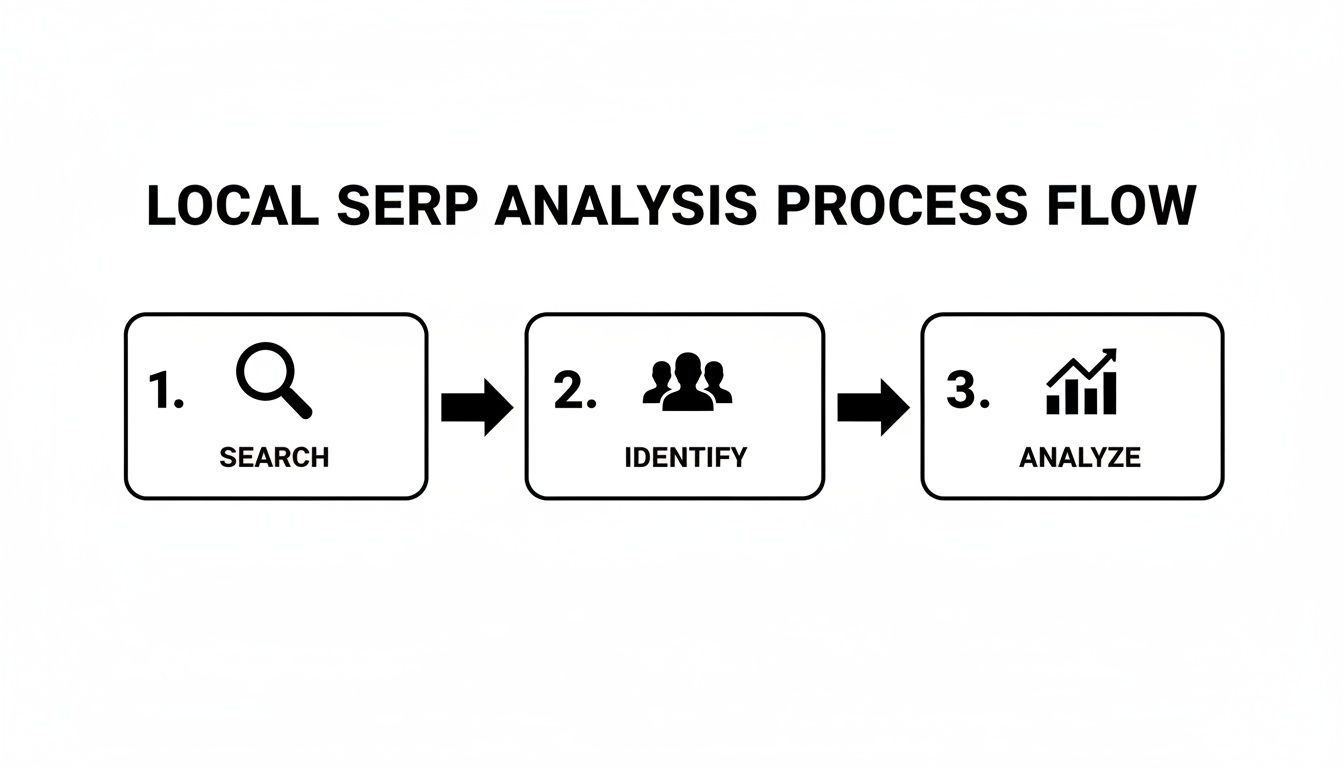
This chart nails the core idea: figure out what customers want, see who you're up against, and let that data shape your strategy. The real insight isn't just about the keywords themselves; it's about understanding the entire search environment before you make a move.
Here’s a practical look at how to map different types of keywords:
Transactional & Geo-Modified Keywords: These are your money-makers. Think "24/7 HVAC repair Houston" or "emergency roof leak service Dallas." The intent is urgent and clear—they need to buy or book now. These belong front and center on your core service pages and location-specific pages, where someone can quickly find service details, contact info, and a clear call-to-action.
Informational & Question-Based Keywords: Queries like "how to choose an HVAC system in Texas" or "what does a new roof cost" mean the user is still in the research phase. This is perfect fodder for your blog or resource center. Answering these questions builds trust, establishes you as a local authority, and captures potential customers early in their journey.
Branded & Navigational Keywords: When someone searches for your business name, they're looking for you. These keywords naturally belong on your homepage and About Us page. The goal is to reinforce your brand and make it incredibly easy for people who already know you to get in touch.
Supercharging Your Google Business Profile
For any local business, your Google Business Profile is just as critical as your website, especially for searches that trigger the coveted Local Pack. Not optimizing your GBP with your hard-won keywords is like leaving cash on the table. Weaving keywords into your profile helps Google understand exactly what you do and where you do it, which directly boosts your visibility on Google Maps and in local results.
Don't treat your GBP as a "set it and forget it" listing. It's a living, breathing profile that needs consistent attention. Regularly adding fresh, keyword-rich content signals to Google that your business is active, engaged, and relevant to what people are searching for right now.
Smart GBP optimization isn't about spamming your business name with keywords (please, don't do that). It’s about integrating them naturally where they count.
Here are the key areas to focus on for maximum impact:
Business Description: You have 750 characters, so make them count. Instead of a generic "We are a plumber," try something like, "We offer expert plumbing services in Houston, specializing in emergency repairs and drain cleaning for residential homes." See how that naturally includes primary services and location keywords?
Services: This section is a goldmine. List out every single service you offer, using the specific phrases you found in your research. If you know people search for "tankless water heater installation," make sure that’s listed as a distinct service.
Q&A Section: Get ahead of the game by populating this section yourself. Ask and answer the most common questions you get from customers. This is the perfect spot to target those long-tail, question-based keywords, such as, "Do you offer financing for new AC units?"
GBP Posts: Use these like mini blog posts. Announce a special offer, share a quick tip, or highlight a specific service. Always include relevant keywords and a strong call-to-action to drive clicks and calls.
By mapping keywords across both your website and GBP, you create a unified local SEO powerhouse. To go even deeper on dominating the map, check out our comprehensive Google Maps SEO services guide. This cohesive approach ensures you’re visible wherever your local customers are looking.
Building a Sustainable Local SEO Strategy
Having a killer local keyword list is a fantastic start, but its true power is unlocked when you weave it into a living, breathing strategy. Local SEO isn't a "set it and forget it" kind of deal. It's a constant cycle of prioritizing what matters, measuring what works, and refining your approach to keep that competitive edge.
The goal here is to build a system that's actually manageable and drives real results over the long haul, moving you away from guesswork and into strategic action. By zeroing in on the highest-impact opportunities first and keeping a close eye on your performance, you create a sustainable engine for local growth.
How to Prioritize Your Keywords for Maximum Impact
Let's be real: not all keywords are created equal. If you try to target every term on your list at once, you'll spread your resources too thin and end up getting nowhere fast. What you need is a simple framework to figure out which keywords offer the biggest bang for your buck.
A method I've used for years involves scoring each keyword on a scale of 1-5 across three simple criteria:
- Relevance: How perfectly does this keyword align with a core service you provide? A term like "emergency roof repair Dallas" is a solid 5 if that’s your bread and butter. A more general query might be a 3.
- Search Volume: How many people are actually searching for this each month in your area? High volume is great, but don't sleep on those low-volume, high-intent keywords. They often convert like crazy.
- Commercial Intent: Is the person searching ready to buy, or just browsing? "Get a plumbing quote now" screams commercial intent, so that's a 5. A research-focused term would score much lower.
Once you've scored your list, just add up the numbers. The keywords with the highest totals are your top priorities. These are your low-hanging fruit—the terms that are most relevant to your business, have decent traffic, and are used by people ready to take action.
Tracking Performance and Iterating Your Strategy
Okay, so you've mapped your priority keywords to your website pages and beefed up your Google Business Profile. Your work isn't done. Now comes the crucial part: tracking what's working and, more importantly, what isn't. Your two best friends here are free and incredibly powerful: Google Search Console and your GBP Insights.
Google Search Console is your window into how your website pages are performing in search. Dive into the "Performance" report. See a high-value keyword stuck on page two? That page is begging for a content refresh or a few more internal links to give it that final push.
I always tell my clients to think of local SEO as a series of small experiments. You launch a page targeting a specific keyword, measure how it does for a few weeks, and then you tweak it. This continuous feedback loop is what separates a successful strategy from a stagnant one.
Your GBP Insights report is just as vital. It shows you the exact search terms people used to find your business in the Local Pack and on Google Maps. If you spot valuable queries in there that you aren't actively targeting on your website, that's a massive green light. It’s a clear signal from the market to either create new content or update an existing page to meet that demand.
Preparing for the Future of Local Search
The way people find local businesses is definitely changing. With the rise of AI-powered search like Google's AI Overviews and voice assistants, your old playbook might not be enough. The key to staying visible is getting serious about structured data, also known as schema markup.
Think of structured data as a special vocabulary you add to your website's code to explicitly tell search engines what your content is about. For a local business, this is a game-changer. You can use schema to clearly define your:
- Business Name, Address, and Phone Number (NAP)
- Hours of Operation
- Specific Services Offered
- Customer Reviews and Star Ratings
By spoon-feeding search engines this information in a language they can't misinterpret, you dramatically increase your chances of being featured in rich results and AI-generated answers. A website with strong schema is much better equipped to show up for a conversational query like, "Find a plumber in Houston that's open now and has good reviews." This isn't just about the future; it's about making sure your business remains a top contender, no matter how people search.
Your Local Keyword Research Questions, Answered
As you dive into local keyword research, a few common questions always seem to pop up. I've heard them from clients for years. Let's walk through them with some straight-to-the-point answers to get you on the right track.
So, What’s the Real Difference Between Local and General Keyword Research?
At its core, the difference comes down to two simple things: geography and intent.
General keyword research is like casting a massive net. You're going after broad terms like "how to fix a leaky faucet" to attract anyone, anywhere in the country. The goal is sheer volume.
Local keyword research, on the other hand, is like spear fishing. It’s incredibly focused. You’re targeting people who need you right now, in your area, with queries like "plumber in San Diego" or "emergency plumber near me." This means digging deep into geo-modifiers—city names, neighborhoods, even zip codes—and understanding the unique lingo of a specific community. The goal isn't just clicks; it's getting the phone to ring or the door to swing.
The entire mindset shifts. You stop asking, "How many people can I reach?" and start asking, "How many of the right people in my city can I connect with?" General SEO chases eyeballs. Local SEO chases actual customers.
What Are the Best Free Tools for Local Keyword Research?
You'd be surprised how much ground you can cover without opening your wallet. Google itself is a goldmine if you know how to look.
Here are my go-to freebies:
- Google Autocomplete: Just start typing your service and location into the search bar. Pay close attention to the suggestions. Those aren't random guesses; they're what real people are actively searching for. This is perfect for finding modifiers like "24 hour," "cheap," or specific neighborhood names.
- "People Also Ask" & "Related Searches": I love these sections. They give you a direct window into your customers' minds, showing you the exact questions and follow-up searches they have. This is instant inspiration for your website's FAQ section or your next blog post.
- Google Trends: This is a fantastic tool for comparing search term popularity across different cities or metro areas. It helps you understand local demand and spot seasonal shifts—like a spike for "pool cleaning" in Phoenix way before it hits Seattle.
- Google Business Profile Insights: Honestly, this might be the most valuable free tool of all. It shows you the exact search queries people used to find your GBP listing. This isn't theory; it’s a list of high-intent keywords that are already working for you.
How Often Should I Revisit My Local Keyword Strategy?
Your keyword strategy should be a living, breathing part of your marketing, not a "set it and forget it" task.
Plan for a deep dive at least once a year. This is your big-picture review, especially crucial if you've added new services or expanded into a new area.
But the local search scene can change fast. That’s why I recommend doing a quick "mini-review" every quarter. A monthly glance at your Google Search Console and GBP Insights is also a non-negotiable. This keeps you agile. You might spot a new competitor ranking for a term you missed or notice customers using new phrases. For example, catching the early wave of searches for "spring AC tune-up" requires you to be paying attention.
Can I Just Target a Bunch of Cities on One Service Page?
You can, but I almost never recommend it. It's a strategy that looks good on paper but rarely works in practice.
Think about it from Google's perspective. Its job is to serve up the most relevant result. A page meticulously optimized for "Plumbing Services in Austin" will almost always beat a generic page that just lists Austin, Dallas, and Houston as an afterthought.
The best approach is to create a unique, high-quality page for each major city or service area. Talk about local landmarks, mention specific neighborhoods, and address challenges unique to that community. This builds authentic geographic relevance. It shows Google—and your potential customers—that you're a true local player, not just an outsider trying to cast a wide net.
Ready to stop guessing and start ranking? Rankai uses AI to identify high-impact local keywords and automatically creates over 20 fully optimized content pages for your business every single month. We handle the research, writing, and optimization so you can focus on serving your local customers. See how it works at https://rankai.ai.