You've probably asked yourself, "How many keywords should I be targeting?" It's one of the most common questions in SEO, and the answer has changed a lot over the years.
The short answer is this: aim for one primary keyword per page. But don't stop there. Support it with a cluster of 3-5 secondary keywords and at least 10+ long-tail variations. Modern SEO isn't about hitting some magic number; it’s about building genuine topical authority.
The Modern Way to Think About Keyword Count
Forget the old-school advice about picking one perfect keyword and hammering it into a page. These days, the real goal is to build out a comprehensive topic, not just rank for a single phrase. I find it helpful to think of it as a "keyword solar system."
Picture your page's content as a solar system. Right at the center, you have the sun—that's your primary keyword. It defines the core topic and what the user is really looking for. This is the main phrase you want to be known for.
Orbiting that sun are the planets—your secondary and long-tail keywords. These related terms add the depth, context, and nuance that search engines crave. They are all the different variations, synonyms, and questions your audience is actually typing into the search bar when they're exploring the main subject.
This whole "topic cluster" approach is perfectly in tune with how search engines like Google actually understand content now. They're not just matching text anymore; they're analyzing the relationships between different concepts to figure out how much of an expert you really are.
Why a Single Keyword Fails
Focusing on just one keyword is like trying to describe an entire forest by showing someone a single leaf. It just doesn't work. You miss the bigger picture and completely fail to demonstrate real authority on the subject. By tunnel-visioning on one term, you're ignoring the hundreds of other ways people are searching for the exact same information.
By targeting a smart, semantic group of related terms, a single page can rank for hundreds of different queries, attracting a wider net of qualified traffic. This method also helps you create more natural, user-friendly content.
Instead of awkwardly forcing one phrase into your text over and over, this strategy naturally leads you to create a more helpful and in-depth discussion. To see how to do this without getting penalized, check out our practical guide for modern SEO to avoid keyword stuffing—a practice that can seriously damage your rankings.
When you build out a full keyword solar system, you're sending a powerful signal to Google that your content is a go-to resource. This not only helps you rank higher for your main target but also pulls in traffic from a huge variety of related searches, maximizing your page's overall visibility and impact.
Keyword Strategy Quick Guide
To make this even clearer, here's a quick reference table that breaks down the role of each keyword type on a single page.
| Keyword Type | Recommended Count Per Page | Primary Goal |
|---|---|---|
| Primary Keyword | 1 | Anchor the page's core topic and user intent. |
| Secondary Keywords | 3-5 | Build context and capture closely related search queries. |
| Long-Tail Keywords | 10+ | Address specific questions and capture highly-qualified traffic. |
Think of this table as your blueprint. The primary keyword sets the foundation, the secondary keywords build the walls, and the long-tail variations furnish the rooms with specific, helpful details.
Building Your Page’s Keyword Solar System
Thinking about keywords like a solar system is a great way to visualize your strategy, but how do you actually put it into practice? It all comes down to a simple, step-by-step process that helps you build from a broad central idea to the nitty-gritty details, making sure every word on the page has a job to do.
This framework isn't about stuffing in as many keywords as you can. It’s about creating a rich, contextual story that shows both your audience and the search engines that you really know your stuff.
Start with the Sun: Your Primary Keyword
Every single page needs a sun—one core, powerful primary keyword that defines its entire purpose. This is the term that perfectly captures the main problem you solve or the question you answer. It should be the phrase with the most relevant search volume and the one that best matches your page's big idea.
For example, if you're creating a guide on making coffee, your primary keyword might be "how to brew coffee at home." This is your anchor. Everything else will revolve around it. The reason you stick to just one is for focus; it prevents you from confusing search engines and readers about what the page is really about.
This diagram shows how your primary, secondary, and long-tail keywords all connect to form a powerful, cohesive system.
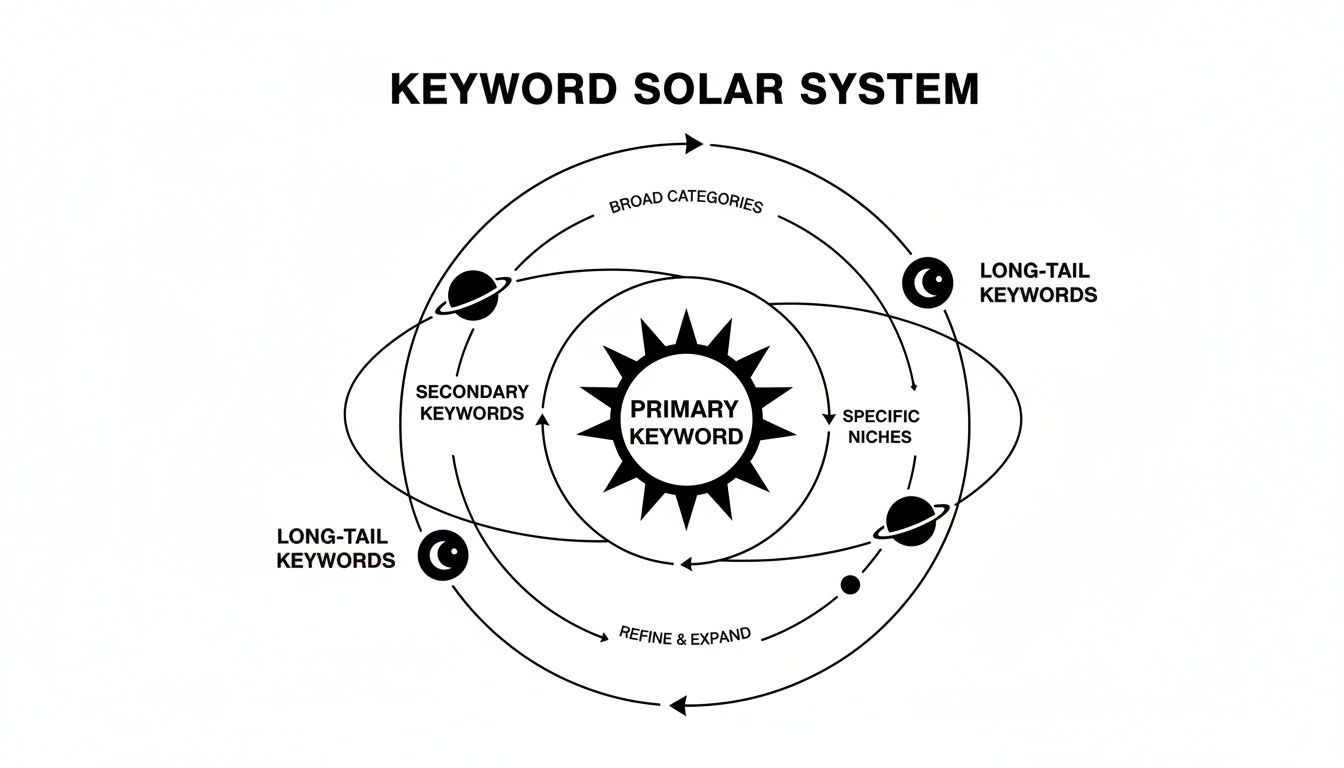
Just like the visual shows, your primary keyword is the gravitational center. The other keywords provide the context and depth that make your content truly comprehensive.
Add Your Orbiting Planets: Secondary Keywords
With your sun in place, it’s time to add the planets. You'll want to identify 3-5 secondary keywords that support your main topic. Think of these as the essential subtopics or closely related ideas that add crucial context.
Back to our coffee guide, some solid secondary keywords would be:
- best coffee brewing methods
- french press coffee instructions
- pour over coffee guide
- coffee grinding tips
These terms help you flesh out the core components of your topic. If you want to go deeper on how these supporting terms work together, this practical guide to using a keyword cluster for SEO dominance is a great resource for understanding how to group related phrases.
Populate the System with Long-Tail Asteroids
Last but not least, you need to fill out the rest of your solar system with asteroids—the 10+ long-tail keywords. These are the longer, highly specific questions and phrases that your audience is typing into Google. They might have lower search volume individually, but they carry incredibly high intent.
You can uncover these gems by checking out Google's "People Also Ask" box or using any decent keyword research tool. For our coffee example, these long-tails could look like:
"How much coffee do I use for a French press?"
"What is the best water temperature for pour over coffee?"
"Should I grind coffee beans fresh every time?"
When you weave these primary, secondary, and long-tail keywords naturally into your headings, body paragraphs, and even image alt text, you create an incredibly thorough piece of content. This layered approach is what signals true topical authority, which is how a single, well-crafted page can end up ranking for hundreds of different but related queries.
Why Long-Tail Keywords Drive More Conversions
It’s so easy to get obsessed with those big, high-volume keywords. We all do it. But honestly, that's often a trap. The real magic in a modern SEO strategy comes from embracing long-tail keywords—those longer, super-specific phrases that are usually three or more words.
They might look unimpressive with their low search volumes, but they consistently blow broad, generic terms out of the water when it comes to results. I like to think of it like fishing. Chasing a high-volume keyword is like trying to catch one specific whale with a single, giant hook. A long-tail strategy is like casting a wide net that catches hundreds of fish that were already looking for exactly what you're offering.
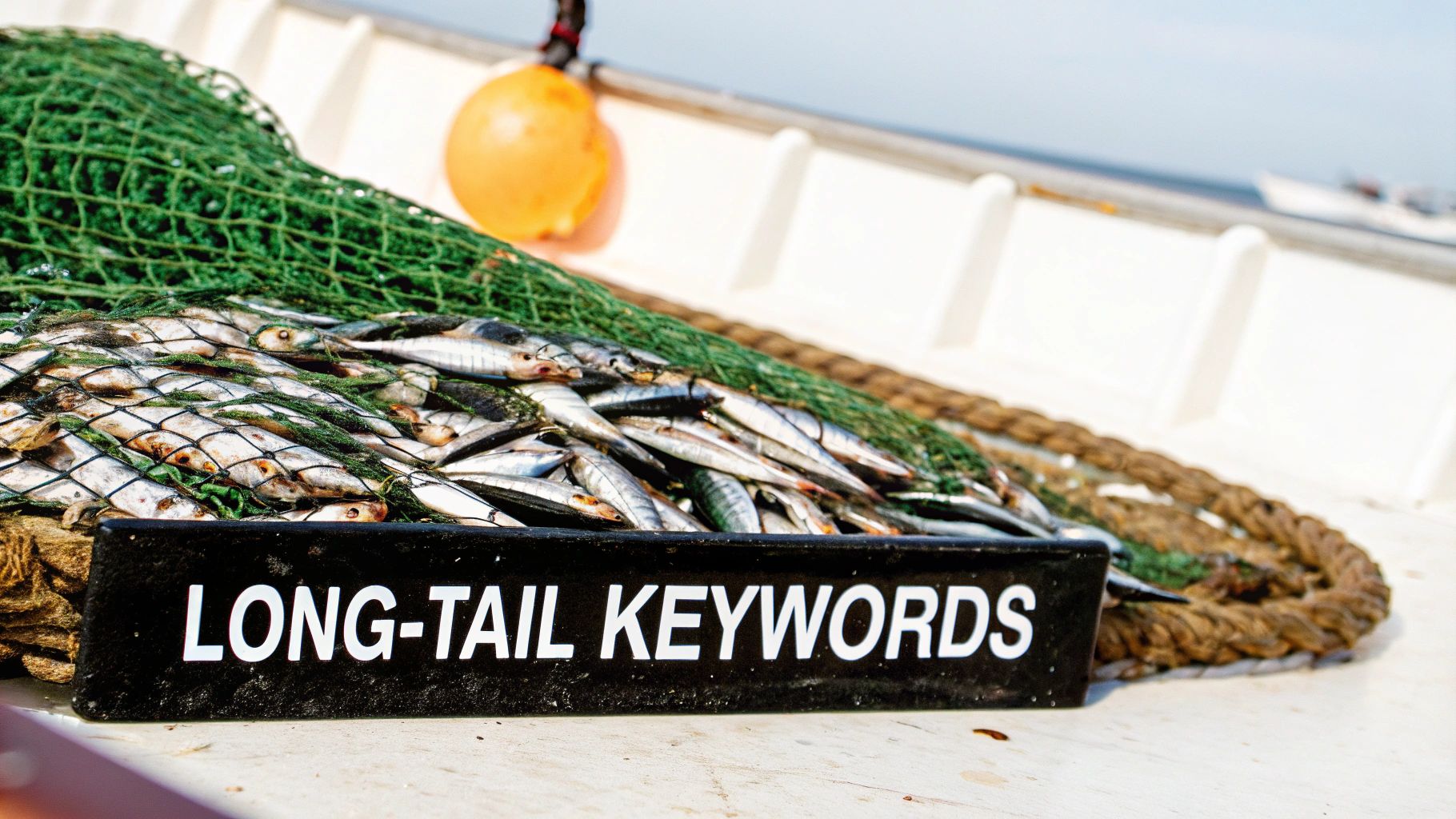
And this isn't just a small shift; it's how people actually search now. The data doesn't lie: long-tail keywords account for a staggering 70% of all search traffic. More importantly, these specific phrases pull in about 2.5× higher conversion rates than their short, generic counterparts. Why? Because they tap directly into user intent.
Intent Is Everything
The secret sauce here is user intent. Think about it. Someone searching for "shoes" is probably just window shopping online. But a person typing "women's waterproof trail running shoes size 8" knows exactly what they need and is very likely ready to pull out their credit card.
Long-tail keywords are your direct line to this high-intent traffic. When your content perfectly matches these specific queries, you're not just getting visitors—you're getting qualified leads who are much further down the buying path. This means more sales and a much better return on the time and effort you put into your content.
By focusing on specific, multi-word phrases, you are essentially pre-qualifying your audience. You attract fewer casual browsers and more serious buyers, which is the key to efficient and scalable growth.
This idea is fundamental when you're building a keyword map. Your primary and secondary keywords build topical authority, which is crucial, but it's the long-tail variations that actually drive the direct business results.
The Competitive Advantage of Being Specific
Here’s another huge win for long-tail keywords: they are way less competitive. While giant brands are burning cash to battle over a term like "marketing software," you can quietly dominate a niche query like "automated invoicing software for freelance designers."
This strategy just plain works, and here's why:
- Lower Competition: Far fewer websites are creating content for these hyper-specific phrases, which makes it much easier for you to land on page one of Google.
- Higher Relevance: You can create content that gives a precise, satisfying answer to a user's specific problem. That creates a fantastic user experience.
- Cost-Effectiveness: If you're running paid ads, long-tail keywords are almost always cheaper to bid on, meaning your marketing budget goes a lot further.
Just look at the e-commerce world; understanding the power of Amazon long-tail keywords can make or break a seller in that hyper-competitive space. At the end of the day, a winning strategy isn't about how many keywords you target; it's about targeting the right ones.
How to Prioritize Keywords for Business Impact
Having a massive keyword list is one thing, but knowing what to do with it is another. Without a smart way to prioritize, you're just staring at a map with no destination. To make your SEO efforts actually move the needle, you need to filter that list down to the keywords that will impact your bottom line.
It’s all about striking a delicate balance. The trick is to look past the raw numbers and get to the heart of what your audience is really asking for. By understanding their intent—are they just looking for information, comparing options, or ready to buy?—you can create content that meets them at the perfect moment.
The Prioritization Framework
A winning keyword strategy isn't a race to the highest search volume. It’s about finding that sweet spot where search volume, difficulty, and business relevance all meet. This approach ensures you're not just pulling in random visitors, but attracting the right traffic that can turn into customers.
Think of it as a three-legged stool. If one leg is missing, the whole thing topples over.
Search Volume: Simply put, how many people are searching for this term each month? While bigger numbers are tempting, don't write off low-volume keywords if the intent behind them is razor-sharp.
Keyword Difficulty: How tough is the competition? Going after less competitive terms can score you some quick wins, build momentum, and give you a foothold on the search results page.
Commercial Relevance: Does this keyword connect directly to a product or service you sell? A term with strong buying intent is infinitely more valuable than a high-volume keyword that has nothing to do with what you offer.
Getting this process right is crucial. For a deeper dive into the nuts and bolts, this guide on how to build a keyword list that drives traffic is a great resource for putting these ideas into action.
Beyond Volume: Why Intent Matters More
Here’s a statistic that might surprise you: over 94% of all keywords get ten or fewer searches per month. This means the overwhelming majority of searches are happening in the "long tail," where queries are more specific and intent is crystal clear.
This is exactly why some websites can rank for hundreds of keywords yet get almost no meaningful traffic. They're ranking for terms nobody is actually searching for, or at least not with any intent to buy.
The big takeaway here is simple: The quality of a keyword and the intent behind it are far more important than the sheer quantity of keywords you target. Relevance is what drives real business results.
At the end of the day, knowing how many keywords to target is less important than knowing which ones to focus on first. By building a content plan that includes a healthy mix of keywords serving different intents, you can build authority and drive consistent, measurable growth for your business.
Putting Keyword Strategies to Work: Real-World Examples

Theory is one thing, but seeing how a keyword strategy actually plays out makes everything click. The ideal number of keywords you target is directly tied to your business model. To make this less abstract, let’s walk through how our "keyword solar system" model works for three completely different businesses.
Think of it this way: your primary keyword is the sun at the center of your page's universe. The secondary and long-tail keywords are the planets and moons orbiting it, each one creating a new pathway for searchers to find you. This structure helps you meet people at every stage of their journey, from just poking around to pulling out their credit card.
The SaaS Company Strategy
For a SaaS business, the name of the game is solving a specific problem. Your keyword strategy has to pull in people who are feeling the pain of their current process and those who are actively hunting for a software solution. It’s a two-pronged attack.
Let's use an accounting software company as our example. They need to show up when a small business owner finally gets fed up with messy spreadsheets.
- Primary Keyword:
best accounting software for small business(This is the big, solution-focused term.) - Secondary Keywords:
small business invoicing tools,automated expense tracking,bookkeeping software comparison(These are features and related solutions.) - Long-Tail Keywords:
how to automate invoicing for my freelance business,software to track mileage and expenses,quickbooks alternative for service businesses(These are hyper-specific problems and competitor lookalikes.)
This layered approach means they can capture broad, high-volume searches while also snagging highly-qualified leads who are much closer to making a decision.
The E-commerce Store Strategy
An e-commerce store's success lives and dies on product visibility. Here, the strategy is all about product categories and the specific details—the attributes—that people use to filter their options. A single product page has to cover a lot of ground to be effective.
Picture an online store selling athletic footwear. Just going after "running shoes" is a recipe for getting lost in a sea of competition.
The secret for e-commerce is to anchor a core product term with descriptive modifiers. Things like color, size, material, or use-case act as powerful secondary and long-tail keywords that attract buyers with high intent.
Here’s how they could map out the keywords for a single product:
- Primary Keyword:
women's running shoes - Secondary Keywords:
lightweight marathon shoes,cushioned trail running shoes,breathable running sneakers - Long-Tail Keywords:
best running shoes for flat feet women,waterproof gore-tex running shoes,women's size 9 neutral running shoes
By optimizing for all these variations, the page doesn't just rank for one term—it can rank for dozens of specific searches, pulling in shoppers who know exactly what they want.
The Local Service Business Strategy
If you're a local business like a plumber or an electrician, your entire world is defined by geography. Your keyword strategy absolutely must be hyperlocal. This means combining your service terms with the specific towns, cities, or neighborhoods you cover. Here, geo-modifiers aren't just an add-on; they're your most valuable asset.
Let’s sketch out a plan for an emergency plumber working in a big city. Time is of the essence for their customers.
- Primary Keyword:
emergency plumber Brooklyn - Secondary Keywords:
24 hour plumbing service,leaky pipe repair Brooklyn,clogged drain cleaning NYC - Long-Tail Keywords:
find a plumber near me now for burst pipe,cost to fix leaking faucet in Brooklyn,best local plumber for hot water heater repair
This approach gets the business in front of local customers with an urgent problem, which dramatically increases the odds of getting that immediate phone call and landing a new job.
Answering Your Top Keyword Strategy Questions
Even with the best plan in hand, some questions always pop up when you start putting it into practice. Let's run through a few of the most common ones I hear from clients. This should clear up any lingering confusion and get you moving forward.
Think of this as your go-to guide for those tricky, real-world SEO scenarios.
How Many Keywords Should My Entire Website Target?
Honestly, there’s no magic number, and there's definitely no upper limit. A healthy, growing website will naturally rank for thousands of keywords over time.
The key is to stop thinking about a "total number" and start thinking in terms of topic clusters. Every single page you build is its own little universe—it has one main, primary keyword at its center, with a whole system of related secondary and long-tail phrases orbiting it.
As you build out more pages and cover more topics relevant to your audience, your site's total keyword count will grow on its own. The real goal isn’t hitting an arbitrary number; it’s about becoming the go-to resource for your niche. Do that, and you'll end up ranking for a massive portfolio of valuable terms.
Does Keyword Stuffing Still Hurt SEO?
Yes. 100% yes. Keyword stuffing is an old-school trick that Google’s algorithms got wise to a long, long time ago. Forcing keywords into your content where they don't belong is a fast track to a penalty and, just as importantly, it makes for a horrible reading experience.
These days, great SEO is all about creating genuinely useful content that naturally weaves in your main keyword and all its related concepts. Your number one priority should always be the human reader. If a sentence sounds clunky or robotic, you've gone too far.
When you write a really thorough, helpful article, you'll find that you use all the right related terms without even trying. That's what helps Google understand the context and reward you for it.
How Do I Measure My Keyword Plan's Success?
Success is so much more than just hitting the #1 spot for one keyword. You need to look at the bigger picture. I always tell people to live inside their Google Search Console dashboard, because it tells the complete story.
Here’s what you should be tracking:
- Impressions: Are your pages showing up in search results more often? This is your first sign of growing visibility across a whole range of queries.
- Clicks & Click-Through Rate (CTR): This tells you if people are actually clicking on your links when they see them. It's the measure of how well your titles and descriptions are working.
- Average Position: Instead of obsessing over a single keyword's rank, watch the average position for your groups of related keywords. Is the whole topic cluster rising in the ranks?
A successful strategy means your pages start ranking for more and more related keywords over time. That's what drives sustainable, long-term organic traffic and, ultimately, the conversions that actually matter to your business.
Should I Update Keywords on Old Content?
Absolutely. Going back to refresh and re-optimize your older content is one of the highest-impact, lowest-effort SEO moves you can make. It's a total game-changer.
If you have an old blog post that's just not performing, fire up your keyword research tools and see what people are searching for today. User intent and search trends change.
You can inject new life into an old piece by adding fresh secondary keywords, updating statistics or outdated info, and just generally making it more in-depth. This "content refresh" can give an existing page a massive rankings boost without having to start all over again.
Ready to stop guessing and start growing? Rankai uses an AI-powered platform backed by human expertise to identify high-impact keywords, create fully optimized content, and deliver measurable organic growth every single month. We handle the complexity of SEO so you can focus on your business. Discover how Rankai can transform your SEO strategy.