A content marketing strategy is simply your game plan. It’s the documented roadmap that connects the content you create—every blog post, video, and social media update—to your actual business goals. Think of it as the bridge between random marketing efforts and a purposeful, results-driven machine designed to attract, engage, and convert your ideal customers.
Why Your Small Business Needs a Content Strategy Now
Trying to do content marketing without a plan is like driving in a new city without a map. Sure, you might accidentally find a cool spot, but you’ll waste a lot of time, gas, and energy without ever getting where you intended to go. For a small business, where every minute and every dollar is precious, this "spray and pray" method just leads to burnout and frustration.
A documented strategy forces you to tie your content directly to what really matters: your business objectives. This shift in thinking turns your marketing from an expense into a genuine growth engine.

From Random Acts to Measurable Results
First things first: you have to define what success actually looks like for your business. Forget vague goals like "get more followers." A real strategy is built on clear, measurable objectives that move the needle.
Your main goals will likely fall into one of these buckets:
- Generating More Qualified Leads: You want to attract people who are genuinely interested in what you offer, which makes the sales process a whole lot smoother.
- Boosting Brand Awareness: The goal here is to become a recognized, trusted name in your niche. You want to be the first company people think of when they have a problem you can solve.
- Driving Direct Sales: This is all about using content to walk customers through their buying journey, from the moment they discover you to the final click of the "buy" button.
- Improving Customer Retention: Keeping your existing customers happy is just as important as finding new ones. Valuable content can foster loyalty and encourage repeat business.
A documented plan isn't just a "nice-to-have." It's the core of a successful marketing operation. It gives you the clarity to make smart decisions, allocate your resources effectively, and create content that delivers a real, tangible return.
This foundational work ensures every piece of content you create has a job to do. A blog post is no longer just a blog post; it’s a tool designed to capture organic traffic for a specific keyword. A quick social media video isn't just a video; it’s a way to build a community and let your brand's personality shine through.
Defining Your Unique Value and KPIs
Once your goals are locked in, you need a way to measure your progress. That’s where Key Performance Indicators (KPIs) come in. These are the specific numbers that tell you if your strategy is actually working.
For example:
- If your goal is lead generation, your KPIs might be the number of contact form submissions, new email subscribers, or demo requests.
- For brand awareness, you’d probably track things like website traffic, social media reach, and brand mentions online.
- To measure sales, you'll look at conversion rates, average order value, or the revenue directly tied to a specific content campaign.
The data doesn't lie. Companies with a documented content strategy see a 33% higher ROI than those who don't. We also know that blogs are proven to drive 55% more website traffic on average. As you can see from these content marketing statistics on SQ Magazine, these aren't just vanity metrics; they represent real business growth powered by a smart plan.
Ultimately, a clear content marketing strategy gives your small business direction and accountability. It ensures that every article, email, and social post is a deliberate step toward hitting your goals, turning your content from a hopeful guess into a predictable and powerful asset.
Defining Who You're Actually Talking To

Before you write a single word, you have to know exactly who you’re writing for. I don't mean a vague, "we sell to millennials" kind of idea. I mean getting an almost personal understanding of one specific person. If you create content for everyone, you'll end up connecting with no one.
A truly effective content marketing strategy for a small business is built on a foundation of empathy. It all starts by digging deeper than basic demographics like age and location to build a detailed Ideal Customer Profile (ICP). This isn't just a box-ticking marketing exercise; it's about creating a fictional character who embodies your perfect customer—someone you can practically see and speak to directly.
What are their daily frustrations? What are their career goals? What keeps them tossing and turning at night? More importantly, what problems are they wrestling with that you are uniquely positioned to solve?
Low-Cost Ways to Find Audience Insights
Here's the good news: you don't need a huge research budget to get these answers. As a small business, you are sitting on a goldmine of qualitative data. The trick is simply learning how to listen to what your audience is already telling you.
Here are a few practical, low-cost ways to get started right now:
- Dig Through Your Communications: Your customer emails, support tickets, and sales call notes are pure gold. Look for the recurring questions, the common sticking points, and the exact language people use to describe their problems. This is direct, unfiltered feedback.
- Run Simple Social Media Polls: Use Instagram Stories, LinkedIn polls, or Facebook groups to ask pointed questions. Don't ask, "What do you want to see?" Instead, try "What's your biggest challenge with [your topic] right now?" or "Which of these two things is more important for your business?"
- Become a Digital Eavesdropper: Spend some time lurking in the online communities where your ideal customers hang out. This could be Reddit subreddits, niche forums, or industry-specific Slack channels. Pay close attention to the discussions—what are they complaining about? What solutions are they looking for?
These methods help you capture the true "voice of the customer." This is the secret sauce for creating content that feels genuinely helpful and personal, not like a thinly veiled sales pitch.
When your content directly solves a real pain point using the same language your customer uses, it creates an instant connection. They feel seen and understood, and that's the very first step toward building real trust and loyalty.
By focusing your research on these customer-centric methods, your strategy immediately becomes proactive. You're no longer guessing what people want; you're building a content plan based on what they've already told you they need.
Mapping the Customer Journey
Knowing who your customer is is only half the puzzle. You also need to understand where they are in their journey. Someone just realizing they have a problem needs completely different information than someone who is deep in research and ready to make a decision.
This is where mapping the customer journey comes in. It helps you pinpoint the crucial moments where your content can add real value and nudge them in the right direction.
For a small business, a simple journey map might look something like this:
1. Awareness Stage: The person is just starting to feel the pain of a problem, but they might not even have a name for it yet. Their searches are broad and problem-focused.
- Your Content Goal: Educate and build trust. No selling.
- Content Examples: Blog posts like, "5 Signs You're Wasting Money on Inefficient [Process]" or short, helpful videos for social media.
2. Consideration Stage: Now they've defined their problem and are actively researching potential solutions. They're comparing options and weighing their pros and cons.
- Your Content Goal: Showcase your expertise and help them compare.
- Content Examples: In-depth guides, comparison sheets, or case studies showing how you solved a similar problem for another customer.
3. Decision Stage: They're ready to pull the trigger and are evaluating your specific offering against a competitor or two.
- Your Content Goal: Instill confidence and remove any final doubts.
- Content Examples: Powerful customer testimonials, a detailed FAQ page that addresses common hesitations, or a free consultation offer.
When you map your content to each of these stages, you ensure you have the right answer ready at the right time. This empathy-driven approach transforms your marketing materials into a valuable resource that guides people from their very first question all the way to their final purchase.
Choosing Your Core Topics and Content Formats
Now that you have a solid picture of who you’re talking to, it’s time to figure out what you’re going to talk about. This is where the rubber meets the road—where you move from abstract ideas to a real, tangible content plan. The goal isn't to be everything to everyone; it's to become the go-to expert in your specific niche.
A smart content marketing strategy for a small business is all about focus and consistency. The best way I've found to lock this in is by establishing content pillars.
Think of these as three to five core subjects that are directly tied to your audience’s biggest challenges and your business’s expertise. They're the main categories for your blog, the foundational themes for your videos, and the backbone of your entire strategy.
For instance, a local financial advisor who specializes in helping young families might build their content around these pillars:
- Saving for College
- First-Time Home Buying
- Retirement Planning for Beginners
- Managing Family Budgets
With these pillars in place, every piece of content—whether it's a detailed blog post on 529 plans or a quick Instagram Reel on saving for a down payment—fits neatly into the plan. This keeps your messaging sharp, helps you build authority with search engines, and constantly reminds people what you stand for.
Matching Your Message to the Medium
With your pillars defined, the next question is how to bring them to life. This is all about choosing the right content formats, and it’s a decision that should be driven by strategy, not just by chasing the latest trend. Think about where your audience actually hangs out, what your team is good at creating, and what you’re trying to achieve.
Different formats do different jobs. A deep-dive blog post is a magnet for search traffic. A snappy video can build a real community on social media. The secret is to build a content mix that meets people where they are. A great way to visualize this is through content mapping, which helps you connect specific topics to different stages of the buyer's journey. You can learn more about content mapping in our practical guide to see how it all fits together.
Here are a few of the most effective formats I see working for small businesses right now:
- In-Depth Blog Posts: Perfect for proving your expertise, ranking for valuable keywords, and delivering real, practical advice.
- Engaging Short-Form Videos: Ideal for platforms like Instagram Reels and TikTok. They’re fantastic for showing off your brand’s personality and sharing quick, helpful tips.
- Compelling Case Studies: These are gold when a potential customer is close to making a decision. They provide powerful social proof and show you can get results.
- Simple Infographics: A brilliant way to make complex information easy to digest and share. They're great for earning backlinks and getting noticed on social media.
- Email Newsletters: Absolutely essential for building direct, lasting relationships with the people who are most interested in what you do.
Don't feel like you have to do everything at once. Seriously. It’s far better to master one or two formats that perfectly suit your strategy than to spread yourself thin with mediocre content across five different platforms.
The smartest approach is to get good at repurposing. One well-researched blog post can become the source material for a dozen other assets—a script for a short video, key takeaways for a tweet thread, a visual for an infographic, and the main topic for your next email newsletter. This kind of workflow maximizes the value you get from every single idea.
Choosing The Right Content Format For Your Goals
To make this crystal clear, let's connect specific formats to your business goals. The content you create should directly help you move the needle on the metrics that matter most.
This table breaks down how to match common business goals with the right content formats.
| Business Goal | Primary Content Format | Secondary Content Format | Key Metric |
|---|---|---|---|
| Increase Brand Awareness | Blog Posts & SEO Articles | Short-Form Social Videos | Website Traffic, Social Reach |
| Generate Qualified Leads | Webinars & Gated Guides | Case Studies & Testimonials | Form Submissions, Downloads |
| Drive Direct Sales | Product Demo Videos | Customer Success Stories | Conversion Rate, Revenue |
| Improve Customer Loyalty | Email Newsletters | Exclusive "How-To" Videos | Open Rate, Repeat Purchases |
Ultimately, your content mix will—and should—evolve. While some studies show top performers publish content constantly, the real takeaway for small businesses is to be thoughtful with your investments. For example, recent research shows video is a huge channel, with 17% of marketers saying short-form video delivers the best ROI. And thought leadership is on the rise, with 52% increasing their investment in it.
By picking a smart mix of these high-impact formats, you can build loyalty and drive sales without needing a massive budget. For more data on this, check out the latest insights on the state of content marketing from Reboot Online.
4. Map Out Your Content Creation and Distribution Plan
Let's be honest: a brilliant idea for an article or video is just an idea until you have a solid plan to create it and, more importantly, get it in front of the right people. This is where you stop thinking about one-off pieces and start building a real content engine.
A smart content marketing strategy for small business isn’t about burning yourself out. It's about creating a simple, repeatable system. Think of it as building a machine that consistently produces high-quality content and delivers it to your audience, week after week.
This simple workflow keeps you focused. You move from a jumble of ideas to specific pillars and then choose the best formats for your channels.
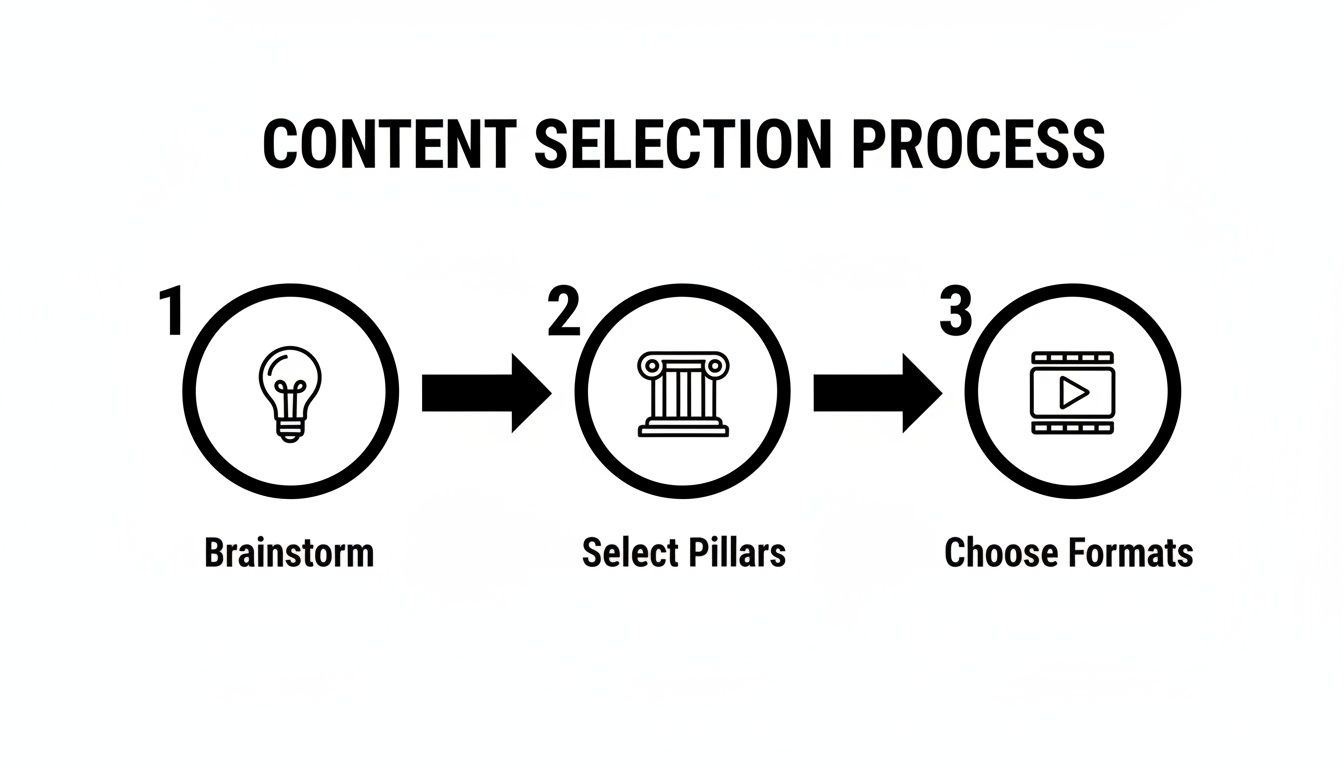
Following a process like this ensures every piece of content has a clear purpose. No more guessing.
Get Your Production Workflow in Order
First things first, you need a content calendar. This doesn't have to be some fancy, expensive software. A simple Google Sheet or a free Trello board works perfectly when you're starting out.
The goal is to track the essentials for every piece of content you plan to create:
- Topic/Title: The core idea and a working headline.
- Format: Is it a blog post, a short video, a case study?
- Owner: Who is actually creating it? (Even if it's just you, write it down!)
- Status: A quick tag like Idea, Drafting, Editing, or Published.
- Publish Date: Your target for when it goes live.
- Channels: Where will you share it? Think newsletter, LinkedIn, Instagram, etc.
Having this single source of truth is a game-changer. It eliminates the chaos and keeps you on track. Consistency is everything—it signals to both search engines and your audience that you’re a reliable source of valuable information. For a much deeper look at this, check out our comprehensive SEO content creation guide that breaks down workflows and tools.
Work Smarter with Smart Distribution
Hitting "publish" is the starting line, not the finish line. Too many small businesses post their content and then just hope someone finds it. A proactive distribution plan is what turns your effort into actual results.
My rule of thumb? You should spend just as much time promoting your content as you did creating it. A fantastic article that nobody sees is a huge missed opportunity. Distribution is the amplifier for your message.
Start by optimizing every single piece for search from day one. This means weaving in your target keywords naturally, writing a meta description that makes people want to click, and structuring your content with clean headings that Google can easily understand. This is your long-term organic growth engine.
Next, master the art of repurposing. One deep-dive blog post can be your source material for a dozen smaller content pieces.
- Key Quotes: Pull out the best one-liners for a tweet thread or a text-based LinkedIn post.
- Data Points: Turn a compelling statistic into a simple, shareable graphic for Instagram.
- Video Script: Use the blog post's outline as a script for a quick YouTube Short or TikTok video.
- Newsletter: Make the new post the star of your next email to subscribers.
This is how you maximize the return on your time. Instead of constantly being on the hamster wheel of "what's next?", you extract every last drop of value from the work you’ve already done.
Amplify Your Reach
Finally, use the channels you own to give every new piece of content an initial kickstart. Your email list is gold. These are people who have explicitly asked to hear from you, so always send them your latest content.
Technology is also becoming a key player in staying efficient. According to a report from Reboot Online, by 2025, an estimated 67% of small business owners will be using AI for content or SEO to get better results. While challenges like budget for proper measurement still exist, the direction is clear: small businesses are adopting tools to compete.
By combining a structured creation workflow with a strategic distribution plan, you build a reliable system that consistently puts your expertise in front of the customers who need it most.
Smart Budgeting: Getting the Most Bang for Your Content Buck
A brilliant content strategy is only as good as its execution, and that means being realistic about your budget. Without a solid financial plan, even the most creative ideas will stall out. But let’s be clear: budgeting isn't about pinching pennies. It’s about making smart, strategic investments that actually deliver a return.
A lot of small business owners get paralyzed at this stage, thinking they need a massive war chest to even get in the game. That’s just not true. It’s all about being resourceful and knowing precisely where to put your money to get the biggest impact. You have to think like an investor, not just a spender.
Understanding the Real Costs
Your content marketing budget really boils down to a few key areas. Getting a handle on these is the first step, even if you're starting with next to nothing.
- Content Creation: This is usually the biggest line item. It's the cost—in either time or money—of actually writing the blog posts, shooting the videos, or designing the infographics.
- Essential Tools: You can get far with free tools, but eventually, you'll likely need to invest in software for things like SEO research (Ahrefs, Semrush), email marketing, or social media scheduling.
- Promotion and Distribution: Hitting "publish" isn't the finish line. You need to earmark funds for getting your content in front of people, whether that's through paid social ads, influencer outreach, or other distribution channels.
A critical mistake I see is budgeting for creation but not for amplification. A fantastic blog post that nobody sees has an ROI of zero. A small ad spend to push it to the right audience can be the difference-maker.
Where to Invest vs. Where to Save
When you’re running lean, every dollar has to pull its weight. The trick is to spend on the things that will truly move the needle and get scrappy everywhere else.
Invest Here for High ROI:
- High-Quality Writing: Nothing sinks a brand's credibility faster than sloppy, poorly written content. If writing isn’t your zone of genius, investing in a skilled freelancer or looking into top SEO content writing services is one of the smartest decisions you can make. It pays for itself over and over.
- Targeted Promotion: Putting even a small budget behind your best content on social media can exponentially increase its visibility and drive high-quality traffic to your site.
- Video (If It Fits Your Audience): Video can be a budget-eater, but it delivers incredible engagement. You don't need a Hollywood studio—a simple, well-lit setup with a good microphone can produce surprisingly professional results.
Save Money Here:
- Repurpose Everything: This is the ultimate budget hack. Turn one deep-dive blog post into a dozen social media snippets, a short video script, and an email newsletter. Squeeze every last drop of value out of your creative efforts.
- Lean on Free Tools: Start with the heavy hitters: Google Analytics, Google Search Console, and the free tiers of amazing tools like Canva and Trello. They're incredibly powerful and often all you need in the early days.
- Embrace User-Generated Content: Encourage your customers to share photos, testimonials, or reviews. This is authentic, powerful social proof that costs you absolutely nothing.
The data backs this up. Small businesses are getting much savvier, now allocating about $43,000 annually to content marketing, which represents 26% of their total marketing spend. It’s no surprise that their top investment priorities are high-impact activities like video and SEO. You can see more stats on small business content spending to benchmark your own plans. By focusing your budget on these proven channels, you’re not just spending money—you’re building a sustainable engine for growth.
How to Measure and Improve Your Strategy
Think of your content strategy as a living, breathing thing. It’s not something you create once and file away; it’s a roadmap you need to revisit and adjust as you learn and your business grows. This is where the magic really happens—turning good results into great ones by paying close attention to what the data is telling you.
This process is how you stop guessing and start knowing what truly clicks with your audience and, more importantly, what actually moves the needle for your business.
The Key Performance Indicators (KPIs) you set earlier are your North Star here. Tools like Google Analytics 4 (GA4) are surprisingly powerful, and best of all, free. You can see everything from where your traffic is coming from to how long people stick around on a blog post.
What Numbers Actually Matter?
You don't need to get lost in a sea of data. Just focus on a handful of metrics that tie directly back to the goals you set in the beginning.
Top-of-Funnel (Are people finding us?): Keep an eye on Website Traffic and Organic Impressions (which you can find in Google Search Console). These tell you if you’re getting in front of new eyeballs.
Mid-Funnel (Are they interested?): Look at metrics like Average Engagement Time in GA4 and social media shares. This shows you if your content is actually holding people's attention or if they're just bouncing away.
Bottom-of-Funnel (Are they taking action?): This is where it gets real. You need to track New Leads, Email Subscribers, and Demo Requests. These are the numbers that connect your content directly to your bottom line.
Build a Simple Review Habit
Don’t wait a whole year to figure out what worked. I recommend setting aside time every month (or at least every quarter) to do a quick content review.
Pull up your best and worst-performing pieces of content. What topics drove the most leads? Which blog post format got shared like crazy? What can you learn from the duds? The answers to these questions will make planning your next batch of content so much easier and more effective.
The best content marketing strategies are built on a simple loop: create, measure, and iterate. The insights you pull from your analytics are the fuel for your next great idea. It’s how you double down on what’s working and confidently cut what isn’t.
This isn’t just a nice-to-have anymore. For small businesses, it's a massive opportunity. In fact, 81% of marketers now see content as a core business strategy. We’re seeing small and mid-sized businesses punch way above their weight with these tactics.
It’s no wonder that 46% of B2B organizations are planning to increase their content budgets. You can dig into more content marketing trends on Reboot Online. By constantly tweaking and refining your approach, you’re not just creating content—you’re building a predictable engine for long-term growth.
Answering Your Top Content Strategy Questions
When you're building a content strategy from the ground up, a few common questions always seem to pop up. Let's tackle them head-on, so you can move forward with a clear plan.
How Much Content Do I Actually Need to Create?
This is the big one, the classic "quality vs. quantity" debate. But here's the real answer: consistency is king. Forget what massive corporations are doing. Your goal is different.
It's far more effective to publish one truly helpful, well-thought-out blog post every single week than it is to pump out three mediocre articles that nobody reads or shares.
Find a rhythm you can realistically maintain without burning out. For most small businesses, a great starting point looks something like this:
- 1 new blog post each week.
- 3-5 social media posts per week on your main platform.
- 1 email newsletter every other week.
Once that feels comfortable and you're not sacrificing quality, then you can think about ramping things up.
The secret for small businesses isn't out-publishing everyone; it's out-caring them. Focus on creating the absolute best resource for your specific audience with the time and energy you have. That’s how you win.
What If I'm Not a Good Writer?
Great news: you don't need to be the next Hemingway to succeed with content marketing. In fact, your genuine expertise and authentic voice are far more valuable than perfect grammar. People connect with real people.
If writing just isn't your thing, don't force it. Play to your strengths and lean into other formats.
Maybe you could start a simple podcast where you just talk about what you know. Or, you could pull out your smartphone and record short, helpful videos answering customer questions. Authenticity builds trust in a way that polished, corporate-speak never can.
And a pro tip: you can always use a transcription service to turn those audio or video files into a blog post later. It’s a fantastic way to create multiple pieces of content from a single effort.
Ready to put your content plan on autopilot? Rankai uses AI to create and publish 20+ fully optimized articles for your business every month, complete with SEO, internal links, and visuals. See how we drive reliable organic growth at https://rankai.ai.