The world of SEO moves incredibly fast. Staying ahead of algorithm updates, competitors, and shifting search trends requires more than just manual effort. For small businesses and startups, the challenge is even greater: how do you achieve scale, speed, and cost savings without a massive budget? The answer is SEO automation, which is the process of using software and technology to handle repetitive and time consuming search engine optimization tasks. It’s no longer a luxury for large enterprises; it’s a vital strategy for anyone looking to win in organic search. By automating the right tasks, you can publish more content, fix technical issues faster, and make data driven decisions that lead to real growth, all while freeing up your team to focus on high level strategy.
What is SEO Automation?
At its core, SEO automation isn’t about replacing human strategists with robots. Instead, it’s about creating a powerful partnership where technology handles the legwork, like crawling for errors, tracking thousands of keywords, or drafting initial content. This allows SEO experts to focus on what they do best: analysis, strategy, and creative problem solving.
Think of it as a force multiplier. Great SEO automation combines the scale of AI with the critical judgment of a human expert. For example, an AI might generate a list of 100 potential keywords, but a human strategist vets that list to find the handful of terms with the highest business impact. This hybrid approach is the future of effective organic marketing.
What SEO Tasks Can You Automate Today?
Nearly every part of the SEO workflow has tasks ripe for automation. By streamlining these processes, you can achieve a level of consistency and velocity that is impossible to match manually.
Keyword Research and Topic Planning
Automated tools can analyze competitors, identify keyword gaps, and cluster topics to build topical authority. This data-driven approach removes guesswork. Instead of manually sifting through spreadsheets, software can instantly highlight low competition, high intent keywords that your business can realistically rank for.
Content Creation and Optimization
From generating content briefs to drafting entire articles, AI has transformed content production. Pair those briefs with smart content mapping to ensure you cover every subtopic deliberately. Modern SEO automation can create dozens of optimized pages per month, complete with internal links, metadata, and images. Services like Rankai take this a step further by combining AI drafting with human editing and a unique “rewrite until it ranks” promise, ensuring the content not only gets published but actually performs.
Technical SEO Monitoring
Technical issues like broken links, slow page speed, or improper indexing can kill your rankings. A technical SEO audit helps you spot them early, and automated crawlers can monitor your site 24/7, alerting you to critical errors the moment they appear. This proactive approach prevents small problems from becoming major traffic drains.
Rank Tracking and Reporting
Manually checking keyword rankings is a relic of the past. SEO automation tools can track your position for thousands of keywords across different locations and devices, delivering simple, actionable reports. BrightEdge research confirms that organic search drives over 53% of all website traffic, making accurate tracking essential for measuring business impact. For a deeper walkthrough, see our guide on how to tell if your SEO strategy is working.
Benefits and Business Value of SEO Automation
Adopting an SEO automation strategy delivers tangible business results that go far beyond just saving time. The compounding benefits create a powerful and sustainable growth engine.
- Massive Speed and Scale: Publish more content than your competitors. While a traditional agency might produce 5 to 10 articles a month, an automated system can help you publish 20 or more, rapidly expanding your digital footprint.
- Drastic Cost Reduction: The average traditional SEO agency can cost upwards of $4,000 per month. SEO automation tools and hybrid services provide enterprise level output for a fraction of the price, making scalable growth accessible to small and medium sized businesses.
- Improved Consistency and Accuracy: Automation eliminates human error in repetitive tasks. It ensures every new page has optimized metadata, proper internal links, and a consistent structure, which are crucial signals for search engines.
- Data Driven Strategy: By automating data collection and reporting, you get a clearer, unbiased view of what’s working. This allows you to double down on successful tactics and quickly pivot away from underperforming content. An Ahrefs study found that only 5.7% of pages rank in the top 10 within a year, so this ability to iterate is key.
Buying Criteria: How to Choose an SEO Automation Tool or Service
Not all SEO automation solutions are created equal. Choosing the right one depends on your team’s size, budget, and technical expertise. Here are the key factors to consider.
- Scope of Features: Do you need an all in one platform that handles everything from keywords to technical fixes, or a specialized tool for a single task like content writing? All in one services like Rankai are often ideal for SMBs who want a single, simple solution.
- AI vs. Human Involvement: Decide on the right balance for your brand. Purely AI driven tools offer maximum speed but may lack strategic nuance. A hybrid model, which combines AI efficiency with human expert oversight, often produces the best results by ensuring content is not just optimized, but also accurate, strategic, and on brand. If you’re concerned about policy, review Google’s stance on AI-generated content.
- Integrations: Your chosen tool must work seamlessly with your existing technology. Look for native integrations with your Content Management System (CMS) like WordPress, Shopify, Webflow, or Squarespace. This simplifies publishing and ensures a smooth workflow.
- Pricing Model: Compare flat monthly fees, usage based pricing, and long term contracts. A “cancel anytime” policy with a flat monthly rate offers the most flexibility and lowest risk, which is especially important for startups and businesses testing a new strategy.
Top 10 SEO Automation Tools
With a solid understanding of why automation is essential, it is time to examine the specific platforms that are revolutionizing how digital marketers manage their search presence. The following tools represent the best in the industry, grouped for their unique capabilities in automating technical audits, content optimization, and performance reporting. Utilizing these top-tier solutions allows teams to move away from tedious manual updates and toward a more agile, technology-driven SEO strategy.
1. Alli AI
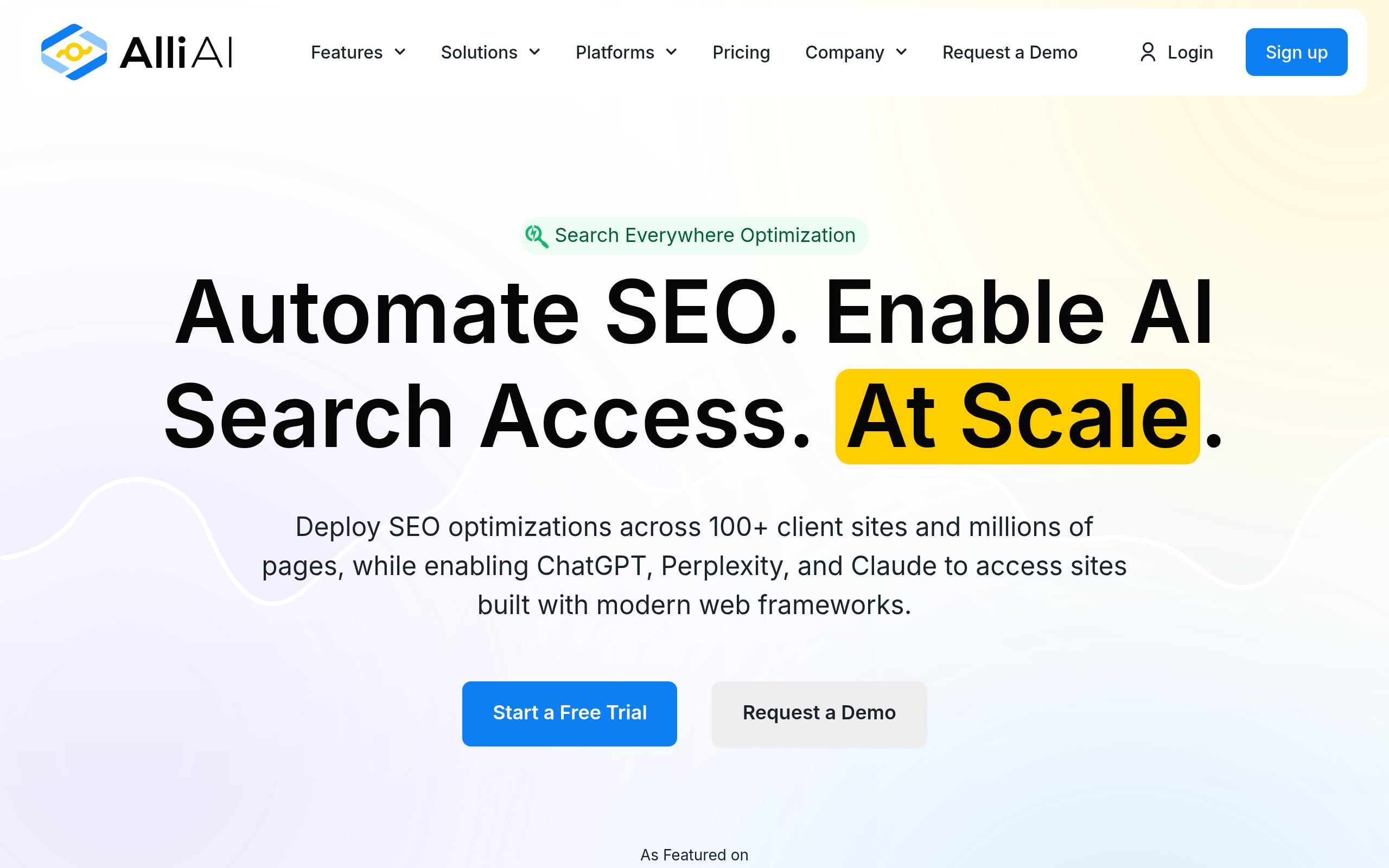
Alli AI turns on-site SEO from a ticket queue into a switch you can flip. By injecting a lightweight JavaScript snippet, it lets marketers push technical and on-page fixes live without code merges or waiting on sprint cycles. For teams managing thousands of URLs, its rules engine standardizes changes in minutes and proves impact fast.
Workflow in one line: Install snippet → set global rule (e.g., FAQ schema on all product pages) → review → 1-click approve → updates go live across the site.
What it automates and why it stands out
- Bulk optimization at scale: Auto-fixes titles, metas, and headers across massive URL sets via global rules.
- SEO AI Agent: Proactively audits and proposes code-level fixes for quick human approval.
- Internal linking automation: Inserts contextual links with optimized anchors to lift priority pages.
- Automated schema: Deploys JSON-LD (FAQ, Product, etc.) without developer work.
- SEO A/B testing: Runs title experiments and rolls out winning variants to lift CTR.
- Speed optimizer: Improves Core Web Vitals by lazy-loading and deferring non-critical elements.
Pricing & fit snapshot
- Best for: Agencies and enterprises facing dev bottlenecks on high-page-count sites.
- Automation style: Managed execution with 1-click human approval.
- Starting price: $169/mo (Small Biz); Agency plans from $499/mo.
- Integrations/setup: Works with any CMS (WordPress, Shopify, etc.) via a JS snippet.
- Watch-outs: Changes are “rented,” meaning if you remove the snippet, the live optimizations revert.
2. seoClarity
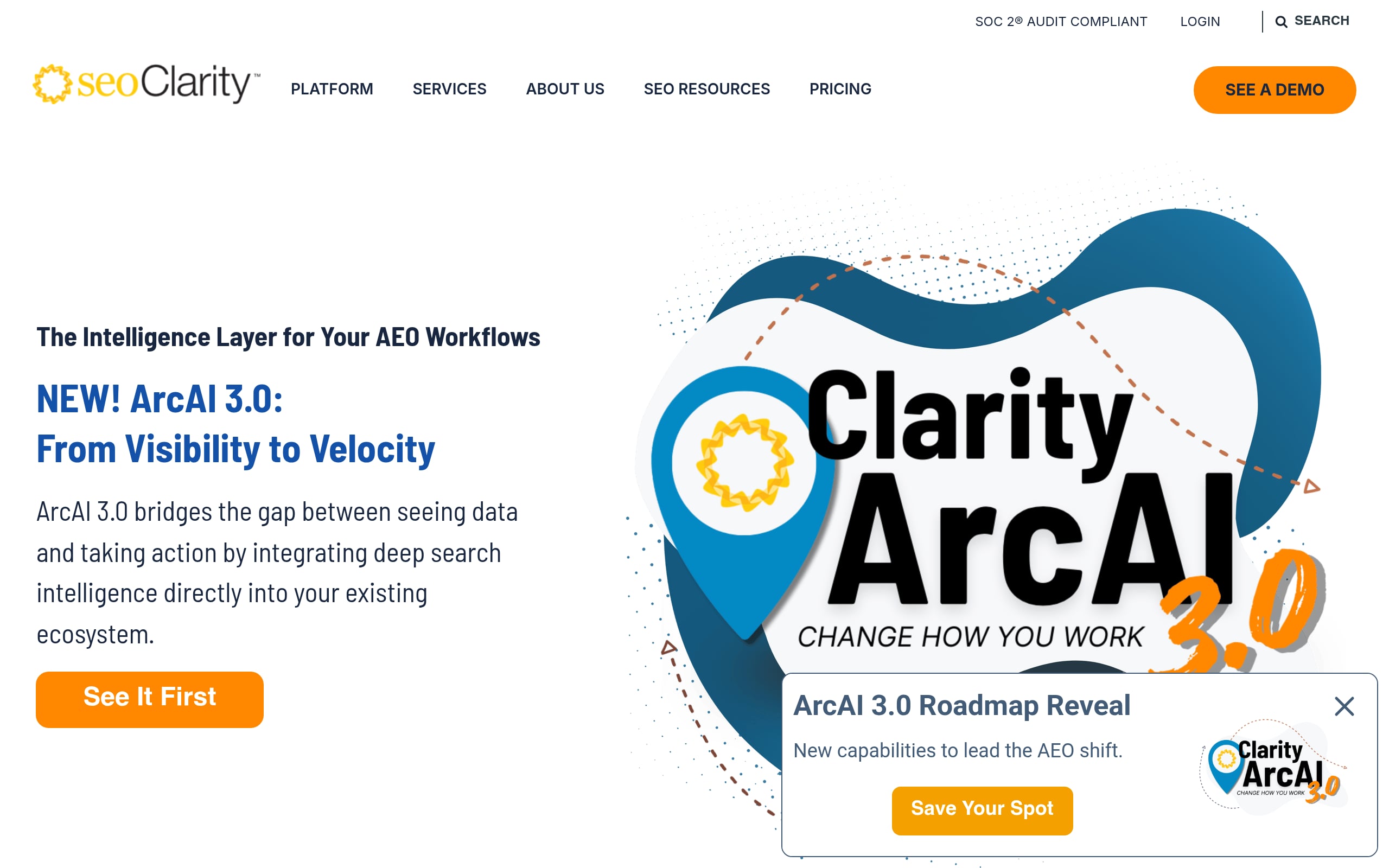
seoClarity is built for enterprises that need to move SEO fixes at the speed of their sites. Its ClarityAutomate engine deploys changes at the edge, so metadata, links, and structured data get updated instantly without touching your core codebase. Paired with AI insights, it compresses discovery, prioritization, and implementation into a single motion.
Workflow in one line: Connect to the edge (e.g., Cloudflare) → surface errors like missing schema → deploy JSON-LD at scale → monitor impact with automated alerts.
What it automates and why it stands out
- ClarityAutomate: No-code, edge-side deployment of technical fixes and metadata rewrites.
- Automated internal linking: Semantic AI injects links to reinforce underperforming pages.
- Sia AI assistant: Summarizes data, drafts meta tags, and runs competitive gap analysis.
- Content Fusion: Generates briefs from real SERP structures and keyword requirements.
- Smart site audits: Continuous monitoring with prioritized tickets to Jira/Asana.
- Rank Intelligence: Volatility alerts for algo shifts and competitor moves.
Pricing & fit snapshot
- Best for: Large enterprises and global brands with 100k+ pages.
- Automation style: End-to-end, from discovery through live edge deployment.
- Starting price: Custom enterprise; entry tiers often start around $1,000/mo.
- Integrations/setup: GSC, Adobe Analytics, CDNs; requires technical edge setup and security review.
- Watch-outs: Steeper learning curve; edge deployments need IT/Sec alignment.
3. Botify
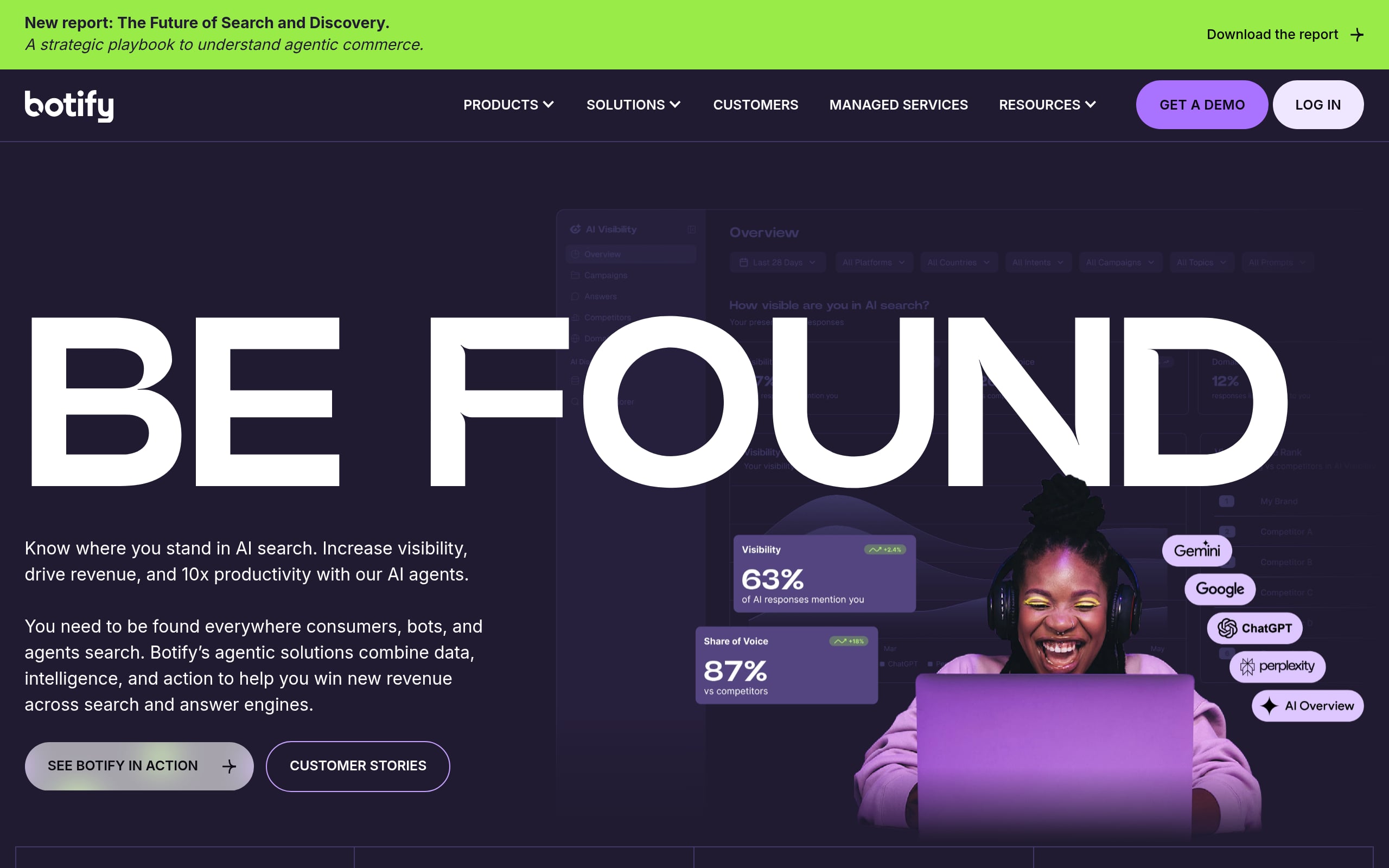
Botify pairs deep crawl intelligence with an execution layer that actually fixes what it finds. Its Activation product deploys code changes at the edge, turning crawl insights like canonicals, meta tags, and headers into live improvements in minutes. The result is a closed loop: diagnose, act, measure.
Workflow in one line: Detect missing canonicals → auto-inject metadata via Cloudflare → verify crawl frequency shifts → attribute wins with closed-loop reporting.
What it automates and why it stands out
- Activation at the edge: Pushes meta and header changes instantly, bypassing dev queues.
- Automated internal linking: Dynamically routes link equity to high-value but underperforming URLs.
- ActionBoard prioritization: AI ranks tasks by predicted ROI to focus effort.
- Real-time log analysis: Monitors Googlebot behavior and flags crawl waste immediately.
- Dynamic sitemap management: Keeps XML sitemaps fresh and focused on indexable, quality pages.
Pricing & fit snapshot
- Best for: Enterprise ecommerce and media properties with 100k+ pages.
- Automation style: End-to-end, from analysis and prioritization to live execution.
- Starting price: Custom enterprise; typically a significant annual investment.
- Integrations/setup: CDN access (Cloudflare, Akamai) or JS snippet; GSC integration.
- Watch-outs: Requires IT/DevOps approval and edge-level setup.
4. OTTO SEO by SearchAtlas
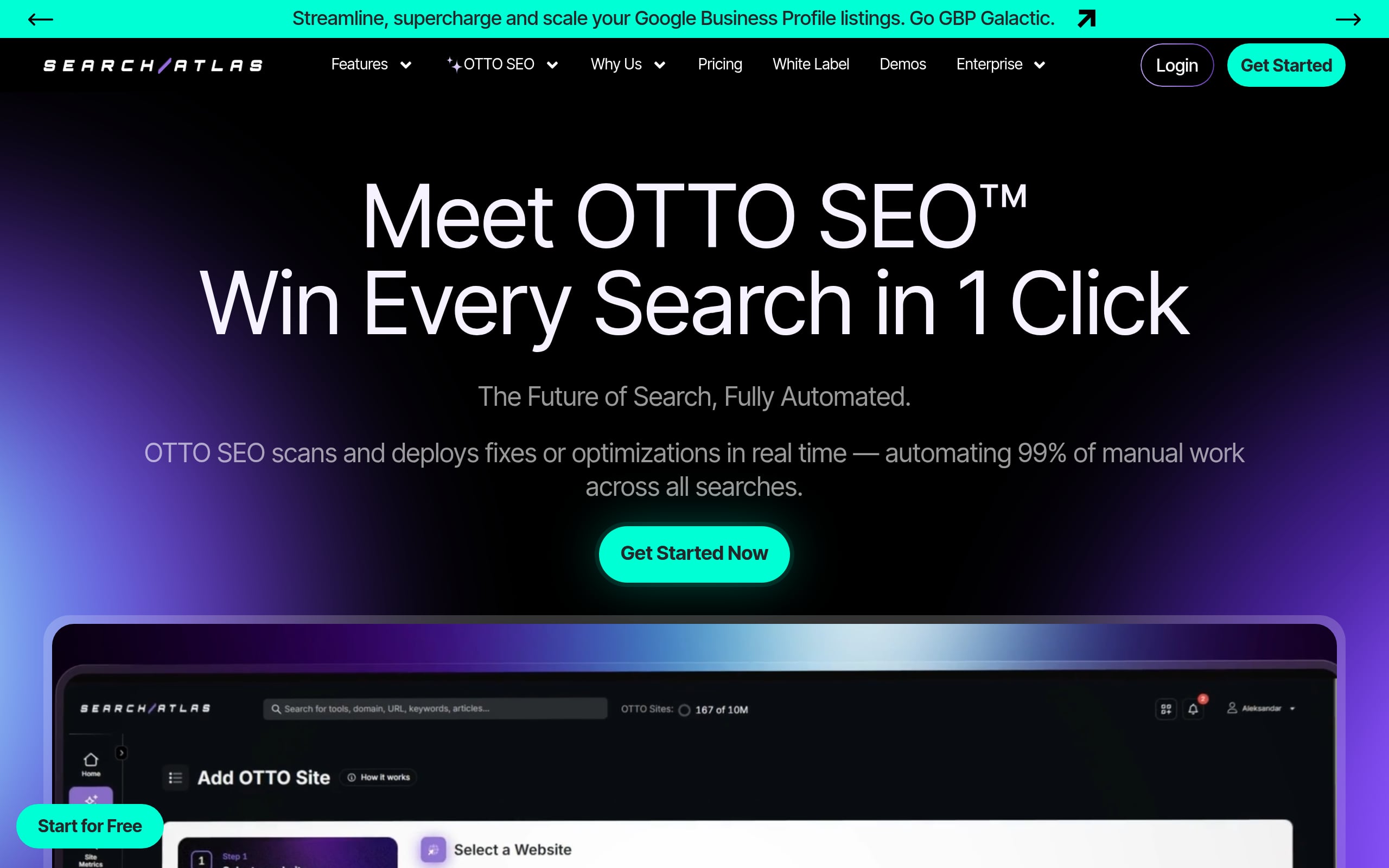
OTTO SEO behaves like a 24/7 SEO autopilot for high-volume sites. Through a simple JavaScript snippet, it identifies gaps, refreshes content, and pushes on-page fixes live, so teams can scale growth without adding headcount. It’s especially sharp at catching ranking dips and shipping targeted improvements fast.
Workflow in one line: Connect plugin/snippet → OTTO detects ranking drop → drafts new H1 from SERP trends → you approve (or set to autopilot) → change goes live.
What it automates and why it stands out
- Programmatic execution: Titles and headers updated across thousands of URLs in seconds.
- AI content refreshing: Revives aging content to reclaim “low-hanging” rankings.
- Dynamic internal linking: Adds contextual links that lift priority pages.
- Technical remediation: Background fixes for broken links and schema errors.
- SERP-driven briefs: Outlines based on competitor structures and keyword coverage.
Pricing & fit snapshot
- Best for: Ecommerce brands and agencies managing content-heavy sites.
- Automation style: Full-stack execution with Approval Mode or Full Autopilot.
- Starting price: $99/mo; Pro tiers with full automation typically start at $299/mo.
- Integrations/setup: WordPress and Shopify plugins; others via 1-line JS snippet.
- Watch-outs: Start with manual approval to ensure voice and brand consistency.
5. NytroSEO
NytroSEO streamlines high-volume on-page optimization for modern CMS and ecommerce stacks. It programmatically generates and maintains titles, metas, and schema so your catalog and content stay aligned with search intent without spreadsheets or copy-paste drudgery.
Workflow in one line: Install native app → scan your site → auto-deploy optimized meta tags and schema across every page → monitor and refresh in real time.
What it automates and why it stands out
- Dynamic meta generation: Keyword-tuned titles and descriptions for every URL.
- AI image alt-text: Vision-powered descriptions to boost accessibility and image SEO.
- Automated schema: Page-type detection triggers JSON-LD for richer results.
- Bulk fixes at scale: Refreshes metadata for thousands of URLs without CSV imports.
- Keyword mapping: Prevents cannibalization by assigning unique target terms.
- Real-time re-optimization: Responds to site changes to keep pages competitive.
Pricing & fit snapshot
- Best for: Large ecommerce stores, agencies, and enterprises with massive page counts.
- Automation style: End-to-end execution that pushes changes directly to your CMS.
- Starting price: $59/mo; native apps for Shopify, WordPress, Wix.
- Integrations/setup: Major CMS apps or custom JS for headless builds.
- Watch-outs: Supervise initial outputs for niche vocabulary; allow manual overrides for tone.
6. ContentKing
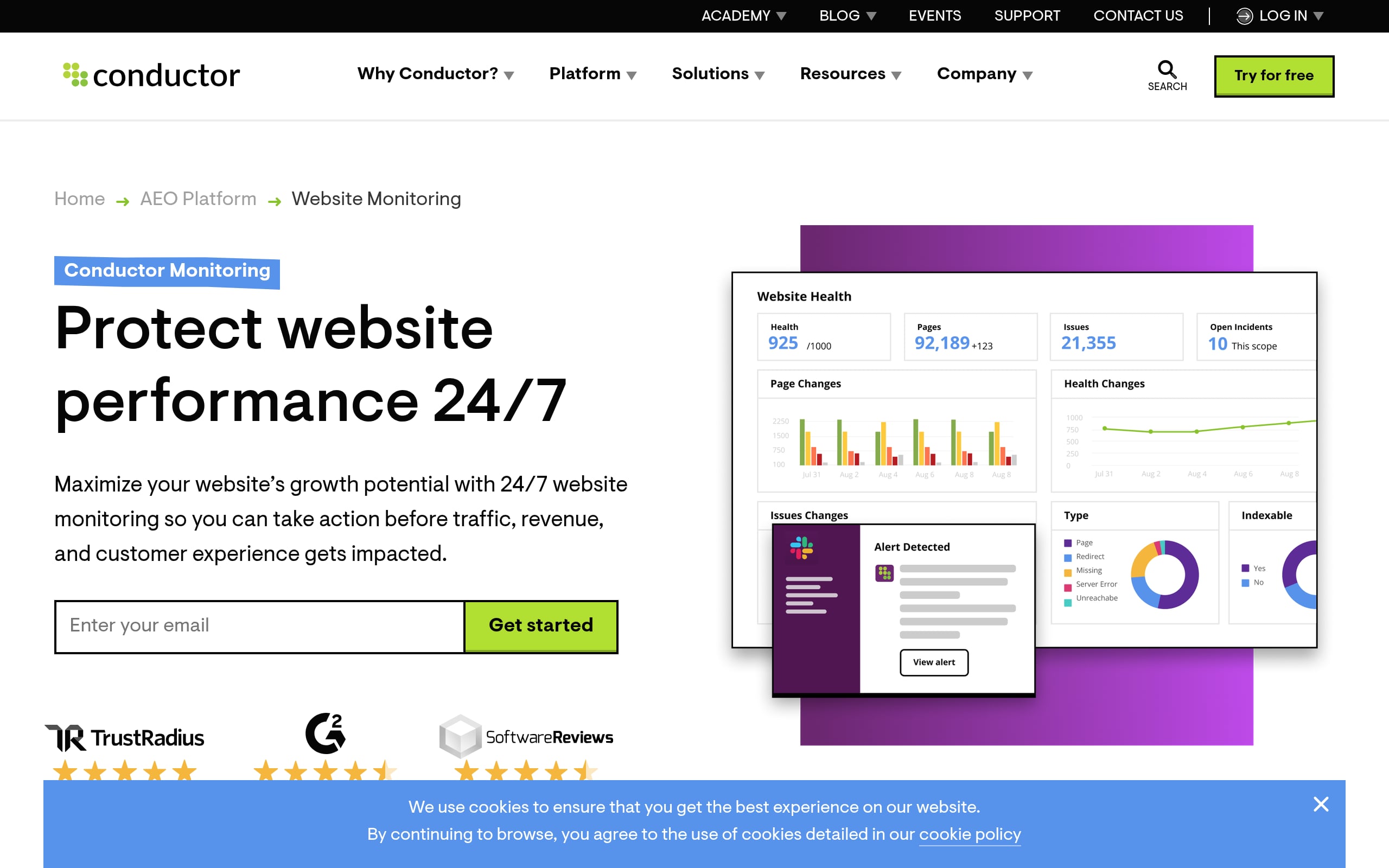
ContentKing replaces periodic audits with a live, always-on view of your SEO health. When something breaks, such as robots rules, noindex tags, or critical templates, it alerts the right people immediately and shows exactly what changed, so you can fix issues before search engines and revenue take a hit.
Workflow in one line: Connect your site → continuous crawl detects a robots.txt or noindex issue → instant Slack alert with the change diff → roll back before deindexing.
What it automates and why it stands out
- Real-time auditing: Persistent crawling updates health scores as changes happen.
- Historical tracking: Logs metas/schema to link ranking shifts to specific edits.
- Smart alerting: Pings Slack/Teams only for high-impact issues.
- Data overlays: Combines GSC/Analytics with audits to show traffic impact.
- Page segmentation: Focuses monitoring on your highest-value URL clusters.
Pricing & fit snapshot
- Best for: Ecommerce, agencies, and enterprises with frequent site changes.
- Automation style: Real-time technical guardrails and alerts.
- Starting price: ~ $39/mo; scales with page count and depth.
- Integrations/setup: Quick cloud setup; Slack, GSC, Teams, and Conductor integrations.
- Watch-outs: Large sites may see higher costs; tune alerts to avoid notification fatigue.
7. Lumar
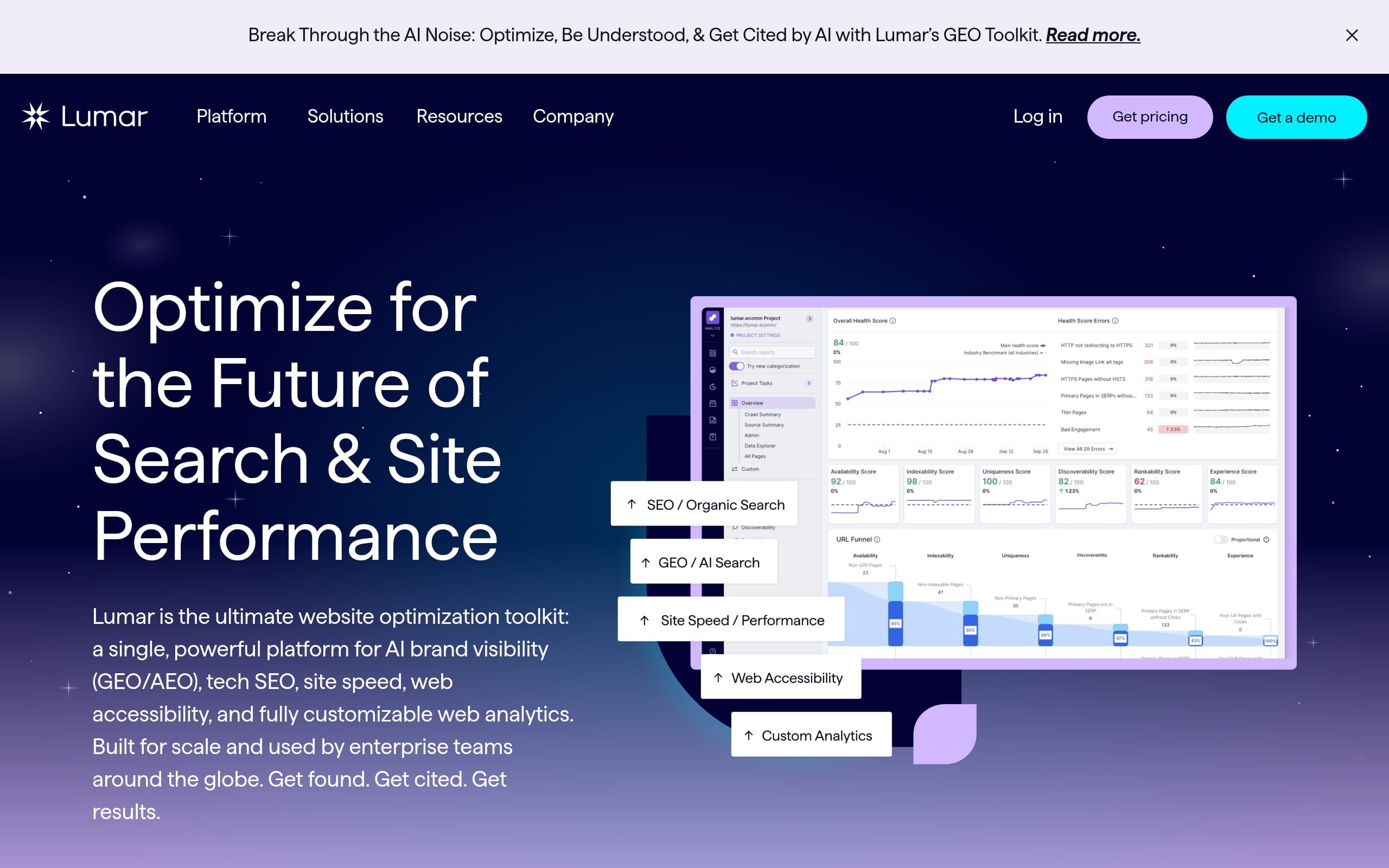
Lumar brings enterprise-grade QA discipline to SEO. By plugging into development workflows, it crawls staging environments, catches defects before deploy, and keeps sprawling architectures healthy with scheduled monitoring and instant alerts, so technical debt doesn’t leak into your rankings.
Workflow in one line: Connect to CI/CD → Lumar crawls staging builds → blocks deployments on SEO errors → sends Slack/Jira alerts with prioritized fixes.
What it automates and why it stands out
- Lumar Protect: SEO QA in staging to prevent regressions before go-live.
- High-velocity crawling: Handles millions of URLs and heavy JavaScript rendering.
- Scheduled monitoring: Recurring audits with alerts tied to health score drops.
- Custom data extraction: Scrapes elements like price/stock/schema at scale.
- Project governance: Auto-prioritizes issues and syncs to Jira for resolution.
Pricing & fit snapshot
- Best for: Large enterprises and massive ecommerce sites.
- Automation style: Technical SEO governance integrated with DevOps.
- Starting price: Custom enterprise; annual agreements common.
- Integrations/setup: GitHub, Jenkins, Bitbucket, GSC, and Slack.
- Watch-outs: Premium pricing; not a keyword research or AI content suite.
8. Oncrawl
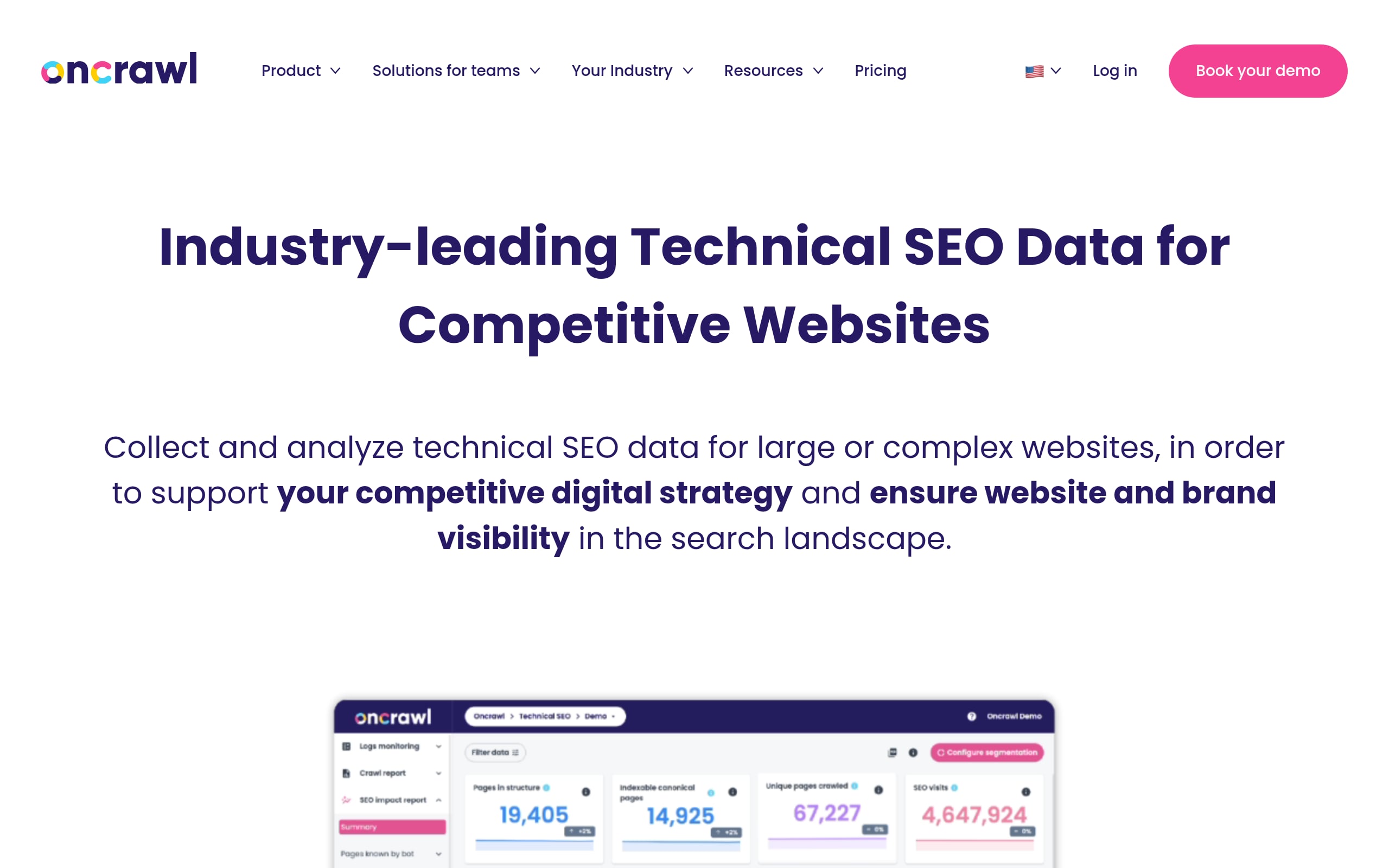
Oncrawl fuses crawl data, server logs, and analytics into automated technical intelligence. Its machine learning models surface crawl waste, internal linking problems, and indexation gaps, while CI/CD hooks and data pipelines keep insights flowing to your BI stack.
Workflow in one line: Connect site and logs via API → run automated audits after deployments → stream results to BigQuery → prioritize fixes using ML insights.
What it automates and why it stands out
- Automated log analysis: Tracks Googlebot in real time to expose crawl waste.
- ML-driven insights: Calculates internal link equity (Inrank) to improve distribution.
- Scalable data pipelines: Ingests GSC/GA4 to reveal orphans and quick wins.
- CI/CD automation: Pre-ship audits catch issues before they reach production.
- Dynamic segmentation: Auto-groups massive URL sets for granular trend analysis.
Pricing & fit snapshot
- Best for: Enterprise ecommerce, large sites, and data-driven agencies.
- Automation style: Deep technical automation and server-side data piping.
- Starting price: From $69/mo; advanced automation via Enterprise plans.
- Integrations/setup: BigQuery, GA4, Adobe Analytics; requires technical setup.
- Watch-outs: Steep learning curve; data volume can overwhelm smaller teams.
9. BrightEdge
BrightEdge marries enterprise SEO intelligence with automated implementation. DataMind identifies shifts and opportunities, while Autopilot applies on-page fixes directly to your site via live JavaScript, turning recommendations into measurable outcomes without waiting on sprints.
Workflow in one line: Connect your CMS → Autopilot flags missing headers/alt text → auto-deploys JS fixes → DataMind alerts track impact and new opportunities.
What it automates and why it stands out
- Autopilot fixes: Repairs broken links, alt text, and headers with live JS injection.
- Opportunity forecasting: Predicts revenue impact to prioritize the highest-ROI tasks.
- DataMind smart alerts: Real-time signals on competitor moves and ranking shifts.
- Automated briefs: Content blueprints with semantic clusters and SERP structure.
- Hyperlocal tracking: City-level monitoring for large multi-location brands.
- Automated clustering: ML groups keywords to expose competitive gaps.
Pricing & fit snapshot
- Best for: Global enterprises managing thousands of pages.
- Automation style: End-to-end, from identification through live implementation.
- Starting price: Enterprise pricing (often $1,000–$5,000+/mo); talk to sales.
- Integrations/setup: Adobe Experience Manager, Salesforce, GSC; JS integration required.
- Watch-outs: High cost; requires trust in automated code changes.
10. Conductor
Conductor closes the gap between insight and action for enterprise teams. With always-on technical monitoring (via ContentKing), AI-guided briefs, and native task handoffs into dev tools, it orchestrates SEO, content, and engineering so fixes and content improvements actually ship.
Workflow in one line: Real-time monitors spot a rogue noindex → instant Slack ping → auto-create Jira ticket → team resolves before rankings or revenue dip.
What it automates and why it stands out
- Real-time auditing: 24/7 monitoring to catch regressions the moment they happen.
- AI content guidance: Aria AI drafts briefs and intent-aware keyword recs.
- Workflow automation: Seamless handoffs to Jira, Asana, and Workfront.
- Competitive intelligence: Auto-tracks market share and content gaps.
- Executive dashboards: Board-ready, automated ROI reporting.
- Smart keyword grouping: ML clusters thousands of terms into usable themes.
Pricing & fit snapshot
- Best for: Large enterprises and global teams with complex tech stacks.
- Automation style: Semi-auto operational and technical automation.
- Starting price: Custom enterprise (typically $2,000+/mo); demo required.
- Integrations/setup: Native Jira, Asana, Slack, GA4; professional onboarding recommended.
- Watch-outs: Cost and complexity can be overkill for SMBs.
Build Your Automation Stack by Budget and Needs
Building an effective SEO automation stack doesn’t have to be complicated or expensive. You can tailor your approach based on your specific goals and resources.
The Lean Startup or SMB Stack (Under $500/month)
For businesses focused on maximum ROI with a limited budget, a “done for you” service is often the most efficient choice. Instead of juggling multiple subscriptions for keyword research, content writing, and technical monitoring, you can get it all in one package.
- Core Engine: A hybrid SEO execution service like Rankai. For a flat monthly fee, you get expert keyword strategy, high volume content creation (20+ pages/month), technical fixes, and continuous optimization. This consolidates the cost and complexity of multiple tools into one predictable expense.
- Analytics: Google Search Console (Free) and Google Analytics (Free). These are non negotiable for tracking performance and understanding your audience.
The DIY Growth Stack ($500 to $1500/month)
If you have an in house marketer who can manage multiple tools, you might build a custom stack.
- Keyword Research & Strategy: Ahrefs or Semrush ($100 to $500/mo).
- Content Generation: SurferSEO or Jasper ($100 to $300/mo).
- Technical SEO: Screaming Frog ($259/year) or Sitebulb.
- Project Management: Trello or Asana (Free to $50/mo).
While this approach offers more control, it also requires significant time to manage the different platforms and connect the workflows.
Workflow Blueprints: How to Connect It All
A successful SEO automation workflow turns strategy into a repeatable process. Here’s a simplified blueprint:
- Monthly Strategy: A human strategist uses a tool like Ahrefs to perform a competitor gap analysis and identify high potential keywords for the month.
- Content Plan: The selected keywords are turned into a content calendar, often inside a project management tool.
- Automated Drafting: An AI content tool generates first drafts for each topic, structured around the target keyword and related entities.
- Human Review & Polish: An editor reviews, fact checks, and refines the AI generated content to ensure quality, brand voice, and accuracy.
- Direct Publishing: The finalized content is pushed directly to the CMS (like WordPress or Shopify) via an integration, complete with metadata and internal links.
- Performance Monitoring: A rank tracker monitors the new content. After 3 to 4 weeks, underperforming pages are automatically flagged for a rewrite.
- Iterate and Improve: The flagged pages are completely rewritten and republished to improve their chances of ranking.
This entire loop can be managed seamlessly by an integrated service, removing the friction between steps. If you’re looking for a pre built workflow that handles all of this for you, check out how Rankai works.
Local and Voice Search: Automations That Move the Needle
SEO automation is particularly powerful for businesses targeting local customers. You can use it for programmatic SEO, which involves creating unique, optimized pages for every service area or location. Imagine creating 50 pages, each targeting “plumber in [city name]”, in a fraction of the time it would take manually.
For voice search, automation helps structure content to answer questions directly. By identifying common questions related to your topics and using AI to generate clear, concise answers, you can increase your chances of being featured in voice search results and Google’s “People Also Ask” sections.
Implementation Checklist and KPIs
Ready to get started? Follow this simple checklist.
- Step 1: Audit Your Current Process: Identify the most time consuming, repetitive SEO tasks you currently perform.
- Step 2: Define Your Goal: Are you trying to increase content velocity, improve keyword rankings, or fix technical debt?
- Step 3: Choose Your Solution: Select a tool or service that directly addresses your primary goal and fits your budget.
- Step 4: Set Up Integrations: Connect your chosen solution to your CMS and Google Search Console.
- Step 5: Track Key Performance Indicators (KPIs):
- Keyword Rankings: Are your target keywords moving up in the SERPs?
- Organic Traffic: Is traffic from search engines increasing month over month?
- Impressions: Is your overall visibility in search results growing?
- Number of Pages Ranking: How many of your pages are indexed and ranking for their target terms?
Conclusion: Adopt an Automation First Approach (With Human Judgment)
SEO automation is no longer an option, it’s a competitive necessity. By embracing technology to handle the scale and complexity of modern SEO, you empower your team to focus on what truly matters: strategy, creativity, and driving business growth. The most successful brands of tomorrow will be those that master the synergy between machine efficiency and human expertise. An automation first mindset doesn’t mean removing humans, it means elevating them.
Ready to see how a hybrid AI and human expert approach can transform your organic growth? Book a demo with Rankai today and discover a smarter, faster way to do SEO.
Frequently Asked Questions
What is the difference between AI SEO and SEO automation?
SEO automation is the broader concept of using any software to perform repetitive SEO tasks, like automated rank tracking or site crawling. AI SEO is a subset of this that uses artificial intelligence specifically for more complex tasks like content generation, keyword clustering, or predictive analytics. Most modern SEO automation platforms incorporate AI.
Can SEO automation replace my SEO team or agency?
It’s more of a transformation than a replacement. For small businesses, an SEO automation service can replace an expensive agency by delivering more output for less cost. For larger companies with in house teams, automation tools act as a force multiplier, handling tedious work so the team can focus on high level strategy that drives greater impact.
How much does SEO automation cost?
The cost varies widely. You can find specialized tools for as little as $50 per month, while comprehensive platforms can cost thousands. All in one execution services like Rankai offer a compelling middle ground, providing a full suite of services including strategy, content, and technical fixes for a flat fee around $499 per month.
Is AI generated content good for SEO?
Yes, when done correctly. Google’s guidance is clear: they reward high quality content, regardless of how it’s produced. The key is to use AI as a tool to create helpful, accurate, and original content, not to generate low quality spam. A human in the loop process, involving expert review and editing, is essential for ensuring quality and performance.
How do I get started with SEO automation?
The easiest way to start is by identifying your biggest SEO bottleneck. If it’s content creation, explore an AI content service. If it’s technical issues, start with an automated site crawler. For a comprehensive and hands off approach, consider a done for you service that bundles strategy, content, and technical SEO into one simple package.