At its heart, search intent is all about figuring out why someone typed a query into Google. It's the "why" behind the "what." Grasping this is non-negotiable in modern SEO because Google’s entire job is to give people exactly what they're looking for, and your content needs to be that perfect answer.
The Why Behind Every Search Query
Think of every search query as the start of a conversation. What is the person really trying to accomplish? It’s less about the specific words they use and more about the motivation behind them. This is the crucial difference between someone who's just window shopping for information and someone with their wallet out, ready to buy.
Let's use a real-world analogy. Imagine walking into a massive hardware store. A customer's question immediately reveals their goal:
- "Where are the hammers?" They need to find a specific location. Simple.
- "What's the best hammer for hanging pictures?" Now they're in research mode, comparing their options.
- "I want to buy this specific claw hammer." This is a crystal-clear signal that they are ready to make a purchase.
Each of these questions requires a totally different answer. Online, Google plays the role of that helpful store employee, and your content is the product on the shelf or the expert advice. If you serve up a long-winded guide on the history of hammer manufacturing to someone who just wants to buy one, they'll bounce. That disconnect is where SEO strategies fall apart.

Understanding the Four Core Intents
To really nail this, the SEO world generally breaks search intent down into four main types. Each one maps to a different point in a user's journey, from a spark of curiosity to a final decision. Getting these categories right is the first major step toward creating content that both users and search engines will reward.
At its core, search intent optimization is about empathy. It requires you to step into the searcher's shoes and deliver exactly what they need, at the moment they need it.
This user-first mindset isn't just a nice-to-have anymore; it's how Google fundamentally judges and ranks pages. The data backs this up, too. Roughly 52.65% of all search queries are purely informational. That means over half the time, people just want to learn something. By creating content that's laser-focused on these distinct intent types, you can pull in more relevant traffic and see your engagement metrics soar. You can find more insights about Google search statistics and how they are reshaping SEO.
To make this crystal clear, here’s a quick breakdown of the four main intent types we'll be diving into throughout this guide.
The Four Main Types of Search Intent at a Glance
This table gives you a quick summary of the primary search intent categories, their common keywords, and the typical user goal for each.
| Intent Type | User Goal | Example Keywords |
|---|---|---|
| Informational | To find information or learn something new. | "how to tie a tie", "what is photosynthesis" |
| Navigational | To find a specific website or brand. | "Facebook login", "Amazon homepage" |
| Commercial Investigation | To research products or services before buying. | "best running shoes", "Rankai vs Ahrefs" |
| Transactional | To complete a purchase or take a specific action. | "buy iPhone 15", "SEO agency pricing" |
Think of this table as your cheat sheet. As we go deeper, you'll learn how to spot these intents in the wild and build a content strategy that perfectly aligns with what your audience is searching for.
Exploring the Four Core Types of Search Intent

To really get SEO, you have to get inside the user's head and figure out why they’re searching. It’s not just about the words they type; it’s about the goal behind them.
While human motivation can get messy, we can boil most search queries down to four main categories. Think of them as different stages in a user's journey, starting with a spark of curiosity and ending with a final decision. By understanding these, you can stop just matching keywords and start giving people exactly what they need, when they need it.
Let's break them down.
H3: Informational Intent: “I Need to Know”
This is the big one. Most searches on the internet fall into this bucket. Someone has a question, and they want an answer. They’re not ready to buy anything or go to a specific site—they just want to learn.
You’ll spot these queries a mile away. They often kick off with words like “what,” “how,” “why,” or “who.” Queries like “how to poach an egg” or “what is the best time to visit Japan” are classic examples. The user is in pure research mode.
To meet this intent, your content has to be the best answer on the block: thorough, accurate, and easy to digest. This is where you build trust. For a deeper look, check out our guide to informational keywords and how to win with SEO.
The Core Purpose: To educate, explain, and give a clear answer. This is how you establish your brand as a helpful authority long before a purchase is ever considered.
For instance, if someone searches “what is search intent in seo,” Google serves up detailed guides and definitions, not sales pages for SEO agencies. The SERP correctly mirrors the user's learning mindset.
H3: Navigational Intent: “I Need to Go”
This one’s as simple as it gets. The user knows exactly where they want to go online, and they're just using Google as a glorified bookmark to get there faster.
These searches almost always include a brand or website name, like “YouTube,” “Chase bank login,” or “Rankai blog.” They aren't looking for options; they have a destination in mind and just want a direct link.
For example, searching "Wikipedia" pulls up the official homepage right at the top. Google knows you want to visit the site, not read an article about the site from a third party.
Optimizing for this is mostly about basic housekeeping. Make sure your homepage and key pages (like login or contact) are easy for Google to find and rank. You won’t get new customers this way, but if you can’t rank for your own name, something is seriously wrong.
H3: Commercial Investigation: “I Need to Compare”
This is where things get interesting. The user has moved past basic learning and is now actively weighing their options. They have a problem to solve or a purchase to make, but they haven't picked a winner yet. They're in comparison mode.
Keywords for this intent are full of evaluative language:
- Best CRM for small business
- HubSpot vs Salesforce
- Monday.com review
- Top email marketing platforms
These searchers are hungry for expert opinions, side-by-side comparisons, and real user reviews to guide their decision. They are incredibly valuable because they are just one step away from buying.
H3: Transactional Intent: “I Need to Act”
This is the finish line. The user has done their homework, made a decision, and is now ready to pull the trigger—usually by making a purchase. Their intent is clear, and their search query is direct.
Transactional keywords leave no doubt. They’re loaded with action words like “buy,” “price,” “sale,” or a specific product name and model number.
Examples include things like:
- Buy Allbirds Wool Runners
- MacBook Air M2 price
- Rankai subscription
When someone searches like this, they expect to land on a page where they can complete the action immediately. Drop them on a long blog post, and they’ll bounce. Your job here is to clear a path from the SERP straight to the checkout.
How to Figure Out the Intent Behind Any Keyword
Knowing the four types of search intent is a great start, but the real skill is spotting them in the wild. If you want your content to rank, you need a solid process for decoding the "why" behind any keyword you target. The best way to do this? Put on your detective hat and go straight to the source: Google's search engine results page (SERP).
The SERP is your treasure map. It shows you exactly what Google thinks people want when they type in a query. Before you write a single word, you have to manually check what’s already ranking on page one. This isn't optional; it's how you reverse-engineer what's working and create content that truly hits the mark.
Analyzing the SERP Like a Pro
When you search for your keyword, don't just look at the first few links. You're looking for patterns—clues that reveal what searchers are actually trying to do.
Here’s what to keep an eye out for:
- SERP Features: Does a "People Also Ask" box pop up? That’s a massive flag for informational intent. Are you seeing a shopping carousel with product images and prices? That's Google screaming transactional or commercial intent. These features aren't random; they're direct responses to user needs.
- The Titles of Ranking Pages: Scan the headlines. Do they start with "How to," "What is," or "A Guide to"? You're looking at informational content. If you see words like "Best," "Top 10," "Review," or "vs.," that’s a dead giveaway for commercial investigation.
- The Types of URLs: What kind of pages are actually ranking? Are they long-form blog posts and deep-dive articles? Or are they product pages, category pages from e-commerce sites, or landing pages for a service? A SERP filled with product pages means people are ready to buy, while a page of guides means they’re still learning.
Once you learn to read the SERP, you stop guessing what users want and start knowing what Google already rewards. It’s the difference between hoping for traffic and building a strategy that earns it.
Think about it. A search for "best running shoes" is always going to show you listicles and review sites, not a single brand’s product page. Google knows that user wants to weigh their options before buying. If you want to go deeper on this, our guide on unlocking SEO success by understanding keyword intent has even more real-world examples.
Using SEO Tools for a Head Start
Manual analysis gives you incredible insight, but let's be realistic—it doesn't scale when you're managing hundreds or thousands of keywords. This is where SEO tools like Ahrefs or Semrush become absolute lifesavers. They do the heavy lifting for you, giving you a quick read on intent.
Most modern SEO platforms now automatically tag keywords with their likely intent, which makes sorting and planning so much easier.
For example, a tool might label your keywords as:
- I (Informational): Someone is looking for information.
- N (Navigational): Someone is trying to get to a specific website.
- C (Commercial): Someone is comparing products or services.
- T (Transactional): Someone is ready to make a purchase.
This feature lets you filter massive keyword lists in seconds. You can instantly see which keywords are perfect for blog posts and which ones need a hard-hitting landing page.
The best approach is a mix of both worlds. Use a tool to get an initial intent classification, then do a quick manual SERP check to confirm what’s really going on. This combination gives you the speed of automation and the sharp, nuanced eye of a human expert. It's how you build a content plan that is both efficient and incredibly accurate.
Optimizing Content to Match User Intent
Knowing what search intent is and putting that knowledge into practice are two very different things. The latter is what separates content that vanishes into the digital ether from content that actually ranks, drives traffic, and converts. Once you've figured out the why behind a search query, it's time to build a page that delivers the perfect answer.
This is where your strategy gets real. It’s not about guessing what might work; it's a deliberate process of choosing the right format, the right tone, and the right call-to-action for each of the four main intent types. When you nail this alignment, you're not just doing good SEO—you're giving Google’s algorithm exactly what it’s designed to reward: a genuinely helpful experience for the searcher.
The flowchart below breaks this down into a simple, repeatable three-step process for turning your intent analysis into a solid content plan.
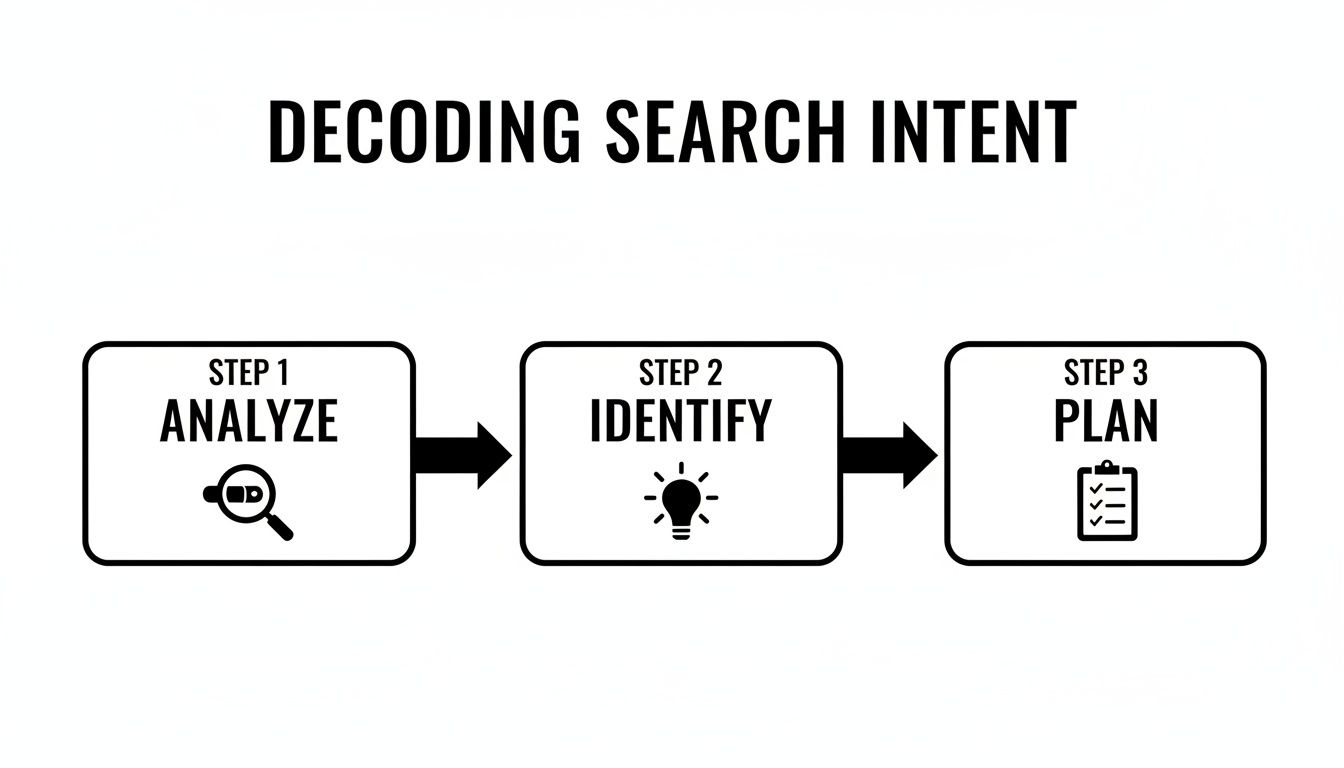
This Analyze -> Identify -> Plan framework is the bedrock of any intent-driven content strategy. It makes sure every single piece you create has a clear purpose and a direct path to success.
Crafting Content for Informational Intent
When someone is in learning mode, their intent is informational. Your job isn't to sell them something—it's to teach them something. The best way to do that is with comprehensive, well-structured content that answers their question better and more clearly than anyone else on the SERP.
Think long-form blog posts, how-to guides, step-by-step tutorials, or articles packed with original data. The call-to-action (CTA) should be a soft sell, something that offers more value instead of demanding a purchase. Think "Subscribe to our newsletter" or "Download our free e-book."
A few on-page SEO pointers for informational content:
- Title Tags: Frame them as questions, like "How to..." or "What Is..." to mirror the user's query.
- Headings: Use clear H2s and H3s to break down complex topics into digestible chunks.
- Internal Links: Point readers to other helpful articles on your site. This keeps them engaged and tells Google you're a subject matter authority.
Perfecting Pages for Navigational Intent
With navigational queries, the user already knows who you are. They’re just using Google as a shortcut to get to a specific page on your site. Your only goal here is to make that journey as fast and seamless as possible. You're not creating a blog post; you're optimizing your homepage, login page, or contact page.
Optimization is pretty straightforward. Make sure your brand name is front and center in your homepage's title tag. Keep your site architecture clean and logical so both humans and search crawlers can find important pages without a hassle. The CTA is simply the page's function—the login button or the main navigation menu.
For navigational intent, the best content is a clean, fast-loading, and easily identifiable page. Don't overcomplicate it. Give the user the direct path they’re looking for.
Building Trust With Commercial Investigation Content
Here, the user is in evaluation mode. They’re getting close to a decision but need more information to compare their options. This is your chance to step in, build trust, and prove you're the expert they've been looking for.
The best formats for commercial investigation are things like:
- In-depth product or service reviews.
- "Best of" listicles (e.g., "Top 10 SEO Tools for 2024").
- Head-to-head comparison articles (e.g., "Rankai vs. Semrush").
Your on-page elements need to scream trustworthiness. Use clear feature comparison tables, bulleted pros and cons lists, and authentic customer testimonials. The CTA shouldn't be "Buy Now" just yet. Instead, guide them to the next logical step with "Learn More," "See Pricing," or "Start a Free Trial."
Fine-Tuning Pages for Transactional Intent
This is it—the bottom of the funnel. The user has their wallet out and is ready to make a move. For transactional intent, your content must be laser-focused on making that action as easy as possible, whether it's a purchase, a sign-up, or a quote request. This is where your product pages, service pages, and pricing pages do the heavy lifting.
Clarity and speed are everything. Strip away all distractions. Use high-quality product photos, write concise and benefit-driven copy, and display pricing information clearly. Your CTA needs to be direct and impossible to miss. Use strong, action-oriented words like "Buy Now," "Add to Cart," or "Get Started Today."
To pull this all together, here’s a quick-reference table that shows how your strategy should shift based on what the user wants to accomplish.
Content Optimization Tactics by Search Intent
| Intent Type | Ideal Content Format | Primary CTA | Key On-Page Focus |
|---|---|---|---|
| Informational | Blog posts, how-to guides, tutorials | "Subscribe," "Download e-book" | Answering questions thoroughly, clear explanations. |
| Navigational | Homepage, login page, about page | The page’s core function (e.g., login button) | Brand name in titles, clear navigation, fast load speed. |
| Commercial | Reviews, comparison articles, "best of" lists | "Compare Features," "Learn More," "Start Trial" | Trust signals, feature tables, pros/cons, user reviews. |
| Transactional | Product/service pages, pricing pages | "Buy Now," "Add to Cart," "Sign Up" | Clear pricing, strong benefits, high-quality images, easy checkout. |
As you can see, a one-size-fits-all approach just doesn't work. By systematically tailoring your content format, on-page SEO, and CTAs to these four intents, you create a far more relevant and satisfying user journey. This alignment doesn't just make users happy—it sends powerful positive signals to search engines, showing them that your page is the best result for the query.
The Future of Search Intent in an AI-Driven World
Thinking you've mastered search intent is a great start, but the game is changing right under our feet. The way people look for things online is evolving, and if your SEO strategy is standing still, it's going to get left behind. It's not just about measuring what works today; it's about getting ready for how AI and conversational search are flipping the script.
First things first, you have to know what success even looks like for each type of intent. The metrics that matter for a "how-to" guide are completely different from those for a product page.
- Informational Intent: Look at your engagement. A high time on page and a low bounce rate are great signs that you’re actually answering the user's question and holding their attention.
- Commercial Intent: Here, you're watching click-through rates (CTR) to things like product comparisons, "best of" lists, or free trial sign-ups. Are you successfully nudging people closer to making a choice?
- Transactional Intent: This one is simple: the conversion rate. It all comes down to whether people are buying, filling out a form, or downloading your guide. This is the ultimate proof that your page is doing its job.
Adapting to AI Overviews and Conversational Search
The next big wave is already here: Large Language Models (LLMs) and features like Google's AI Overviews. These tools are built to give people instant answers, pulling summaries from the top-ranking pages and displaying them right on the results page. This ushers in a huge challenge we're all facing: the "zero-click" search.
This isn't some far-off problem; it's happening now. Studies in 2024 showed that almost 60% of searches in the EU and over 58% in the U.S. ended without a click. On top of that, you have the explosion of local intent—over 1.5 billion “near me” searches every month—where the answer often comes from a map pack, not a website. As AI Overviews continue to roll out, optimizing for intent isn't just a good idea; it's a survival tactic. You can dig into more of these numbers and what they mean over at digitalmarketinginstitute.com.
To keep getting traffic, your content strategy has to adapt.
The goal is no longer just to be a source for Google. It's to be the source that AI models cite and to offer value that a quick AI summary simply can't match.
This means you need a two-part plan. First, make your content incredibly easy for AI to understand. Use clean headings, structured data (like schema), and get straight to the point with factual statements. Second, create content that goes beyond the basics. You need to offer unique perspectives, expert opinions, and real-world experiences that an AI can't just scrape and rephrase. We dive much deeper into this in our complete guide to AI SEO for the new era of search.
Building a Resilient SEO Strategy
The fundamentals of what is search intent in SEO haven't changed, but how we apply them is getting a lot more sophisticated. Your content now has to please two very different audiences: the human user and the AI that acts as their gatekeeper.
Your focus should shift toward creating comprehensive pillar pages that become the go-to resource on a topic. Build out your topical authority by connecting related articles, proving you have deep expertise in your corner of the internet. By delivering genuine value—through original data, interviews with experts, or detailed case studies—you give people a reason to click through, even after they've seen an AI summary. This is the kind of forward-thinking that builds an SEO strategy tough enough to handle whatever algorithm updates and user behavior shifts come next.
Frequently Asked Questions About Search Intent
Even after you get the hang of the basic concepts, some tricky questions always pop up when you start applying search intent to your own work. Let's walk through some of the most common ones I hear from marketers to clear up any confusion and help you sidestep a few common mistakes.
How Does Search Intent Change Keyword Research?
Grasping what is search intent in SEO completely flips keyword research on its head. It’s no longer just about chasing the terms with the highest search volume. Instead, your focus shifts to finding keywords that actually line up with what you want your business to achieve.
You stop asking, "How many people search for this?" and start asking, "What are people who search for this really trying to do?"
This simple change in perspective helps you zero in on keywords that drive real results. A keyword with informational intent might be perfect for building brand awareness, while one with commercial intent can bring in qualified leads. It's the difference between pulling in random traffic and attracting people who are genuinely interested in what you have to offer.
When you focus on the why behind a search, you stop just collecting a list of keywords and start building a strategic content map. Every single article, blog post, or landing page gets a specific job to do, whether it's educating a new visitor or helping to close a sale.
Can One Page Target Multiple Intents?
Absolutely, but you have to be smart about it. It's definitely possible for one page to serve more than one type of search intent, especially for broader queries where people might be looking for a few different things. A great example is "best running shoes"—it’s a mix of commercial and informational intent. People want to see comparisons, but they also want to understand what makes one shoe better than another.
The trick is to structure your page so it meets both needs without feeling cluttered.
- For the Commercial side: You'd want to include things like a comparison table, feature highlights, and obvious links to purchase.
- For the Informational side: You could add a detailed buying guide section that explains different materials, what to look for in a good fit, and other key considerations.
This strategy works best when the intents are closely related, like commercial investigation and transactional. Trying to force a hard-sell transactional pitch onto a purely informational page, however, almost always backfires. It just creates a confusing experience that doesn't really help anyone.
What Is the Biggest Mistake to Avoid?
The single biggest—and most damaging—mistake is trying to force the wrong intent onto a page. This usually happens when a marketer gets a little too eager and tries to jam a "buy now" call-to-action into a piece of content that's meant to be purely educational.
Picture this: you're reading a fantastic, in-depth guide on "how to bake sourdough bread," and every other paragraph is interrupted by a pop-up screaming, "Buy Our Premium Flour Now!" It's annoying, it’s not helpful, and it shows a complete disregard for why you're there. You came to learn, not to get sold to.
This kind of mismatch leads to a terrible user experience, which sends people clicking the back button in droves. That high bounce rate is a huge red flag for Google, signaling that your page isn't the right answer for that query, and your rankings will suffer because of it. Always, always respect the user's goal first.
Ready to stop guessing and start ranking with content perfectly matched to user intent? Rankai uses AI to identify high-impact keywords and automatically creates 20+ fully optimized pages for your business every single month, complete with visuals, links, and CTAs tailored to what your audience is searching for. See how we drive reliable organic growth at https://rankai.ai.