Gone are the days of the old-school "one keyword, one page" SEO strategy. Keyword clustering is a smarter approach where you group related search queries that all share the same user intent and target them with a single, comprehensive page. This allows one piece of content to rank for potentially hundreds of keyword variations at once.
What Is Keyword Clustering Explained Simply

If you're still building a separate page for every minor keyword variation, you're fighting an uphill battle. Modern search engines like Google have evolved; they don't just match words anymore, they understand the topics and intent behind them. Keyword clustering is all about aligning your content strategy with how search actually works today.
Think about how a well-run grocery store is organized. You wouldn't find apples in one aisle, oranges in another, and bananas halfway across the store. They're all grouped together in the "Fruit" section. This makes the shopping experience intuitive and efficient.
That's exactly what keyword clustering does for your website. It organizes your content into logical, topical groups, making it incredibly easy for both your audience and search engines to recognize your expertise on a subject.
The Shift to Intent-Based SEO
This strategic pivot really started gaining traction around 2015, thanks to pioneering work by Russian SEO expert Alexey Chekushin. He popularized a method that analyzes the top 10 search results for different keywords. If the same URLs kept appearing for multiple queries, it was a clear signal that Google saw them as serving the same user intent. You can learn more about the origins of this SERP analysis method on semrush.com.
For example, if queries like "king size mattress" and "king mattress" consistently bring up at least three of the same websites in the top results, they belong together in the same cluster. This proves they share the same underlying search goal.
Adopting this mindset helps you move beyond just matching keywords and start focusing on what the user actually wants to accomplish. By creating one powerhouse page that serves a whole cluster of related queries, you can:
- Build topical authority faster: You're sending a strong signal to Google that your site is a definitive resource on the subject.
- Improve user experience: Visitors get a single, in-depth resource that answers all their related questions in one place.
- Save time and resources: You stop creating thin, redundant pages that end up competing against each other for rankings.
By grouping keywords, you create a single piece of content that acts as a powerful magnet for a wide range of relevant traffic, consolidating your ranking power and establishing clear topical relevance.
At the end of the day, understanding what is keyword clustering means building a more efficient and effective content architecture—one that mirrors how search engines actually see and organize the web.
Why Keyword Clustering Drives Modern SEO Success
The old SEO playbook of creating one page for every single keyword variation is officially dead. If you want to succeed today, you have to get in sync with how modern search engines actually think. After game-changing updates like Google's Hummingbird, the focus has shifted dramatically from exact-match keywords to understanding topical relevance and what a user is truly looking for.
This is exactly where keyword clustering gives you a serious edge. Instead of creating a dozen thin pages that compete with each other, you build one powerhouse resource that answers multiple related questions all at once. This strategy screams authority to Google, signaling that your site is the go-to source for a particular subject.
Build Authority and Stop Cannibalizing Your Own Traffic
One of the biggest wins from clustering is putting an end to keyword cannibalization. This is the classic self-sabotage scenario where multiple pages on your own website fight for the same search terms, leaving search engines confused and splitting your ranking power. By consolidating your efforts into a single, authoritative page, you make sure all of your SEO juice flows to one definitive asset.
This focused approach also puts you on the fast track to building topical authority. Think about it: when one page ranks for "how to fix a leaky faucet," "leaky faucet repair," and "dripping sink fix," Google starts to see your content as the ultimate guide. This halo effect often lifts other related pages on your site, too. You can go deeper on this by reading our guide to understanding keyword intent.
This screenshot shows just how powerful this can be, with a single clustered page ranking for a ton of related keywords.
It's a perfect example of how one great piece of content can pull in traffic from hundreds of different searches that all share the same goal.
Future-Proof Your Content for the AI Search Era
Keyword clustering isn't just about winning in today's search results; it's about preparing for what's next. AI-powered search tools like Gemini and Perplexity are here, and they love well-structured, comprehensive content that covers a topic from every angle. A clustered page gives these AI models a rich, context-heavy source to draw from, making it much more likely your content will be featured in AI-generated answers.
By organizing your content around user intent instead of just keywords, you build a logical site structure that makes everyone happy. It improves the user experience and makes it easier for search engines to crawl, ultimately delivering a much better return on your content investment.
The results of a smart clustering strategy can be incredible. We've seen a single clustered page rank for over 2,200 keywords and pull in more than 183,100 organic visits a month. In fact, 2023 benchmarks revealed that clustered content saw a 35% higher click-through rate from SERP positions 5-10, proving just how much traffic you can gain. You can find more about these keyword clustering statistics on seranking.com.
The Different Ways to Cluster Keywords
Now that we’re on the same page about why keyword clustering is so important, let's get into the how. There isn't just one way to group your keywords; the right method really depends on your goals, the size of your project, and how much time and money you can invest.
At the most basic level, you have manual clustering. This is exactly what it sounds like: you, a spreadsheet, and your own brain sorting keywords based on what seems to fit together. It’s a fantastic way to really get to know your topic and understand search intent on a gut level. The big catch? It’s incredibly slow and simply doesn't scale. Once you have more than a few hundred keywords, it becomes an impossible task.
That’s when you need to turn to more sophisticated, automated approaches.
SERP-Based Clustering: The Gold Standard
The most effective and trusted method in the SEO world today is SERP-based clustering. The logic here is simple but powerful: it looks directly at Google's search engine results pages (SERPs) to see which keywords bring up the same ranking URLs.
Think of it like this: if you search for "best running shoes for beginners" and "comfortable sneakers for new runners" and see a lot of the same articles from Runner's World and Asics on the first page, that's a huge clue. It tells you Google sees those two queries as part of the same conversation, serving the same user need.
By finding keywords with overlapping SERPs, you’re essentially letting Google do the hard work for you. This approach takes the guesswork out of the equation and aligns your content strategy directly with what the algorithm has already decided works.
When you cluster based on SERP overlap, you are reverse-engineering what Google considers a single, comprehensive topic. This allows you to build one powerhouse page that satisfies a whole group of related queries instead of ten weak ones.
Semantic Clustering: The AI-Powered Approach
A newer, more tech-driven method is semantic clustering. This approach leans on Artificial Intelligence (AI) and Natural Language Processing (NLP) to understand the actual meaning and contextual relationships between words.
Instead of just checking which pages rank, an NLP model can figure out that "sofa," "couch," and "divan" all refer to the same type of furniture, even if their SERPs don't match up perfectly. It’s a fantastic way to uncover less obvious topical connections and expand your content's reach.
For more ideas on finding these kinds of related terms, check out our guide on using Google's "related searches" to your advantage.
In reality, the best modern SEO tools don't force you to choose one or the other. They use a hybrid model, leaning on SERP data as the primary source of truth while layering in semantic analysis to add nuance and surface new opportunities. This gives you the best of both worlds: data-backed accuracy and AI-driven discovery.
To make it even clearer, let's break down the main approaches side-by-side.
Keyword Clustering Methods Compared
This table gives you a quick snapshot of the different ways you can group keywords. Each has its place, and understanding the pros and cons will help you pick the right tool for the job.
| Method | How It Works | Best For | Pros | Cons |
|---|---|---|---|---|
| Manual | You sort keywords in a spreadsheet based on your intuition about topic and intent. | Small projects (<100 keywords), learning the basics, or refining clusters from an automated tool. | - Free - Deepens topic understanding |
- Extremely slow - Prone to human error - Impossible to scale |
| SERP-Based | An algorithm checks the top 10-20 search results for keyword pairs. If they share a minimum number of ranking URLs, they're clustered. | Most SEO content strategies, building topic authority, and creating pages that directly match user intent. | - Highly accurate - Aligns with Google's algorithm - Removes guesswork |
- Requires a paid tool - Can be API-intensive - May miss very new or long-tail terms |
| Semantic | AI/NLP models analyze the meaning and context of words to find thematic relationships, regardless of SERP overlap. | Brainstorming new content angles, identifying shoulder niches, and understanding broad topic relationships. | - Uncovers nuanced connections - Great for ideation - Not reliant on SERPs |
- Can be less precise for page-level planning - May group keywords with different intents |
| Hybrid | Combines SERP-based analysis as the primary method with a layer of semantic analysis to enrich and refine the groups. | Comprehensive, large-scale content strategies where both accuracy and topical depth are critical. | - Best of both worlds - Highly accurate and contextually rich |
- Almost always requires a sophisticated, paid platform |
Ultimately, while manual and semantic methods have their uses, a SERP-based or hybrid approach is the most reliable path for building a content strategy that will actually rank and drive organic traffic.
Your Step-By-Step Keyword Clustering Workflow
Alright, enough with the theory. The real magic happens when you roll up your sleeves and turn a massive, messy keyword list into a smart, actionable content plan. This isn't just about grouping words; it's about building a repeatable process that ensures every piece of content you create is backed by data, serves a real user need, and actually helps your business grow.
Let's walk through the five essential steps. To make it concrete, we'll imagine we're working with a SaaS company that sells project management software. Their goal? To become the go-to authority for anything and everything related to managing projects.
Step 1: Generate a Comprehensive Keyword List
Your clusters are only as good as the keywords you start with. The first step is to get everything out on the table—and I mean everything. You need to cast a wide net and think beyond the obvious head terms to capture the full spectrum of how people search.
For our project management SaaS example, the initial brain dump would include:
- Core Terms: "project management software," "task management tools"
- Feature-Based Queries: "gantt chart software," "kanban board online"
- Problem-Oriented Searches: "how to manage team workload," "project deadline tracker"
- Comparison Keywords: "best project management tools for small business," "asana vs monday"
Use tools like Ahrefs, Semrush, or even the free Google Keyword Planner to pull this data. The bigger and more comprehensive your list, the more powerful your final clusters will be.
Step 2: Run the Clustering Process
Now that you have your master list, it’s time for the heavy lifting. This is where you hand things over to a clustering tool. It will automate the process of analyzing the search engine results pages (SERPs) for thousands of keywords in minutes—a soul-crushing task that would take weeks to do by hand.
You'll upload your keyword list and set your parameters. The most important one is the clustering level. This tells the tool how many overlapping URLs are needed to group two keywords together.
A common setting is 3, which means at least three of the top ten search results must be the same for any two keywords to be considered part of the same cluster. Setting a higher number (like 4 or 5) creates tighter, more specific clusters, while a lower number gives you broader, more thematic groups.
The different ways these tools work, from simple manual grouping to sophisticated semantic analysis, are shown below.
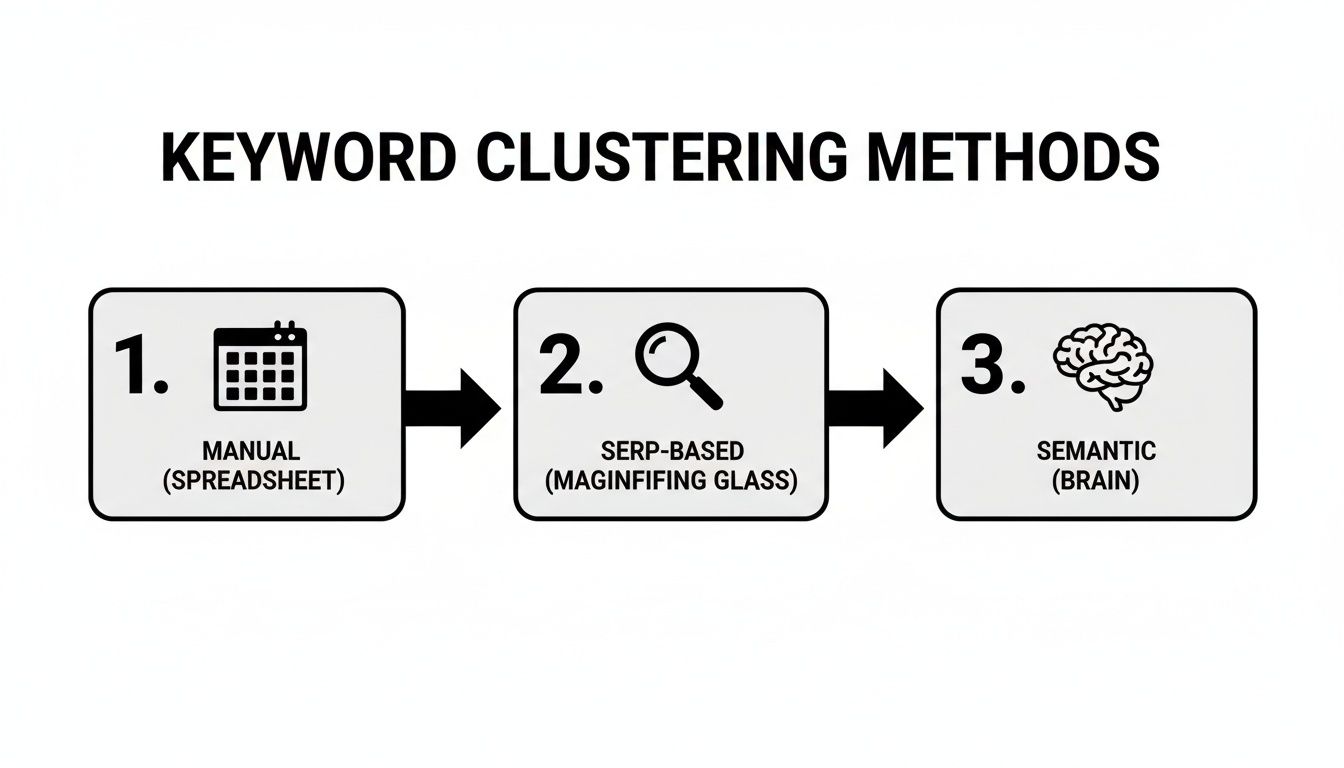
As you can see, SERP-based analysis is often the go-to because it directly reflects how Google currently understands the relationships between queries.
Step 3: Analyze and Refine Your Clusters
Once the tool spits out its results (usually in a spreadsheet), your work begins again. This is where human expertise is absolutely critical. You have to put your strategist hat on and review what the machine has done.
A clustering tool provides the data-driven foundation, but your strategic oversight is what transforms that data into a coherent content plan. You must verify that each cluster makes logical sense and aligns with a single, clear user intent.
Scan the groups for any oddballs. For example, our SaaS company might find the keyword "project manager salary" clustered with "project management software." While they're topically related, the intent is completely different. One is for someone researching career paths, while the other is for a buyer looking for a tool.
This is a classic case where you’d manually intervene and split them into two separate clusters. This refinement step is non-negotiable; it ensures every page you create is laser-focused on a specific audience need.
Step 4: Map Clusters to Content
The final, and most important, step is mapping each refined cluster to a page on your website. This is where your keyword research becomes a tangible content strategy. For every single cluster, you'll ask one of two questions:
- Does a page for this already exist? If yes, fantastic. That cluster now becomes your blueprint for optimizing and expanding that page. You can identify subtopics you missed and add new sections to make your content more comprehensive.
- Is this a new content opportunity? If you don't have a page that serves the cluster's intent, it goes straight onto your content calendar. This is how you find and fill the gaps in your content, creating new blog posts, landing pages, or tools.
By following this workflow, you're not just guessing what to write about. You're building a content machine that directly translates data into a high-impact strategy that drives real, measurable SEO results.
Choosing the Right Tools for Keyword Clustering

Any keyword clustering strategy, no matter how brilliant, is only as good as the tools you use to bring it to life. Just grouping keywords isn't the finish line; you need software that can handle the complex analysis accurately and a solid framework for measuring the results.
Thankfully, there are plenty of options out there for different budgets and skill levels. The real trick is finding a tool that automates the SERP analysis. This is the heavy lifting that can take countless hours to do by hand and is prone to human error.
Recommended Keyword Clustering Software
For teams that need to scale their efforts and get reliable results, a few paid tools have really set the standard. They remove the guesswork and let you focus your energy on creating great content instead of getting bogged down in data.
Here are some top contenders:
- SE Ranking's Keyword Grouper: Part of a comprehensive SEO platform, this tool gives you precise control by letting you set the clustering strictness—for example, how many of the top URLs must overlap for keywords to be grouped.
- Keyword Cupid: This one takes a more semantic approach. It uses machine learning to try and reverse-engineer how Google actually understands topics, which can lead to more nuanced and effective clusters.
- Python Scripts: If you have some technical chops, you can build your own solution. Using libraries like Scikit-learn, custom Python scripts offer a free and endlessly customizable way to group your keywords.
Figuring out which one is best for you really depends on your team's technical skills and the size of your project. If you want to dig deeper, check out our guide on the best AI keyword research tools available today.
Measuring the Impact of Your Clusters
Once your new content is live, you have to prove it's actually working. It's time to move past vanity metrics and focus on what really moves the needle: measurable growth in search visibility and qualified traffic. The best place to see this is right inside Google Search Console (GSC).
The whole point of keyword clustering isn't just to make neat lists. It’s to drive real business outcomes. Success means tracking the growth in impressions and clicks for entire topic groups, not just obsessing over a few specific terms.
Stop getting lost in the daily ups and downs of individual keyword rankings. Instead, start monitoring the overall health of your topic clusters. This means tracking performance indicators that show your strategy is having a genuine impact.
Here's what to look for in GSC:
- Number of Queries per Page: Head over to the "Performance" report and filter by one of the pages you built for a cluster. A page that's truly working will start ranking for a growing number of related keyword variations.
- Impression Growth for a Topic: You can use a page filter with a regex to pull in all the pages that belong to a single topic cluster. You should see a steady upward trend in total impressions, which is a strong sign of growing topical authority.
- Traffic and Conversions: This is where you connect the dots. You want to see that the increase in qualified organic traffic and conversions can be directly tied back to the content you created based on your clusters.
This focused measurement gives you clear proof that your strategy is paying off. In fact, studies show that sites using SERP-based clustering can see a 45% increase in impressions in GSC within the first 60 days. It’s a powerful testament to how quickly this approach can deliver.
Putting Your Keyword Clustering Strategy into Action
We've covered a lot of ground—the what, why, and how behind keyword clustering. Now comes the most important part: turning that messy list of keywords into a structured, intent-driven content plan that actually gets results. This is where strategy meets execution.
The whole point is to build genuine topical authority and create a foundation for long-term organic growth.
This process takes the guesswork out of content creation. Instead of throwing spaghetti at the wall and seeing what sticks, each cluster gives you a precise blueprint. You can now build a high-impact page designed to completely own a specific user need, ensuring every article or landing page has a crystal-clear purpose.
From Strategy to Results
Of course, knowing what to do is one thing; having the time and resources to actually do it is another story entirely. This is a common hurdle for most marketing teams, and it’s where a smart mix of technology and human expertise really shines.
An effective keyword clustering strategy combines AI-powered data analysis for speed and scale with human oversight to ensure every piece of content perfectly aligns with search intent and core business goals.
At Rankai, we live by this principle. We use automation for the heavy lifting—the data crunching, the clustering, and even the initial content drafting. This frees up our strategists to focus on the critical details that AI just can't nail on its own, like capturing your unique brand voice or fine-tuning a page for conversions.
By focusing on high-impact clusters, you can finally move beyond theory and start seeing tangible results. You’re not just ranking for random keywords; you’re establishing your brand as a true authority in your space. You’re building a content moat that competitors will struggle to cross, driving the kind of sustainable organic growth that moves the needle for your business.
Answering Your Keyword Clustering Questions
Even with the best plan, practical questions always pop up. Let's tackle some of the most common ones I hear from teams just getting started with keyword clustering.
How Many Keywords Should I Put in a Cluster?
There's no single "right" answer here. The real driver is user intent, not an arbitrary number.
A very specific, long-tail cluster might only contain 5-10 keywords. On the other hand, a broad head-term cluster destined for a huge pillar page could easily have 50+ keywords. The key is that every single query in that group shares the exact same core intent. If a user searching any of those terms would be satisfied with the same piece of content, you're on the right track.
What’s the Difference Between a Topic Cluster and a Keyword Cluster?
This one's a classic, but it's a crucial distinction. Think of it like this:
A keyword cluster is the most granular level—it’s a tight group of search queries that can all be answered by a single page. It's one piece of the puzzle.
A topic cluster is the entire puzzle. It’s a strategic collection of multiple pages, each targeting its own keyword cluster, that are all interlinked and support a central "pillar" page on a broad subject.
Essentially, you build powerful topic clusters by creating content for many different, highly-relevant keyword clusters.
Can I Do This for Free?
You absolutely can, but it comes with a trade-off. The manual method, using spreadsheets to painstakingly compare SERPs, costs nothing but your time—and it takes a lot of time. It's also easy to make mistakes.
If you have some coding know-how, you could use Python scripts to automate parts of the process. For most businesses, though, the most practical path is a specialized tool. The investment pays for itself in speed and accuracy, letting your team focus on creating content instead of managing spreadsheets.
Ready to build topical authority without all the manual guesswork? Rankai blends powerful AI-driven keyword clustering with the strategic oversight of human experts to build content strategies that actually rank. See how we drive predictable organic growth at https://rankai.ai.