A solid SEO strategy for a small business isn't about outsmarting Google's secret formula. It's about building a dependable, automated sales engine that runs for you 24/7. Think of it as setting up your digital storefront on the busiest street in the world—right where people are actively looking for what you sell.
Why SEO Is Your Small Business Growth Engine
Paid ads are like renting a billboard. The second you stop paying, you vanish. SEO, on the other hand, is like buying the land and building your own store. It's a true business asset that appreciates over time, bringing in a steady stream of organic traffic without you having to constantly feed it ad money. For a small business, this is the most sustainable way to grow.
Instead of interrupting people who might not even be interested, SEO puts you right in front of them the moment they search for a solution you provide. It’s the difference between a cold call and a customer walking into your shop asking for help. This approach gets you in front of ready-to-buy customers, which is absolutely critical when every dollar and every minute counts.
The Four Pillars of Small Business SEO
A powerful SEO strategy for any small business is built on four core pillars. They all work together, creating a strong foundation that supports long-term growth and keeps you visible in search results. Getting a handle on these components is the first step to building a focused, high-impact plan.
This diagram shows how these four pillars—Local, Technical, Content, and Authority—come together to form a complete strategy.
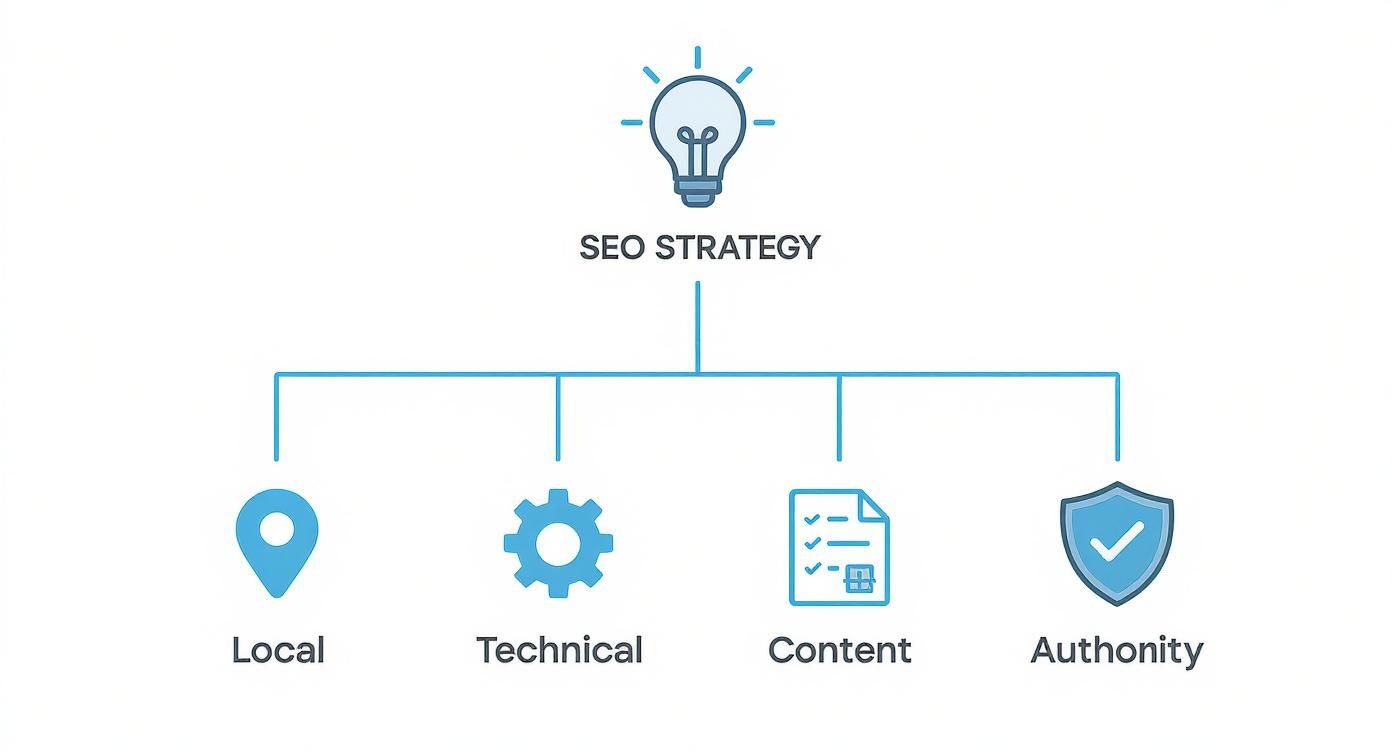
As you can see, a central strategy guides targeted efforts in your local presence, your website's health, the quality of your content, and the trust you build in your industry.
To break it down even further, here's a look at what each pillar involves.
The Four Pillars of a Small Business SEO Strategy
| Pillar | Primary Goal | Key Actions |
|---|---|---|
| Local SEO | Dominate your local service area. | Optimize Google Business Profile; get local citations and reviews. |
| Technical SEO | Ensure your site is fast, secure, and easy for Google to crawl. | Improve site speed; fix broken links; implement schema markup. |
| Content SEO | Create helpful content that answers customer questions. | Blog posts; service pages; guides that target relevant keywords. |
| Authority | Build trust and credibility with search engines and users. | Earn backlinks from reputable sites; showcase expertise. |
Each of these pillars is a piece of the puzzle. When you put them all together, you build an unshakeable online presence.
Investing in Sustainable Growth
This strategic focus is why more and more businesses are getting serious about their search presence. In fact, 74% of small businesses plan to allocate resources toward SEO, because they see its power to drive real revenue. It makes sense, considering that about 40% of small business revenue is driven by organic search traffic, making it a primary channel for finding new customers.
While the investment level varies, it's clear that business owners understand that showing up in search results directly leads to sustainable growth. You can dig into more data on how small businesses are investing online in this detailed report on SEO statistics.
A strong SEO strategy doesn't just bring you traffic; it brings you the right traffic. It connects your business with local customers who have a high intent to purchase, making it one of the highest-ROI marketing activities you can undertake.
By focusing on these four pillars, you can systematically build an online presence that doesn’t just rank well but also turns visitors into loyal customers. That’s how you create a true growth engine for your business.
Building Your Foundation with Technical SEO

Let's think of your website as your digital storefront. Technical SEO is all about making sure the doors are unlocked, the lights are on, and the aisles are clearly marked for search engines. If Google's little bots can't get inside to see what you're selling, even the most amazing content will just sit on the shelves collecting dust.
Getting the technical basics right means none of your other SEO efforts go to waste. It's the essential, behind-the-scenes work that makes everything else click. The good news? For a small business, you don't need to get lost in the weeds. Focusing on a few high-impact areas is enough to build a solid framework.
This initial setup doesn't have to be some massive, complex project. By tackling the essentials first, you can score some quick wins that immediately improve how both search engines and actual customers experience your site.
Make Your Site Fast and Mobile-Friendly
In a world where everyone is glued to their phone, speed and mobile-friendliness aren't just nice-to-haves; they're deal-breakers. A slow site is a frustrating site, and that frustration sends all the wrong signals to Google. Your first technical job is to guarantee a smooth experience for every single visitor, regardless of what device they're using.
The numbers don't lie. A whopping 73% of U.S. small businesses now have their own websites, so the competition is real. More telling is that 84% of visitors say they prefer sites that are optimized for mobile. You can find more stats on the importance of a modern website from Network Solutions.
Here are the two things to nail down first:
- Page Speed: How fast your pages load is a direct ranking factor. Use a free tool like Google's PageSpeed Insights to see where you stand. It'll even give you a punch list of fixes, like compressing your images.
- Mobile-Friendliness: Your website absolutely has to look and work great on a smartphone. Most modern website themes are "responsive," meaning they do this automatically, but it's always worth double-checking.
Create a Simple and Logical Site Structure
Ever walked into a store that’s a total mess, with no signs or clear layout? You probably walked right back out. A logical website structure is like good in-store signage—it helps both people and search engine crawlers find exactly what they need without any fuss. All you need is a simple navigation menu and a clear hierarchy.
For example, a local plumber’s site might be laid out like this:
- Homepage
- About Us
- Services
- Emergency Plumbing
- Drain Cleaning
- Water Heater Repair
- Contact Us
This simple, intuitive path makes it easy for a potential customer to get around. It also helps search engines understand how your pages are related, funneling ranking power from your homepage down to your most important service pages.
Key Takeaway: A well-organized website isn't just for users; it's a roadmap for search engine crawlers. This helps them understand which pages are the most important, which helps you rank better.
Optimize Your On-Page Elements
Once your site is fast, mobile-ready, and easy to navigate, it's time to zoom in on individual pages. These on-page elements are direct signals that tell search engines what a page is all about. They are some of the easiest parts of an seo strategy for small business to get right for an immediate boost.
You don't need to be a technical wizard here. Start by just reviewing your most important pages. If you want to go deeper, our guide on how to perform a technical SEO audit walks you through the whole process.
For each key page, just focus on these three things:
- Title Tag: This is the blue clickable headline in the search results. Make it unique, pop your main keyword in there, and keep it under 60 characters.
- Meta Description: This is the little blurb of text right below the title tag. It doesn't directly affect your ranking, but a good one makes people want to click. Aim for under 160 characters.
- Headers (H1, H2, H3): Use one H1 tag for your main page title. Then, use H2s and H3s to break up your content into logical sections. It makes the page much easier to read for people and gives search engines helpful context.
2. Win the Neighborhood with Local SEO
Let's be honest. For most small businesses, your highest-value customers aren't halfway across the globe; they're right around the corner. That's why any smart SEO strategy has to start by winning the local battle.
Think of local SEO as putting up digital signposts that guide nearby customers—people who are right now looking for what you sell—straight to your door. It’s the fastest, most direct way to turn a Google search into actual foot traffic and revenue.
This isn't just a "nice to have" anymore. It's about survival and growth. The data is crystal clear: a staggering 96% of people find local businesses through online searches. And with 46% of all Google searches containing "near me" or similar local queries, being invisible in your own backyard is a massive missed opportunity.
Shockingly, 58% of businesses still don't have a formal local SEO plan. This is great news for you. It means there's a huge opening to get ahead of the competition. For more eye-opening numbers on this, check out this deep dive into local SEO statistics.
Your Single Most Powerful Local SEO Tool
At the very heart of your local strategy is your Google Business Profile (GBP). This free listing is your business's digital billboard, and it's prime real estate. It’s what shows up in the "map pack" at the very top of the search results page.
A GBP is so much more than just a listing. It’s a dynamic profile where customers can instantly find your hours, get directions with one tap, call you directly, and—crucially—read reviews from their neighbors.
Optimizing your Google Business Profile is the single highest-impact, lowest-effort local SEO action you can take. Period. Neglecting it is like leaving your storefront locked during business hours while your competitors have their doors wide open. A complete, active profile tells Google you're a legitimate, trustworthy business ready to serve the community.
The GBP Optimization Checklist
Ready to turn your profile into a customer-generating machine? Just follow this checklist. Each step adds another layer of trust and clarity, making it a no-brainer for both Google and potential customers to choose you.
Claim and Verify Your Listing: First things first, you need the keys to your profile. Search for your business on Google Maps and follow the steps to claim it. This usually involves Google mailing a postcard with a verification code to your physical address.
Fill Out Everything: Don't get lazy here. Complete every single section: business name, address, phone, website, hours, and a detailed description. The more info you give Google, the more it will trust you.
Get Hyper-Specific with Categories: This is a big one. Choose the most accurate primary category for your business (e.g., "HVAC Contractor" is way better than the generic "Home Services"). Then, add secondary categories for everything else you do, like "Air Duct Cleaning Service" or "Furnace Repair Service."
Upload High-Quality Photos & Videos: Show, don't just tell. People want to see who they're hiring. Add clear photos of your storefront, your team, your products, and your work in action. A quick video tour or a customer testimonial can work wonders.
Use the Q&A Feature Proactively: Don't wait for people to ask questions. Head to your profile and add your own FAQs, then answer them yourself. This lets you control the conversation and address common concerns before a customer even has to ask.
Think of your optimized Google Business Profile as your best salesperson. It works 24/7 to answer questions, show off your best work, and build trust with reviews—all before someone even clicks through to your website.
Building Local Trust with Citations
Beyond your own profile, Google plays detective. It scours the web to see if the information about your business is consistent everywhere else. This is where local citations come in.
A citation is simply any online mention of your business's Name, Address, and Phone number (often called NAP).
Think of each consistent NAP listing on sites like Yelp, Angie's List, or industry-specific directories as a vote of confidence. The more consistent, high-quality citations you have, the more certain Google becomes that you are who and where you say you are.
Consistency is everything. A wrong phone number here or an old address there can create confusion and hurt your rankings. The goal is to create a rock-solid, unified digital footprint that cements your place in the local market.
Local SEO Action Plan Priority Matrix
To help you decide where to focus your energy first, here’s a simple matrix. It breaks down common local SEO tasks by their potential impact and the effort required to get them done. Start with the High Impact, Low Effort tasks to get the biggest bang for your buck right away.
| Tactic | Impact Level (High/Medium/Low) | Effort Level (High/Medium/Low) | First Step to Take |
|---|---|---|---|
| Google Business Profile Optimization | High | Low | Claim your profile and fill out every single section completely. |
| Actively Solicit Customer Reviews | High | Low | Set up a simple system to email or text customers a direct link to leave a review. |
| Local Citation Building | Medium | Medium | Check your business NAP on 10-15 major directories and correct any inconsistencies. |
| Create a "Location" Page on Website | Medium | Low | Add a page to your site with your address, an embedded Google Map, and hours. |
| Create Localized Content/Blog Posts | High | High | Write a blog post about a local event you sponsored or a project in a specific neighborhood. |
This matrix isn't just a to-do list; it's a strategic roadmap. By focusing on the high-impact, low-effort items first, you can build momentum quickly and start seeing real results from your local SEO efforts without feeling overwhelmed.
Creating Content That Attracts Your Ideal Customers

Content is the engine that drives your entire seo strategy for small business. Without it, you’ve got a well-built car with an empty gas tank—it looks great, but it’s not going anywhere. Tossing up a generic blog post every few months just won't cut it.
The real goal is to get out of your own head and start thinking exactly like your customer. What problem is keeping them up at night? What specific, urgent question are they typing into Google right before they’re ready to pull out their wallet?
Your content’s job is to be the single best, most helpful answer to that question. When you create content that genuinely solves problems, you do more than just climb the search rankings. You build trust, prove your expertise, and make your business the obvious choice when it's time to buy.
Understanding Customer Intent
Before you write a single word, you have to nail the "why" behind a search. We call this user intent, and it’s the absolute core of a successful content plan. Every search query falls into a few key categories, and knowing which one you're aiming for is everything.
- Informational Intent: The user is just looking for an answer. Think "how to fix a leaky faucet" or "what are the best flowers for a shady garden." They're in learning mode.
- Commercial Intent: The user is doing their homework before a purchase. They're comparing options with searches like "best plumber in Denver" or "Marvin vs. Pella windows."
- Transactional Intent: The user is ready to buy now. These searches are direct and urgent: "emergency plumber near me" or "buy petunias online."
For a small business, your goldmine is content that targets commercial and transactional intent. This makes sure the traffic you bring in is full of potential customers, not just window shoppers. For a much deeper dive into this, our complete guide to SEO content creation has you covered.
Practical Content Types for Small Businesses
You don’t need some massive, complex content calendar to get started. Just focus on creating a few high-value, evergreen pages that will work for your business for years to come. Think of these as your "content assets"—the real workhorses of your SEO strategy.
Start with these proven formats:
- In-Depth Service Pages: Don't just list what you do. Create a dedicated page for each core service. Explain the real-world benefits, answer the most common questions you get, and show exactly why you’re the best choice.
- Local Case Studies: Show off a successful project you did in a specific neighborhood or town. This is powerful social proof and a great way to target geographic keywords like "kitchen remodel in Lakewood."
- Helpful FAQ Articles: Just listen to the questions your customers ask you every single day. Turn those into detailed blog posts, like "How Much Does It Cost to Replace a Water Heater?" This builds authority and pulls in that valuable informational search traffic.
Key Insight: The most effective small business content isn't about being clever; it's about being genuinely helpful. Answer your customers' most pressing questions better than anyone else, and Google will reward you for it.
A Simple Keyword Research Framework
Keyword research sounds intimidating, but it doesn't have to be. Your goal is simple: find the exact phrases your ideal customers are actually typing into the search bar. Think about how they would describe their problem, not how you would describe your service.
Here’s a simple way to get started:
- Brainstorm "Seed" Keywords: Start with broad terms for your services (e.g., "landscaping," "tax preparation," "personal trainer"). These are your starting points.
- Add "Modifiers": Now, combine those seed keywords with words that signal intent or location. Think "services," "company," "near me," or the name of your city.
- Look for "Long-Tail" Keywords: These are longer, super-specific phrases of three or more words, like "affordable weekly lawn mowing service." They have far less competition and attract visitors who are much closer to making a decision.
For example, a roofing company might go from a generic term to a high-intent, long-tail keyword like this:
| Keyword Type | Example | Customer Intent |
|---|---|---|
| Broad | roofing | Very low |
| Better | roofer in Austin | Medium |
| Best | emergency roof leak repair Austin TX | High (Ready to buy!) |
By focusing on these specific, long-tail phrases, you sidestep the brutal competition for broad terms and connect directly with customers who need your help right now. This customer-first approach is the most reliable way to create content that doesn't just rank—it actually grows your business.
Building Trust with Links and Local Authority

Once you've got great content, the next piece of a solid seo strategy for small business is building authority. Think of it this way: in the real world, a referral from a respected colleague means a lot. Online, links from other websites work the same way. They are digital "votes of confidence" that tell Google you're the real deal.
This whole process is called link building, but don't let the term intimidate you. For a small business, it’s less about technical wizardry and more about genuine community engagement. You don't need to chase complicated or expensive tactics; the most powerful links often come from simply being a good neighbor.
Earning Links Through Local Engagement
You can forget about sending hundreds of generic emails begging for links. Your best and most authentic opportunities are probably right down the street. Focusing on local connections doesn't just earn you links; it reinforces your brand's place in the community—a signal that search engines really value.
Here are a few practical, relationship-first ways to earn those valuable local links:
Sponsor a Local Event or Team: Getting involved with a local charity 5K, a youth sports team, or a community festival is a classic for a reason. It almost always results in a link from their sponsors page, giving you a boost while you support a good cause.
Partner with Complementary Businesses: Find a non-competing business and team up. A local roofer and a painter could run a "Home Exterior Makeover" webinar. This creates a natural reason for you to cross-promote and link to each other’s websites.
Join Your Local Chamber of Commerce: This is one of the easiest wins. Most chambers have an online member directory, and that membership fee often gets you a high-quality, locally relevant link back to your site.
Think of each local link as a digital handshake. It connects your business to the community's online ecosystem, showing search engines that you are a trusted, established local player.
Becoming a Local News Source
Getting your name in the local news is another fantastic way to build authority. Local news sites, community bloggers, and radio stations are always hungry for stories. Your job is to give them something interesting to talk about.
You could host a free workshop for the public, launch a special community initiative, or share a major business milestone. Creating a newsworthy event makes it incredibly easy for a local journalist to write about you. The result? A high-quality link and some fantastic brand exposure.
As you grow, you might explore more advanced options. You can learn about the top link building services that can skyrocket your SEO when you're ready to scale. For now, starting with these local, relationship-driven tactics is the most effective and sustainable path for any small business. It lays a foundation of trust that will pay off for years.
How to Measure Your SEO Success
An SEO strategy isn't something you can just set and forget. You have to know if your hard work is actually paying off. But measuring your progress doesn't mean drowning in a sea of data; it's about zeroing in on the few key metrics that tell you if the business is growing.
Think of it like checking the gauges in your car. You don't need to be a master mechanic to know if you're moving forward, how fast you're going, and if you have enough gas in the tank. The same idea applies here. A handful of vital signs will show you the real-world impact of your work.
Your Essential SEO Toolkit
Getting started is way easier—and cheaper—than most people think. You don’t need to shell out for expensive software. In fact, two incredibly powerful and completely free tools from Google will give you all the clarity you need.
- Google Search Console (GSC): This is your direct link to Google. It tells you exactly which keywords people are using to find you, how many times your site shows up in search results (impressions), and how many of those people actually click.
- Google Analytics 4 (GA4): This tool picks up where GSC leaves off, showing you what happens after someone lands on your website. It tracks how many visitors you're getting from search engines (organic traffic), what pages they're looking at, and whether they take important actions, like filling out your contact form.
Honestly, these two tools give you everything you need to prove your SEO is worth the effort.
Key Metrics That Actually Matter
It's easy to get distracted by numbers that look good but don't mean much—we call them vanity metrics. Instead, you need to focus on the data that ties directly back to your business goals. For most small businesses, that boils down to tracking leads and local customer actions.
SEO success isn’t about chasing huge traffic numbers. It's about getting the right traffic—the kind that turns into real phone calls, form submissions, and new customers walking through your door.
Here’s a simple checklist of what you should be looking at every single month:
- Organic Traffic Growth: Is the number of people finding you through search engines going up over time? You're looking for a steady, upward trend in your GA4 reports.
- Keyword Rankings for Core Services: Are you climbing the ladder for your most important, money-making keywords? A quick look in GSC will show you your average ranking for those key terms.
- Google Business Profile Insights: For any local business, this is gold. Keep an eye on the number of phone calls, website clicks, and requests for directions that come straight from your GBP listing.
- Organic Leads and Conversions: This is the bottom line. How many people who found you on Google ended up filling out your contact form or buying something? You can set up goals in GA4 to track this automatically.
Reviewing this short list once a month is all it takes. You'll quickly see what's working, spot content that might need a refresh, and make smarter decisions to guide your strategy. This tight focus makes sure every bit of your time and effort is pushing your business forward.
Frequently Asked Questions About Small Business SEO
Diving into the world of SEO can feel a little overwhelming, and it's natural to have questions. Let's tackle some of the most common ones that small business owners ask so you can move forward with confidence.
How Long Does It Take for SEO to Work?
This is the big one, isn't it? While you might see a quick bump from technical fixes or a newly polished Google Business Profile in just a few weeks, real, meaningful growth takes time. You should expect to see a noticeable increase in traffic and rankings after about 4 to 6 months of consistent work.
Think of it like planting a tree. You don't get a shady oak overnight. You're building a valuable, long-term asset for your business, and that process requires a bit of patience. The payoff is that the results you build are lasting and tend to grow on themselves over time.
Can I Do SEO Myself for My Small Business?
Yes, you absolutely can! A lot of the foundational SEO work, especially for local businesses, is completely manageable for a business owner. The secret isn't being a tech wizard; it's just about being consistent.
If you can set aside a few hours each month to follow the steps in this guide—things like keeping your Google Business Profile updated, asking happy customers for reviews, or writing a genuinely helpful blog post—you can make a huge difference. It's all about steady progress, not trying to do everything at once.
The most successful small business SEO plans are built on consistency, not complexity. Simple, repeated actions executed over several months will always outperform sporadic, complicated efforts.
What Is the Most Important Part of SEO?
For almost any small business with a physical location or a service area, the answer is crystal clear: Local SEO. It’s your most direct path to getting in front of customers who are nearby and ready to make a purchase.
Your first move should always be to claim and meticulously fill out your Google Business Profile. This is your new front door. Once that's handled, your focus should shift to getting a steady stream of positive reviews from your customers and making sure your business name, address, and phone number (NAP) are identical everywhere online.
How Much Should a Small Business Budget for SEO?
SEO spending is all over the map. If you're tackling it yourself, your biggest investment is simply your time. For many small businesses, this is the most effective and affordable way to start, costing you virtually nothing in hard cash.
If you decide you need to bring in help, like a freelancer or an agency, the costs can vary. For basic, foundational SEO services, monthly retainers often start around the $500 mark. Of course, that price can climb quickly depending on how ambitious your goals are and how tough your local competition is. A good approach is to start with what you can handle yourself and then look into paid help as you grow.
Ready to put your SEO on autopilot? Rankai combines expert strategy with powerful AI to publish over 20 perfectly optimized articles for your business every single month. We handle the content, technical optimization, and even rewrites until your pages rank—all for a simple, flat fee. See how it works at rankai.ai.