SEO services for a small business are all about making you easy to find online. Think of it this way: when people need something—a plumber, a new pair of shoes, a good local restaurant—their first move is usually to search on Google. SEO is what gets your website to show up high in those results, bringing you customers who are already looking for what you offer, all without paying for every single click.
Why Your Business Is Invisible Without SEO
Imagine you’ve just opened the most incredible little shop, but it's tucked away on a side street with no sign. You have amazing products and the best customer service, but hardly anyone will ever stumble upon it. A website without SEO is that hidden shop. It’s out there, but it's invisible to the millions of potential customers searching online every single day.
SEO is what puts that giant, flashing neon sign on your digital storefront. It’s the craft of making sure that when someone types in "best accountant near me" or "emergency roof repair," your business pops up as one of the top, most relevant answers. This isn't about playing tricks on Google; it's about genuinely making your website the most helpful and trustworthy resource for what your customers need.
The High Cost of Staying Hidden
Let's be blunt: if you're ignoring SEO, you're just handing customers over to your competitors. Each time a potential client searches for a service in your area and finds someone else first, that's a lost sale. The cost of being invisible online is huge, and it only gets bigger as more and more people rely on search engines to find local businesses.
A strong online presence isn't just a nice-to-have anymore. Shockingly, recent data shows that 31% of U.S. shoppers will actively avoid a small business if it doesn't have a website. The good news is that most business owners are catching on, with 73% of U.S. small businesses now having a website. For them, the most valued SEO activities are managing their Google Business Profile (76%), creating content (53%), and having a well-designed website (43%). The message here is crystal clear: you have to be visible to grow. You can dig into more of these small business trends on networksolutions.com.
The whole point of SEO is simple: connect your business with the people who are actively searching for what you do. It turns your website from a static online brochure into a proactive, lead-generating machine.
Effective SEO for small businesses zeroes in on the activities that give you the biggest bang for your buck. It's not about quick fixes; it's about building a valuable, long-term asset that brings in qualified leads day after day. By investing in a smart SEO strategy, you transform your website from a hidden gem into a customer magnet that fuels predictable growth.
Understanding the Pillars of Small Business SEO
Effective SEO isn't just one thing; it's a mix of interconnected strategies working together. For a small business, getting this right is everything. Think of your website like a brand-new shop. To get customers through the door, you need a strong foundation, clear signs, helpful staff, and a prime location. SEO works the same way, with each pillar playing a critical part in your online success.
This visual breaks down how a solid SEO strategy connects your website, local presence, and content creation directly to your business goals.
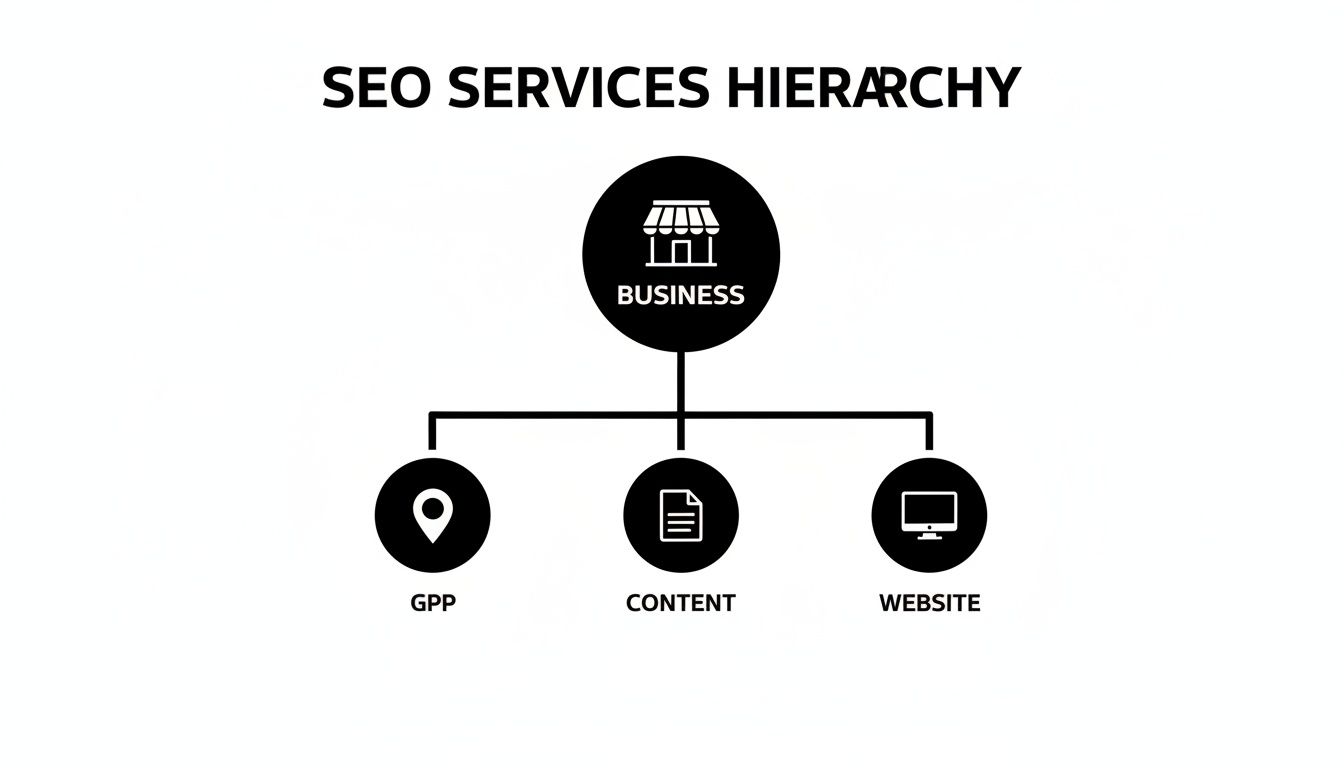
As you can see, whether you’re focusing on your Google Business Profile, the performance of your website, or the content you publish, it all ladders up to support the growth and health of your business.
Technical SEO: The Foundation of Your Website
Let's start with the bedrock of your entire online presence: technical SEO. This is all the behind-the-scenes work that makes your website functional and accessible to search engines. It’s like the plumbing, wiring, and structural integrity of your building. If search engines can't easily crawl, understand, and index your site, even the most amazing content will go unseen.
This means ensuring your site is fast, secure, and works perfectly on a phone. Search engine "bots" have a limited budget to crawl your site. A clean, well-structured website makes their job easier, which is a huge step toward better rankings.
Key components of technical SEO include:
- Site Speed: Pages need to load in a snap to keep visitors from bouncing away.
- Mobile-Friendliness: Your site must look and work great on smartphones and tablets.
- Crawlability: Bots have to be able to navigate and index your content without hitting dead ends.
- Site Security (HTTPS): This protects your visitors' data and builds trust with both people and search engines.
Ignoring these elements is like building on sand. If you want to check your site's foundation, a good place to start is our ultimate guide to performing a technical SEO audit.
On-Page SEO: Organizing Your Digital Storefront
Once the foundation is solid, it's time for on-page SEO. This is the art of optimizing individual web pages to rank higher and pull in more relevant traffic. It’s all about making every page crystal clear and perfectly aligned with what your customers are actually searching for.
Think of it as arranging the aisles in your shop. You need clear signs (headings), descriptive product labels (meta descriptions), and a logical layout (internal linking) that helps customers find exactly what they need without getting lost.
On-page SEO is your chance to directly tell Google what your page is about. By optimizing titles, headings, and content with relevant keywords, you’re not just trying to rank—you're creating a better, more intuitive experience for your visitors.
This pillar ensures that when someone lands on your page, they know they're in the right place. This simple act reduces bounce rates and sends a strong signal to Google that your content is valuable.
Content Strategy: Becoming the Go-To Expert
Content is the heart and soul of modern SEO. It’s how you answer your customers' questions, solve their problems, and prove you know your stuff. A smart content strategy turns your website from a simple brochure into a valuable resource that people actively seek out.
Imagine you own a local bakery. Your content could be blog posts like "5 Tips for Keeping Sourdough Fresh" or "How to Choose the Perfect Birthday Cake." This kind of content doesn't just sell; it helps. It builds trust and establishes your bakery as the local expert.
This is where you truly connect with your audience by providing real value. The goal is to create content so helpful that other sites want to link to it and customers want to share it, which naturally builds your authority over time.
Local SEO: Putting Your Business on the Map
For most small businesses, this is the most important pillar of all. Local SEO is the process of optimizing your online presence to attract more customers from local searches. When someone nearby types "plumber near me" or "best coffee in town," local SEO is what gets your business seen.
A huge piece of this puzzle is managing your Google Business Profile (GBP). This is your digital storefront on Google Maps and in the local search results. Keeping it updated with the correct hours, address, services, and fresh, positive reviews is non-negotiable for attracting nearby customers.
The numbers here are staggering. Research shows that 46% of all Google searches have local intent. Even better, a remarkable 78% of local searches on a mobile device result in an offline purchase within 24 hours. Showing up in Google’s Local Pack can also boost your click-through rate by 40%, making it one of the highest-impact activities you can do.
Optimizing for the Future of Search
The way people find your business is changing faster than ever. For years, it was all about keywords typed into a Google search box. But now, your potential customers are asking questions directly to AI assistants like ChatGPT, Gemini, and Perplexity. This isn't just a small tweak—it's a whole new ballgame.
This new world runs on Large Language Models (LLMs). Instead of just handing you a list of links, these AIs act like a research assistant, pulling information from all over the web to give you one, direct answer. Someone might ask, "Where can I find a local coffee shop with good Wi-Fi that’s open past 9 PM?" The LLM's goal is to give them the perfect spot, not just a blog post titled "10 Best Coffee Shops."

For a small business, this is a massive deal. Your objective is no longer just to show up on a results page. You need to become the source that AI assistants trust and cite. Preparing for this now is the best way to make sure you're still visible tomorrow.
Becoming the Answer Engine's Favorite Answer
So, how do you get an AI to recommend your business? It boils down to making your website's information incredibly clear for both people and machines. You need to prove you're the expert and structure your data in a way that AI can understand in a split second.
The big shift here is moving from thinking about individual keywords to covering entire topics. The goal is to build such a deep well of knowledge on your subject that you become the obvious authority.
Here’s how you can start positioning your business for this new reality:
- Create Question-Based Content: Don't just target a term like "roof repair." Go deeper. Write articles that answer the real questions people have, like "What are the tell-tale signs my roof needs replacing?" or "Which roofing materials hold up best in a rainy climate?" This lines up perfectly with how people talk to AI.
- Structure Your Data with Schema Markup: Think of schema markup as a set of labels you add to your website's code. It's like putting clear, easy-to-read price tags on everything in your store. This helps an AI instantly understand what you sell, where you're located, your hours, and more.
- Demonstrate Your E-E-A-T: Google’s standard for Experience, Expertise, Authoritativeness, and Trustworthiness (E-E-A-T) is non-negotiable for AI. LLMs are designed to find the most reliable sources. Build that trust by showcasing customer reviews, featuring detailed author bios, and earning mentions from other respected local sites.
Preparing for the future of search isn't about outsmarting an algorithm. It's about building an online presence so helpful and trustworthy that your business becomes the most logical and reliable answer to a customer's problem.
Practical Steps to Get Your Site LLM-Ready
You don't need to rebuild your entire website to get ready. Small, focused efforts add up quickly. A great first step is to simply list the top ten questions you get from customers every single day. Then, create a detailed page or blog post dedicated to answering each one.
Next, make sure your basic business info is machine-readable. Tools can help you generate LocalBusiness schema markup, which explicitly feeds AI assistants your address, phone number, and hours. This makes you a top contender for any "near me" style recommendation. Any modern seo services for small businesses worth their salt should be including LLM optimization to keep you competitive as search continues to change.
Your SEO Journey: What to Expect and When
Let's be honest: SEO isn't an overnight fix. It’s more like planting a tree than flipping a switch. You do the groundwork, put in the consistent effort, and over time, you see real, sustainable growth. Understanding the timeline is key to managing your expectations and seeing the incredible compounding value of your investment.
Here's a look at what a typical first 90 days of an SEO campaign really involves, breaking down the foundational work that sets the stage for long-term success.
This calendar view isn't just for show; it highlights that great SEO is a series of deliberate, strategic actions. Each month builds directly on the last, creating that steady upward climb in traffic and visibility you're looking for.
The First 30 Days: Foundational Setup
The first month is all about discovery and strategy. Your SEO partner should be rolling up their sleeves and digging deep into your business, your market, and your website. Think of it as an architect drawing up the blueprints before a single brick is laid. This initial groundwork is what the entire campaign will be built on.
During this phase, the focus is on a few core deliverables:
- A Comprehensive SEO Audit: This is a top-to-bottom analysis of your site’s technical health, existing content, and backlink profile. It tells us what’s working, what's broken, and where the biggest opportunities are hiding.
- Deep-Dive Competitor Analysis: We'll take a hard look at what your top competitors are doing right (and wrong), so we can find strategic gaps for you to exploit and gain an edge.
- Initial Keyword Research: This isn't just a list of words. It's about identifying the exact terms and questions your ideal customers are typing into Google, which will become the foundation of your content strategy.
- Google Business Profile Optimization: For most small businesses, this is a goldmine. We'll fine-tune your local listing to get you showing up in map searches, which often leads to some of the quickest, most tangible wins.
Don't expect a flood of traffic in the first month. What you will see are the first signs of life—maybe your brand name ranks a little higher, or your site feels a bit faster. The engine is just getting warmed up.
The Next 60 Days: Gaining Momentum
With a solid plan in hand, month two is all about execution. This is where the rubber meets the road. Your SEO partner starts putting the strategy into action, creating the content and fixing the technical issues that will attract both search engines and new customers. The focus shifts from planning to actively building.
Here’s what you should expect to see:
- A Content Calendar: You'll get a detailed roadmap of the blog posts, service pages, and other content we'll be creating over the next few months. No more guessing what to write about.
- The First Content Pieces Go Live: New, highly optimized pages will start appearing on your site, each one targeting the valuable keywords we identified in month one.
- Technical Fixes Get Implemented: All those critical issues from the audit—like slow page speed, broken links, or mobile-friendliness problems—get sorted out.
By the end of day 60, you'll likely see what we call "early wins." This could be ranking on page one for a few less-competitive, long-tail keywords, or maybe you notice more calls coming directly from your Google Business Profile. These are the proof points that confirm the strategy is working.
SEO progress isn't a sudden explosion; it's a gradual climb. Early indicators like improved rankings for specific terms and more impressions in Google Search Console are the first footholds on your way to the summit.
The First 90 Days and Beyond: Building Sustainable Growth
By the third month, the magic of compounding starts to kick in. The content we published in month two has had time to get indexed and "marinate" in Google's system. The technical fixes are now allowing search engine crawlers to navigate your site smoothly. This is when you should start seeing a real, measurable lift in organic traffic.
At this stage, the process evolves to include:
- Monthly Performance Reporting: You'll get clear, easy-to-understand reports showing growth in the metrics that matter: keyword rankings, organic traffic, and impressions.
- Strategy Refinement: We'll analyze the data from the first two months, doubling down on what's working and adjusting anything that's underperforming. SEO is never "set it and forget it."
- Link Building Initiatives: Depending on the strategy, we might begin acquiring high-quality backlinks from other reputable websites to boost your site's authority even further.
It’s crucial to know how to read these reports and spot the signs of a successful campaign. For a deeper dive, check out our guide on how to tell if your SEO strategy is working. After 90 days, you'll have a clear picture of the progress we've made and the road ahead for even bigger growth.
How to Choose the Right SEO Partner
Picking the right provider for SEO services for small businesses is a huge decision, one that can genuinely make or break your growth. You’re not just hiring someone to "do SEO"—you're looking for a real partner who gets what you're trying to achieve and can actually turn those goals into results you can see.
The market is flooded with options, from solo freelancers to massive agencies, so it's critical to know what separates the good from the bad. Otherwise, you risk burning through your budget with nothing to show for it.
Think of it like hiring a contractor to build your house. You'd never go with someone who promises to build it in a week for a price that sounds too good to be true, right? You want someone with a solid plan, clear communication, and a portfolio of work that proves they build things to last. The same logic applies here.
Checklist for Vetting SEO Providers
A great SEO partner is obsessed with your bottom line, not just vanity metrics like traffic for traffic's sake. They should be able to walk you through their strategy in plain English, connecting every single action back to a business goal, like getting more qualified leads in the door or boosting online sales.
The following checklist is a fantastic tool for cutting through the sales pitches and really figuring out if a provider is the real deal. Use it to compare your options and make a confident choice.
| Evaluation Criteria | What to Look For | Red Flags to Avoid |
|---|---|---|
| Strategy & Communication | A clear, customized plan that connects SEO activities to your business goals. They should speak your language, not just jargon. | Vague promises like "we'll get you more traffic." A one-size-fits-all approach that ignores your unique business. |
| Case Studies & Proof | Relevant case studies and testimonials from businesses similar to yours in size or industry. | No proof of past work or an unwillingness to share client references. |
| Transparency & Reporting | Regular, easy-to-understand reports that focus on key metrics: rankings, organic traffic, leads, and sales. | Confusing reports filled with fluff metrics. Hiding the "how" behind their results. |
| Deliverables & Scope | A clear "Statement of Work" outlining exactly what you get each month (e.g., 4 blog posts, 10 backlinks, technical fixes). | Unclear scope of work. They can't tell you exactly what they will be doing for you. |
| Realistic Promises | A focus on long-term, sustainable growth. They set realistic expectations and timelines. | Guarantees of a #1 ranking on Google. Promises of overnight success. |
| Tools & Techniques | Use of industry-standard tools and adherence to Google's best practices (white-hat SEO). | Talk of "secret sauce" or proprietary methods that sound shady. Any mention of black-hat tactics. |
Asking these kinds of direct questions shifts the conversation from just cost to actual value. A good partner will welcome the scrutiny and be more than happy to show you their expertise.
Understanding Pricing Models and Red Flags
SEO pricing isn't a one-size-fits-all deal. The right model for you will depend on your budget, your goals, and the amount of work needed to get you there. Knowing the common pricing structures helps you find a service that fits your financial plan.
Most SEO services are priced in one of three ways:
- Monthly Retainers: This is the most common setup. You pay a fixed fee each month for a consistent, ongoing effort. It’s perfect for building a long-term, comprehensive strategy. For small businesses, retainers usually fall between $500 and $2,500 per month.
- Project-Based Pricing: Here, you pay a one-time fee for a specific task with a clear start and end, like a full SEO audit, a website migration, or fixing a batch of technical problems. It's a great option if you have a very specific need but aren't ready to commit to a monthly plan.
- Hourly Consulting: This is like having an expert on call. You pay for their time when you need strategic guidance, troubleshooting, or training for your in-house team.
One major red flag to watch for: any company that guarantees a #1 ranking on Google. Nobody can ethically make that promise. Google's algorithm is a complex, constantly changing beast. These guarantees are almost always a sign that they'll use risky, short-term tactics that could get your site penalized down the line.
Ultimately, choosing the right partner comes down to finding a team that is transparent, goal-oriented, and realistic. For a deeper dive into some great options out there, check out our guide on the top affordable SEO services and agencies to consider. It’ll give you a solid framework for finding a modern, effective SEO partner who can deliver real, sustainable results.
Common Questions About Small Business SEO
Diving into SEO for the first time can feel like learning a new language. You've got questions about cost, how long it all takes, and where to even begin. Let's clear up some of the most common concerns we hear from small business owners, so you can make your next move with confidence.
How Much Should a Small Business Budget for SEO?
This is the big one, and the honest answer is: it depends. There’s no one-size-fits-all price tag for seo services for small businesses. You might see plans ranging from a few hundred dollars a month to several thousand, and that price is usually shaped by how competitive your market is, your geographic area, and how aggressive your growth goals are.
Instead of thinking of it as a cost, it’s better to see SEO as an investment in an asset that generates revenue. A solid SEO strategy can easily become your most effective marketing channel, bringing in customers who are actively looking for you, all without paying for every single click. A good partner will be upfront about their pricing and tie it directly to the results you want to achieve.
How Long Until I See Real Results?
While you can definitely see some quick wins in under 30 days—like getting your Google Business Profile in shape—real, lasting growth takes time. We usually tell clients to expect significant momentum in about four to six months. It’s a lot like planting a garden; you have to do the work upfront and be consistent before you can reap the rewards.
In the early stages, you’ll start to see positive signs like your website climbing the ranks for a few key search terms or showing up more prominently on local maps.
Patience is key here. SEO results build on themselves. The work you do in month one makes the work in month three more effective, creating a snowball effect that paid ads just can't replicate. That compounding growth is what makes it so powerful for the long haul.
Those first few months are all about laying a strong foundation. The big, visible results come once that groundwork is solidly in place.
Can I Do SEO Myself or Should I Hire a Pro?
You can absolutely tackle some SEO basics on your own. Many business owners can handle things like keeping their Google Business Profile updated or tweaking the titles on their website pages. But let's be real—SEO gets complicated, fast. It’s a full-time discipline that’s always changing.
Hiring a professional gives you a shortcut to expertise. You get access to sophisticated tools you wouldn't pay for yourself, deep knowledge of what actually works, and a team that lives and breathes Google's latest algorithm updates. For a busy owner, the time you save and the better results you get from an expert almost always pay for themselves many times over. An agency takes care of the technical heavy lifting so you can focus on running your business.
Ready to see how AI can deliver agency-level SEO results at a fraction of the cost? With Rankai, you get 20+ optimized content pages published monthly, continuous rewrites, and LLM optimization to future-proof your growth. See how we can help your business grow.