At its core, SEO services for small businesses are all about making your website more visible when potential customers search online. This isn't just about tweaking a few things here and there; it's a comprehensive approach that includes everything from technical website tune-ups and on-page optimization to local SEO and content creation. The goal is simple: help smaller companies get noticed and compete effectively without having to pour all their budget into paid ads.
Why SEO Is Your Small Business Growth Engine

Think about this for a second: right now, your ideal customer is probably searching for the exact product or service you offer. The real question is, will they find you or your competitor? This happens thousands of times a day. Search Engine Optimization (SEO) is what connects your business to these motivated searchers, turning your website from a simple online brochure into a customer-generating machine.
Let's use a real-world example. Imagine a local bakery, "Sweet Treats," that makes amazing cakes but struggles to bring in new people. They get by on foot traffic and word-of-mouth, but online, they're practically invisible. So, when someone in town searches "birthday cakes near me," a competitor with a better online game gets the business every single time. This is precisely where strategic SEO services for small businesses can completely change their trajectory.
By optimizing their website and Google Business Profile, Sweet Treats can finally start showing up for those crucial local searches. All of a sudden, they're not just a brick-and-mortar shop; they're a top result on Google, building trust and attracting people who are actively looking to buy.
Building a Lasting Digital Asset
Here’s the big difference between SEO and paid ads: ads give you a temporary boost that disappears the second you stop paying. SEO, on the other hand, builds a long-term, sustainable asset for your business. Every piece of content you create and every technical fix you implement steadily builds your website's authority, creating a snowball effect that fuels growth for years to come.
SEO is your silent sales engine, working 24/7 to attract, engage, and convert customers. It's about being the definitive answer when your ideal client asks a question online.
The online world is definitely crowded, but it’s also more accessible than ever. With roughly 73% of small businesses in the U.S. now having a website, just having one isn't enough to stand out. A smart SEO strategy is what separates you from the pack. Add to that the fact that over 60% of searches happen on mobile devices, and it's clear that a mobile-friendly approach isn't just a nice-to-have—it's essential. You can dig deeper into these figures with these small business web statistics.
This guide will serve as your roadmap for understanding SEO services for small businesses. We'll break down exactly what each service involves, what you can expect to pay, realistic timelines for results, and how to pick the right partner to help you invest wisely and achieve real, measurable growth.
Breaking Down the Core SEO Services You Need

To really get what SEO services are all about, think of building a house. You wouldn't put up the walls before pouring a solid foundation, and you definitely wouldn't invite people over before you have any furniture. Every step builds on the last. If you skip one, the whole thing could be unstable.
Professional SEO services for small business work the same way. The process follows a logical order, focusing on four essential pillars: Technical SEO, On-Page SEO, Content Creation, and Link Building. Each one has a specific job, but they all work together to build a strong online presence that attracts the right customers and can weather any storm (or Google algorithm update).
Let's pull back the curtain on what each of these services actually entails, so you know exactly what a good SEO partner should be delivering.
Technical SEO: The Foundation of Your Website
Think of technical SEO as the concrete foundation and steel frame of your digital house. It's all the crucial, behind-the-scenes work that makes sure search engines like Google can easily find, crawl, and understand your website. If your technical SEO is shaky, everything else you do—no matter how brilliant—will be built on quicksand.
It’s like having a beautiful storefront with a jammed front door. Nobody can get in to see what you’re selling. That’s exactly what happens when technical glitches block search engines. Any good agency will start here to make sure your site is built to last.
Key activities in technical SEO include:
- Site Speed Optimization: Making sure your pages load in a snap. Slow sites are a major turn-off for visitors and a red flag for Google.
- Mobile-Friendliness: Ensuring your site looks and works great on smartphones and tablets, which is where more than half of your traffic comes from.
- XML Sitemap Creation: Basically, a roadmap of your website that you hand to search engines to help them discover all your important pages.
- Robots.txt Management: A simple file that gives search engine bots clear instructions on which pages they should and shouldn't crawl.
A technically sound website is the price of admission for ranking in search results. Without it, even the best content can go unseen because search engines can't properly access and understand it.
On-Page SEO: The Interior Design and Signage
With a solid foundation in place, it’s time to work on the inside. On-Page SEO is all about arranging the elements on your web pages—your titles, headings, images, and text—so both people and search engines immediately get what each page is about. It’s the clear signage and thoughtful layout that makes your digital home easy to navigate.
This involves strategically placing the right keywords where they’ll have the biggest impact. It’s not about just stuffing them in everywhere. It’s about creating a clear, logical structure that guides your visitors and signals relevance to Google. For example, your main heading (the H1 tag) is like the title of a chapter, telling everyone exactly what to expect.
To really get this right, you have to align each page with what people are actually searching for. You can find all the essential steps in a good on-page SEO checklist for essential optimization techniques.
Common on-page SEO tasks include:
- Keyword Optimization: Weaving target keywords naturally into page titles, meta descriptions, headings, and the main content.
- Title Tag & Meta Description Writing: Crafting magnetic headlines and short summaries that show up in search results and make people want to click.
- Internal Linking: Connecting pages on your own website to each other. This helps search engines understand how your content is related and helps spread authority across your site.
- Image Optimization: Compressing image files so they load faster and adding descriptive "alt text" so search engines know what the image is about.
Content Creation: The Valuable Furniture and Decor
Content is the very reason people come to your website. In our house analogy, it's the comfortable couches, cool artwork, and useful appliances that make people want to walk in, stay for a while, and come back again. Great content positions your business as an expert and answers the burning questions your customers have.
But effective content isn't just about cranking out blog posts. It's a strategic process of figuring out what topics your audience is desperate to learn about and then creating the absolute best resource online for that topic. A single, deeply researched article can bring in visitors for years. In fact, studies show that 49% of customers look at up to five pieces of content before they decide to buy.
This makes content an incredibly powerful tool for building trust and, ultimately, driving sales. When you consistently provide value, you become the go-to name in your field.
Link Building: The Roads Leading to Your Door
Finally, link building is how you build roads and highways that lead directly to your digital house. This is the work of earning links (also known as backlinks) from other reputable websites. To Google, a link from another site is like a vote of confidence or a personal recommendation. The more high-quality "votes" you collect, the more authoritative and trustworthy your website becomes.
This is an absolutely critical piece of any SEO services for small business plan because it directly builds your site's authority. A brand-new website, no matter how amazing it looks, starts with zero authority. Link building changes that.
Common link-building strategies include:
- Local Directory Submissions: Getting your business listed in trusted online directories like Yelp or industry-specific sites.
- Guest Posting: Writing helpful articles for other relevant websites in your industry in exchange for a link back to your own site.
- Digital PR: Creating something so interesting—like a unique study or an amazing infographic—that other sites naturally want to talk about it and link to it.
When brought together, these four core services form a complete SEO strategy. They don't work in isolation; they support each other to build a strong, visible, and trusted online presence that brings in customers for the long haul.
Winning Local Customers with Main Street SEO
If your business has a physical address—a bakery, a plumbing service, a boutique shop—local SEO isn't just another box to check. It's the main event. This is how you turn "near me" searches from people in your neighborhood into actual foot traffic, phone calls, and new customers.
Think of it like your digital welcome mat, rolled out for everyone in town who's actively looking for what you offer. While general SEO casts a wide net, local SEO is all about winning over the people right in your backyard. It's what gets your café to pop up in Google's "Map Pack" when someone nearby searches for the "best coffee downtown."
Your Digital Front Door: The Google Business Profile
The absolute heart of any local SEO effort is your Google Business Profile (GBP). This free listing is your single most powerful tool for grabbing the attention of local customers. It's that handy info box you see in Google Maps and search results, showing your address, hours, phone number, photos, and—crucially—your customer reviews.
Leaving your profile incomplete is like hanging a permanent "closed" sign on your digital door. But a fully fleshed-out profile tells Google and potential customers that you're open, active, and trustworthy.
The payoff is huge. Local intent drives an incredible number of sales. Studies show that 46% of all Google searches are for local information, and a jaw-dropping 78% of local mobile searches lead to an offline purchase within 24 hours. The data also makes it clear that customers are about 2.7 times more likely to consider a business reputable if its Google Business Profile is complete. You can dig into more of these eye-opening small business SEO statistics and insights.
Building Trust with Local Signals
Beyond your GBP, Google is always looking for other clues to verify that you're a legitimate, relevant part of the local community. Two of the most important signals here are citation consistency and your customer reviews.
1. Citation Consistency (NAP)
Citations are simply mentions of your business's Name, Address, and Phone number (NAP) on other websites. Think of directories like Yelp, Angi, or other sites specific to your industry.
- What it is: This is basically Google running a background check. It scans the web to see if your core business information is the same everywhere.
- Why it matters: If your address is "123 Main St" on one directory and "123 Main Street" on another, it creates uncertainty for search engines. Rock-solid, consistent NAP information tells Google it can trust your location and legitimacy.
2. The Power of Customer Reviews
Reviews are today's word-of-mouth marketing, plain and simple. They provide the social proof that builds confidence with both new customers and search engines. A steady stream of recent, positive reviews is a massive ranking factor.
A business with 50 four-star reviews will almost always outrank a competitor with just five five-star reviews. Google values both quality and quantity, as it shows an ongoing record of customer satisfaction.
Making it easy for happy customers to leave feedback and responding professionally to all reviews—even the tough ones—is an absolute must for winning at local SEO.
Create Content That Speaks to Your Community
Finally, the content on your website needs to prove you're a local expert. This means creating pages and blog posts that are hyper-relevant to your specific service area. It’s a foundational piece of any effective SEO services for small business plan.
Here's what that looks like in the real world:
- A roofer in Denver could write a blog post titled, "How to Prep Your Roof for a Denver Hail Storm."
- A Chicago-based caterer might create a page on "Our Favorite Wedding Venues in the Chicago Suburbs."
- An Austin real estate agent could publish a guide on "The Best Family-Friendly Neighborhoods in Austin."
This kind of content does more than just target valuable local keywords. It shows you're an active, knowledgeable member of the community. It tells both Google and your neighbors that you're the go-to expert, bringing high-intent customers right to your door.
Understanding SEO Pricing and Measuring Your Return
Let’s get straight to the two questions every small business owner asks: “How much does this cost?” and “How do I know if it’s working?” Getting a straight answer on pricing and results is non-negotiable before you spend a dime. Knowing the financial side of SEO helps you walk into any conversation with a potential agency feeling confident and in control.
SEO isn't something you can just buy off a shelf. The pricing usually follows a few common models, each built for different goals. The most common is the monthly retainer, where you pay a set fee every month for ongoing work like creating content, keeping an eye on your site’s health, and building links. This approach is all about building steady, long-term growth.
Then there’s project-based pricing. This is your go-to for a specific, one-time job. Think of it like hiring a contractor for a single project, like a deep-dive technical audit to clean up your website's backend or a local SEO setup to get your Google Business Profile optimized and running.
What Should a Small Business Expect to Pay?
For most small businesses, a realistic starting budget for good SEO work falls somewhere between $500 to $1,500 per month. Of course, this number can swing quite a bit depending on how competitive your market is, what you're trying to achieve, and the amount of work involved.
Here’s a general breakdown:
- $250–$500/month: This budget usually covers foundational tasks. You might get a one-off audit, a local SEO setup, or some strategic consulting to point your own team in the right direction.
- $500–$1,500/month: This is the sweet spot for many small businesses. It typically buys you a comprehensive "lite" campaign with regular content, ongoing technical tune-ups, and monthly reports so you know what’s happening.
- $1,500+/month: When you get into this range, you’re usually paying for more aggressive strategies, like a serious link-building campaign or a much higher volume of content. This is for businesses in really tough markets.
Think of SEO not as an expense, but as a capital investment. You're building a digital asset—your website's authority—that grows in value over time. The whole point is to create an engine that brings in organic traffic and leads on its own, so you don't have to rely so much on paid ads.
Setting Realistic Timelines for Results
I’ll be blunt: SEO is a marathon, not a sprint. Paid ads get you on page one tomorrow, but you pay for every click. Organic growth is earned, and it takes time to build momentum. Getting your expectations right from day one will save you a lot of headaches.
A typical timeline breaks down like this:
- Months 1-3 (The Foundation): The first few months are all about fixing technical problems, optimizing your pages, and creating that first batch of core content. You might see a few small wins here, with rankings for some of your less-competitive keywords starting to pop up.
- Months 3-6 (Building Momentum): As Google starts to find and index all your hard work, you should see a real, measurable bump in organic traffic. More keywords will start appearing in search results.
- Months 6-12+ (Significant Growth): This is where the magic happens. The compounding effect of all that consistent effort really starts to pay off. You should be seeing significant growth in qualified traffic, more leads coming in, and a clear impact on revenue.
If you want to see exactly how services are bundled at different price points, it’s worth exploring some example SEO packages for small businesses.
Measuring What Truly Matters: Your SEO ROI
The single most important part of any SEO services for small business is tracking success. Forget about so-called "vanity metrics," like obsessing over a #1 ranking for a term nobody searches for. True return on investment (ROI) has to connect directly to your bottom line.
This infographic shows some of the real-world results you can expect, especially from a solid local SEO campaign.
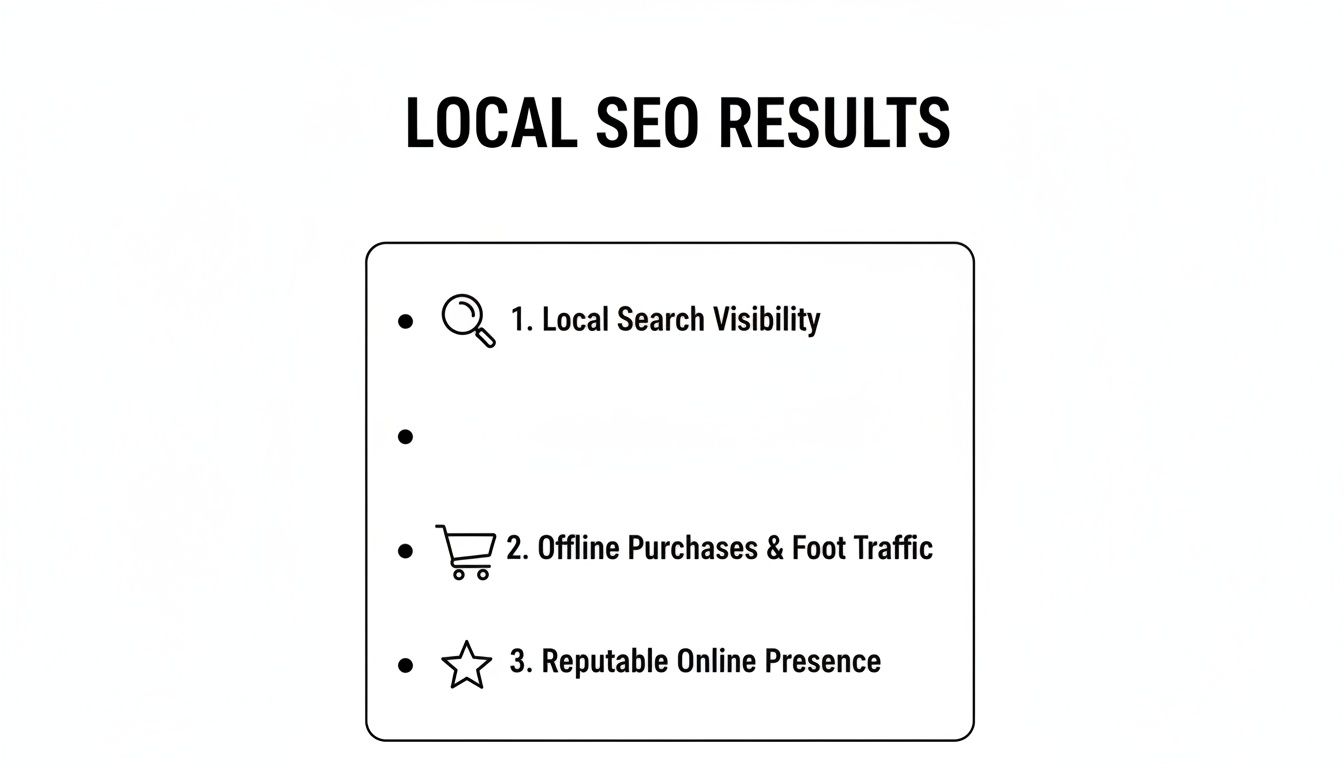
As you can see, good SEO doesn't just happen online; it drives real customers to your door and builds a more trustworthy brand.
To measure success the right way, focus on Key Performance Indicators (KPIs) that actually mean something for your business growth:
- Organic Traffic Growth: Are more people finding you through Google this month than last month?
- Lead Generation: How many phone calls, contact form fills, or email sign-ups came from that organic traffic?
- Conversion Rate: Of all the visitors from search, what percentage are actually doing what you want them to do (e.g., buying something, booking a demo)?
- New Revenue: This is the big one. Can you draw a straight line from your SEO efforts to new money in the bank?
When you track these metrics, you’re no longer guessing. You can see the tangible value SEO brings to your business, turning it from a marketing cost into a predictable, profitable way to grow.
How to Choose the Right SEO Partner

Finding the right SEO provider can feel like navigating a minefield, but it's one of the most important decisions you'll make for your business’s growth. A great partner is like an extension of your own team, driving tangible results that move the needle.
The wrong one? They can burn through your budget and, in the worst-case scenario, do lasting damage to your website's reputation with search engines. Your goal is to find a partner who values transparency, understands your business goals, and sets realistic expectations from day one.
Key Questions to Ask Any Potential Partner
Before you even think about signing a contract, you need to ask the right questions. Treat this like a job interview—because that's exactly what it is. A solid agency will welcome your questions with clear, confident answers. A shaky one might give you vague promises.
Come to the conversation ready with this checklist:
- Process and Strategy: "Can you walk me through your process for building an SEO strategy for a business like mine? What would be your top priorities in the first 90 days?"
- Success Metrics: "How do you define success? What key performance indicators (KPIs) can I expect to see in my monthly reports?"
- Communication and Reporting: "What does your reporting look like, and what's our communication rhythm? Could I see a sample report?"
- Past Performance: "Do you have a case study from a small business in a similar industry? What were some of the challenges you ran into and how did you solve them?"
These questions help you cut through the sales pitch and get to the core of their competence and communication style.
Spotting the Critical Red Flags
Knowing what to look for is only half the battle; you also need to know what to run from. Certain claims are immediate red flags that should give you pause. When you're trying to find reliable SEO services for small business, be wary of anyone who makes promises that sound too good to be true.
Here are the most common warning signs:
- Guaranteed #1 Rankings: This is the oldest and biggest red flag in the book. No one can guarantee a specific ranking on Google, period.
- "Secret" or "Proprietary" Methods: A trustworthy partner is open about their tactics. Secrecy often hides outdated or risky "black-hat" practices that could get your site penalized.
- Focus on Vanity Metrics: If they only talk about rankings without connecting them to actual traffic, leads, and revenue, they aren't focused on what truly matters to your business.
- Long-Term, Inflexible Contracts: A confident agency will often offer shorter or more flexible contracts because they know their results will convince you to stay.
The right SEO partner sells a clear process and measurable outcomes, not a magical result. Their value is in their strategic expertise, consistent execution, and transparent communication—not in a secret formula.
Choosing a provider is a big commitment. For a deeper look at the financial and logistical side of things, check out our complete guide to outsourcing SEO, which breaks down costs, steps, and expected ROI.
Ultimately, the best partner is one who acts like one. They should be invested in your success, happy to educate you on what they're doing, and focused on building a strategy that drives sustainable growth for your small business.
Frequently Asked Questions About Small Business SEO
Diving into SEO often brings up some very practical questions. If you're thinking about investing in SEO services for your small business, you're definitely not alone in wondering about the timelines, the costs, and what you should actually expect.
Let's cut through the noise and get straight to the real-world answers we give business owners like you every day.
How Long Does SEO Take to Show Results?
This is usually the first question on everyone's mind, and the honest answer is this: SEO is a marathon, not a sprint. Every business and industry is different, but having a realistic timeline is key to setting the right expectations.
You can generally expect to see some initial, positive movement in your rankings and traffic within 3 to 6 months. This is when the foundational work—like fixing technical glitches and optimizing your existing pages—starts to get noticed by search engines.
But the more substantial, business-driving results? The kind that leads to a real increase in leads and sales? That typically takes 6 to 12 months to build up. Think of SEO as a long-term investment that compounds over time. The competitiveness of your industry and the starting condition of your website will also play a big role in how quickly you see a major impact.
Can I Do SEO Myself for My Business?
Absolutely. In fact, DIY SEO is a fantastic way to get your feet wet and learn the fundamentals. Many small business owners can get some great results on their own, especially when they're just starting out.
Here are a few high-impact things you can tackle yourself:
- Optimize Your Google Business Profile: This is a free and incredibly powerful tool. Fill out every single section with accurate info, add plenty of photos, and encourage your customers to leave reviews. You can see some quick local wins this way.
- Create Your First Pieces of Content: Start by writing blog posts or service pages that directly answer your customers' most common questions. It's a simple, effective starting point.
- Basic On-Page SEO: Just learning how to write clear page titles and compelling meta descriptions can make a noticeable difference in how many people click on your site from search results.
That said, SEO is a deep and constantly changing field. As you start aiming for more competitive keywords or need more advanced technical fixes and link-building strategies, the time and expertise required can become overwhelming. At that point, hiring a professional often becomes the more cost-effective choice. Many businesses start with a DIY approach and then partner with an agency to really scale their growth.
What Is the Difference Between SEO and PPC Ads?
The easiest way to think about it is earning versus renting your online visibility. It's a core concept to grasp when you're planning your marketing budget.
SEO (Search Engine Optimization): This is all about earning organic, or unpaid, rankings in search results. You're building a long-term digital asset. Every piece of content you create and every link you earn adds to your site's authority, generating traffic that keeps coming without you having to pay for every click.
PPC (Pay-Per-Click): This is where you rent ad space at the top of search results pages, like with Google Ads. It’s fantastic for getting immediate traffic, making it perfect for short-term campaigns or special promotions. The catch? The moment you stop paying, the traffic stops.
A smart digital strategy often uses both. PPC can get you quick wins and valuable data, while SEO builds the sustainable, authoritative presence that fuels your business for the long haul.
How Do I Know if My SEO Investment Is Working?
Measuring the return on your SEO investment is non-negotiable. Any good SEO partner will give you transparent reports focused on the key performance indicators (KPIs) that actually matter to your business goals. It's so important to look beyond just rankings.
Here are the crucial metrics that show real success:
- Growth in Organic Traffic: Are more people finding your website through search engines this month than last month?
- Improvements in Keyword Rankings: Are you climbing higher for the specific terms your ideal customers are actually searching for?
- Increase in Organic Leads or Sales: How many contact forms, phone calls, or online purchases can be traced directly back to your organic traffic?
- Enhanced Local Visibility: Are you getting more calls, requests for directions, and website clicks from your Google Business Profile?
At the end of the day, the success of your SEO services for small business is measured by the real, tangible impact it has on your bottom line.
Ready to see how a dedicated SEO strategy can fuel your growth without the high agency fees? Rankai uses an intelligent blend of AI and human expertise to deliver high-volume, ROI-focused content that ranks. Explore how we can help your business at https://rankai.ai.