Any solid e-commerce SEO agency will tell you straight up: online stores are a different beast. You're not just trying to rank a blog post or a service page. You're wrestling with thousands of product pages, a labyrinth of site architecture, and a constant battle for high-intent, "buy now" keywords. This isn't just SEO; it's SEO supercharged for sales.
Why Generic SEO Fails E-commerce Brands

So many online store owners hit the same wall. They follow the usual advice—write some blogs, build a few links—but their product pages are still collecting dust on page five of Google. The hard truth is that generic SEO playbooks just aren't designed for the chaos and complexity of an e-commerce site.
Think about it. Your online store is a massive, living ecosystem. It's a dynamic inventory system, not just a handful of static pages. With potentially thousands of SKUs, each needing its own shot at ranking, a one-size-fits-all strategy is doomed from the start.
The E-commerce SEO Difference
For an e-commerce brand, the only thing that matters is selling products. Every single SEO action has to circle back to that goal. A generalist agency might be thrilled to rank you for a broad, informational keyword, but a true e-commerce SEO agency knows the real money is in capturing traffic at the very bottom of the funnel.
There are a few areas where this specialized focus is absolutely critical:
- Faceted Navigation: This is a classic e-commerce headache. All those filters for size, color, brand, and material can accidentally spawn thousands of duplicate, low-value URLs. Without an expert hand, this technical mess will drain your site’s authority and obliterate your crawl budget.
- Product & Category Page Optimization: These pages are your money-makers. They demand flawless structured data, unique descriptions that actually sell, and a smart internal linking strategy to funnel authority where it matters most.
- Scalable Content Creation: Let's be real—no in-house team is writing unique, compelling copy for 5,000 different products. A specialist agency has proven systems for creating optimized content at scale, avoiding the dreaded duplicate content penalties that can tank a site.
A generic SEO strategy treats every website like it's the same. An e-commerce SEO strategy knows a product page isn't a blog post, a faceted URL isn't a category page, and a sale is the only metric that truly counts.
The Growing Need for Specialization
It’s getting more crowded out there, and the demand for real expertise is skyrocketing. The global market for agency SEO services is expected to explode, jumping from USD 75.22 billion in 2025 to a massive USD 141.02 billion by 2029. What’s driving this? The sheer scale of online retail, where search is the lifeline for discovery and revenue. You can dig deeper into these market trends and their impact on e-commerce.
Hiring a generic agency for your store is like asking your family doctor to perform open-heart surgery. Sure, they know the basics of health, but they don't have the specialized skills or tools for a high-stakes operation. When it comes to the long-term health of your organic revenue, you need a specialist.
Know Thyself: The Crucial First Step Before You Hire an SEO Agency

Before you even think about sending that first email or getting on a discovery call, the most critical work needs to happen in-house. Hunting for an e-commerce SEO agency without a crystal-clear picture of your own business is like going grocery shopping hungry without a list—you'll end up with a cart full of things you don't need and forget the essentials.
This initial self-audit is your game plan. It’s what turns you from a passive buyer into an informed partner, ready to steer conversations and find an agency that truly fits your goals, not just one that’s good at selling a generic package.
What Does "Success" Actually Look Like for Your Store?
"More traffic" isn't a goal; it's a wish. To build a real partnership with an agency, you have to translate those vague desires into specific, measurable business outcomes. What, exactly, will move the needle for your bottom line?
Start by hammering out your key performance indicators (KPIs). These aren't just for the agency to report on; they're your North Star for the entire relationship.
- Organic Revenue Growth: "We need to increase organic revenue by 30% over the next 12 months."
- Keyword Ranking Targets: "Let's get top-5 rankings for our three main product categories, like 'organic cotton baby clothes' and 'eco-friendly wooden toys.'"
- Non-Branded Traffic Increase: "Our goal is to boost non-branded organic traffic by 40% to lower our dependence on paid ads."
- Conversion Rate Improvement: "We have to improve the organic conversion rate from 1.5% to 2.0% by fixing our key product and category pages."
A clear brief is your single most powerful negotiation tool. When you know exactly what you need to achieve, you can instantly see through the agencies that offer vague promises instead of concrete, results-driven strategies.
Walking into your first conversation with these numbers in hand completely changes the dynamic. You're no longer asking a potential SEO agency for e-commerce what they can do; you're telling them what you need to accomplish and asking how they'll get you there.
Get Honest About Your Current Pain Points
With your goals set, it's time to get your hands dirty and dig into your data to figure out what’s holding you back. You don’t need to be an SEO wizard to spot the big red flags. Tools you already have, like Google Analytics and Google Search Console, are your best friends here.
Jump into your analytics and start asking some tough questions. Where are the leaks in your e-commerce funnel?
- Is Your Mobile Experience Killing Sales? Look at your conversion rates on mobile versus desktop. If there's a massive drop-off, you likely have a clunky mobile checkout or painfully slow page speeds on phones.
- Are Technical Glitches Tripping You Up? Check Google Search Console for crawl errors, poor Core Web Vitals scores, or a huge number of "excluded" pages. These are technical roadblocks a specialized agency can demolish. For a head start, our ultimate guide to performing a technical SEO audit can walk you through a structured process.
- Which Pages are Underperforming? Find those key category or product pages that pull in decent traffic but have terrible bounce rates or abysmal conversion rates. This points to a problem with the content, the user experience, or maybe even the product-market fit.
- Are You Stuck on Page Two? If you’re lingering on the second page for your most important commercial keywords, it’s a strong sign you lack page authority or content depth—something a skilled agency can tackle head-on.
Putting together this list of pain points basically creates a diagnostic report for your business. When you approach an agency, you can hand them this evidence and ask for their specific plan of attack for each issue. This forces them to propose a strategy tailored to your real-world problems, not one they just copied and pasted. You’re hiring a problem-solver, not just another vendor.
How to Vet Agencies and Spot the Real Experts
Alright, you've done your homework and know what your store needs. Now for the hard part: telling the true e-commerce SEO experts apart from the generalists who just happen to have a few online stores in their portfolio.
Finding the right seo agency for e-commerce isn't about sitting through a sales pitch. It's an investigation. You need to cut through the fluff and see if they really get what it takes to sell products online.
Vague questions get you vague answers. You need to get specific and push them on their real-world experience.
Questions That Expose True E-commerce Expertise
A slick presentation doesn't mean an agency understands the nuts and bolts of your online store. You have to dig into the specific challenges that keep e-commerce managers up at night. Their answers here are everything.
I always start with their platform knowledge. If you're on Shopify, you don't care about their experience with Magento.
- Platform Proficiency: "Walk me through a complex technical SEO issue you solved for a client on [Your Platform, e.g., Shopify, BigCommerce]. How did you spot it, what did you do, and what was the result?"
- Product Page Strategy: "Our product pages are our lifeblood. What's your approach for ranking product pages that target low-volume, high-intent keywords?"
- Category Page Authority: "How do you build authority to our key category pages? Talk me through your process for internal linking and acquiring backlinks to these money pages."
These questions force them to talk about actual work, not just theory. A great answer for a Shopify store, for instance, might involve explaining how they used specific apps or custom scripts to fix tricky faceted navigation issues. For a deeper dive into this, it's worth checking out a complete guide on how to hire a Shopify SEO expert to get even more pointed questions.
The Agency Vetting Red Flags vs Green Flags
As you talk to agencies, certain phrases should make you raise an eyebrow, while others signal you've found a real partner. I've put together this table to use as a quick cheat sheet during your calls. It helps you quickly sort the contenders from the pretenders.
Agency Vetting Red Flags vs Green Flags
| Area of Inquiry | Red Flag (Warning Signs) | Green Flag (Positive Indicators) |
|---|---|---|
| Performance Guarantees | "We guarantee #1 rankings on Google for your keywords." | "We focus on driving measurable business outcomes like organic revenue and conversion rate growth." |
| Strategy & Tactics | "We use a proprietary blend of secret SEO techniques." | "Our strategy starts with a deep technical audit, competitor analysis, and keyword mapping." |
| Platform Experience | "We work with all e-commerce platforms; they're all pretty similar." | "We specialize in [Your Platform] and understand its unique challenges, like managing app bloat." |
| Reporting & KPIs | "We'll send you a monthly keyword ranking report." | "Our reports connect SEO activities directly to your KPIs, showing traffic, conversions, and revenue." |
| Communication | "You'll have an account manager you can email." | "You'll have a dedicated point of contact, a shared Slack channel, and scheduled bi-weekly calls." |
| Link Building | "We have a network of sites we use to build links quickly." | "We focus on earning high-quality, relevant links through digital PR and content outreach." |
This simple checklist cuts right through the noise. An agency that talks about business outcomes is on your team. An agency that talks about secret formulas is likely using outdated tactics that could get your site penalized down the road.
A true partner sells a strategy, not a secret. They talk about process, data, and business goals. A pretender sells guarantees, secrets, and vanity metrics like rankings.
Assessing Their Communication and Reporting Style
An agency’s technical skills are useless if you can't understand what they're doing or see the impact. Clear communication and transparent reporting are absolutely non-negotiable. This is where you find out if they’ll be a real partner or just another vendor sending you invoices.
Don't just ask if they send reports; ask to see one.
- Request a Sample Report: Ask for a sanitized monthly or quarterly report from another e-commerce client.
- Analyze the Content: Does it just list keyword rankings? Or does it connect their work to your bottom line? You want to see sections on organic traffic trends, conversion rates from search, and—most importantly—revenue attributed to SEO.
- Evaluate Clarity: Is the report a wall of technical jargon, or is it written so your CEO can understand it? A great agency translates complex data into clear business insights.
Finally, get a feel for their communication rhythm. How often will you meet? Who is your main point of contact? What's the plan when something urgent comes up? A solid seo agency for e-commerce will have a structured plan with regular check-ins and a clear process for emergencies, ensuring you're never left wondering what’s going on. This whole vetting process is your best defense against a bad partnership. It’s what ensures you invest in an agency that actually grows your business.
Decoding Proposals and Understanding Pricing Models
After you’ve narrowed down your list of potential agencies, the proposals will start hitting your inbox. This is where the rubber meets the road, and honestly, it can get confusing fast. A proposal from a top-tier SEO agency for e-commerce shouldn't just be a price list; it should feel like a custom-built strategic plan that directly reflects the goals and challenges you discussed.
A generic, one-size-fits-all proposal is a massive red flag. You want to see a document that proves they were actually listening. It should reference your specific KPIs, mention the competitors you're trying to beat, and lay out a strategy that solves the problems you found during your own audit. If it looks like they just swapped out a logo on a template, they're probably not the partner for you.
Common E-commerce SEO Pricing Models
Agencies typically structure their fees in a few different ways. The right model for your brand will come down to your budget, how aggressive your goals are, and your comfort level with risk. Getting a handle on these structures is crucial for finding a partnership that makes financial sense.
Here’s a look at the most common models you’ll encounter:
- Monthly Retainer: This is the industry standard for a reason. You pay a set fee each month for a clearly defined scope of work. It’s perfect for a long-haul strategy that includes ongoing technical SEO, consistent content development, and authority-building efforts.
- Project-Based: This model is great for one-off, specific tasks. Maybe you need help with a complex site migration, a deep-dive technical audit before a replatform, or a targeted link-building push for a new product category.
- Performance-Based: This can sound like a dream deal—the agency only gets paid if you see results, like a cut of organic revenue growth. The reality is these agreements are rare and often loaded with complicated terms. If you go this route, be extremely careful and make sure the success metrics are crystal clear and easily trackable.
For most e-commerce brands, a monthly retainer just makes the most sense. SEO is a marathon, not a sprint, and this model allows for a consistent, adaptable strategy that can pivot as your business—and Google—evolves.
What to Look for in a Strong Proposal
A truly great proposal does more than just sell you a service; it educates you. You should walk away with a solid understanding of what the agency plans to do, why they’re doing it, and how it’s all supposed to help you sell more products.
Any proposal from a credible SEO agency for e-commerce worth its salt should include:
- A Preliminary Site Audit: This is non-negotiable. It shows they’ve done their homework on your site, not just their pitch deck. It should pinpoint specific technical snags, content gaps, and real opportunities.
- A Detailed Scope of Work (SOW): This part needs to be incredibly specific. Vague promises won’t cut it. Look for a clear list of monthly or quarterly deliverables, like the number of pages they'll optimize, articles they'll write, or technical fixes they'll implement.
- Clear Timelines and Milestones: Nobody can promise you the #1 spot overnight, but a good agency will give you a roadmap for the first 30, 60, and 90 days. This sets expectations for foundational work and shows you what early progress should look like.
- Defined KPIs and Reporting Cadence: The proposal must spell out exactly which metrics they will track (e.g., organic revenue, non-branded traffic, keyword rankings for top categories) and how often you’ll get updates.
Choosing the right payment model is a big decision. For a deeper dive, you can explore the pros and cons of fixed-price SEO packages and how to choose the right one to see what truly fits your store's budget and growth plans.
Don’t Skip the Fine Print
Finally, before you sign on the dotted line, you have to read the contract. The proposal is the strategic handshake; the contract is the legally binding agreement. A few minutes spent reviewing key clauses now can save you major headaches later.
- Contract Length & Termination Clause: What's the initial commitment? Six months? A year? Even more important: how do you get out of it if things go south? Look for a reasonable notice period, like 30 days, so you aren't locked in with an underperforming partner.
- Ownership of Assets: This is a big one. The contract must explicitly state that you—and only you—own all the work product. That includes every blog post, graphic, and report they create for your brand.
- Exclusivity: This can be a smart clause to negotiate, especially in a competitive market. Does the contract prevent the agency from turning around and working with your biggest competitor at the same time?
Setting Your Partnership Up for Success
You’ve signed the contract and filed away the proposal. It’s tempting to breathe a sigh of relief, but honestly, the real work is just getting started. The first 90 days with your new SEO agency for e-commerce are absolutely critical—they set the tone and build the foundation for everything that follows.
A solid onboarding process is so much more than a welcome email and a kickoff call. Think of it as an intensive period of discovery, alignment, and strategic planning. This is where your agency shifts from pitching ideas to digging into your actual data to build a concrete roadmap for growth.
The Critical First 90 Days
The initial phase should feel like a collaborative deep dive. Your agency should be a firehose of questions, requesting access to all your analytics platforms and scheduling meetings to soak up as much of your team's institutional knowledge as they can.
A well-oiled onboarding process usually hits a few key milestones right away:
- The Kickoff Call: This isn’t just a meet-and-greet. It’s a strategic huddle to lock in business goals, confirm the scope of work, and figure out who the main points of contact are and how you’ll all communicate.
- Deep-Dive Technical Audit: Within the first couple of weeks, the agency should be deep in the weeds, conducting a technical SEO audit that goes far beyond the initial once-over from their proposal. This is where they uncover everything from crawl budget waste to messy schema markup.
- Strategy and Roadmap Presentation: Armed with audit findings and your business goals, the agency should come back with a detailed 6-12 month roadmap. This document needs to outline priorities, deliverables, and timelines so you know exactly what they’re working on and when.
This roadmap becomes your north star. From the proposal to the scope and finally the contract, each step builds on the last to give you a clear path forward.
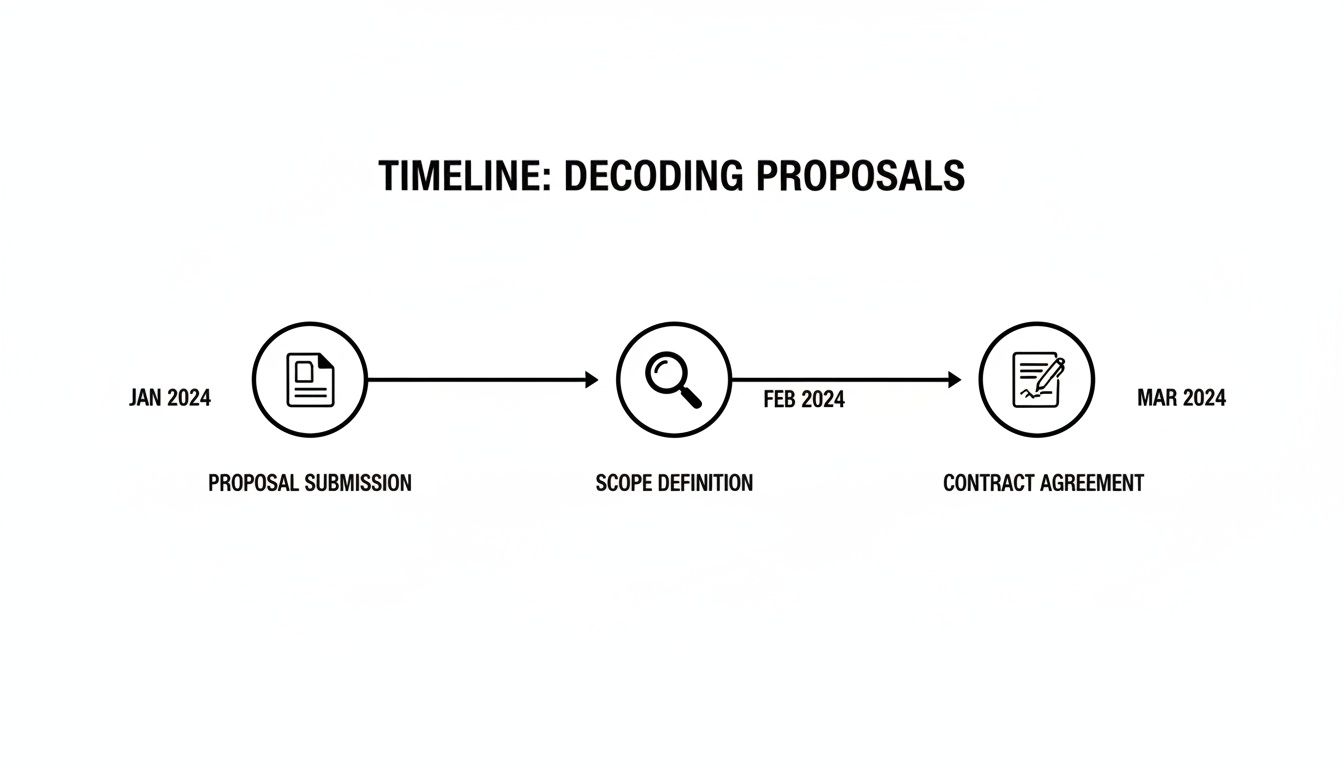
Seeing the journey from proposal to contract laid out like this really helps clarify how each document shapes the partnership's goals and boundaries.
Establishing KPIs That Actually Matter
Forget vanity metrics. A top-tier SEO agency for e-commerce will immediately pivot the conversation away from things like isolated keyword rankings and toward what directly impacts your bottom line. Success has to be measured in dollars and cents, not just search positions.
Your reporting dashboard needs to tell a business story.
The ultimate measure of a successful e-commerce SEO campaign isn’t rankings; it’s revenue. If your traffic is doubling but your sales are flat, something is fundamentally wrong with the strategy.
Here are the key performance indicators (KPIs) you should insist on tracking:
- Organic Revenue: The total sales generated directly from organic search. This is the big one.
- Organic Conversion Rate: The percentage of visitors from organic search who actually buy something. This tells you if you're attracting the right kind of traffic.
- Average Order Value (AOV) from Organic: Are SEO-driven customers spending more or less than people from other channels?
- Non-Branded Keyword Traffic: Growth here is a huge signal that you're capturing new customers who don't know your brand yet. That’s how you scale.
Setting these expectations early ensures your agency is laser-focused on activities that drive sales, not just chase traffic. In a market with over 24 million e-commerce sites and global sales projected to hit $6.4 trillion in 2025, you need that focus to survive. You can get a better sense of the competitive landscape from these comprehensive e-commerce statistics.
Creating a Rhythm of Communication and Reporting
Transparency is the bedrock of any good agency relationship. You should never be left wondering what your agency is working on or how their efforts are translating into results. A clear communication and reporting cadence needs to be set from day one.
A healthy rhythm often looks something like this:
| Communication Type | Frequency | Purpose |
|---|---|---|
| Weekly Check-in | Weekly | A quick email or Slack update on tasks done, what’s next, and any blockers. Keeps the momentum going. |
| Monthly Performance Call | Monthly | A formal review of the KPI dashboard to discuss wins, challenges, and strategic tweaks for the month ahead. |
| Quarterly Business Review | Quarterly | A high-level strategy session to review roadmap progress, talk about bigger market trends, and plan for the next quarter. |
This structure ensures communication is consistent and purposeful. You get regular tactical updates while also having dedicated time for bigger strategic conversations.
When you get that first monthly report, it should tell a clear, data-driven story—not just be a data dump. A great report from an SEO agency for e-commerce will connect their activities directly to your KPIs. It should explain why certain metrics moved and lay out the plan to build on successes and tackle any shortfalls. That level of accountability is what turns a vendor into a true growth partner.
Common Questions About Hiring an E-commerce SEO Agency
Even after all the pitches and proposals, you're probably still wrestling with a few key questions. That's a good thing. Bringing on an SEO agency for e-commerce is a serious investment, so getting crystal clear on what to expect—from timelines to costs to results—is essential before you sign on the dotted line.
Let's dive into some of the most common questions that pop up right before a brand makes its final decision.
How Long Does It Take to See SEO Results for an E-commerce Store?
This is the big one, isn't it? While everyone wants instant gratification, SEO is a long game. Realistically, you should expect to see tangible results for an e-commerce store emerge within 6 to 12 months.
The first few months, say three to six, are all about laying the groundwork. This is where the heavy lifting happens: deep technical audits, untangling messy site architecture, and methodically optimizing your most valuable category and product pages. It’s not glamorous, but it’s absolutely critical.
You might see some small victories during this foundational phase, like better indexing of your product catalog or a few rankings popping up for long-tail keywords. But the real needle-movers—significant lifts in organic traffic and, most importantly, revenue—tend to show up in the back half of that first year. By then, the content and link-building efforts have had time to marinate and earn Google's trust.
Any good agency will manage your expectations from the get-go with a clear 90-day plan and a roadmap for what comes next. If someone promises you the moon overnight, run the other way. Real, sustainable growth takes time.
Of course, this timeline can shift based on your site's current state, how cutthroat your market is, and the budget you're working with.
What Is a Reasonable Budget for an E-commerce SEO Agency?
There's no one-size-fits-all price tag here. E-commerce SEO agency retainers can swing wildly, but most fall somewhere in the $2,500 to $10,000+ per month range. Where your business lands depends entirely on its size, complexity, and ambitions.
- Small Businesses: For startups or brands in less crowded niches, you can often find solid, effective SEO work in the $2,500-$5,000 monthly bracket.
- Mid-to-Large Brands: If you're an established name with thousands of SKUs and stiff competition, you should be prepared to invest $5,000-$15,000 or even more per month.
The trick is to stop thinking of it as an expense and start seeing it as an investment. A holistic strategy that weaves together technical SEO, content marketing, and digital PR is going to cost more than a simple on-page tune-up, but the potential return is exponentially higher. Always steer the conversation toward ROI and the tangible business outcomes they can deliver.
Can an SEO Agency Guarantee #1 Rankings?
In a word: no. If an agency ever guarantees you a #1 ranking, it’s a massive red flag. Thank them for their time and show them the door.
Search algorithms are a black box—they're complex, they're always changing, and they're influenced by hundreds of signals, many of which are completely out of anyone's direct control. A reputable SEO agency for e-commerce would never make a promise they can't keep.
Instead, they'll guarantee the things they can control:
- A transparent, data-backed process.
- Diligently following SEO best practices.
- A strategy focused squarely on your business goals.
- Clear and consistent communication and reporting.
A great partner gives you educated forecasts based on data and competitive intelligence, not empty guarantees pulled from thin air.
Ready to see real, measurable SEO growth without the high cost and long-term contracts of a traditional agency? Rankai uses AI-powered automation combined with human strategy to deliver high-impact content and technical optimizations that drive results. Learn more and get started at https://rankai.ai.