A real SaaS content marketing strategy isn't just about blogging. It’s a long-term game plan designed to find, hook, and keep customers by creating genuinely helpful content over and over again. It’s about becoming a core engine for growth, focusing on educating your audience and solving their real-world problems. When you do that, you build trust and naturally guide people toward using your product. This approach gives every single piece of content a job to do, one that’s tied directly to your business goals.
Building Your Foundation for SaaS Content Success
A winning content strategy doesn't start with a brainstormed list of blog post ideas. It starts with a solid foundation, built from a deep understanding of your customers and crystal-clear business objectives. Trying to skip this part is like building a house on sand. Sooner or later, all your hard work will come crumbling down without ever driving meaningful traffic or revenue.
The whole point here is to create content with purpose. Every article, webinar, and case study has to serve a strategic role—whether it's bringing in a new type of user, keeping existing customers happy and engaged, or giving a prospect that final nudge they need to buy. This is how you turn content from just another expense into a predictable revenue machine.
Define Your Content Marketing Goals
Before you write a single word, you have to connect your content plan to actual business outcomes. Vague goals like "get more traffic" just won't cut it. A powerful strategy links every piece of content directly to the key performance indicators (KPIs) that actually matter to a SaaS business.
So, what are you really trying to do? The answer will shape everything from the topics you choose to the channels you use to get the word out.
- Boost Trial Sign-Ups? This calls for content that screams value and solves urgent problems. We're talking bottom-of-the-funnel stuff like direct competitor comparisons, detailed guides for specific use cases, and articles targeting keywords that show someone is ready to buy.
- Lower Customer Churn? Here, your focus flips to education and product adoption. You need content that helps your current customers master your software. Think about building out a killer knowledge base, creating in-depth tutorials, or hosting webinars that show off your most powerful features.
- Generate Marketing Qualified Leads (MQLs)? This goal is often about creating gated assets—think ebooks, whitepapers, or original research reports. The content behind the form has to be so valuable that someone is willing to trade their email address for it.
- Establish Topical Authority? If you want to be the undisputed expert in your space, you’ll need to build comprehensive pillar pages and topic clusters. This isn't about ranking for a handful of keywords; it's about owning the entire conversation around a specific subject in the search results.
Key Takeaway: Always start with the end goal. If you can't tie a content idea back to a core business objective—like driving trials or reducing churn—it’s probably not worth your time.
Uncover Deep Customer Insights
Let's be honest, generic buyer personas like "Marketing Mary" are mostly useless. For SaaS, you have to dig way deeper. You need to understand the entire group of people involved in the buying decision, what keeps each of them up at night, and the specific "jobs" they're trying to get done with a tool like yours.
Go talk to your best customers—the ones with the highest lifetime value (LTV). Sit down with your sales and customer support teams; they're in the trenches every single day. Mine your support tickets and listen to sales call recordings. What questions pop up constantly? What frustrations do you hear over and over?
This process uncovers the exact words and phrases your customers use, which is absolute gold for your content and SEO. It helps you build out detailed Ideal Customer Profiles (ICPs) that reflect real-world challenges. For example, instead of targeting "recruiters," you might find your sweet spot is "Rachel, the agency recruiter, who needs to source 10+ senior software engineers a month for fast-growing startups." Her problems are completely different from an in-house HR manager's.
That level of specificity is what makes content truly connect, convert, and drive a SaaS business forward.
How to Map Content to the SaaS Customer Journey
A great SaaS content strategy isn't just about publishing articles; it's about creating a guided tour for your future customers. You need to anticipate their questions at every step and deliver the right answers at just the right time, building trust along the way. Tossing a random collection of content out there is a surefire way to waste time and money.
The secret is to strategically map specific types of content to each stage of the customer's journey. It starts by visualizing their path from "I have a problem" to "This is the solution I need to buy." Before you even think about mapping, though, you need a solid foundation.
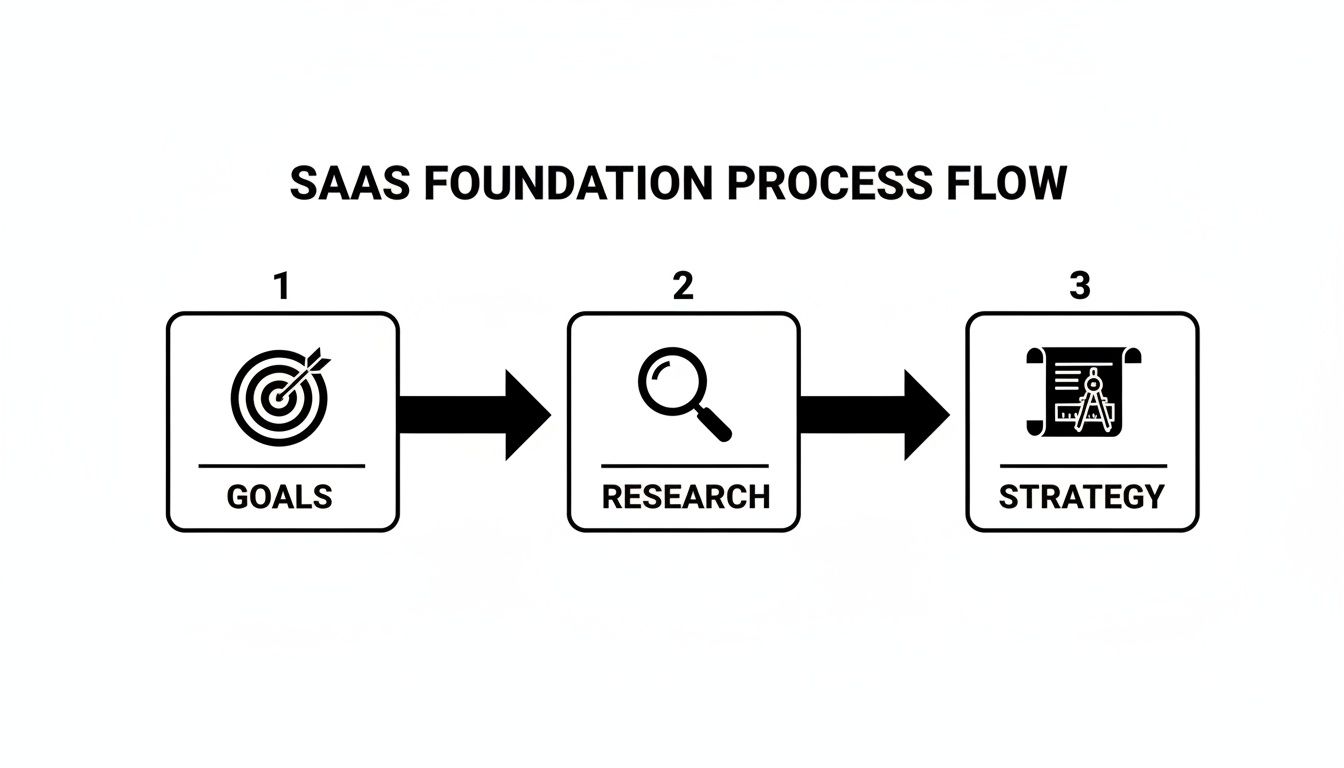
As you can see, any successful content map is built on a clear understanding of your business goals and deep audience research. That groundwork is what informs your entire strategy.
Attracting Prospects at the Top of the Funnel
At the top of the funnel (ToFU), it’s all about awareness. The people you're trying to reach are just realizing they have a problem, but they have no idea what the solutions are yet. They're turning to search engines to understand their challenges, not to find your specific software.
Your content's job here is to be purely educational. You want to cast a wide net with content that addresses their pain points in a broad, helpful way. Think about creating:
- Educational Blog Posts: These are your classic "how-to," "what is," and "why" articles. For a project management tool, a great topic would be something like, "How to Improve Team Collaboration Remotely."
- Original Data Reports: Nothing builds authority like fresh, proprietary data. If you can publish unique industry insights or survey results, you'll become a go-to resource. Infographics are perfect for this—in fact, 41.5% of SaaS marketers say they're their most engaging type of content.
- Free Checklists and Templates: Offer simple, downloadable tools that provide instant value. They help solve a small, specific problem and introduce your brand as a helpful guide.
The goal here isn't to sell. It's to become the most helpful resource on the internet for the problems your software will eventually solve for them.
Nurturing Leads in the Middle of the Funnel
Once someone moves into the middle of the funnel (MoFU), they're actively looking for solutions. They know they need a tool, and now they're starting to evaluate their options. Your content needs to shift from general education to specific guidance that showcases your expertise.
This is the perfect place for more in-depth content that you can "gate" behind an email signup form. It's how you capture qualified leads that you can continue to nurture. SaaS companies often invest heavily here, spending anywhere from $342,000 to $1,090,000 annually on content marketing, with a huge portion going toward these MoFU assets.
Some of the most effective MoFU formats include:
- Webinars: A massive 91% of SaaS brands use educational webinars to demonstrate their solution's value in a live, interactive setting. They work.
- In-Depth Guides and eBooks: These are comprehensive resources that dive deep into a topic and subtly position your product as a key part of the solution.
- Email Courses: Think of these as automated email sequences that deliver valuable lessons over several days. They're fantastic for building a relationship and keeping your brand top-of-mind.
Pro Tip: Your webinar isn't a one-and-done event. I've seen teams get incredible mileage by repurposing them. Data shows 92.31% of SaaS marketers turn recorded webinars into on-demand videos, blog posts, and social media clips to maximize their value.
Converting Prospects at the Bottom of the Funnel
At the bottom of the funnel (BoFU), your prospects are on the verge of a decision. They’re comparing your product directly against others and are desperately looking for social proof to feel good about their choice. Your content now needs to give them that final nudge of confidence.
This is where you can finally be more direct and product-focused. The goal is to highlight your unique value and build an undeniable case for why your tool is the best choice. This stage is absolutely critical; 49% of marketers say that case studies are a key part of boosting sales. For a deeper dive, check out our practical guide on what content mapping is and how to use it.
Your most powerful BoFU assets are going to be:
- Case Studies: Show, don't just tell. Detailed success stories from real customers that highlight tangible results and ROI are incredibly persuasive.
- Comparison Pages: Create honest, head-to-head comparisons between your product and your top competitors (e.g., "Rankai vs. Competitor X"). Buyers are doing this research anyway, so do it for them.
- Free Trials and Demos: Ultimately, the best BoFU content is the product itself. Make it ridiculously easy for prospects to get their hands on it and experience its value firsthand.
To pull this all together, here’s a quick-reference table that maps content formats to each stage of the funnel.
SaaS Content Funnel Mapping
| Funnel Stage | Goal | Primary Content Formats | Key Metrics |
|---|---|---|---|
| Top of Funnel (ToFU) | Generate awareness & attract new traffic | Blog Posts, Infographics, Checklists, Social Media, Data Reports | Organic Traffic, Keyword Rankings, Social Engagement, Backlinks |
| Middle of Funnel (MoFU) | Capture leads & educate prospects | eBooks, Webinars, In-Depth Guides, Email Courses, White Papers | Lead Magnet Downloads, Email Subscribers, Webinar Registrants |
| Bottom of Funnel (BoFU) | Drive conversions & close deals | Case Studies, Comparison Pages, Demos, Free Trials, Customer Testimonials | Demo Requests, Trial Signups, Conversion Rate, New Customers |
Using this framework ensures you're creating the right content for the right person at the right time, guiding them seamlessly from a curious visitor to a happy customer.
Developing SEO and Topical Authority
If you're in SaaS, you can't just treat organic search as another marketing channel. It's your most sustainable growth engine, period. But getting there means building real topical authority—convincing search engines that you are the definitive expert on your subject. This isn't about ranking for a handful of keywords; it's about owning the entire conversation.
When you pull this off, you create a moat around your business that consistently brings in qualified leads who are already looking for what you offer. It takes a deliberate, long-game approach to content, but the payoff is huge.

Build Topic Clusters, Not Just Pages
The single best way to build authority is by adopting the topic cluster model. Forget about writing random, one-off blog posts. Instead, you build a web of interconnected content that covers a core topic from every possible angle. It’s a fundamental shift from thinking about individual pages to owning entire topics.
This model is built on two key parts:
- Pillar Page: This is your cornerstone. It's a massive, in-depth guide that gives a broad overview of a core topic. It links out to all your more specific articles.
- Cluster Content: These are the supporting articles. Each one dives deep into a specific subtopic mentioned on the pillar page and, crucially, links back up to it.
This structure sends a powerful signal to Google that you've got serious expertise. For example, if you sell project management software, your pillar page might be "The Ultimate Guide to Agile Project Management." Your cluster content would then be articles like "Scrum vs. Kanban" or "How to Run an Effective Sprint Retrospective." If you're new to this, you can get a deeper understanding of what topical authority is and how to measure it from our guide.
Target Keywords Across the Entire Funnel
Not all keywords have the same value. A winning SaaS strategy targets keywords with different buying intent, matching them to where a person is in their journey. This means your keyword research has to be much more nuanced than just finding high-volume terms.
I like to break it down into two main buckets:
- Problem-Aware Keywords (Top of Funnel): These are the questions people ask when they're just starting to feel a pain point. They’re looking for information, not a product. For a cybersecurity SaaS, a classic example is "how to prevent phishing attacks." This content casts a wide net and introduces your brand as a trusted resource.
- Solution-Aware & High-Intent Keywords (Bottom of Funnel): This is where the magic happens. These are searchers who are actively shopping for a solution. They use comparison terms ("product A vs product B"), look for alternatives ("competitor X alternatives"), and search for specific use cases ("best tool for remote team collaboration"). These keywords have lower search volume, but their conversion rates are exponentially higher.
You absolutely need a mix of both to build a healthy pipeline. Top-of-funnel content feeds your brand, while bottom-of-funnel content drives sign-ups.
Let's talk numbers for a second. SaaS content marketing has a serious ROI, averaging $7.65 earned for every $1 spent. A huge chunk of that comes from organic search, which drives 62% of all inbound leads. As you map out your strategy, keeping these economics in mind is critical. You can dig into more data on the impact of content marketing statistics on SQ Magazine.
Optimizing for the Future of Search
Search isn't just a list of ten blue links anymore. With AI-driven features like Google's Search Generative Experience (SGE), the game is changing. SGE often creates a direct, conversational answer right at the top of the page by piecing together information from the most credible sources it can find.
To win in this new world, your content needs to be:
- Clearly Structured: Use descriptive H2s and H3s that sound like questions people actually ask.
- Factually Dense: Pack your articles with specific data, hard numbers, and verifiable facts.
- Authoritative: Cite your sources, link to experts, and build a backlink profile that proves you're legit.
This evolution just makes topical authority more critical than ever. Search engines are actively looking for true experts to power their AI answers, making a comprehensive, cluster-based strategy the only reliable path to long-term success.
How to Scale Content Creation and Distribution
Getting a piece of high-quality content out the door feels like a huge win, but let's be honest—it's only half the job. Without a rock-solid plan for creating and distributing content at scale, even the most brilliant guide will just gather dust.
This is where you shift from simply being a content creator to becoming a content operator. Your goal is to build a well-oiled machine that doesn't just produce great stuff, but also gets it in front of the right people, every single time. It's about building a predictable, repeatable process that boosts your output and amplifies the reach of every single asset.
Building a Scalable Content Engine
Scaling content isn't about just "writing more." That’s a recipe for burnout and mediocre results. It’s about building smarter systems that let you produce more without a proportional spike in chaos or a drop in quality. A robust editorial calendar is the absolute cornerstone of this engine.
And I don't mean a simple spreadsheet with topics and due dates. A truly strategic SaaS editorial calendar is your command center, aligning every piece of content with what’s actually happening in the business.
- Product Updates: A new feature is launching? Your calendar should already have tutorials, use-case guides, and success stories queued up. You're not just announcing what's new; you're explaining why it matters and driving immediate adoption.
- Marketing Campaigns: If you're running a campaign to break into the finance industry, your calendar should be loaded with content that speaks their language and solves their specific problems.
- Sales Enablement: Talk to your sales team. What questions do they hear on every demo? What objections pop up constantly? Build content that answers those questions and helps them close deals.
When you do this, content stops being a siloed activity and becomes a crucial, integrated part of your company's growth engine.
Mastering Content Distribution and Promotion
Hitting "publish" isn't the finish line; it’s the starting gun for promotion. Your distribution strategy needs to be just as thoughtful as your creation process. The biggest mistake I see teams make is treating distribution as an afterthought. You have to build it into your workflow from day one.
So many SaaS teams spend 90% of their effort creating content and a measly 10% distributing it. If you want to scale your impact, you have to flip that ratio. Every article, webinar, and case study deserves its own promotion plan.
One of the most powerful ways to do this is by repurposing your content. A single, high-effort asset can be sliced, diced, and remixed into dozens of smaller pieces for different channels.
For example, let's take a 60-minute webinar on "AI for Sales Teams." That one asset can become:
- A detailed blog post summarizing the key insights.
- The original slide deck uploaded to SlideShare for more visibility.
- A handful of short video clips (1-3 minutes each) perfect for sharing on LinkedIn and X.
- An infographic visualizing the most compelling stats from the presentation.
- A quote carousel for Instagram featuring powerful takeaways.
- A 5-day email mini-course to nurture new leads.
This "create once, distribute forever" approach squeezes every drop of value out of your best content and ensures you’re meeting your audience on the platforms they actually use.
Intelligently Integrating AI for Speed and Scale
AI isn't some far-off concept anymore; it's a practical tool that can help you scale your content operations right now. Its role isn't to replace your strategic thinking or brand voice, but to supercharge the most time-consuming parts of the job. It’s how a small team can punch way above its weight class.
The numbers back this up. An incredible 64% of SaaS firms are now using AI in their marketing strategies. And it's working—68% of businesses report a better content marketing ROI after bringing AI tools on board. Yet, only 29% of SaaS marketers feel their strategies are "very effective," which shows there's a big difference between having the tools and knowing how to use them well. You can explore the full research on RevenueZen for more stats.
Here's how you can use AI in a practical, day-to-day way:
- Accelerate Research: Use AI to summarize dense reports, pull out key statistics, or get a quick overview of a new topic.
- Generate Initial Drafts: AI is fantastic for overcoming the "blank page" problem. It can generate a solid first draft or a detailed outline in minutes, saving your team hours.
- Optimize for Search: Many AI tools can analyze top-ranking content and suggest keywords, headings, and related topics to include for better SEO. For larger-scale projects, this can feed into a more structured system. To dig deeper, check out our ultimate guide to programmatic SEO and how to scale your content.
The key here is human oversight. Let AI do the heavy lifting with research and drafting, but your human editors and strategists must be the ones ensuring the final piece has a unique point of view, nails the brand voice, and delivers real value to the reader.
Measuring Content Performance and Driving Growth
If you want your SaaS content marketing to be more than just a publishing exercise, you have to treat it like a living system—one that you’re constantly feeding with data to make it stronger. The goal is to move past surface-level vanity metrics and get laser-focused on the numbers that actually grow your business.
It’s about connecting the dots between your content and your revenue. Sure, page views are nice, but they don't keep the lights on. The real questions are: Is our content generating qualified leads? Are those leads converting into paying customers? Which blog posts are actually pushing people to sign up for a trial? Answering these questions requires a solid measurement framework.
Identify Your North Star SaaS Metrics
Every single article, guide, or webinar you create needs a job to do. To figure out if it's doing its job well, you first have to define what success looks like in real, business-centric terms. For any SaaS company, this almost always comes down to a handful of key performance indicators (KPIs) that tell you a prospect is getting serious.
These are the metrics that truly matter:
- Trial Sign-ups: This is the big one for most. How many people who read a specific blog post went on to start a free trial? Tracking this connection is how you prove which content topics effectively sell your product's value.
- Demo Requests: For SaaS products with a higher price point or more complex setup, a demo request is a massive signal of intent. Tying content back to demo requests shows you which articles are pulling in qualified buyers ready for a sales conversation.
- Marketing Qualified Leads (MQLs): This is your bread and butter for gated content like ebooks or webinars. An MQL isn't just a name and an email; it's a lead who fits your ideal customer profile and is showing signs they're ready to engage with your sales team.
When you obsess over these bottom-of-the-funnel metrics, you guarantee your content efforts are always pointed directly at revenue. This focus also makes it a whole lot easier to build a rock-solid business case for getting more budget and resources.
Set Up Content Attribution
Okay, so you know what to measure. The next hurdle is figuring out how to connect the dots between someone reading a blog post and then converting. This is where attribution comes in, and for SaaS, it’s rarely a straight line. Someone might read a blog post today, join a webinar next week, and finally start a trial a month from now.
A simple but incredibly powerful place to start is with first-touch attribution. This model gives 100% of the credit to the very first piece of content a user ever engaged with before they converted. It’s fantastic for figuring out which top-of-funnel articles are your best magnets for attracting brand-new, qualified prospects into your world.
You can get this up and running pretty easily in Google Analytics by setting up goals and conversion tracking. For instance, you’d create a goal that fires when someone lands on your trial sign-up confirmation page. Then, by looking at your landing page reports, you can see which blog posts served as the initial entry point for all the users who eventually hit that goal. Suddenly, you have a clear line of sight into the content that sparks initial interest.
Key Insight: Don't get paralyzed trying to build a perfect, complex multi-touch attribution model from day one. Start with a first-touch or last-touch model. I promise it will immediately give you 80% of the insights you need to understand which topics and formats are generating real business results.
Conduct Regular Content Audits
A content audit shouldn't be a dreaded, one-off project you do every few years. It needs to be a recurring process for optimizing your entire library of content. Think of it as a systematic tune-up where you review what’s working, what’s flopping, and where the low-hanging fruit is. For most SaaS teams, doing this quarterly is the perfect rhythm.
Your audit should be all about categorizing every article based on how it performs against your core KPIs. This empowers you to make smart, data-backed decisions instead of just guessing what to create or update next.
Here’s a simple framework to guide your audit:
- Keep and Amplify: Find your champions—the articles that consistently drive trial sign-ups or MQLs. The mission here is to double down. Can you run more ads to them? Can you create a "Part 2" or a deep-dive webinar on the same topic?
- Update and Optimize: Look for content that gets decent traffic but has a dismal conversion rate. These are your prime candidates for a refresh. Maybe you need to add stronger calls-to-action (CTAs), embed a relevant on-demand webinar, or update the stats and examples to make it more current and persuasive.
- Consolidate or Prune: Let's be honest, some articles are duds. If a post has been live for a year with barely any traffic and zero conversions, it might be dragging you down. You can either merge it into a related, higher-performing article or delete it entirely to improve your site’s overall health.
This iterative process is what turns your content from a static library into a dynamic growth engine. By consistently amplifying your winners and fixing or cutting your losers, you build a powerful, compounding asset that drives predictable results for your business.
Common Questions I Hear About SaaS Content
When you're in the trenches building a SaaS content strategy, theory quickly gives way to real-world questions. It's one thing to have a plan on paper, but executing it brings up all sorts of practical hurdles around timelines, budgets, and who you're really talking to.
Let's clear up some of the most common questions I get from SaaS teams trying to get their content engine running.
How Long Until I Actually See SEO Results?
This is the big one, and the honest answer is: it takes time. You're playing the long game here.
While you might catch a few glimmers of hope in the first few months, don't expect the floodgates to open overnight. For most SaaS businesses, you'll start to see a real, meaningful impact—we're talking qualified leads and rankings for keywords that actually make you money—within about 6 to 12 months of consistent effort.
My Advice: Stop obsessing over traffic alone in the early days. Instead, look for the leading indicators. Are your impressions climbing in Google Search Console? Are you slowly creeping up the rankings for your main topic clusters? Are you starting to earn backlinks without even asking? These are the signs that your strategy is working long before you see that big traffic spike.
Is B2B and B2C SaaS Content Really That Different?
Absolutely. While both are trying to get people to sign up and pay, how you get them there is worlds apart. The difference all comes down to the buying journey and what your audience cares about.
If you don't tailor your approach, you'll be shouting into the void.
B2B SaaS Content: You're not selling to a person; you're selling to a company. This means you’re trying to convince a whole committee of people—from the daily user to the CTO to the CFO who signs the check. Your content needs to be all about solving a painful business problem and showing a clear return on investment. The tone is less about flash and more about authority. Think:
- Deep-dive whitepapers backed by original data.
- Hard-hitting case studies with real numbers and client quotes.
- Webinars that walk through a specific, high-value workflow.
- No-fluff competitor comparison pages that help a buyer make their business case.
B2C SaaS Content: Here, it’s all about the individual. The decision is emotional, the sales cycle is fast, and you're often selling a feeling or a personal benefit. Your content has to be much more engaging, visual, and shareable. You’re trying to build a connection. This is where you lean into:
- Quick, snappy video tutorials perfect for Instagram or TikTok.
- Blog posts that feel relatable, focusing on personal productivity or lifestyle wins.
- Fun, interactive quizzes or simple tools that get people engaged.
- Campaigns that feature content from your actual users or collaborations with influencers.
What's a Realistic Content Marketing Budget for a SaaS Company?
There’s no one-size-fits-all answer here, as it really depends on your stage of growth and how aggressive your goals are. The best way to think about it is as a percentage of your overall marketing spend.
For an early-stage startup that’s just getting its feet wet, putting about 10-15% of the total marketing budget toward content is a solid starting point. This usually covers the essentials: writing the actual content and getting it in front of a small audience.
But if you're a scale-up looking to steal market share and dominate your category? You'll need to invest more heavily. I've seen companies in this phase dedicate 25-40% of their marketing budget to content. That bigger budget fuels a much higher output, allows for paid promotion, supports more sophisticated analytics, and can fund a dedicated team or a specialized agency to pour gas on the fire.
Ready to stop guessing and start growing? Rankai combines expert human strategy with powerful AI automation to deliver agency-level SEO outcomes at a fraction of the cost. Get consistently high-ranking content that drives real business results. See how we can scale your organic growth at https://rankai.ai.