Optimizing for a featured snippet is all about giving Google a perfect, ready-made answer to a user's question. You do this by creating incredibly clear, well-structured content—think short paragraphs, clean bullet points, or easy-to-read tables. The goal is to make it ridiculously simple for Google to grab your answer and place it right at the top.
Thriving in the New Age of Featured Snippets

Let's be honest, the search results page looks a lot different than it used to. What we once called "Position Zero" has become a much more dynamic, and frankly, more competitive space. Google's introduction of AI Overviews has completely changed the game, affecting where—and how often—we see traditional featured snippets.
The Impact of AI Overviews
This wasn't just a small adjustment; it was a seismic shift for SEOs. The latest data shows a pretty stark picture: 83% of the time, AI Overviews have pushed out featured snippets, leaving only 17% of those prime opportunities on the table. For many of us, watching this happen over just eight months was jarring.
The health and medical niches got hit particularly hard, with a jaw-dropping 94% of snippets vanishing. It’s a new reality, and it means we have to get smarter.
Why Snippet Optimization Still Matters
Seeing those numbers, you might be tempted to give up on snippets altogether. That would be a huge mistake. That remaining 17% is more valuable than ever.
Winning a featured snippet now means you've truly delivered the best, most concise answer in a field with far less competition. It sends a powerful signal of authority to both users and Google. It's your chance to own high-intent keywords where AI Overviews haven't yet taken over.
The game has changed from broad tactics to precision targeting. Success now lies in identifying the specific industries and query types where snippets persist and focusing your efforts there for maximum impact.
This playbook is designed for this new environment, cutting through the old advice to focus on what actually works today. We’re going to walk through how to:
- Pinpoint the high-value snippet opportunities that still exist.
- Structure your content with surgical precision to give Google exactly what it’s looking for.
- Understand the various SERP features and how to win them in our practical guide.
The objective isn't just to win any snippet anymore. It's about winning the right ones—the ones that drive real traffic, build your brand's credibility, and deliver a measurable return on your content. Let's get to it.
Finding Your Best Snippet Opportunities
Winning a featured snippet isn't about luck—it's about smart targeting. Before you even think about writing, you have to know where to aim. The best strategy is to find keywords that already show a featured snippet, because that’s a direct signal from Google that it wants to provide a quick, direct answer for that search. This takes all the guesswork out of the equation.
The first move is to identify these high-potential keywords. Sure, you could do this by manually searching your target terms, but that's a slow and painful process. A much better use of your time is to fire up an SEO tool like Ahrefs or Semrush and filter the keywords you already track. What you're looking for are keywords that not only have a snippet but also where you're already ranking on the first page—ideally somewhere in positions 2 through 10.
Uncovering Low-Hanging Fruit
These existing first-page rankings are your "low-hanging fruit." They represent your fastest path to a win. Why? Because industry studies show that a staggering 99% of all featured snippets are pulled from pages already ranking on page one. Google already sees your content as relevant and authoritative; you just need to give it a little nudge to convince it that your page has the best answer.
This is where you can get a serious competitive edge. By filtering your keyword reports, you can build a hit list of pages to optimize first. Look for those perfect scenarios where a competitor holds the snippet, but your page is right behind them in the organic results. That's a huge sign that with some strategic content adjustments, you can snatch that coveted Position Zero spot right out from under them.
The goal isn't just to find any snippet opportunity. It's to find the ones where you have the highest probability of success. Focusing on keywords where you already have a page-one presence dramatically shortens the time it takes to see results.
Targeting Question-Based and Long-Tail Keywords
The vast majority of featured snippets pop up for long-tail, question-based searches. Just think about how real people search, especially now with voice assistants. They aren't just typing "SEO." They're asking things like, "what is the most important part of SEO?" or "how to improve local SEO rankings." These are precisely the kinds of queries that Google loves to answer with a snippet.
A great way to find these questions is to dive into the "People Also Ask" (PAA) boxes right in the search results. PAA is a goldmine of related questions that Google considers highly relevant to your topic, and each one is a potential featured snippet waiting to be won.
- Analyze PAA Questions: For any of your main target keywords, make a list of every question you see in the PAA box.
- Use Them as Subheadings: Structure your content by turning these questions directly into H2 or H3 subheadings.
- Give Direct Answers: Right after each subheading, provide a clear, concise answer formatted perfectly for the snippet you’re after (paragraph, list, or table).
Using this method, a single article can become a magnet for dozens of potential snippet rankings. It also forces you to create the kind of comprehensive content that truly satisfies user intent. When you focus on these informational keywords, you’re not just optimizing for one term; you're building the kind of topical authority that search engines reward. Our complete guide to informational keywords dives deep into how to master this for long-term SEO success.
Using SEO Tools to Accelerate Discovery
Let's be real: manually checking the SERPs for every single keyword just isn't practical. This is where your SEO tools become absolutely essential for finding snippet opportunities at scale.
For example, in Semrush's Keyword Magic Tool, you can enter a starting keyword and use an advanced filter for "SERP Features" to see only the keywords that trigger a featured snippet. Just like that, you have a validated list of targets.
Ahrefs' Site Explorer has a similar powerhouse feature. You can see all the keywords your site already ranks for, then filter that report to show only the ones that have a featured snippet... that you don't currently own. This workflow is incredibly effective for pinpointing that low-hanging fruit we talked about. By building a system like this, you stop hoping to win snippets and start strategically targeting and capturing them.
Structuring Content for Snippet Success
Knowing which keywords to target is only half the battle. If you want to actually win the featured snippet, you have to structure your content so Google can easily grab it. This isn't about fancy prose; it’s about strategic formatting.
Think like a journalist and use the inverted pyramid model. Get straight to the point. Deliver the most important information—the direct answer to the user's query—right at the top of your page or section. Don't make Google (or the reader) dig through a long-winded intro. If the search is "what is a SERP," your first sentence should define it. That directness is exactly what the algorithm is looking for.
This whole process boils down to a clear, repeatable system: you filter for opportunities, analyze the current snippet, and then target it with perfectly formatted content.
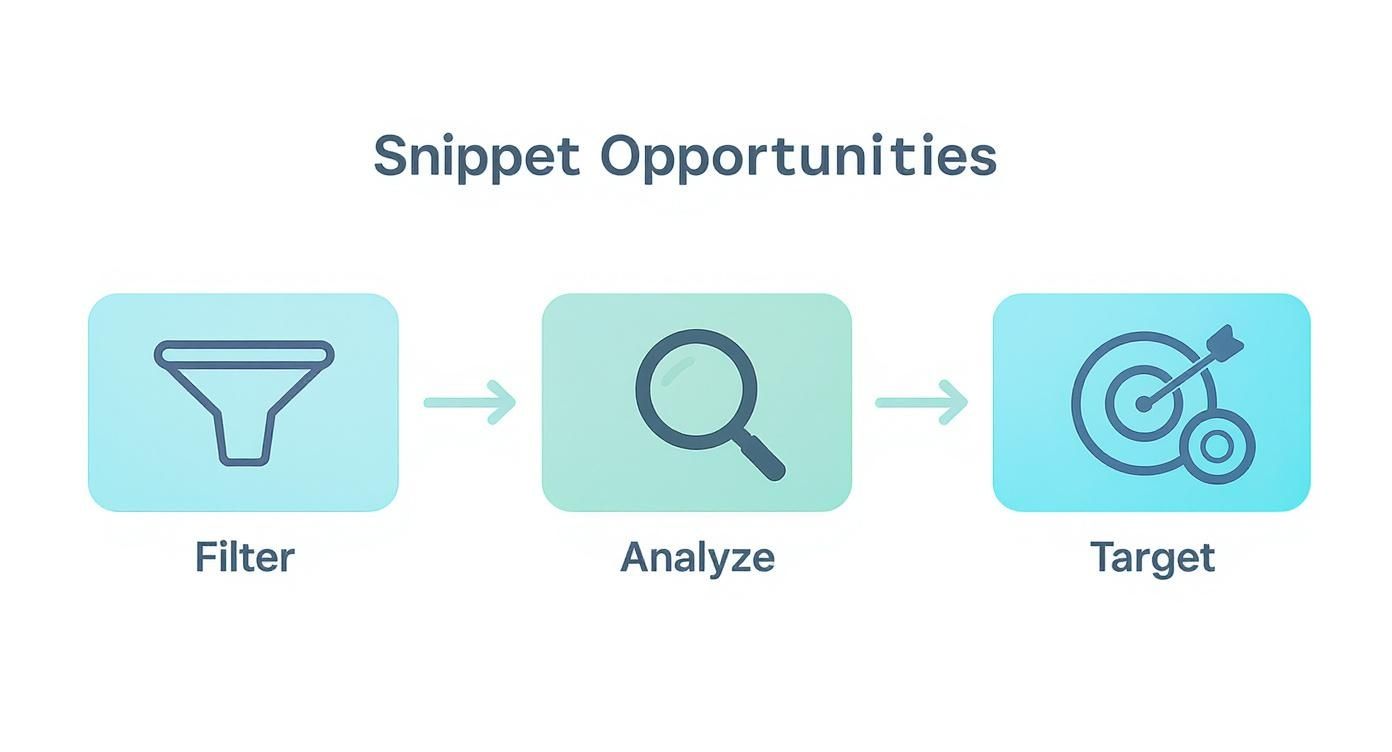
It’s about being methodical, not just lucky. Let’s break down exactly how to format your content for each of the main snippet types.
Crafting the Perfect Paragraph Snippet
Paragraph snippets are the most common type you'll encounter, making up a whopping 70% of all snippets. Winning them comes down to precision. While there’s no magic formula straight from Google, the data gives us some very strong clues.
There's a definite sweet spot for length. Based on a deep dive into featured snippet statistics, answers that are exactly 45 words (or 293 characters) have the highest success rate at 21.09%. Content around 40 words (19.27%) and 50 words (20%) also does incredibly well. The takeaway? Keep it tight. Your odds drop off a cliff once you go past 55 words.
To put this into action, create what I call a "snippet bait" block directly under your target subheading.
- The Subheading: Write a clear, question-style heading, like "What Is Topical Authority?"
- The Answer: Immediately follow it with a paragraph that’s 40-50 words long and gives a direct, concise answer.
- The Tone: Keep it objective and factual, almost like a dictionary definition. Strip out any brand voice or personal opinions from this specific block.
This little block is your pre-packaged answer, perfectly formatted for Google to lift and place right at the top of the search results.
Building Snippet-Ready Lists
When a query involves steps, processes, features, or "best of" roundups, a list snippet is often the prize. Think of any search that includes words like "how to," "steps," or "what are." Getting these right is all about using clean, semantic HTML.
For ordered lists (like a step-by-step guide):
- Use H3s for Each Step: I've had great success wrapping each step's title in its own H3 tag (e.g.,
<h3>Step 1: Plan Your Content</h3>). - Elaborate Below: Add a short paragraph under each H3 to explain the step in more detail. Often, Google will just pull your headings to create the snippet.
- Stay Consistent: Make sure your heading format is identical for every single step. If you start with "Step 1," stick with that—don't switch to "Step Two" or "#2" halfway through.
For unordered lists (good old bullet points):
- Lead with a Strong H2: Introduce the list with a heading that clearly states what it's about, like "Key Benefits of SEO."
- Use Proper HTML: This seems basic, but make sure your list is actually coded with
<ul>and<li>tags. - Keep Bullets Punchy: Each list item should be scannable and focus on a single, distinct point.
Keep in mind, Google is smart. It will sometimes build its own list snippet by pulling various H2 or H3 subheadings from your article. This is why a logical heading structure is non-negotiable for all your content, not just listicles.
The goal is to make your content's structure completely predictable for a machine. Clean HTML and consistent formatting are like a roadmap for search crawlers, leading them straight to the answer.
Winning with Table Snippets
Tables are less frequent but are absolute gold for data-heavy queries. If you’re targeting keywords around pricing, product comparisons, or technical specs (e.g., "HubSpot pricing tiers"), a table isn't just a nice-to-have; it's essential.
Optimizing for table snippets is refreshingly straightforward.
| Best Practice | Why It Works |
|---|---|
| Use Real HTML Tables | Never, ever use an image of a table. Google needs to read the data, so use proper <table> tags. |
| Keep It Simple | Avoid merged cells or overly complex layouts. Simple rows and columns are what the algorithm prefers. |
| Add a Descriptive Title | Always place a clear H2 or H3 heading right above the table to give it context, like "Comparison of Plans." |
By deliberately applying these formatting rules, you're no longer just writing an article. You're building a collection of snippet-ready answers, dramatically increasing your chances of landing that coveted Position Zero.
Sending the Right On-Page SEO Signals to Google

Okay, so you've written the perfect "snippet bait." That's a huge piece of the puzzle, but it’s only half the battle. Now you have to give search engines the technical clues they need to find and understand it. This is where your on-page SEO work really pays off.
Think of it like this: your brilliantly written paragraph or list is the answer, but the HTML and schema you use are the giant neon signs pointing directly to it. They shout, "Hey Google, the answer you want is right here!" If you skip these technical signals, it's like writing an amazing speech but forgetting to turn on the microphone.
Clean Code Starts with Semantic HTML
Before you get into anything too complex, let's talk about the basics. Using the right HTML tags for the job, known as semantic HTML, is non-negotiable. It’s all about using code that describes the meaning of your content, not just how it looks.
For winning featured snippets, this is foundational.
- Paragraphs: That crisp, 40-50 word answer you wrote? It needs to be wrapped in
<p>tags. Simple, but crucial. - Lists: When outlining steps or a process, always use ordered list tags (
<ol>and<li>). If the order doesn't matter, an unordered list (<ul>and<li>) is the way to go. - Tables: If you're presenting data, put it in a proper
<table>with<tr>and<td>tags. Never, ever use an image of a table. Search engine crawlers can't read text inside an image, making it completely invisible to them.
This kind of clean, logical structure makes it incredibly easy for Google to parse your content and reformat it for a snippet. It removes any guesswork for the algorithm.
Go a Step Further with Schema Markup
If semantic HTML is the basic map, think of schema markup as the high-tech GPS that adds rich, contextual detail. Schema is a specific vocabulary of code that helps search engines understand precisely what your content is about. While it won't single-handedly guarantee a snippet, it can give you a serious edge over the competition.
For snippet hunting, two types of schema are especially powerful:
- FAQPage Schema: This is tailor-made for any page with a question-and-answer format. It explicitly tells Google that your page contains a list of frequently asked questions and their corresponding answers, making it a prime candidate for both paragraph snippets and "People Also Ask" boxes.
- HowTo Schema: Got a guide that walks users through a process? Use this. It lets you mark up each individual step with text and even images, signaling that your page is a clear, actionable tutorial perfect for a numbered list snippet.
By implementing this markup, you make your content far more machine-readable, which can dramatically boost the odds that Google will understand its purpose and feature it prominently.
When you combine clean semantic HTML with targeted schema markup, you're essentially pre-packaging your content for Google. You're not just hoping it finds the answer; you're handing it over in a perfectly labeled box.
Don't Forget the Technical Fundamentals
Finally, let's be clear: none of these targeted optimizations will work if your site's technical foundation is shaky. Two core pillars of on-page SEO are absolutely critical just to get in the game. For a full breakdown, our on-page SEO checklist for essential optimization techniques covers these fundamentals in detail.
Mobile-Friendliness: A huge volume of searches happens on mobile, where snippets are even more dominant on the screen. Your site has to be responsive and dead simple to use on a phone.
Page Speed: User experience is everything to Google, and a slow-loading page is a bad experience. If your site is sluggish, Google is much less likely to promote your content to the very top of the results, no matter how great it is.
These aren't just best practices; they're the price of admission. Without a fast, mobile-friendly site, your perfectly crafted content and clean code might never get the chance to shine in Position Zero.
Measuring the Real-World Impact of Position Zero
Landing a featured snippet is a great feeling, but the real win is proving it's actually moving the needle for your business. Let's be honest, Position Zero isn't about bragging rights; it's about seeing tangible gains in traffic, user engagement, and overall authority. If you can't track the results, you can't make the case for investing more time and resources into your snippet strategy.
Your first stop for measuring success should always be Google Search Console. It's the ultimate source of truth for your organic performance.
Once you've optimized a page and see it's won a snippet, dive into the Performance report. You can filter by that specific page and the target keyword to see what's happening. You’re looking for a clear upward trend in two crucial metrics: impressions and clicks. A spike in impressions shows your new snippet is grabbing more eyeballs, while a jump in clicks confirms it's actually bringing more people to your site.
The True Value of a High Click-Through Rate
This is where you really see the magic of a featured snippet. Earning Position Zero almost always translates to a much higher click-through rate (CTR) than a traditional #1 organic ranking. Why? Because the snippet completely dominates the top of the SERP, grabbing a user's attention before they even scroll. It’s a powerful endorsement from Google, signaling that your content is the definitive answer.
The data paints a pretty clear picture. When a webpage lands in a featured snippet, it enjoys an average CTR of about 44%. A snippet that takes the place of the #1 organic result does even better, capturing a staggering 42.9% of clicks.
Now, compare that to the average CTR of roughly 19.6% for a standard #1 result when no featured snippet is present. The difference is huge. Even more telling, the mere presence of a featured snippet actually drops the CTR of the first-place organic result by 5.3%. Position Zero is literally capturing clicks that would have otherwise gone to the top-ranking page.
You can discover more insights about Position Zero SEO on mcneece.com.
This massive CTR advantage is the core ROI of snippet optimization. You’re not just ranking higher; you're capturing a disproportionately large share of clicks for a given keyword, effectively stealing traffic from your competitors.
Here's a quick look at just how much of a difference owning that top spot makes.
CTR Impact of Featured Snippets vs Standard #1 Ranking
The table below breaks down the average Click-Through Rate (CTR) for a URL in different SERP positions. It really highlights the significant advantage of owning the featured snippet.
| SERP Position | Average Click-Through Rate (CTR) | Performance Impact |
|---|---|---|
| Featured Snippet (Position 0) | ~43-44% | Captures the largest share of clicks, significantly outperforming the #1 spot. |
| #1 Organic (No Snippet) | ~19.6% | The standard benchmark for a top-ranking page without a snippet present. |
| #1 Organic (With Snippet) | ~14.3% | Shows a 5.3% decrease in CTR as the snippet above absorbs clicks. |
This data shows why featured snippets are such a powerful SEO play. It’s not just a small bump in performance; it’s a fundamental shift in how much traffic you can pull from a single search query.
Using Rank Trackers to Visualize Success
While Google Search Console gives you the raw numbers, a dedicated rank tracking tool helps you visualize your dominance on the SERP. Tools like Semrush or Ahrefs are perfect for this because they don't just show your organic rank—they show you which SERP features you own.
By setting up tracking for your target keywords, you can:
- Monitor Snippet Ownership: Get instant alerts when you win or lose a featured snippet.
- Analyze SERP Volatility: See how often the snippet owner changes, giving you a sense of how competitive a keyword really is.
- Track Competitors: Keep a close eye on which competitors are winning snippets, which lets you reverse-engineer their strategy and find opportunities.
This kind of continuous monitoring is non-negotiable. Losing a snippet is common, but with proper tracking, you can react immediately. You can analyze what the new winner did differently, tweak your own content, and get back to the top.
Frequently Asked Snippet Optimization Questions
As you get your hands dirty with snippet optimization, you'll inevitably run into the same questions that trip up everyone at some point. It's one thing to know the playbook, but another to know what to do when things don't go according to plan. Let's tackle some of the most common questions I hear.
How Long Does It Take to Get a Featured Snippet?
I wish there were a magic number, but anyone promising a specific timeline isn't telling you the whole story. The single biggest factor is where your page currently ranks. If you're already on the first page for your target query, you could snag the snippet in a matter of days or weeks after getting the content and structure just right.
But for new content or pages lingering on page two or beyond, you have a longer road ahead. Your first job is to build enough authority and relevance to even make it to the first page. Keep this in mind: industry data consistently shows that over 99% of featured snippets come from pages already ranking in the top ten.
The way I see it, it's a two-step mission. First, earn that page-one ranking with solid, all-around great SEO. Second, apply these optimization tactics to make the jump from a standard blue link to Position Zero. Patience is key here.
Can I Get a Snippet If I Am Not Ranking Number One?
Yes, absolutely! And honestly, this is what makes chasing snippets so powerful. Most featured snippets aren't even owned by the #1 ranking result; they're usually pulled from pages in positions two through five. This is your golden ticket to leapfrog competitors, even if they've held that top spot for ages.
Google's goal isn't to reward the top-ranking page—it's to give the user the best and most direct answer. If your content, sitting at position four, gives a clearer, more concise, or better-structured answer than the page at #1, you have a very real shot at stealing that snippet. It’s a fantastic way to punch above your weight and get that coveted top-of-SERP real estate.
What Should I Do If I Lose a Featured Snippet?
First thing's first: don't panic. Losing a snippet feels like a gut punch, but it’s a normal part of the game. SERPs are constantly changing, and this is just a signal that it's time to adapt.
Start by doing a little competitive recon on the new snippet owner.
- Format: Did they win with a different format? If you had a paragraph, did Google decide a bulleted list was a better answer?
- Content: Look closely at their answer. Is their information fresher? Did they add a new statistic or explain the concept more clearly?
- Structure: How did they use H2s or H3s to frame their answer? Is their HTML cleaner?
Often, a simple content refresh is all it takes to reclaim your spot. Update some stats, rephrase your definition, or restructure your answer to better match what's currently winning. Think of it less as a loss and more as free competitive intelligence telling you exactly what to do next.
Does Using Schema Markup Guarantee a Featured Snippet?
No, there are no guarantees in SEO. But using schema is a major competitive advantage that I'd never skip. Think of it as speaking Google's native language. It helps you spell out exactly what each piece of content on your page is for, removing any guesswork for the crawlers.
When you use something specific like FAQPage or HowTo schema, you're literally telling Google, "Hey, this is a question, and this block of text right here is its direct answer." It makes it incredibly easy for algorithms to parse your page and see it as a perfect snippet candidate. While it isn’t a silver bullet, skipping schema is like leaving one of your best tools in the toolbox.
At Rankai, we automate this entire process. From identifying high-value keywords to publishing perfectly structured, snippet-ready content, our AI-powered platform does the heavy lifting so you can focus on growth. See how we deliver agency-level results without the agency price tag at https://rankai.ai.