To get more organic traffic, you really have two main levers to pull: improving the content you already have and creating brand new stuff that people are searching for. The secret is knowing which one to pull first.
It all starts with digging into your analytics to find the low-hanging fruit. From there, you can move on to smart keyword research, dialing in your on-page SEO, and building real authority with quality backlinks. This isn't just a checklist; it's a process that makes sure every ounce of effort pushes your growth in the right direction.
Setting the Stage for Sustainable Organic Growth
Before you can map out a plan to get more traffic, you have to know where you stand right now. Jumping straight into keyword research without this initial analysis is like trying to plan a road trip without knowing your starting point. You’ll end up wasting a ton of time and money on tactics that don't actually fix your site's real problems or play to its strengths.
So, the first move is always a foundational audit using the data you already have. This isn’t about getting lost in spreadsheets for days. It’s about uncovering the story your analytics are dying to tell you. By spending some quality time in tools like Google Search Console and Google Analytics, you can spot hidden opportunities and pinpoint the critical issues holding you back.
What to Look for in Your Initial Audit
Your main goal here is to find your "unsung hero" pages. These are the articles and landing pages that are already doing okay but have the potential to deliver a whole lot more traffic with just a few smart tweaks. They're your quickest path to a win.
Here’s what to look for in your data:
- High Impressions, Low Clicks: Find pages that show up a lot in search results (high impressions) but rarely get clicked. This is a classic sign of a weak title tag or a boring meta description that just isn't compelling enough to earn the click. A simple rewrite can work wonders.
- Pages Ranking on Page Two: Any content ranking between positions 11-20 is right on the edge of greatness. These pages are so close to driving real, meaningful traffic. Often, a content refresh, some new internal links, or better on-page optimization is all it takes to bump them onto page one.
- High-Traffic Pages with High Bounce Rates: If a page gets tons of visitors but they all leave immediately, you have a problem. It’s a huge red flag that the page isn't meeting searcher intent. The cause could be anything from outdated information to a clunky user experience.
This diagnostic phase is your secret weapon. It stops you from chasing vanity metrics and helps you build a realistic, actionable roadmap based on actual data.
Key Takeaway: The fastest way to boost organic traffic is almost always by optimizing what you already have. Squeeze more juice out of your existing assets before pouring all your resources into creating new ones from scratch.
By analyzing these core metrics first, you create a clear, data-backed baseline. This starting point is crucial for measuring the true impact of your SEO efforts and proving the ROI of your strategy down the road. It shifts your entire approach from guesswork to a calculated plan for real, sustainable growth.
Finding Your High-Impact Content Opportunities

Now that you’ve handled your quick wins, it's time to think bigger. We need to build a forward-looking content strategy that drives real, sustained growth. A classic mistake I see all the time is treating keyword research like a one-and-done task—people pull a giant list of terms and just start chipping away at it randomly.
There’s a much smarter way to play the game: think in topic clusters.
This strategy is about creating a central, authoritative "pillar" page on a broad topic. Then, you surround it with multiple "cluster" pages that dive deep into all the related subtopics. Every cluster page links back to that main pillar, creating this powerful, interconnected web of content. This structure shouts to search engines that you're a true expert, boosting your authority and rankings for a whole group of related keywords at once.
From Keywords to Customer Journeys
Let's shift our mindset away from just chasing search volume. The real goal is to build a content library that answers questions at every single stage of your customer's journey. This means we're not just mapping content to keywords; we're mapping it to user intent.
You need the right answers for someone just starting their research, for the person deep in comparing solutions, and for the one who's ready to pull the trigger.
This is the heart of what we call content mapping. It's a process that ensures every piece you create genuinely helps your audience and naturally guides them toward your solution. We've put together a full breakdown on what is content mapping that you can dig into. When you align content with the entire user journey, you don’t just get more traffic—you get traffic that’s far more likely to convert.
Prioritizing Your Content Production
Okay, so you've got a ton of great topic ideas. How do you decide what to create first? This is where a simple prioritization matrix becomes your best friend. It forces you to look beyond basic metrics and really consider the business value of ranking for a given term.
Pro Tip: Don't get mesmerized by huge search volume numbers. A low-volume, high-intent keyword that directly solves a problem your product addresses can be 10x more valuable than a generic, high-volume term that attracts casual browsers.
Here’s a simple framework to help you sort through the noise and pinpoint what really matters.
Keyword Prioritization Matrix
This matrix helps you weigh different factors to find the keywords with the highest potential impact on your business.
| Keyword Type | Search Volume | Competition Level | User Intent | Priority |
|---|---|---|---|---|
| High Commercial | Low-Medium | Low-Medium | Transactional | High |
| Informational | High | High | Informational | Medium |
| Long-tail | Low | Low | High (Specific) | High |
| Branded | Medium | Low | Navigational | Medium |
Using a system like this helps focus your team's energy on content that actually moves the needle, not just boosts vanity metrics on a chart.
Scaling Content Without Sacrificing Quality
One of the biggest hurdles in SEO is the sheer volume of content you often need to compete. The solution isn't to start churning out mediocre articles faster; it's to develop a production workflow that can scale. This means creating detailed templates and briefs, using AI as an assistant for outlines and first drafts, and maintaining a strict editing process.
The objective here is to build a well-oiled content engine that consistently produces high-quality, optimized pages. When you scale effectively, you start capturing a massive long-tail audience, and your traffic growth begins to compound over time.
For instance, one publisher in the cost-of-living niche scaled from 10,000 to 425,000 pages in just three months. The result? A staggering 10,737% surge in organic traffic. That new content ended up accounting for over half of their entire site's traffic, which just shows the incredible power of strategic, scaled production.
Growth like that doesn't happen by accident. It's the direct result of a plan that identifies valuable topic clusters, maps content to real user needs, and scales production efficiently. Once you move beyond a simple keyword list, you can build a comprehensive content library that solidifies your authority and becomes a lasting asset for your business.
Optimizing for High-Intent Search Queries
Building a foundation with broad, informational topics is a great start, but the real business impact comes from zeroing in on high-intent search queries. This is where you pivot from attracting casual browsers to engaging users who are actively searching for a solution. It’s the critical difference between ranking for "what is SEO" and ranking for "best SEO agency for small business."
Let's be clear: not all traffic is created equal. While top-of-funnel (TOFU) content is fantastic for building brand awareness, it's the middle (MOFU) and bottom-of-funnel (BOFU) queries that really move the needle on conversions and revenue. These searches are a dead giveaway that a user is close to making a decision.
The way people search is also evolving, with zero-click searches on the rise. Projections show that by 2025, nearly 60% of U.S. Google searches could end without a single click to a website. This trend hits broad informational queries the hardest. On the flip side, high-intent searches—like product comparisons or solution-focused guides—boast much lower zero-click rates, often under 20%. More importantly, they convert at 4 to 5 times the rate of typical TOFU content. You can dig into more of these SEO priorities over at Search Engine Land.
Identifying and Targeting High-Intent Keywords
So, where do you find these golden, high-intent keywords? The key is to get inside the head of a customer who has a problem and is on the hunt for a solution. Their search terms will naturally be more specific and often contain commercial or transactional language.
Keep an eye out for these common patterns:
- Comparison Keywords: "Rankai vs competitor" or "best SEO tools for startups"
- "Alternative To" Keywords: "Ahrefs alternative" or "cheaper alternative to Semrush"
- Pricing and Cost Keywords: "Rankai pricing" or "how much does an SEO agency cost"
- Solution-Oriented Keywords: "how to scale content production" or "outsource SEO content"
Keywords like these signal that a user is well past the initial "what is" research phase. They know their pain point and are now actively evaluating their options. Creating content that directly answers these queries puts your solution front and center at the exact moment they need it. Mastering these nuances is crucial, and you can go deeper by reading our guide to understanding keyword intent.
Crafting Content That Converts
Once you've locked down your high-intent keywords, your next job is to build a page that not only ranks but also persuades. This content needs to do more than just inform; it needs to confidently guide the user toward taking the next step.
For instance, if you're building a product comparison page, don't just throw up a wall of text listing features. Create a clean, easy-to-read table that shows exactly how you stack up against a competitor on critical points like pricing, key features, and ideal user. Weave in customer testimonials and case studies to build trust and provide that all-important social proof.
Pro Tip: Structure these high-intent pages for maximum scannability. Use clear H3 subheadings for features or comparison points, sprinkle in bullet points to highlight benefits, and end with a powerful call-to-action (CTA) that leaves no doubt about what the user should do next.
On-Page SEO for High-Value Pages
Optimizing these bottom-of-funnel pages requires a more surgical approach than your average blog post. Every on-page element should be sharp, persuasive, and completely aligned with the user's intent.
- Title Tag: Make it benefit-driven. Instead of a generic "Rankai vs Competitor," try something like "Rankai vs Competitor: Why Startups Choose Our Scalable SEO."
- Meta Description: This is your ad copy. Highlight a unique benefit and include a direct call to action. For example: "See how we deliver agency-level results at a fraction of the cost. Compare plans now."
- Content Structure: Implement schema markup for reviews or products. This helps you earn those eye-catching rich snippets in the search results, which can seriously boost your click-through rate.
When you focus on these high-intent queries, your website transforms from a simple information library into a powerful customer acquisition machine. You start attracting visitors who aren't just browsing—they're actively looking for the very solution you offer, which means more qualified leads and a much healthier return on your content investment.
Getting Your Technical and On-Page SEO in Order
Here's a hard truth: the most amazing content on the planet won't see the light of day if your website's technical foundation is a mess. It's like building a beautiful house on quicksand. The content is your stunning interior design, but technical SEO is the foundation, plumbing, and wiring. Without a solid base, the whole thing comes crashing down.
Ultimately, strong technical and on-page SEO is all about removing friction. You're making it incredibly easy for search engine crawlers to find, understand, and index your content. It’s not about obsessing over perfect scores in every tool, but about clearing the path so your high-quality content can rank where it deserves to.
Building a Rock-Solid Technical Foundation
Your site’s technical health has a direct, and often immediate, impact on both user experience and search rankings. A slow, glitchy site doesn't just annoy visitors—it sends a clear signal to Google that your page might not be a quality result.
The good news is you don’t need to be a developer to make a huge difference. Focusing on a few core areas can deliver some of the biggest wins.
Start by digging into these components:
- Site Speed: This is non-negotiable. Users expect pages to load in under three seconds. Any longer, and they're gone before they even see what you have to offer. Use a tool like Google's PageSpeed Insights to diagnose what’s slowing you down, like massive images or messy code.
- Mobile-Friendliness: Google's indexing is now mobile-first, meaning it primarily looks at the mobile version of your site to determine rankings. Your site absolutely must provide a seamless experience on a smartphone. No pinching and zooming allowed.
- Logical Site Structure: A clean site architecture with clear navigation helps both people and search bots understand what your site is about. A URL like
yourdomain.com/services/content-strategyis infinitely better than a jumbled one likeyourdomain.com/p?id=123.
Key Insight: Technical SEO isn't a "set it and forget it" task; it's ongoing maintenance. For a deeper dive, a routine check-up is a must. Learn how to get started with our ultimate guide to performing a technical SEO audit to keep your site in top shape.
Perfecting Your On-Page Optimization
With a solid technical base in place, it's time to zoom in on optimizing individual pages. This is where your keyword research truly comes to life. On-page SEO is the art and science of signaling to search engines exactly what each page is about and why it’s valuable.
Believe it or not, a single line of code can be the difference between getting indexed and being completely ignored.
This simple instruction, the robots meta tag, shows just how much power you have with on-page details. Get them right, and you’re in control.
Your On-Page SEO Checklist
Every page you publish should get a quick review against this checklist. It’s these small, consistent efforts that add up over time.
- Compelling Title Tags: This is your page’s headline in the search results. It has to include your primary keyword and be magnetic enough to make someone click your result over the nine others on the page.
- Persuasive Meta Descriptions: While not a direct ranking factor, a great meta description is your ad copy. It's your one chance to convince a searcher that your page has the answer they're looking for.
- Proper Header Tag Use: Structure your content for readability. Use one H1 tag for your main title, then break up the text with H2s and H3s for subtopics, weaving in related keywords where they fit naturally.
- Optimized Images with Alt Text: Large images kill page speed. Compress them first. Then, always use descriptive alt text—it's crucial for accessibility and helps search engines "see" what your images are about.
Beyond these basics, never underestimate the power of a smart internal linking strategy. Whenever you publish a new post, find older, relevant pages on your site and add a link to your new piece. This simple action helps spread authority throughout your site and guides both users and search crawlers to your most important content.
A Quick Word on Structured Data
Finally, let's talk about structured data, also known as schema markup. Think of it as a special vocabulary you add to your site's code to give search engines more context about your content. You can use it to explicitly tell Google, "Hey, this block of text is an FAQ," or "This number is a product rating."
The payoff? Implementing schema can help your pages earn rich snippets in the search results. These are the eye-catching extras like star ratings, event dates, or recipe times that make a listing pop. They can dramatically increase your click-through rate, even if your ranking doesn't budge. While it sounds complex, tools like Schema.org and various plugins make getting started much easier than you'd think.
Earning Authority with Modern Link Building
Even with all the chatter about AI content and technical SEO, one thing hasn't changed: backlinks are still a massive signal of trust for search engines. Think of them as votes of confidence. The more high-quality, relevant sites that link to yours, the more authoritative Google sees you.
But let’s be crystal clear—the old days of buying links and spamming forums are dead. Good riddance. Today, link building is about earning trust, not tricking algorithms. It’s about creating assets so genuinely useful that other people in your industry want to reference them.
This modern approach goes beyond just rankings. A clean, authoritative link profile also drives some of the most qualified referral traffic you can get and builds your brand’s credibility in the process.
Forget Outdated Tactics
It’s no longer a numbers game. A single, powerful link from an industry-leading publication is worth a hundred times more than a pile of links from irrelevant, low-quality directories. The goal is to build a backlink profile that looks completely natural because it is natural.
So, where do you get these kinds of links?
- Digital PR: You're not just pitching for links; you're pitching compelling stories, data, or expert commentary to journalists and bloggers. When they cover your story, the link is a natural byproduct of providing real value.
- Original Research: Pull together a unique data study, a customer survey, or an industry report that offers fresh insights. This kind of content is a link magnet because you become the primary source others have to cite.
- Strategic Guest Posting: This isn't about blasting generic articles across the web. It's about writing a genuinely helpful, in-depth piece for a specific, high-authority site in your niche. You share your expertise and earn a highly relevant backlink in return.
- Finding Unlinked Mentions: Use tools to find where your brand has been mentioned online without a link back to your site. A quick, friendly email to the author is often all it takes to get that mention turned into a valuable link.
My Takeaway: Modern link building is really just an extension of great content marketing and public relations. It's all about building relationships and creating assets that genuinely deserve to be referenced.
Creating Content People Actually Want to Link To
The most sustainable way to attract backlinks is to build something worth linking to in the first place. This requires a mental shift from "how do I get links?" to "what can I create that people will naturally want to share?"
Here are a few ideas for powerful assets that work time and time again:
- Free Tools or Calculators: A simple, useful tool that solves a common problem for your audience can attract links for years. Think mortgage calculators, ROI estimators, or even a clever headline generator.
- Definitive "Ultimate" Guides: Set out to create the single best, most comprehensive resource on a specific topic. Make it so thorough that other bloggers would rather just link to your guide than even attempt to create their own version.
- Unique Data Visualizations: Turn complex data from your research into a beautiful, easy-to-understand infographic. These are incredibly shareable and often get embedded in other articles, with a link back to you as the source.
The connection here is undeniable. We see it in the data all the time. The number one organic result on Google has, on average, 3.8 times more backlinks than the results in positions two through ten. This just goes to show the immense power of building link equity to claim those top spots. You can dig into more eye-opening SEO statistics and findings to see just how critical this is.
Spying on Your Competitors for Easy Wins
Honestly, one of the smartest ways to jumpstart your link building is to see what’s already working for your competitors. Tools like Ahrefs or Semrush can show you exactly who is linking to the top-ranking content for the keywords you’re targeting.
This isn't about copying them link-for-link. It's about reverse-engineering their success. You're looking for patterns and, more importantly, opportunities they might have missed.
Look for high-authority sites that link to multiple competitors but not to you—that's a warm lead. If you can create a superior piece of content on that same topic, you can reach out and simply suggest they link to your more updated or comprehensive resource instead. It's a proven path to building real authority and driving more organic traffic.
Your 90-Day Organic Traffic Action Plan
Let's be honest, a great SEO strategy is useless if it just sits in a document. The real magic happens when you turn those plans into consistent, focused action. I've found that a 90-day sprint is the perfect way to build serious momentum and see tangible results without feeling completely overwhelmed.
This plan breaks the whole process down into three distinct phases. We'll start with the foundational fixes, move into creating new content and building authority, and then scale what works. Each phase builds on the last, creating a compounding effect that drives real, sustainable growth.
Let's dive in.
The First 30 Days: Foundational Fixes
Your first month is all about clearing the runway for takeoff. Forget about creating anything new for now. Instead, we're focused on low-effort, high-impact tasks that fix existing problems and get more value out of the assets you already have. This is where you'll find your quickest wins.
Here are your primary goals for this phase:
- Run a Technical SEO Audit: Get under the hood of your website. Use your favorite SEO tool to run a full site audit and hunt down critical errors. We're talking broken links, indexing problems, and poor mobile usability—the technical hiccups that can silently kill your ranking potential.
- Find On-Page Quick Wins: Look for your "unsung hero" pages. You know the ones—they're stuck on page two or get a ton of impressions but hardly any clicks. Go back and optimize their title tags and meta descriptions to make them irresistible in the search results.
- Prune Your Content: It's time to do some gardening. Identify content that gets zero traffic, has no backlinks, and serves no real purpose. Deciding whether to remove, redirect, or consolidate these low-value pages helps focus your site's authority where it actually matters.
Key Metric to Track: For the first 30 days, your main goal is to improve your site's overall health score in your SEO tool. In Google Search Console, keep a close eye on the click-through rate (CTR) for the pages you just re-optimized.
Days 31-60: Content Creation and Outreach
Now that your foundation is solid, it's time to build on it. This second month marks a shift from fixing the old to creating the new. We’ll be using those high-impact keyword opportunities you found earlier to create genuinely valuable content and, just as importantly, get it in front of the right people.
This isn't about just churning out blog posts; it's a deliberate process of research, creation, and outreach.
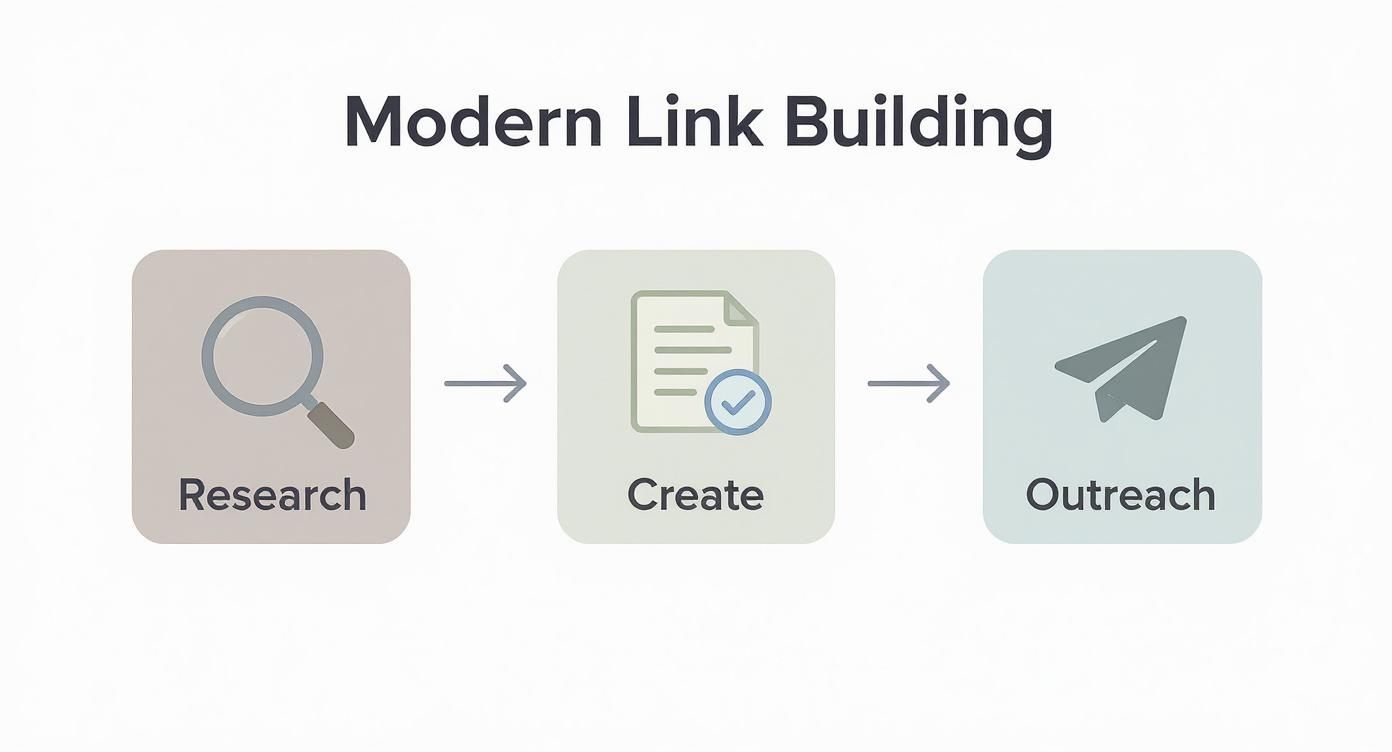
As you can see, effective link building and authority building start long before you send a single email. It all begins with creating an asset that people actually want to link to.
Days 61-90: Scaling and Analysis
The final month of our sprint is all about hitting the accelerator and analyzing what's working. Consistency is everything here. We'll double down on the successful plays and refine our strategy based on real-world feedback from both search engines and users. The goal is to establish a repeatable workflow for growth.
During this final stretch, you will:
- Scale Content Production: Get a content calendar in place and streamline your workflow. The aim is to consistently publish new, high-quality articles that target your priority topic clusters.
- Analyze Performance: Dig into Google Analytics and Search Console. Which new pages are gaining traction? Look for those early signs of success, like a steady climb in impressions and gradual ranking improvements for your target keywords.
- Refine and Iterate: Use this early data to inform your next content cycle. If a certain topic area is showing positive movement, double down on it. If another isn't performing, it’s time to adjust your approach or pivot.
Got Questions About Driving More Organic Traffic?
Even the most seasoned marketers have questions when mapping out a new SEO strategy. Let's tackle some of the most common ones I hear all the time.
How Long Until I Actually See Results from SEO?
Everyone wants to know this, and the honest answer is: it depends. While you might see a small bump from quick on-page fixes in a few weeks, real, sustainable growth doesn't happen overnight.
For a brand-new SEO push, you should plan on it taking 4 to 12 months before you see that exciting, compounding growth kick in.
A few things can speed up or slow down that timeline:
- Your starting point: Does your site already have some authority and a clean history?
- Your competition: Are you up against major players or in a less crowded niche?
- Your consistency: Are you putting in the work week after week?
Think of it like planting a tree. You won't get shade tomorrow, but with consistent care, you'll build an asset that grows stronger over time.
Should I Focus on Creating New Content or Just Update My Old Stuff?
You absolutely need to do both. It’s not an either/or situation; it’s a powerful combination.
Publishing new content is how you expand your reach. It lets you target a wider net of keywords and talk about new topics, pulling in different segments of your audience.
But don't sleep on updating your existing content. A "content refresh" is one of the most effective, low-effort plays in the SEO game. You’re improving pages that Google already knows and trusts.
My favorite trick: Jump into Google Search Console and find pages with tons of impressions but a pathetic click-through rate. These are screaming for an update and are your best bet for a quick win.
Is It Better to Go After Big, High-Volume Keywords or Long-Tail Ones?
If you're just getting started or don't have a massive, authoritative site, the answer is almost always long-tail keywords.
These are the longer, more specific phrases people actually type into Google, like "how to increase organic traffic for a local business."
Sure, the search volume for any single long-tail keyword is lower. But they come with two huge advantages: the user's intent is crystal clear, and the competition is way, way lower. You can actually rank for these. As you collect wins on these more specific terms, you build the authority needed to eventually take a swing at the bigger, more competitive keywords.
Ready to stop guessing and start growing? Rankai uses an AI-powered approach, backed by human expertise, to deliver agency-level content and SEO results without the agency price tag. See how we can scale your organic traffic at https://rankai.ai.