Finding profitable keywords isn't about chasing the biggest search volumes. It’s about getting inside your customers' heads and figuring out the exact phrases they type right before they're ready to pull out their wallet. The real magic happens when you mix your own human intuition with the raw power of AI to find these high-intent queries that lead to actual business, not just empty clicks.
Why Profitable Keywords Are Your Secret Weapon
Let's get one thing straight: traffic for the sake of traffic is a colossal waste of time and money. A smart SEO strategy isn't about getting more visitors; it's about attracting the right visitors. A truly profitable keyword is a direct line to a customer who has a problem you can solve and is actively searching for that solution right now.
This marks a huge shift away from old-school, volume-obsessed keyword research. We stop asking, "How many people search for this?" and start asking, "What's the business value of the person searching for this?" Getting that answer right is the difference between a content strategy that bleeds cash and one that prints it.
Beyond Vanity Metrics
Sure, high-volume keywords look great in a report, but they usually attract a window-shopping crowd with zero intent to buy. A term like "treadmills" might pull in 100,000 searches a month, but think about who's searching. It could be a student doing a research paper, someone just getting ideas, or a tire-kicker. It’s incredibly broad.
Now, compare that to a long-tail keyword like "best quiet treadmill for apartment." The search volume is way lower, but the person behind that search is signaling exactly what they need. They have specific problems to solve (noise, small space) and are deep into the evaluation stage. Capturing that person's attention is infinitely more valuable.
This whole process is about using powerful tools to execute a smart strategy—one that drives real business growth.
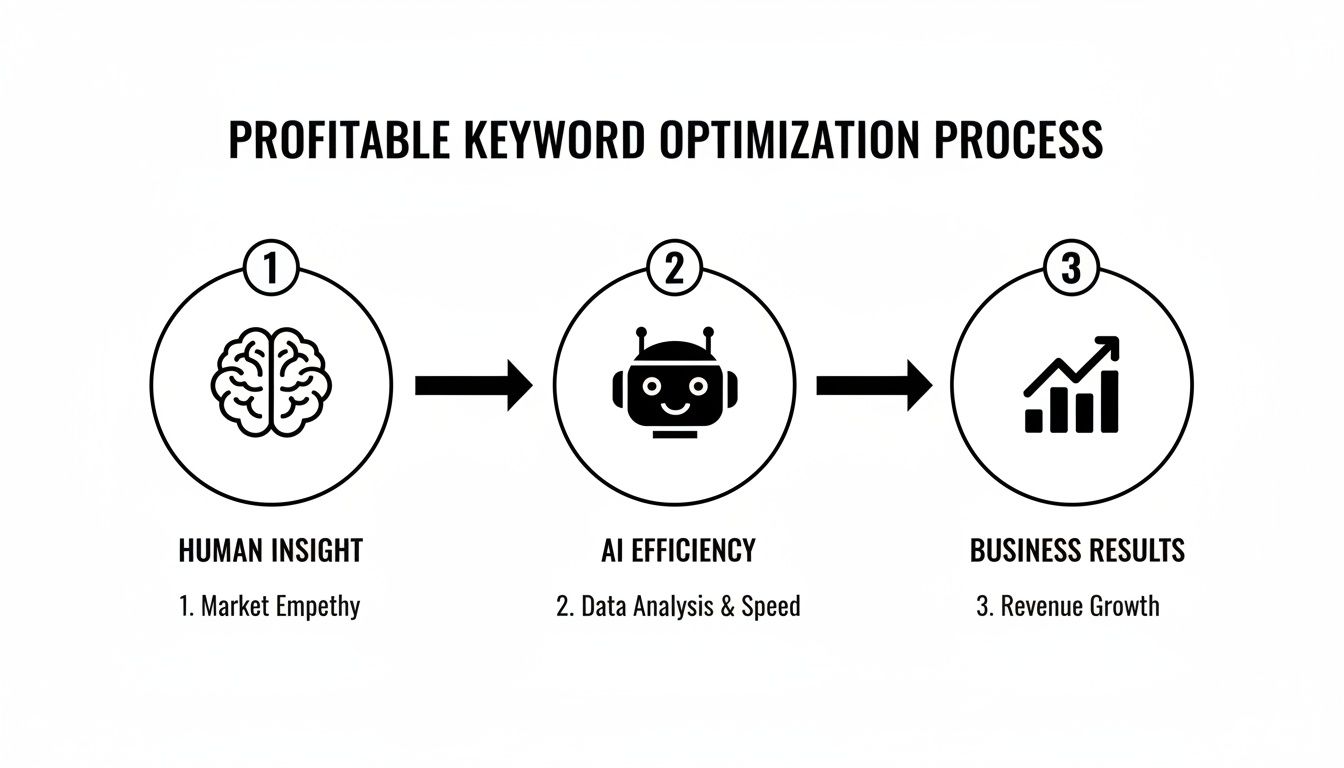
Remember, technology is an amplifier for a good strategy; it can't fix a bad one.
The True Goal of Keyword Research
Profitable keyword research should do more than just bring people to your site. It needs to build a sustainable engine for growth by hitting a few key business objectives.
- Capture High-Intent Users: Go after phrases that scream "I'm ready to do something!" This means buying, signing up for a demo, or asking for a quote. These are your money-making commercial or transactional keywords.
- Find the Gaps: Pinpoint the valuable keywords your competitors are sleeping on or just doing a terrible job of ranking for. This is your opening to swoop in and win qualified traffic without a brutal fight.
- Build Topical Authority: A smart keyword strategy lets you build out content clusters that prove your expertise. When you do this right, Google starts to see you as the go-to source in your niche.
To truly nail this, you need to understand the fundamental pillars that separate a profitable approach from the old way of doing things.
The Pillars of Profitable Keyword Research
| Pillar | Description | Why It Matters for Profitability |
|---|---|---|
| User Intent First | Prioritizing why a user is searching over what they are searching for. | Aligns content directly with the user's stage in the buying journey, dramatically increasing conversion rates. |
| Business Relevance | Every keyword must have a clear, direct path to a product, service, or business goal. | Prevents wasting resources on creating content that attracts traffic but generates zero revenue. |
| Competitive Opportunity | Focusing on keywords where you have a realistic chance to rank and outperform competitors. | Creates quicker wins and a more efficient path to ROI instead of fighting unwinnable battles for broad terms. |
| Long-Tail Specificity | Targeting longer, more detailed search phrases that reveal precise user needs. | Attracts highly qualified leads who are further down the funnel and closer to making a decision. |
By building your strategy on these pillars, you move away from vanity metrics and toward what actually matters: your bottom line.
The most successful SEO campaigns are built on a foundation of keywords that align directly with business goals. If a keyword doesn't have a clear path to revenue, it's a distraction.
Getting a handle on the nuances of user intent is everything. For example, knowing how to use a transactional keyword for more sales is critical, as these terms target users at the very bottom of the funnel. Ultimately, every single keyword you decide to target should have a purpose that clearly supports your business.
Map Customer Intent Before You Even Think About Searching

Before you ever open an SEO tool, the real work begins. The first step—the one most people skip—is to get inside your customer's head. The most profitable keywords aren't just strings of words; they're direct reflections of human needs, pains, and goals.
Jumping straight into keyword data without this context is like trying to navigate a city with a map but no destination. You'll see a lot of roads, but you won't know which ones lead to your ideal customer.
The secret sauce is understanding search intent—the "why" behind every search. This simple concept is the bedrock of any SEO strategy that actually drives revenue. It tells you exactly what a searcher wants to accomplish, which dictates how close they are to making a purchase.
The Four Flavors of Search Intent
Every single keyword can be sorted into one of four main categories. Knowing these lets you create content that meets people at every stage of their journey, serving up the right message at precisely the right time.
- Informational Intent: The user is looking for answers. They're asking "how-to," "what is," or "why." While these queries aren't about buying something today, they are absolutely critical for building trust and establishing your brand as a go-to authority.
- Navigational Intent: The user knows where they want to go and is just using Google as a shortcut. Think of someone searching "Rankai blog" instead of typing out the full URL. Simple as that.
- Commercial Intent: Now we're getting warm. The user is in research mode, actively comparing products, services, or brands. Their searches are peppered with words like "best," "review," "vs," or "alternative." This is a huge buying signal; they're gathering the final bits of information before they pull out their credit card.
- Transactional Intent: This is the money-maker. The user is ready to buy right now. Their searches are direct and specific, including terms like "buy," "pricing," "discount," or "sale." These are the hottest leads because they're at the exact moment of conversion.
If you want to go deeper on this, our guide to understanding keyword intent breaks down the entire framework.
Start with Pain Points, Not Keywords
Let's make this practical. For a moment, forget about generic "seed keywords" you'd type into a tool. Instead, brainstorm the actual, tangible problems your customers are trying to solve. This user-first approach naturally uncovers the profitable, long-tail keywords your competitors are probably ignoring.
Imagine you sell CRM software to small businesses. The old way is to start with "CRM software." The smart way is to start with the customer's real-world frustrations.
What's a founder actually thinking?
- "My sales leads are a mess, scattered across five different spreadsheets."
- "I desperately need to track follow-ups, but I can't afford a sales team."
- "Is a tool like HubSpot total overkill for a two-person company?"
These pain points are a goldmine. They translate directly into high-intent keywords that you can build content around.
Your ideal customer isn't just searching for "CRM software." They're searching for "how to manage sales leads without a team" (Informational) or "HubSpot vs Salesforce for small business" (Commercial). When you answer that specific question, you earn their trust and, eventually, their business.
Putting Intent Mapping into Action
Let’s see how this plays out for different types of businesses. The same customer will use different language depending on where they are in their buying journey.
| Business Type | Informational Intent Keyword | Commercial Intent Keyword | Transactional Intent Keyword |
|---|---|---|---|
| SaaS (CRM) | "how to track sales pipeline" | "best CRM for startups" | "Pipedrive pricing plans" |
| E-commerce (Shoes) | "what causes plantar fasciitis" | "Hoka vs Brooks for running" | "buy new balance 1080 size 11" |
| Local (Plumber) | "why is my faucet dripping" | "emergency plumber reviews Miami" | "plumber near me now" |
Your job is to have a presence at each of these stages. By grounding your entire process in solving real customer problems first, you ensure that every keyword you target has a clear path to generating revenue.
Finding the Long-Tail Keywords That Actually Convert
Forget chasing broad, high-volume keywords like "running shoes." That's a game you probably can't win. The SERPs are packed with giants like Nike and Zappos, and more importantly, the intent is a total mystery. Is the searcher just browsing? Looking for pictures? Writing a school paper? Who knows.
The real money is in the long-tail. These are the longer, more specific phrases that signal someone is deep into their research and ready to act. They've moved past idle curiosity and are actively looking for a solution to a very specific problem.
It's the difference between someone searching for "running shoes" versus someone searching for "best trail running shoes for flat feet." That second person isn't just window shopping; they have their credit card in hand. Capturing their attention is how you drive revenue, not just traffic.
Eavesdrop on Your Customers
Your best keyword ideas won't come from a fancy tool. They'll come directly from the mouths (or keyboards) of your ideal customers. You just have to know where to listen.
Online communities are a goldmine for the raw, unfiltered language people use to describe their needs.
- Reddit and Quora: Dive into relevant subreddits (like r/smallbusiness or r/running). Hunt for the questions that pop up over and over again. The exact phrasing people use to air their frustrations is pure keyword gold.
- Niche Facebook Groups: Join groups where your audience hangs out. Search for terms like "recommend," "help," or "alternative to." You'll uncover a treasure trove of commercial-intent queries.
For example, I once saw someone in a startup-focused group ask, "Does anyone know a simple project management tool that integrates with Slack for a non-technical team?" That single question is loaded with high-intent keywords that a SaaS company could build an entire content strategy around.
The secret is to listen before you write. Stop guessing what people search for and start paying attention to what they actually say. This is how you create content that speaks their language and solves their real problems.
Let Google Be Your Guide
Google itself leaves a trail of breadcrumbs leading you straight to valuable long-tail keywords. You just have to analyze the search results page (SERP) like an expert.
The "People Also Ask" (PAA) Box
This little box is a direct look into the user's mind. It shows you the very next questions people ask after their initial search. It’s not a random list; it's a roadmap of their research journey.
A search for "how to improve website speed" might bring up PAA questions like:
- What is a good page load time?
- How can I test my website speed for free?
- Does image size affect website speed?
Boom. Each one of those is a perfect long-tail keyword for a piece of content that builds out a comprehensive topic cluster.
Autocomplete and Related Searches
Don't ignore the obvious. Google's Autocomplete and the "Related Searches" section at the bottom of the page show you what real people are searching for right now. Use these features to turn one broad idea into a dozen specific, actionable long-tail keywords.
The data overwhelmingly supports this strategy. Long-tail keywords account for a staggering 70% of all online searches. Even better, research shows they get 1.7x higher click-through rates in organic search. In fact, keywords with 4 words can hit a peak CTR of 31.8%—a massive advantage. You can dig into more keyword research statistics to see just how powerful this is.
Exploit Your Competitors' Weak Spots
One of my favorite tactics is to find out what's almost working for my competitors.
Use an SEO tool like Ahrefs or Semrush to analyze a competitor's domain. But don't just look at their highest-volume keywords. That's a trap.
Instead, filter for the keywords where they rank on page two or three (positions 11-30). These are their "striking distance" keywords. They're clearly targeting these terms but haven't managed to crack the first page.
This is your opening.
If you can create a piece of content that is demonstrably better—more thorough, more helpful, and better optimized—you have a fantastic shot at leapfrogging them and stealing that high-intent traffic right out from under them.
Validating and Prioritizing Your Keyword List

So, you've done the digging and have a solid list of high-intent and long-tail keywords. Great start. But a long list is just raw potential—the real magic happens when you turn it into a strategic action plan.
This is where many campaigns go wrong. Without a clear system for deciding what to tackle first, you end up just spinning your wheels. A data-driven framework is what separates the pros from the amateurs, ensuring you're not just chasing traffic but strategically targeting terms that actually move the needle.
Decoding the Essential Metrics
To find truly profitable keywords, you need a balanced scorecard. I’ve seen countless teams fixate on search volume alone, only to get stuck competing for overly broad terms they can't win. To get the full picture, you need to look at these four pillars together.
- Search Volume: This is your basic demand signal—the estimated number of searches per month. A keyword with zero searches is a dead end, but one with massive volume isn't automatically a winner. It’s just the starting point.
- Keyword Difficulty (KD): Scored from 0-100, this metric from tools like Ahrefs or Semrush estimates how hard it’ll be to crack the first page of Google. It’s a gut check on the competition, based on the authority of who’s already ranking.
- Cost-Per-Click (CPC): This is my favorite proxy for commercial intent. Even if you aren't running paid ads, CPC tells you what other businesses are willing to pay for a single click. A high CPC is a massive clue that the keyword converts.
- Business Relevance: This is where your human expertise comes in. How perfectly does this keyword align with a product you sell or a service you offer? Does it hit a specific pain point you can solve? A keyword can have perfect metrics, but if it doesn't match your business, it's worthless.
Assessing Your Ranking Potential
Keyword Difficulty is your reality check. A term might have amazing volume and a juicy CPC, but if the SERP is clogged with industry giants, your chances of ranking anytime soon are slim to none. This is why having a KD score is non-negotiable.
Look at how Ahrefs visualizes this—it gives you an instant sense of the battlefield.
That score of 39 is labeled "Hard," telling you that you'll need a serious backlink strategy to even have a shot. This kind of insight is invaluable for prioritizing the low-hanging fruit first to build momentum.
This isn’t a one-and-done task. User behavior is always in flux—Google sees 15% new, never-before-seen searches every day. It's why research shows that 57% of PPC specialists dive into keyword research every single week. Staying on top of these shifts is crucial. You can get more details on this from a great PPC keyword research report.
Don't just look at the numbers; look at the story they tell. A keyword with moderate volume, low difficulty, and high CPC is often the sweet spot for generating profitable traffic quickly.
Creating a Simple Scoring Model
The best way I’ve found to cut through the noise is by building a simple scoring model in a spreadsheet. It forces objectivity into the process and stops you from chasing shiny objects.
Here’s a basic framework you can copy and tweak:
- List Your Keywords: Get all your potential targets into Column A.
- Add Metrics: Pull the data. You’ll want columns for Monthly Search Volume, Keyword Difficulty (KD), and CPC.
- Assign Scores (1-5): Now, create three new columns to score each metric based on your goals. For KD, a low score of 1-10 might get a "5" (easy win), while a KD over 70 gets a "1" (long shot). For CPC, a higher value gets a higher score.
- Calculate Total Score: Simply sum the scores for each keyword to get a total priority score.
- Sort and Prioritize: Sort the entire sheet by your total score, highest to lowest.
Voilà. The keywords that bubble to the top are your highest-priority targets. They represent the sweet spot between opportunity and feasibility. This methodical approach turns a messy list into a clear roadmap, ensuring every piece of content you create is aimed at a target with the highest possible ROI.
Using AI to Scale Your Keyword Research
Human strategy is the soul of a great keyword plan, but machine efficiency is what brings it to life at scale. Let's be honest, trying to manually sift through thousands of potential keywords is a surefire recipe for burnout. This is where AI stops being a buzzword and becomes your most valuable assistant for finding profitable keywords, fast.
AI-powered tools can knock out tasks in minutes that would take a human researcher days. Think about it: generating hundreds of long-tail variations, spotting semantic relationships you might have missed, and grouping thousands of keywords into clean, logical content clusters. This isn't about letting a robot take over your job; it's about amplifying your strategic thinking.
By offloading the repetitive, data-heavy parts of the process, you get to focus on what really matters—understanding your audience, analyzing competitor weaknesses, and making the final call on which keywords truly move the needle for your business. It's a partnership that leads to smarter, faster results.
Using LLMs for Creative Brainstorming
Large Language Models (LLMs) like ChatGPT or Gemini are fantastic brainstorming partners. Instead of just plugging a seed keyword into a traditional tool and getting the same old suggestions, you can have a real conversation to explore angles you hadn't considered.
The trick is to move beyond simple prompts. Don't just ask for "keywords for CRM software." That's lazy and you'll get lazy results. Instead, give the LLM a rich, detailed customer persona and ask it to put itself in their shoes.
Here’s a prompt that will get you much closer to gold:
"Act as a marketing strategist for a SaaS company. Our target customer is the solo founder of an e-commerce store with 1-3 employees. They're totally overwhelmed managing customer inquiries and sales leads in spreadsheets.
Brainstorm 20 long-tail keywords they might search for when looking for a solution. Focus on their pain points like 'disorganized,' 'saving time,' and 'affordable.'"
This approach grounds your keyword ideas in actual human problems, which means they're almost guaranteed to be more relevant and carry higher commercial intent. You're not just getting a list of terms; you're getting a list of solutions your customers are desperate to find.
Automating Keyword Clustering
One of the biggest time-sinks in keyword research is organizing a giant, messy list into logical groups, or "clusters." A list of 5,000 keywords is completely useless until it’s structured. Doing this manually by topic and intent is a monumental headache.
This is where AI truly shines. Keyword clustering tools use smart algorithms to group keywords based on semantic relevance. In simple terms, they analyze the SERPs to see which keywords consistently rank alongside the same URLs. It's a data-driven approach that's far more accurate than just eyeballing which topics feel related.
- For example, an AI tool will instantly group "how to track sales leads" and "best way to manage customer pipeline" because it sees they share the same underlying informational intent and often appear on the same pages.
- It would do the same for "HubSpot pricing" and "Salesforce cost for small business," correctly identifying them as a commercial investigation cluster.
Automating this lets you build out a comprehensive content map in a fraction of the time. You can see every angle of a topic you need to cover, ensuring no gaps and no creating redundant content that just competes with itself.
The AI-Assisted Workflow in Action
Picture a small marketing team at a new tech startup. Their goal is to build topical authority around the concept of "project management for remote teams."
Here's how they could tackle it with an AI-first approach:
- Ideation: They start by feeding their detailed customer personas and pain points into ChatGPT. In about 15 minutes, they have a list of 200+ highly specific long-tail keyword ideas.
- Clustering: Next, they export that list and upload it to an AI clustering tool. An hour later, those 200 keywords are neatly organized into 25 distinct topic clusters, like "asynchronous communication tools," "setting remote project deadlines," and "best monday.com alternatives."
- Outlining: For each cluster, they use an AI writer to generate a comprehensive content outline. The AI analyzes the top-ranking articles for the main keyword in that group to build a structure that's already proven to work.
This entire workflow achieves in a single afternoon what would have traditionally taken a full week of grinding. The human strategist is still firmly in the driver's seat—guiding the AI, validating its output, and making the final decisions—but all the heavy lifting is handled automatically.
To get a better sense of the available options, you can explore a full guide to the top AI keyword research tools that can plug right into this workflow.
Answering Your Questions on Profitable Keywords

Once you get into the weeds of keyword research, the questions always start to fly. That's a good thing. It means you're moving past the basics and into the nuanced thinking that separates good SEO from great SEO.
Finding keywords that actually make a difference is part art, part science. It's about blending hard data with a real understanding of what makes your audience tick. Let's tackle some of the most common questions I hear, so you can build a strategy that drives results, not just clicks.
How Many Keywords Should I Target per Page?
This is a classic, but the game has changed. Forget the old rule of "one page, one keyword." That's not how people search, and it's not how Google ranks content anymore.
Today, we think in topic clusters. Your page should have a primary keyword, sure, but it needs to be surrounded by a whole family of related long-tail variations that support it.
Let's say your main target is "best CRM for startups." A truly helpful, comprehensive article will naturally cover—and rank for—related queries people are searching for, like:
- "affordable CRM for small sales teams"
- "easy to use CRM for non-technical founders"
- "CRM with good email integration"
A single, well-crafted page can easily pull in traffic from dozens, if not hundreds, of these related keywords. The goal isn't to hit a magic number; it's to cover the topic so completely that you're the undeniable authority.
The modern approach is to focus on one core topic, not one keyword. A high-performing page should naturally rank for a primary "head" term and a multitude of related long-tail queries that fall under the same user intent.
What Is a Good Keyword Difficulty Score?
Keyword Difficulty (KD) is a critical metric, but there's no universal "good" score. The right number for you depends entirely on your website's strength—its authority, age, and backlink profile.
If you're working with a brand-new site, stick to keywords with a KD score below 20. Think of these as the low-hanging fruit. They give you a realistic shot at ranking relatively quickly and building that crucial initial momentum.
For a more established site with a solid reputation and good links, going after terms in the 40-60 KD range is a totally reasonable strategy. The key is to be honest with yourself. Don't burn six months chasing a KD 80 keyword if your site simply doesn't have the authority to compete at that level yet.
Can I Find Profitable Keywords for Free?
Absolutely. While paid tools like Ahrefs and Semrush are fantastic for their data and efficiency, some of the most powerful research tools are free and built right into Google.
- Google Autocomplete: Just start typing a search term. The suggestions that pop up are a direct line into what real people are actively looking for.
- "People Also Ask" (PAA) Boxes: This is a goldmine. It shows you the questions people have right after their initial search, revealing both informational and commercial intent.
- Related Searches: Scroll to the bottom of the results page. This section gives you even more long-tail ideas and alternative phrasings.
Beyond Google, spend time where your audience hangs out. Lurking in Reddit threads or Quora discussions lets you hear the exact language people use to describe their problems—which is often the exact phrase they type into a search bar.
How Long Does It Take to Rank for a Keyword?
I know you're looking for a hard number, but the honest answer is: it depends. The timeline is influenced by a handful of key factors, like the keyword's difficulty (KD), your site's authority, how good your content is, and how well you promote it.
As a general rule of thumb, for a low-competition keyword (KD < 20), a site with decent authority might start seeing first-page rankings within 2-4 months. For a tougher, medium-competition term (KD 40-60), you're probably looking at a 6-12 month journey, maybe longer.
The most important thing to remember is that SEO is a long-term play. You're building an asset that compounds over time, not flipping a switch for overnight traffic. Focus on creating the absolute best content for your target keywords, and the rankings will follow.
FAQ on Finding Profitable Keywords
Here are quick answers to some of the most common questions that pop up during the keyword research process.
| Question | Answer |
|---|---|
| How many keywords should I target per page? | Focus on one primary topic, not one keyword. A strong page will naturally rank for a main keyword and dozens of related long-tail variations that share the same user intent. |
| What is a good Keyword Difficulty (KD) score? | It's relative. For new sites, aim for KD below 20. For established sites with strong authority, targeting keywords in the 40-60 range can be a smart move. Match the difficulty to your site's current strength. |
| Can I find profitable keywords for free? | Yes. Use Google's own tools like Autocomplete, "People Also Ask," and "Related Searches." You can also find high-intent phrases by observing conversations on platforms like Reddit and Quora. |
| How long does it take to rank for a keyword? | It varies. For low-competition keywords (KD < 20), expect 2-4 months. For medium-competition keywords (KD 40-60), it can take 6-12 months or more. SEO is a long-term investment that requires patience and consistent effort. |
Hopefully, these answers clear up some of the fog and give you a more confident path forward.
Finding and targeting the right keywords is just the first step. To truly scale your growth, you need a system to create high-quality, optimized content consistently. Rankai automates the entire content creation process, turning your prioritized keyword list into 20+ fully optimized pages published on your site every month, ensuring you capture every ounce of opportunity.