Think of a content gap analysis as creating a map of your content universe. You’re looking for the black holes—the topics your audience is searching for where you have absolutely nothing to offer them. It's a systematic way to see what you have, what your competitors have, and what the search results are rewarding, so you can find those missing pieces in your strategy.
This process is what pulls you out of the "publish and pray" cycle and gives you a clear path to actually growing your traffic.
Why Content Gap Analysis Is Your Secret SEO Weapon
Let's be real: getting content to consistently rank feels like an uphill battle these days. A content gap analysis is like hitting a strategic reset button. It stops the guesswork and hands you a data-driven roadmap for real, sustainable organic growth. You're no longer just throwing content at the wall to see what sticks; you're making calculated moves.
This approach directly tackles the biggest headaches for content marketers. A 2025 survey from Siege Media found that a whopping 77.6% of marketers say "getting content to rank" is their number one challenge. That same survey showed 70.6% struggle with matching user intent and 66.5% have no idea where to put their budget. A content gap analysis is built to fix all of that.
You can dig into the full report and discover the findings on Hive Digital to see just how much the content world is changing.
Pinpoint High-Value Opportunities
A good gap analysis does more than just show you what you're missing—it points you straight to the gold. When you see the keywords your competitors are ranking for and you aren't, you've just uncovered a list of proven topics with built-in search demand.
Suddenly, your strategy shifts. You stop creating content you think your audience wants and start creating content you know they're already looking for.
Take a look at this screenshot from Ahrefs' Content Gap tool. It shows this idea in practice perfectly.
Instantly, you have a prioritized list of content ideas that are already working for others in your space. No more staring at a blank page.
Align Content with the Buyer's Journey
Truly effective content doesn't just attract visitors; it guides them from their first search all the way to becoming a customer. A content gap analysis lays your entire content inventory bare, making it painfully obvious where the holes are in that journey.
I see this all the time: a company has tons of high-level, top-of-funnel blog posts but almost nothing for the middle or bottom of the funnel. They're great at attracting attention but terrible at converting it because they're missing the crucial content that actually guides someone toward a decision.
Finding and filling these gaps ensures you're not just a revolving door for traffic. You're building a complete content ecosystem that actually nurtures leads and, ultimately, drives revenue.
Building Your Content Gap Analysis Framework
Diving into powerful SEO tools without a clear plan is a recipe for disaster. It’s like trying to navigate a new city without a map—you’ll just wander aimlessly. A solid framework is what turns your content gap analysis from a messy data-dump into a strategic, mission-driven process. It all starts with setting specific, measurable goals that connect your efforts to actual business results.
Before you even think about plugging a competitor’s URL into a tool, you have to define what victory looks like. Are you trying to snag high-intent, bottom-of-funnel traffic that’s ready to buy? Or is the main goal to build up your topical authority around a new product line? Maybe you just want to close the gap with that one competitor who always seems to outrank you.
This first step is non-negotiable. Without clear objectives, you’ll quickly find yourself drowning in endless keyword lists and competitor data, completely unable to tell a real opportunity from background noise.
Auditing Your Existing Content Baseline
To figure out where you’re going, you need an honest picture of where you are right now. An audit of your existing content gives you that performance baseline. It’s a candid look at what's working, what's falling flat, and what's basically invisible to search engines and your audience.
The first move is to pull together an inventory of your key content URLs. You can usually export this from your CMS or use a crawler tool like Screaming Frog. The point is to get a clean list of what you’ve already published. Then, enrich that list with some essential metrics from Google Search Console.
- Impressions: This tells you which pages are showing up in search results, even if they aren't getting clicked. A page with high impressions but a low click-through rate (CTR) is a classic sign of a content gap—or at least a very weak title and meta description.
- Clicks: This is the good stuff. It shows you what content is actively bringing people to your site. These are your current MVPs.
- Average Position: This helps you spot the low-hanging fruit. Content hovering in positions 11-20 is on the verge of greatness and often just needs a solid update to start performing.
This simple act of looking inward shifts your content gap analysis from being just about competitors to being a holistic growth strategy for your own brand.
Mapping Content to the Marketing Funnel
With your baseline figured out, the next step is to map your existing content to the different stages of the marketing funnel. This is where you’ll find the big, gaping holes in your customer’s journey. For instance, you might realize you have dozens of top-of-funnel (TOFU) blog posts but only two middle-of-funnel (MOFU) case studies to help people actually make a decision.
A common trap I see all the time is businesses over-investing in awareness content while completely neglecting the decision-making stages. This creates a "leaky funnel." You do all the hard work to attract an audience, but then you fail to give them what they need to convert, essentially gift-wrapping them for your competitors.
This flowchart shows how a structured content gap analysis helps you move past that frustration and toward real growth.
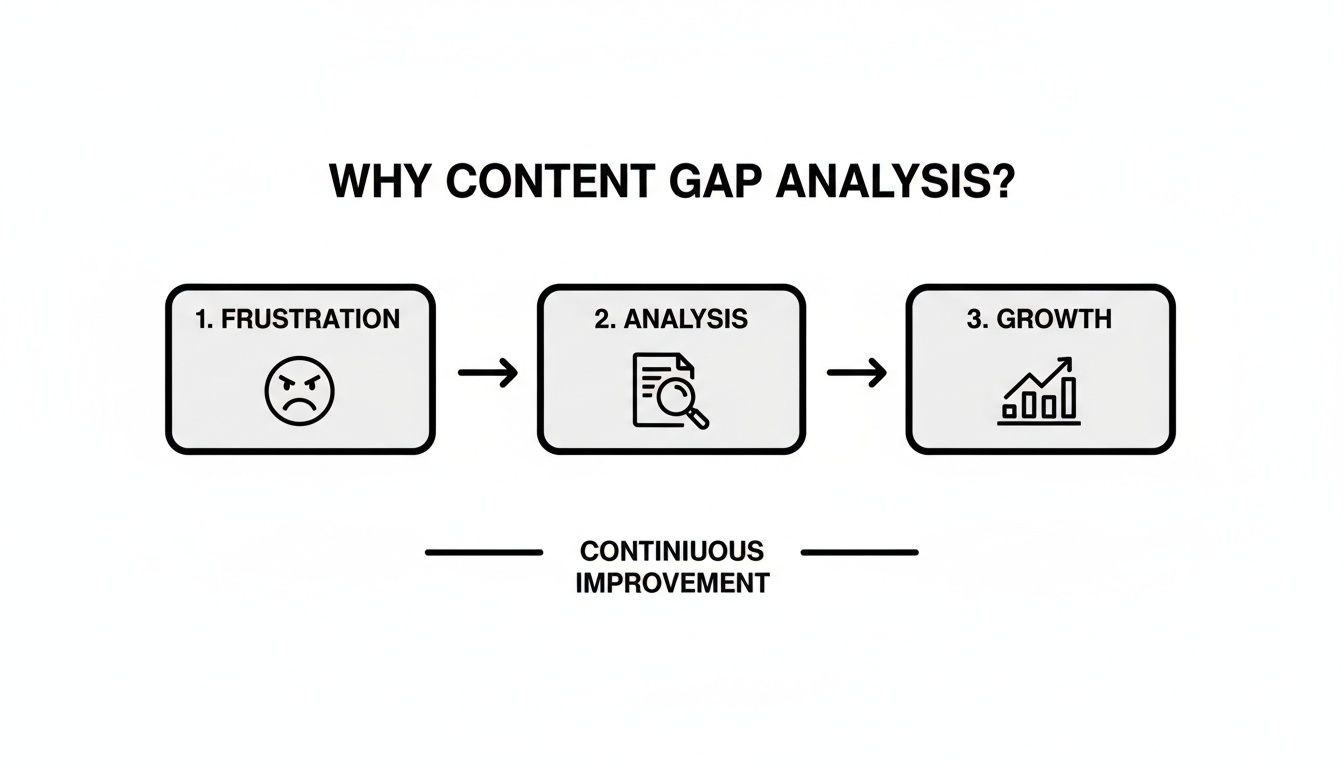
The visual makes a simple but powerful point: a structured analysis is the bridge between content chaos and measurable results. By finding and filling the gaps, you can systematically build a content library that guides people through every step of their journey, turning casual visitors into loyal customers.
And the need to do this is only getting more urgent. The web is becoming unbelievably crowded, with a projected 5.65 billion internet users and 5.41 billion social media profiles. This explosion of noise makes content gaps even more damaging, especially as publishers lose traffic to AI summaries and shrinking SERPs. For many brands, fixing this is pure ROI gold—in fact, 23% credit content as having the biggest multichannel impact.
You can dig into the numbers yourself in the latest global overview report from DataReportal. Using a framework like this ensures your content efforts aren't just busywork, but are always tied directly to tangible business outcomes.
Uncovering Gaps: A Deep Dive into Competitor and SERP Analysis
With a clear picture of what you already have, it's time to shift your focus outward. This is the real discovery work—where you stop looking at your own site and start investigating what your audience is actually searching for and what your competitors are ranking for. This isn't just about plugging a few domains into a tool; it's a strategic hunt for proven opportunities.
First things first, you need to know who you’re up against. Your competitors aren’t always who you think they are. They typically fall into three buckets:
- Direct Competitors: The obvious ones. They sell a similar product or service to the exact same audience.
- Indirect Competitors: These folks solve the same core problem as you, but with a different solution entirely.
- SERP Competitors: This is the most overlooked group. These are the sites—blogs, publishers, forums—that consistently show up for your target keywords, even if they don't sell anything that competes with you.
If you don't account for all three, you're only seeing a fraction of the competitive landscape and missing a ton of content ideas.
Using SEO Tools to Find Keyword Gaps
The quickest way to get a bird's-eye view of your content gaps is with specialized SEO tools. Platforms like the Content Gap tool from Ahrefs or the Keyword Gap tool from Semrush are built for this exact task.
The concept is simple but incredibly powerful: show me the keywords my competitors rank for, but I don't.
Let’s say you run a project management software company. You'd pop your domain into the tool, along with two or three of your top competitors. The platform then does the heavy lifting, cross-referencing millions of keywords to spit out a list of terms they're getting traffic from while you’re invisible.
This list is your initial treasure map. It’s not just a list of random keywords; it's a list of topics with proven search demand that you haven't even touched yet, instantly shifting your strategy from guesswork to a data-backed plan.
Going Manual: Deep Diving into the SERPs
Tools give you the "what," but a manual SERP analysis gives you the "why." It provides qualitative insights you simply can't get from a spreadsheet. This is where you actually search for your high-priority keywords and see what your potential customers see.
I always tell my team that the SERP itself is the ultimate content brief. It tells you exactly what Google believes the user wants to see for that query, from the format of the content to the specific subtopics covered. Ignoring these clues is a massive missed opportunity.
When you look at the results, don't just glance at the top 10 blue links. Dissect the entire page. Are there videos? Images? A "People Also Ask" box? These elements are direct clues about user intent. For a full breakdown, check out our guide on how to win Google SERP features.

Choosing the right discovery method depends on your goals—whether you need a high-level overview or granular, topic-specific insights.
Content Gap Discovery Methods Comparison
| Method | Primary Tools | Best For | Pros | Cons |
|---|---|---|---|---|
| Keyword Gap Tools | Ahrefs, Semrush, Moz | Finding high-volume ranking keywords your competitors own and you don't. | Fast, scalable, provides keyword metrics (volume, difficulty). | Lacks qualitative context; can miss emerging or long-tail topics. |
| Manual SERP Analysis | Google Search | Understanding user intent, content formats, and SERP features for a specific high-value topic. | Deep qualitative insights, reveals what Google rewards, great for content briefs. | Time-consuming, not scalable for hundreds of keywords. |
| Topical Analysis | AlsoAsked, AnswerThePublic | Mapping out all the questions and subtopics around a broad theme. | Uncovers user questions, great for building pillar pages and topic clusters. | Can be overwhelming; doesn't provide traditional keyword metrics. |
| Community Mining | Reddit, Quora, industry forums | Discovering the exact language, pain points, and "hidden" questions your audience has. | Authentic, uncovers gaps tools miss, reveals raw customer voice. | No SEO metrics, requires manual sifting, highly qualitative. |
Ultimately, a blended approach works best. Use tools for scale, then zero in on your highest-priority topics with manual SERP and community analysis to get the full picture.
Mining SERP Features for Content Gold
Today's SERPs are packed with interactive features that are basically a cheat sheet for what searchers want. These are goldmines for finding content gaps.
- People Also Ask (PAA): This box is a direct feed of the most common follow-up questions related to a query. Each question is a potential H2 for your article or even a new piece of content on its own.
- Related Searches: Found at the bottom of the page, this list shows you the other avenues people explore during their research. It’s perfect for finding long-tail keywords and understanding related concepts.
- Featured Snippets: Look at who owns the snippet. The content is almost always a concise definition, a bulleted list, or a numbered set of steps. This tells you Google wants a quick, direct answer, and that’s the format you need to provide.
For instance, if you're analyzing the SERP for "how to create a content calendar," you might find PAA questions like "What should be included in a content calendar?" and "How do I create a content calendar for social media?" Boom. Those are two validated content gaps you can immediately fill.
By weaving together the quantitative data from SEO tools and the rich, qualitative insights from manual SERP analysis, you'll build a master list of content opportunities. This becomes the bedrock of a strategy where every article is created with a purpose—to meet a specific, known audience need and drive real results.
From Keywords to a Content Roadmap: Mapping Intent and Prioritizing for Impact
Finding a huge list of keywords is a great start, but it can also be overwhelming. A raw export from your favorite SEO tool is just noise. The real magic happens when you turn that data into an actual, ROI-focused content plan. This is the crucial step where you shift from listing everything you could write about to pinpointing what you should write about to actually move the needle for your business.
First things first: you have to figure out the search intent behind every single keyword. This is about looking past the words on the screen and getting into the user's head. What are they really trying to do? Are they just kicking the tires and looking for information, or do they have their credit card out, ready to buy? Nail this, and you can create content that meets them at the perfect moment.
Getting a Read on User Intent
Every search query has a "why" behind it, and they usually fall into a few key categories. By mapping your keywords to these intents, you stop chasing vanity traffic and start attracting the right kind of visitors. Seriously, understanding keyword intent is the foundation of content that not only ranks but also converts.
Here are the main types of intent you'll see:
- Informational Intent: The user has a question. They want to learn. Think "how to tie a tie," "what is a content gap," or "best ways to brew coffee."
- Navigational Intent: The user knows where they want to go and is using Google as a shortcut. Searches like "Rankai blog" or "LinkedIn login" fall into this bucket.
- Transactional Intent: The user is ready to make a move. They want to buy, sign up, or download. Keywords will include action words like "buy," "pricing," "demo," or specific product names.
- Commercial Investigation: The user is deep in the research phase, comparing their options before making a final decision. You'll see searches like "Ahrefs vs. Semrush," "best CRM for small business," or "Rankai reviews."
Mapping intent helps you connect your content directly to your sales funnel. Informational keywords feed the top of the funnel (TOFU), while commercial and transactional queries are your money-makers at the middle (MOFU) and bottom (BOFU).
I've seen it a hundred times: a team gets obsessed with a high-volume informational keyword but completely ignores the lower-volume transactional terms that are packed with commercial intent. They end up with a ton of traffic and zero conversions because they never built the content that helps people make a buying decision.
How to Actually Prioritize Your Content Plan
Okay, so you've mapped your keywords to intent. Now what? You can't possibly create content for everything at once, especially with limited resources. This is where a simple prioritization model becomes your new best friend, helping you zero in on the topics that will deliver the biggest bang for your buck.
I like to use a straightforward scoring system. Just pop your keyword opportunities into a spreadsheet and add a few columns for scoring, say on a scale of 1 to 5.
- Search Volume: How many people are actually searching for this? (1 = Low, 5 = High)
- Keyword Difficulty (KD): Realistically, how hard will it be to crack the first page? (1 = Easy, 5 = Extremely Difficult)
- Business Relevance: How directly does this term relate to what you sell? A keyword like "buy SEO automation software" is a 5. A broader term like "what is SEO" is probably a 2.
Just add up the numbers to get a "Priority Score." The keywords with the highest scores are your low-hanging fruit—they represent that perfect sweet spot of search demand, achievable ranking potential, and direct business value.
This kind of methodical approach is more important than ever. So many marketers are flying blind; 66.5% say they're uncertain about where to invest their content resources. And even though content marketing costs 62% less than old-school marketing and brings in way more leads, 56% of marketers admit they can't clearly tie their efforts back to ROI. A solid prioritization model cuts through that uncertainty by linking every piece of content to a measurable business goal. If you want to dig into more data like this, check out these content marketing statistics on Siege Media.
When you combine sharp intent analysis with a clear prioritization framework, your content gap analysis becomes more than just a research doc—it becomes a powerful, actionable roadmap for real growth.
Putting Your Analysis into Action

All that data you've gathered is just a pile of interesting facts until you do something with it. Your prioritized list of keywords and topics is the blueprint; now it’s time to actually build something. The best way to turn your analysis into content that actually performs is by creating incredibly detailed, data-driven content briefs. This is the critical step that bridges your high-level strategy and the writer who's about to start typing.
A great content brief is so much more than a keyword and a word count. It’s a roadmap, giving a writer everything they need to create a piece that has a real shot at ranking. By doing the strategic heavy lifting upfront in the brief, you ensure every article or landing page is laser-focused on its objective from the very first word.
Crafting a Winning Content Brief
Think of your brief as the DNA for a new piece of content. It needs to be clear, concise, and absolutely packed with the insights you just worked so hard to uncover. A solid brief cuts down on endless back-and-forth revisions and makes sure the final product aligns perfectly with what users are searching for and what you need to achieve.
Here’s what I always include in mine:
- Primary Target Keyword: The main phrase we're going after.
- Secondary Keywords: A small, tight group of related long-tail keywords and LSI terms.
- Target Audience: Who are we talking to? What are their biggest headaches? Are they a beginner or an expert?
- Search Intent: Why are they searching? Are they looking for information (Informational), comparing options (Commercial), or ready to buy (Transactional)?
- Key Questions to Answer: Lift these directly from the "People Also Ask" boxes and forum threads you found during your research.
- Internal Linking Opportunities: Pinpoint 2-3 existing, relevant pages on your site to link to.
This structured process is how you turn your content gap analysis into a repeatable content engine, not just a one-off project. It's also a key part of a much larger strategy. To see how these individual pieces fit together, check out our practical guide on content mapping for growth.
The single biggest mistake I see teams make is handing a writer a keyword and expecting magic. A detailed brief is your quality control. It's how you scale content creation without sacrificing strategic direction, ensuring every dollar you spend on content has a clear purpose.
Optimizing for Modern Search Engines
Once the draft is done, the optimization work really starts. These days, that means looking beyond old-school SEO tactics. You need to prepare your content for a world with AI-driven answer engines. Your goal is to be seen as a trustworthy, authoritative source by both Google's crawlers and language models like ChatGPT and Perplexity.
First, you have to nail the SEO fundamentals. That means your primary keyword should be in the title tag, meta description, and H1, and used naturally within the content. Second, you have to structure your content for AI. This is all about making information easy for a machine to parse and cite. Use clear headings, bullet points, and numbered lists. When you include specific statistics and direct answers to common questions, you make your content a prime target for being used in AI-generated summaries and featured snippets.
Measuring Success and Driving Continuous Improvement
Hitting "publish" isn't the end of the road. The real value of a content gap analysis comes from creating a feedback loop: measure performance, learn from the data, and make your content even better. Your most important tool for this is Google Search Console (GSC).
After a new article has been live for a few weeks, it's time to dive into its GSC performance report. You're looking for specific signs that tell you if your strategy is actually working.
Key KPIs to Track in Google Search Console:
- Impressions: This is your early warning system. Are people even seeing your page in the search results for your target terms? A healthy, growing impression count means Google is starting to view your content as relevant.
- Clicks and Click-Through Rate (CTR): High impressions but a dismal CTR? That's a classic sign of a boring or irrelevant title tag and meta description. It's showing up, but nobody wants to click it.
- Average Position: Keep a close eye on your ranking for that primary keyword. You want to see that number slowly but surely creeping towards 1.
Look, you're not going to hit page one overnight. SEO is a marathon, not a sprint. But you absolutely should see positive signs within the first 30-90 days. If a piece of content has plenty of impressions but is still stuck on page two or three after a few months, that's your cue to act. It’s time to revisit the brief, refresh the content with new data or examples, and give it another push. This cycle of publishing, measuring, and refining is what turns a one-time analysis into a sustainable growth engine.
Your Top Content Gap Analysis Questions, Answered
Once you start digging into a content gap analysis, the questions always start to fly. It's a detailed process, and let's be honest, the nuances can make or break the value you get from all that work.
I've been there. So, here are some straight-to-the-point answers to the questions that almost always come up when you're in the thick of it.
How Often Should I Be Doing This?
Think of it in two layers. A massive, site-wide content gap analysis is something you'll want to tackle during your big annual or semi-annual planning sessions. This gives you that 30,000-foot view needed to set your strategy for the next 6-12 months.
But the digital world moves way too fast to just set it and forget it. For that reason, you should run smaller, more focused analyses quarterly. This keeps you nimble.
- Competitor Check-in: Pick a key competitor each quarter and see what they’re up to. Did they launch a new feature? Are they targeting a new topic? This lets you react quickly.
- Topic Deep-Dive: Planning a new content hub or a big pillar page? A focused gap analysis is non-negotiable. It ensures you’re covering every possible angle before you even start writing.
This approach keeps your strategy fresh and lets you play offense instead of constantly playing catch-up.
What Are the Best Free Tools for This?
Look, premium tools like Ahrefs or Semrush are fantastic, but you absolutely do not need a massive budget to get meaningful insights. You can actually get pretty far with free tools.
Your number one asset here is Google Search Console. Jump into the Performance reports and look for queries where you get tons of impressions but a disappointingly low click-through rate. That’s the classic sign of a content gap. Google thinks you're relevant, but your page title or meta description isn't sealing the deal, or the content itself isn't quite right.
Beyond that, the Google Keyword Planner is still a solid way to find related keywords you aren’t targeting. And don't ever forget the power of just Googling your main terms. The "People Also Ask" and "Related Searches" sections are a goldmine—it's Google telling you exactly what people want to know.
Can AI Actually Help Speed This Up?
Yes, without a doubt. AI is a huge time-saver and an incredible brainstorming partner for a content gap analysis. It won't replace the hard data you get from SEO tools, but it's brilliant for the qualitative side of things.
Think of a large language model like ChatGPT or Gemini as your junior research analyst. You can literally copy and paste the text from a top-ranking competitor's article and ask it to identify the main themes, pull out key points, and—most importantly—suggest related questions the article failed to answer. This is an amazing way to find those little, nuanced gaps that automated tools always miss.
You can also use it to generate massive lists of audience questions about a topic or to help you organize a messy keyword list into neat, thematic clusters. It can turn hours of manual sorting into a ten-minute task.
My Analysis Gave Me Hundreds of Keywords. Where Do I Even Start?
This is the most common roadblock, and it’s where a great strategy can die a quiet death. Staring at a spreadsheet with a thousand keywords is completely paralyzing. The only way through is ruthless prioritization.
First, put on your business hat. Filter that entire list by asking one simple question: "Would a potential customer search for this?" This instantly helps you separate commercially valuable keywords from the purely informational ones.
Next, get realistic. Filter by a keyword difficulty you can actually compete for and a search volume that’s worthwhile. I’d much rather rank #1 for a term with 300 monthly searches that converts than be stuck on page five for a vanity term with 10,000 searches.
Finally, group what's left into logical content clusters. Now, instead of a giant list, you have a handful of projects. Pick the cluster that directly supports your most pressing business goal—maybe it’s a new product you’re launching or a service area where you need to build authority—and start there. You've just turned chaos into a clear, actionable plan.
A thorough content gap analysis provides the roadmap, but execution is everything. Rankai turns your content gaps into high-performing assets by blending expert SEO strategy with powerful AI automation. We handle the entire process—from finding high-impact keywords to publishing fully optimized articles—so you can see reliable organic growth without the heavy lifting. If a page underperforms, we rewrite it until it ranks. See how we drive measurable results at https://rankai.ai.