In the hyper-competitive world of online retail, standard SEO tactics aren't enough. Ecommerce sites face unique challenges that generic toolkits often fail to address, from managing thousands of product pages and optimizing for transactional keywords to handling complex technical issues like faceted navigation and ensuring product schema is flawless for rich results. Using the right software doesn't just mean finding keywords; it means streamlining workflows, uncovering competitive gaps in product categories, and ensuring your site's technical foundation can support scalable growth.
This guide cuts through the noise to deliver a curated list of the best SEO tools for ecommerce, specifically chosen to tackle these unique challenges. We've categorized each tool by its core strength, whether it's keyword research, on-page optimization for product descriptions, technical SEO audits, or advanced schema implementation. For every tool listed, you will find a concise summary, practical ecommerce use cases, a transparent look at its pros and cons, and up-to-date pricing information to help you make an informed decision.
Instead of vague feature lists, this resource provides a clear roadmap for building a powerful, ROI-focused tech stack. We'll show you how each platform, from comprehensive suites like Semrush to specialized crawlers like Screaming Frog, fits into a cohesive ecommerce strategy. You'll learn exactly how to leverage these tools to drive qualified organic traffic, enhance product visibility in search results, and ultimately increase revenue. Each entry includes direct links and screenshots to help you evaluate the best fit for your business needs without guesswork.
1. Rankai
Best For: Ecommerce stores needing agency-level SEO outcomes without the high cost and complexity.
Rankai distinguishes itself from traditional SaaS tools by operating as an AI-powered SEO service, blending expert human strategy with powerful automation. Instead of just providing software, Rankai executes a comprehensive SEO campaign for you, making it an exceptional choice for ecommerce brands that need to focus on product and sales, not SEO minutiae. It's a fully managed solution designed to generate measurable organic growth and ROI.
The core of their service revolves around a high-volume, performance-driven content strategy. An expert SEO strategist first identifies high-impact keywords with clear commercial intent, mapping every piece of content to actual search demand. The AI then produces over 20 fully optimized pages per month, complete with metadata, internal links, and structured data, a pace that significantly outstrips traditional agency output.

Key Features & Benefits
What makes Rankai one of the best SEO tools for ecommerce is its focus on tangible results. Performance is tracked directly in Google Search Console, with weekly, easy-to-understand reports. If a page fails to rank within three weeks, Rankai’s system automatically flags it for a complete rewrite or rebuild at no extra cost, ensuring your investment always targets performance.
A significant differentiator is its forward-thinking optimization for Large Language Models (LLMs). Content is structured with LLM-ready schemas and citation-friendly formats, positioning your brand to capture visibility in emerging AI search engines like ChatGPT, Gemini, and Perplexity. This future-proofs your SEO strategy beyond traditional search. Rankai's approach integrates several key functions, as you can explore in their analysis of other top AI tools for ecommerce sites.
Pricing, Pros & Cons
Rankai simplifies pricing with a single, transparent plan that sets it apart from complex agency retainers.
- Pricing: A flat $499/month for their complete service, which you can cancel anytime. This includes 20+ pages per month, all optimizations, and unlimited rewrites until ranking is achieved.
| Pros | Cons |
|---|---|
| High-Volume Output: 20+ optimized pages monthly accelerates traffic growth. | Limited Customization: The single plan may not suit large enterprises with highly specific needs. |
| Hybrid Human+AI Model: Expert strategy ensures content is ROI-focused and relevant. | Variable Timelines: While early movement is common, ranking timelines can vary by niche. |
| LLM & AI Search Ready: Future-proofs your content for next-gen search engines. | Cadence Might Be High: Some very small sites may not need 20+ new pages every month. |
| Performance Guarantee: Pages are rewritten until they rank, maximizing your investment. | |
| Transparent & Affordable: Agency-level results at a predictable, fraction-of-the-cost price point. |
2. Semrush
Semrush is a comprehensive, all-in-one digital marketing suite that provides powerful competitive intelligence, making it one of the best SEO tools for ecommerce businesses aiming to dominate their market. It goes beyond standard SEO features by integrating deep advertising and Product Listing Ad (PLA) research, offering a holistic view of your competitors' search strategies.
For an ecommerce store, this means you can uncover the exact keywords your rivals are bidding on, analyze their top-performing ads, and identify gaps in their organic and paid strategies. The platform's Site Audit tool is invaluable for technical SEO, flagging issues on product and category pages that could hinder performance, from slow load times to broken internal links. Semrush’s granular backlink analysis also helps you discover link-building opportunities from relevant industry blogs or publications.
Key Ecommerce Use Cases & Features
- Competitive PLA Research: Analyze competitors' Google Shopping ads to inform your own product-level advertising strategy.
- Keyword Gap Analysis: Identify high-intent transactional keywords your competitors rank for but you don't.
- On-Page SEO Checker: Get actionable recommendations for optimizing individual product descriptions, meta tags, and category pages.
- Local SEO Management: For brands with physical storefronts, the Semrush Local add-on helps manage listings and reviews across multiple directories.
Our Take: Semrush excels at providing actionable competitive data. If your growth strategy heavily involves outmaneuvering direct competitors in both organic and paid search, the investment is easily justified by the insights you gain. For a deeper look at its capabilities, you can find more information in this breakdown of top SEO tools.
Pricing & Implementation
- Pricing: Starts at $129.95/month for the Pro plan. More advanced features and user seats require higher-tier plans (Guru and Business) or specific add-ons, which can increase costs significantly.
- Pros: Extensive feature set covering SEO, PPC, and content; unparalleled competitive analysis tools.
- Cons: The interface can feel overwhelming for beginners, and the pricing structure can become expensive as you scale.
Website: https://www.semrush.com
3. Ahrefs
Ahrefs is a powerhouse SEO platform renowned for its industry-leading backlink index and robust keyword research capabilities, making it one of the best SEO tools for ecommerce. Its strength lies in providing deep competitive insights and powerful technical analysis, which is essential for stores managing extensive product catalogs and complex category hierarchies. The platform's ability to crawl large sites efficiently makes it ideal for identifying technical issues across thousands of product pages.
For ecommerce businesses, Ahrefs' Site Explorer is invaluable for dissecting a competitor's backlink profile to find high-authority link-building opportunities. You can identify which blogs, publications, or affiliates are driving traffic to rival product pages. Furthermore, its Keyword Explorer helps uncover long-tail, high-intent buyer keywords, allowing you to optimize product descriptions and category content to attract customers who are ready to purchase. The free Ahrefs Webmaster Tools (AWT) also provides a fantastic entry point for new store owners to diagnose site health.

Key Ecommerce Use Cases & Features
- Content Gap Analysis: Find keywords your competitors rank for across their product and category pages that you are missing.
- Top Pages Report: Identify which of your competitors' products or categories attract the most organic traffic and backlinks.
- Site Audit Tool: Crawl your entire ecommerce site to find and fix technical SEO issues like broken links, slow pages, or improper redirects that hurt user experience and rankings.
- Backlink Prospecting: Use Link Intersect to find sites linking to your competitors but not to you, creating a targeted outreach list.
Our Take: Ahrefs is the gold standard for backlink analysis and competitive research. If your ecommerce strategy involves building authority and understanding the link profiles of market leaders, its superior data and intuitive interface make it an essential investment.
Pricing & Implementation
- Pricing: Starts at $99/month for the Lite plan. Access to more data, historical trends, and higher usage limits requires more expensive Standard, Advanced, or Enterprise plans.
- Pros: Best-in-class backlink database; powerful keyword and content gap analysis tools; free AWT option is great for beginners.
- Cons: The credit-based system can lead to unexpected costs for heavy users; higher-tier plans are a significant investment for smaller businesses.
Website: https://ahrefs.com
4. Moz Pro
Moz Pro is a venerable all-in-one SEO software suite that excels in accessibility and campaign-based tracking, making it an excellent choice among the best SEO tools for ecommerce, especially for small to medium-sized businesses. It simplifies complex SEO data into digestible metrics and reports, focusing on core functionalities like rank tracking, site audits, and its renowned link-building tools. The platform is built around the concept of "campaigns," allowing you to neatly organize and monitor SEO efforts for specific product lines or regional sites.
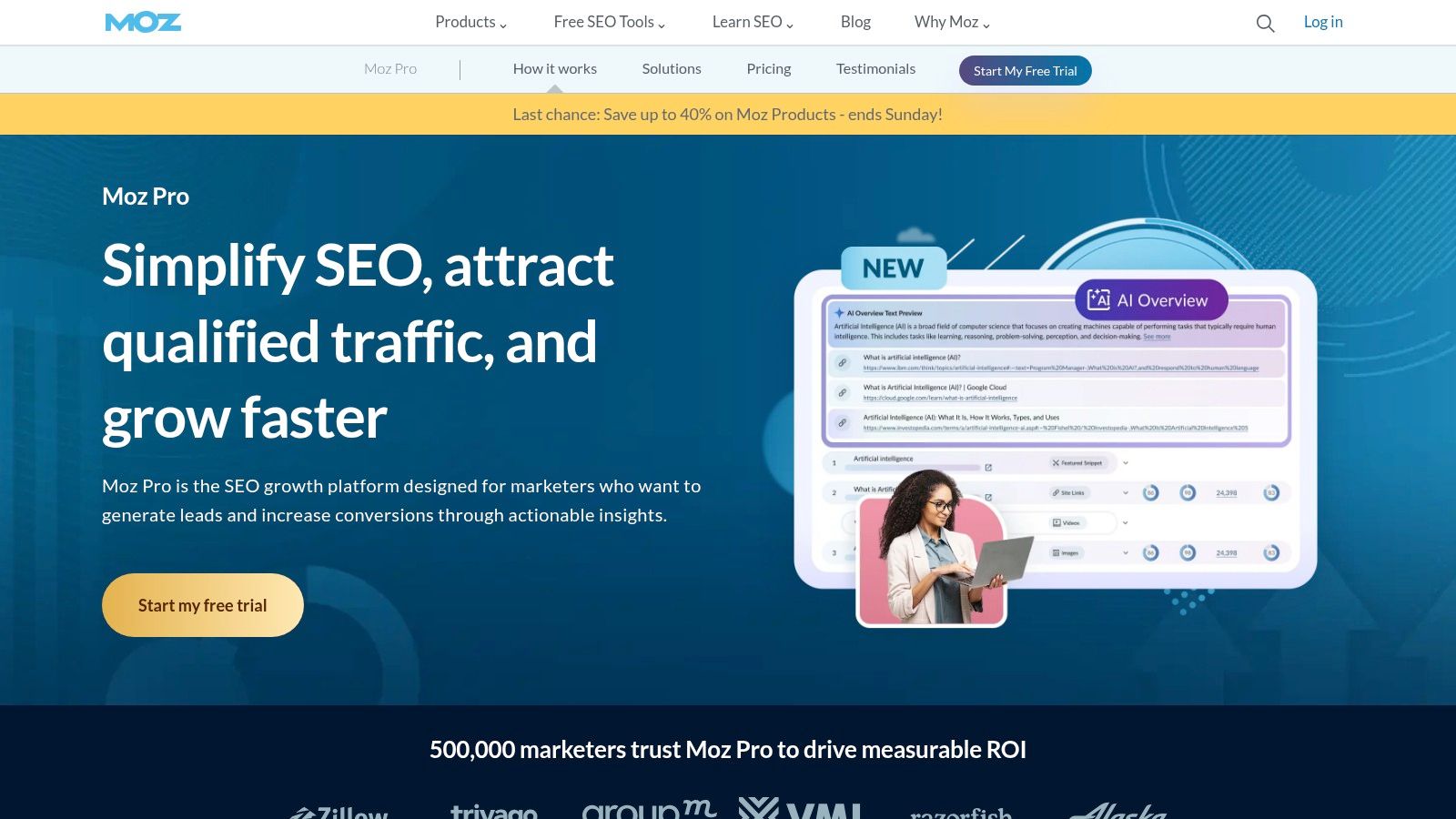
For an ecommerce store, this translates to straightforward tracking of keyword rankings for top products and categories. The Site Crawl feature is particularly useful for identifying common ecommerce technical issues, such as duplicate content on product variants or broken links within your navigational structure. Moz’s Domain Authority (DA) and Page Authority (PA) metrics also provide a quick, comparative benchmark for evaluating link-building prospects and your site's overall SEO health against competitors.
Key Ecommerce Use Cases & Features
- Campaign-Based Tracking: Easily monitor a curated set of keywords for specific product categories or landing pages.
- Link Explorer: Analyze your backlink profile and identify link-building opportunities from relevant blogs or industry websites.
- On-Page Grader: Get scores and suggestions for optimizing individual product pages for their target keywords.
- Custom Branded Reporting: Create professional, easy-to-understand SEO reports to share with stakeholders or clients (available on higher tiers).
Our Take: Moz Pro is ideal for ecommerce teams that need a reliable, user-friendly tool without the overwhelming complexity of larger platforms. If your primary goals are to track keyword performance, conduct regular site audits, and build a solid backlink profile, Moz provides all the essential tools with a gentle learning curve.
Pricing & Implementation
- Pricing: Starts at $99/month for the Standard plan. Higher tiers (Medium, Large, Premium) offer increased limits for keywords, crawled pages, and more advanced features.
- Pros: User-friendly interface with transparent limits; excellent for teams wanting core SEO functions without heavy complexity.
- Cons: Its keyword and backlink databases can sometimes be less comprehensive than those of its largest competitors.
Website: https://moz.com/products/pro
5. Screaming Frog SEO Spider
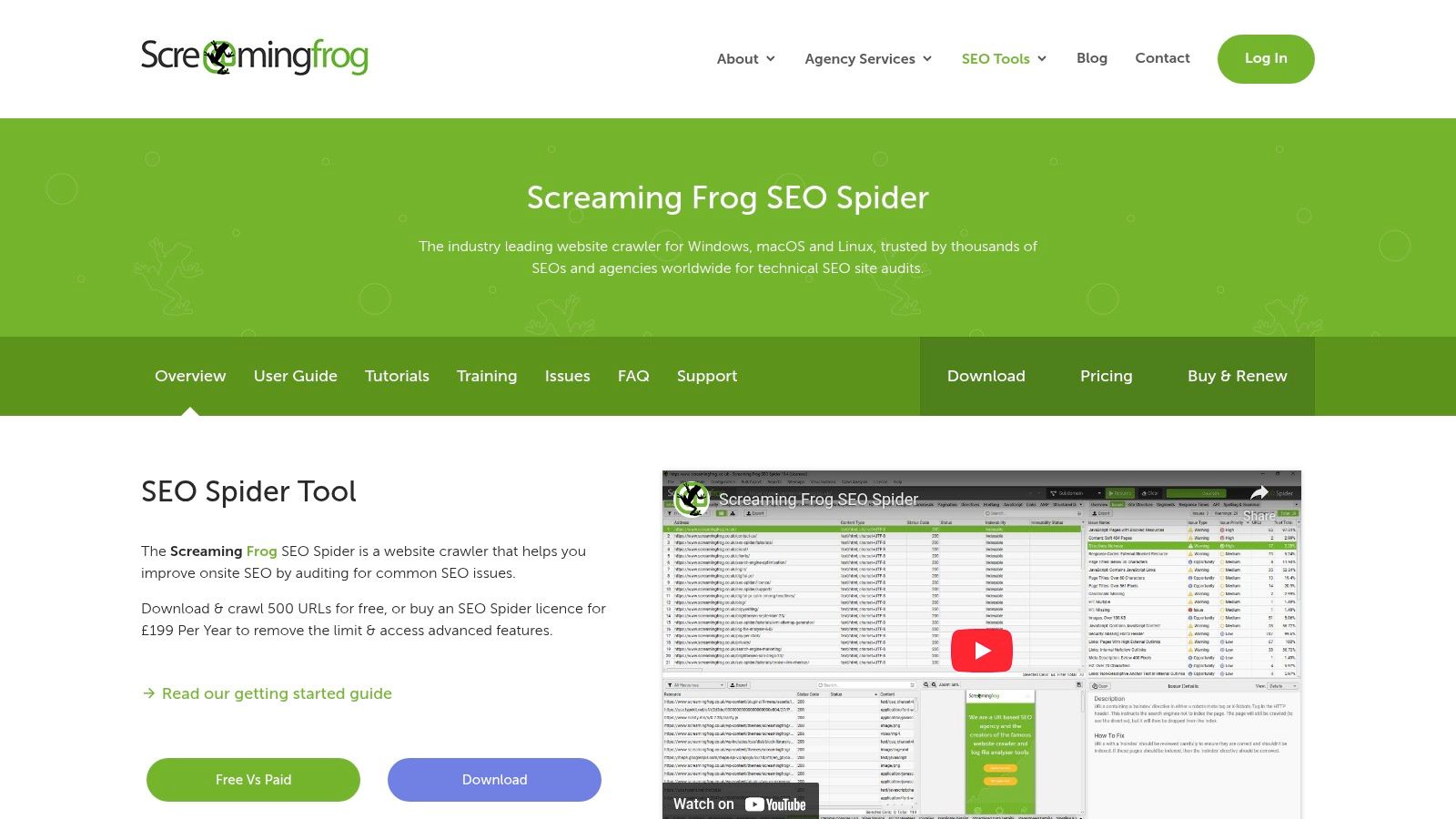
Screaming Frog SEO Spider is a powerful desktop-based website crawler and a cornerstone tool for deep technical audits. For ecommerce sites with potentially thousands of product pages, it is one of the best SEO tools for ecommerce to uncover critical site architecture issues at scale. The platform excels at identifying problems that can directly impact rankings, such as broken links, redirect chains, duplicate content, and issues with canonical tags across your entire product catalog.
Its real power lies in its granularity. Ecommerce managers can quickly crawl their site to find product pages with missing meta descriptions, images lacking alt text, or incorrect structured data implementation. This allows for bulk identification and exporting of technical issues, creating a clear, actionable roadmap for developers to improve site hygiene and search engine crawlability.
Key Ecommerce Use Cases & Features
- Bulk Technical Audits: Identify site-wide issues like 404 errors, server errors, and improper redirects that hurt user experience and SEO.
- Duplicate Content Discovery: Easily find duplicate product descriptions, titles, and H1 tags across thousands of pages.
- Structured Data Validation: Crawl and validate product schema to ensure rich snippets appear correctly in search results.
- Crawl Configuration: Customize crawls to analyze specific subdirectories like
/products/or to test staging environments before launch.
Our Take: Screaming Frog is an indispensable tool for any serious ecommerce SEO strategy. While it has a steeper learning curve, no other tool provides this level of detailed, raw technical data, making it essential for diagnosing complex site-wide problems. For a step-by-step guide on using its data, you can follow this guide on how to perform a technical SEO audit.
Pricing & Implementation
- Pricing: A free version is available for crawling up to 500 URLs. The paid license is £259/year (approximately $325), providing access to all features and unlimited crawling.
- Pros: Incredibly powerful and fast for technical analysis; excellent value for the depth of data it provides; highly configurable for any site size.
- Cons: Runs as a desktop application, which can consume significant local machine resources on very large crawls; the interface is data-heavy and can be intimidating for beginners.
Website: https://www.screamingfrog.co.uk/seo-spider
6. Surfer SEO
Surfer SEO is a powerful content intelligence platform designed to streamline and optimize the on-page SEO process, making it one of the best SEO tools for ecommerce brands focused on content marketing. Its primary strength lies in providing data-driven guidelines for creating and auditing content that ranks, which is ideal for crafting high-performing blog posts, buying guides, and even long-form category page descriptions.
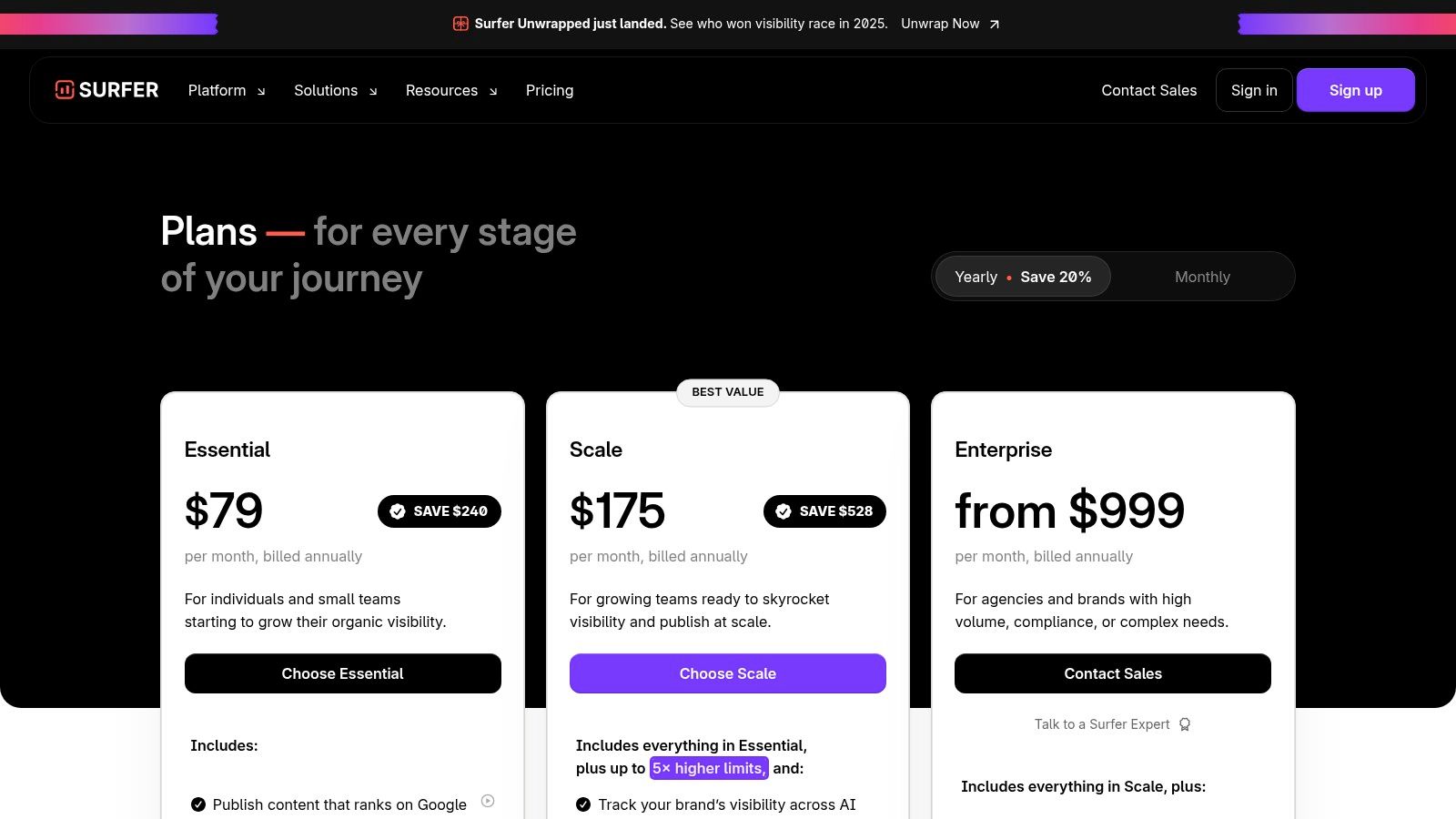
For an online store, Surfer’s Content Editor removes the guesswork from content creation by analyzing top-ranking pages for a target keyword and generating a specific brief. This includes recommended word counts, keywords to include, and structural elements. The platform’s Content Audit feature is also invaluable for ecommerce, allowing you to quickly identify underperforming blog posts or guides that can be refreshed for a quick traffic boost.
Key Ecommerce Use Cases & Features
- Content Editor: Get real-time feedback and scoring as you write product guides or blog content to ensure it’s optimized for your target keywords.
- Content Audit: Systematically identify and refresh outdated or underperforming content to improve rankings and traffic without starting from scratch.
- AI-Powered Articles: Generate entire article drafts for buying guides or "best of" lists that can be quickly edited and aligned with your brand voice.
- Keyword Research & Topical Maps: Discover related subtopics and questions your customers are asking, helping you build content clusters that establish topical authority.
Our Take: Surfer SEO excels at making on-page optimization accessible and actionable, especially for marketing teams without deep technical SEO expertise. It provides a clear, repeatable workflow for creating content that has a high probability of ranking well from day one.
Pricing & Implementation
- Pricing: Plans start at $89/month for the Essential plan, with higher tiers offering more audits, AI credits, and team seats. AI credit bundles can be purchased separately for content production spikes.
- Pros: User-friendly interface with practical workflows; excellent for scaling content creation and optimization; flexible AI credit purchasing.
- Cons: AI-generated content always requires significant human editing for brand alignment and factual accuracy; primarily focused on content and on-page, not a full SEO suite.
Website: https://surferseo.com/pricing
7. Yoast WooCommerce SEO
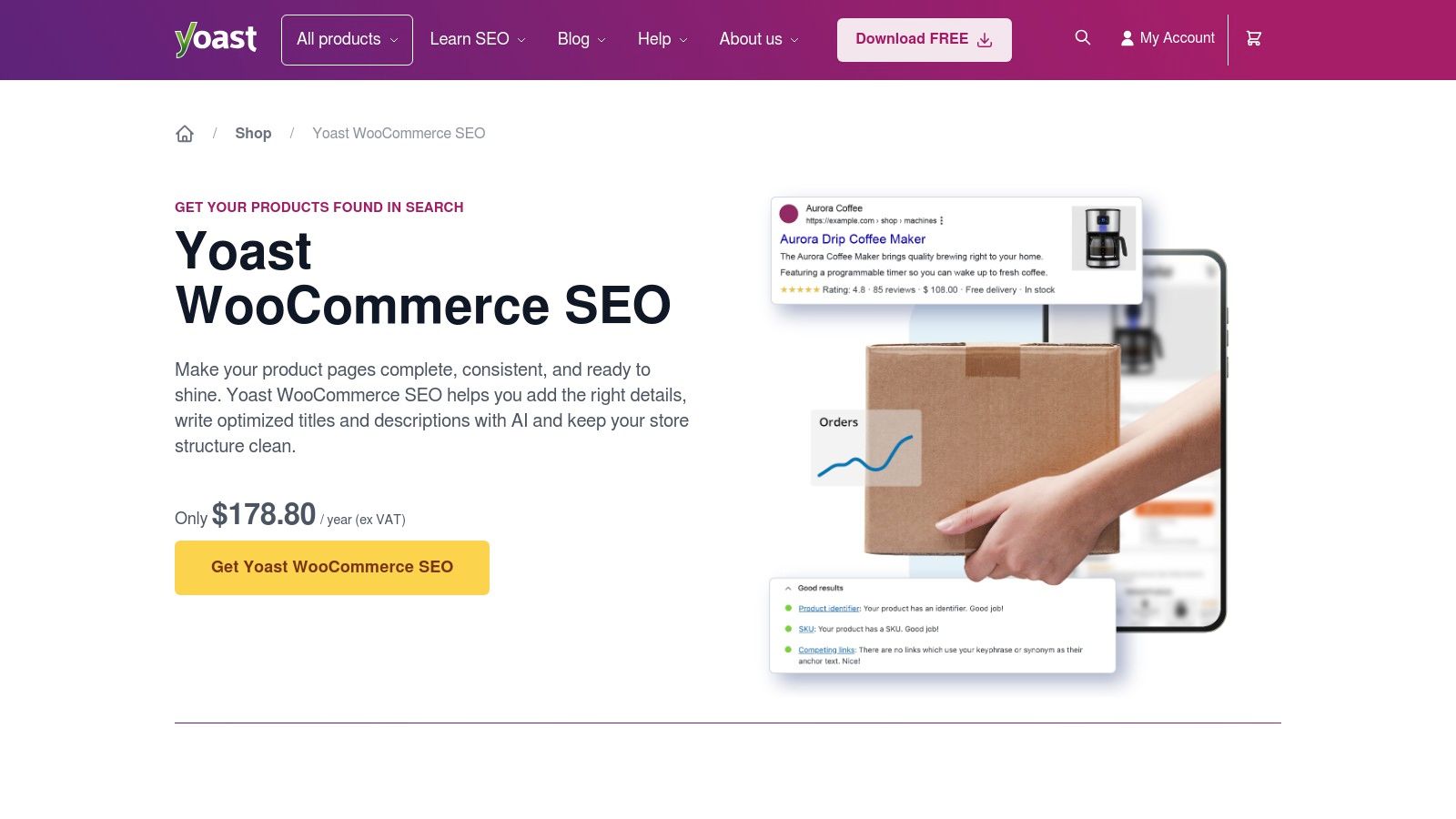
For businesses running on WordPress, the Yoast WooCommerce SEO plugin is an essential extension that tailors the core Yoast SEO functionality specifically for online stores. It bridges the gap between a content-focused SEO plugin and the unique requirements of product-centric websites, making it one of the best SEO tools for ecommerce merchants who want seamless integration within their existing workflow.
The plugin automatically enriches your product pages with the correct schema markup, such as price, stock availability, and reviews, which is crucial for securing rich snippets in search results. This direct integration within the WooCommerce editor provides real-time feedback on product descriptions, category page content, and metadata, helping you optimize as you create or update listings without ever leaving your WordPress dashboard.
Key Ecommerce Use Cases & Features
- Product Schema Markup: Automatically adds structured data for products, including price, brand, and stock levels, to help Google display rich results.
- Enhanced XML Sitemaps: Creates and maintains a sitemap that specifically excludes filtered URLs and includes product-specific information, ensuring efficient crawling.
- Breadcrumb Navigation: Improves the default WooCommerce breadcrumbs for better user navigation and search engine understanding of your site structure.
- Integrated SEO Analysis: Provides instant SEO and readability feedback directly within the WooCommerce product and category editing screens.
Our Take: Yoast WooCommerce SEO is a non-negotiable for any serious WooCommerce store. Its biggest strength is its native integration, allowing you to implement crucial on-page and technical SEO best practices without technical expertise or leaving the platform you work in daily.
Pricing & Implementation
- Pricing: The plugin is sold as part of Yoast SEO Premium, which starts at $99/year for one site. This bundle includes access to all premium features and the Yoast SEO academy.
- Pros: Purpose-built for WooCommerce, simplifies complex product schema, and integrates directly into the WordPress admin interface.
- Cons: It is not a standalone tool; it only works for websites built on WordPress with the WooCommerce plugin.
Website: https://yoast.com/product/yoast-premium-woocommerce/
8. Rank Math (WordPress/WooCommerce)
For ecommerce businesses built on WordPress and WooCommerce, Rank Math is a powerful and lightweight SEO plugin that offers a suite of advanced tools directly within your dashboard. It simplifies on-page optimization, making it one of the best SEO tools for ecommerce stores that need an integrated solution. Its standout feature for online stores is its deep integration with WooCommerce, providing specialized product schema and other on-page signals that search engines use to understand your product listings.
The plugin streamlines technical and on-page SEO tasks, from generating XML sitemaps to managing redirects and implementing schema markup. This allows store owners to focus on their products and customers rather than getting lost in complex SEO configurations. With its Content AI, you can optimize product descriptions and blog posts with keyword suggestions based on real-time data, ensuring your content is competitive and relevant.
Key Ecommerce Use Cases & Features
- Advanced Schema Support: Automatically add Product, Local Business, and other relevant schema types to product and category pages to enhance SERP appearance.
- WooCommerce SEO Integration: Offers specific optimizations for WooCommerce, such as removing the
/product/base from URLs and adding brand identifiers. - Content AI: Get intelligent suggestions for keywords, questions, and links to include in your product descriptions and blog content.
- Built-in Rank Tracking: Monitor keyword performance for key product and category pages directly from your WordPress dashboard.
Our Take: Rank Math is a must-have for any serious WooCommerce store owner. It bundles features that would otherwise require multiple separate plugins, offering incredible value and simplifying your tech stack. The advanced schema automation is particularly powerful for gaining rich snippet visibility.
Pricing & Implementation
- Pricing: A robust free version is available. The PRO plan, ideal for most store owners, is $5.75/month (billed annually). Business and Agency tiers offer support for more sites and keywords.
- Pros: Excellent feature set for a low annual price; simplifies complex SEO tasks directly in WordPress; scales well for businesses managing multiple sites.
- Cons: The most useful plans are billed annually, with no standard month-to-month option for the PRO tier.
Website: https://rankmath.com/pricing/
9. Shopify App Store – SEO category
For merchants on the Shopify platform, the official Shopify App Store’s SEO category is an essential starting point for enhancing store visibility. It acts as a curated marketplace, offering hundreds of plug-and-play applications specifically designed to integrate seamlessly with Shopify’s ecosystem. This makes it one of the best SEO tools for ecommerce merchants who prefer a modular, app-based approach to optimization rather than a single, monolithic platform.
From automated image alt-text generators and JSON-LD schema creators to broken link checkers and site speed optimizers, the App Store provides specialized solutions for nearly every SEO task. The user review system and "Built for Shopify" badges help merchants vet apps for quality and compatibility, ensuring they add functionality without compromising site performance or user experience. Many apps offer a one-click installation process, making technical implementations accessible even for non-developers.
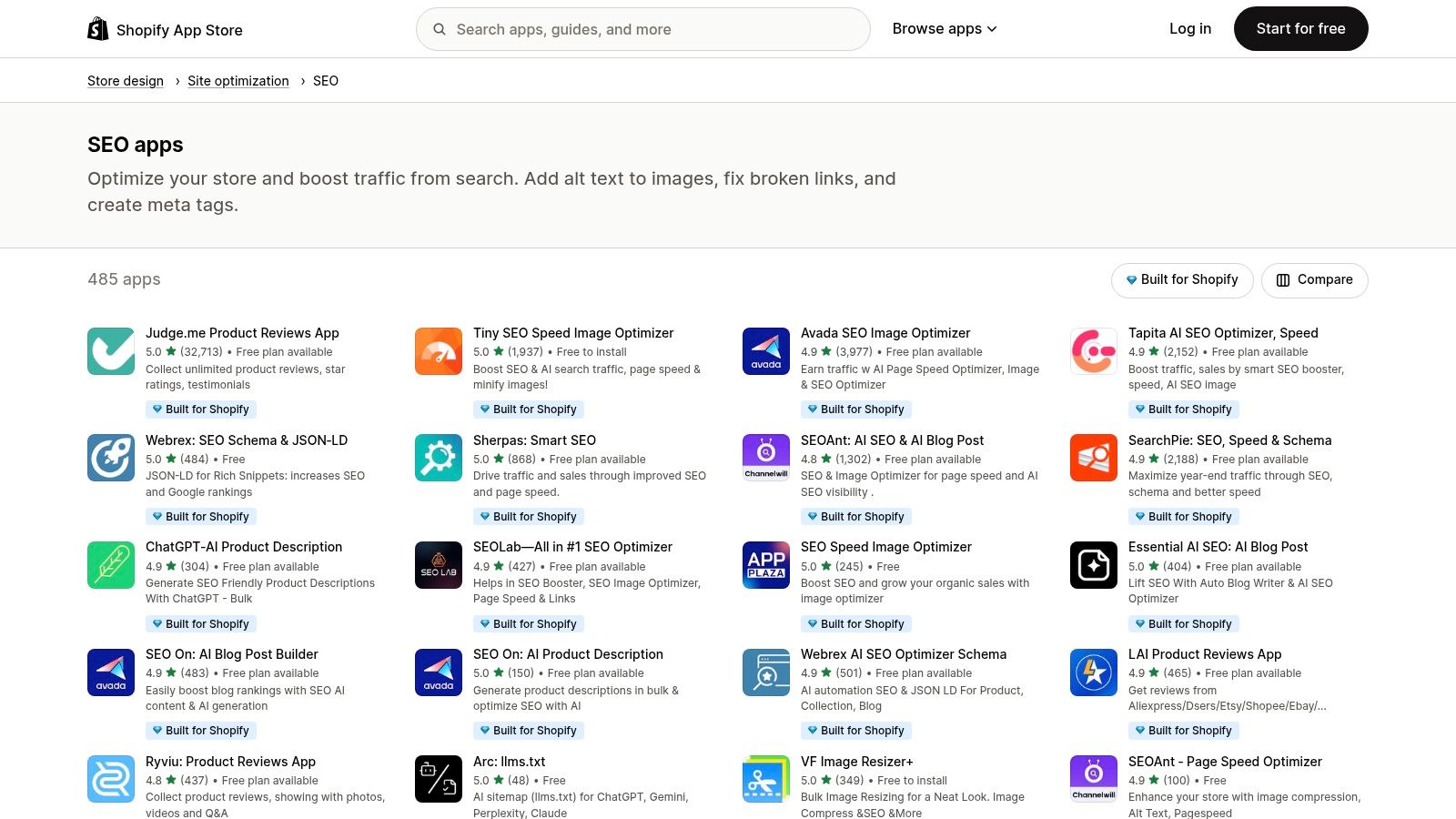
Key Ecommerce Use Cases & Features
- Targeted SEO Enhancements: Install apps for specific needs like rich snippets (JSON-LD), image compression, meta tag editing, or fixing 404 errors.
- One-Click Implementation: Easily add complex features like structured data for products and reviews without needing to edit theme code manually.
- AI-Powered Content: Utilize apps that leverage AI to automatically generate optimized product descriptions and meta titles at scale.
- Vetted and Reviewed: Select from a vast catalog of apps with transparent user reviews and developer support information.
Our Take: The Shopify App Store is less a single tool and more of an indispensable resource hub. It empowers store owners to build a custom SEO toolkit that perfectly matches their specific needs and budget, allowing for incremental improvements without a major upfront investment.
Pricing & Implementation
- Pricing: Varies widely by app. Many top-rated apps offer a free plan for basic features, with premium plans ranging from a few dollars to $50+/month for advanced capabilities.
- Pros: Enormous selection of specialized tools; direct integration with Shopify; many free or low-cost options available.
- Cons: The sheer number of apps can be overwhelming to navigate; quality can vary, requiring careful vetting.
Website: https://apps.shopify.com/categories/store-design-site-optimization-seo
10. BigCommerce – Native SEO features and Apps
While not a standalone tool, BigCommerce is an ecommerce platform with a powerful suite of native SEO capabilities, making it a foundational part of the best SEO tools for ecommerce tech stacks. It provides robust, out-of-the-box technical SEO controls that many other platforms require third-party apps to achieve, such as fully customizable URLs, automated 301 redirects for changed product names, and direct robots.txt file editing.
For an ecommerce store, this means having a technically sound foundation from day one. The platform automatically generates microdata (rich snippets) for product pages, helping your listings stand out in search results with pricing, availability, and review ratings. Its marketplace extends these native functions with apps for faster indexing through IndexNow, or AI tools that can generate optimized product descriptions and meta tags, allowing you to enhance your SEO without leaving your store's dashboard.
Key Ecommerce Use Cases & Features
- Built-in Rich Snippets: Automatically adds structured data to product pages to improve visibility in SERPs.
- Customizable URLs: Full control over URL structures for products, categories, and pages without auto-generated strings.
- Automated 301 Redirects: Prevents broken links by automatically creating redirects when product or category URLs are changed.
- App Marketplace: Extend SEO functionality with official apps for Google Listings & Ads, IndexNow, and AI content generation.
Our Take: BigCommerce is an excellent choice for merchants who prioritize a strong, native technical SEO framework. It handles many crucial on-site optimizations automatically, allowing you to focus on content and off-page strategy instead of technical fixes.
Pricing & Implementation
- Pricing: Included with a BigCommerce plan, which starts at $39/month for the Standard plan. SEO apps from the marketplace may have separate subscription costs.
- Pros: Strong native technical SEO baseline included with the platform; official apps integrate seamlessly for key workflows like indexing and ads.
- Cons: Advanced SEO functionality often relies on installing third-party marketplace apps, which can add to the monthly cost.
Website: https://www.bigcommerce.com/product/seo/
11. Google Search Console
Google Search Console (GSC) is the indispensable, free diagnostic tool that provides a direct line of communication between your ecommerce store and Google. It offers unparalleled insight into how Google crawls, indexes, and views your website, making it a foundational component of any ecommerce SEO strategy. For online stores, it is the ultimate source of truth for understanding organic performance and identifying technical issues straight from the source.
The platform is crucial for diagnosing why specific product pages might not be appearing in search results. Using the URL Inspection tool, you can see the exact crawl status, indexing issues, and mobile usability problems for any product or category page. The Enhancement reports are particularly valuable, showing whether your product schema, review snippets, and other structured data are implemented correctly and eligible for rich results, a key factor in boosting click-through rates for ecommerce sites.
Key Ecommerce Use Cases & Features
- Performance Reports: Discover the exact search queries customers use to find your products, helping you optimize product titles and descriptions.
- Coverage Reports: Identify and fix indexing errors that prevent product pages from being shown in Google’s search results.
- Enhancements Section: Validate your structured data implementation for products, reviews, and breadcrumbs to ensure eligibility for rich snippets.
- Manual Actions & Security Issues: Receive direct alerts from Google about penalties or security vulnerabilities that could devastate your organic traffic.
Our Take: Google Search Console is non-negotiable; it's less of a "tool" and more of a mandatory dashboard for any serious website. For ecommerce, its ability to confirm indexing and validate product schema is critical for visibility and is often the first place you should look when troubleshooting traffic drops.
Pricing & Implementation
- Pricing: Completely free to use.
- Pros: Provides direct, unfiltered data from Google; essential for technical SEO diagnostics and monitoring; validates critical structured data for rich results.
- Cons: Primarily a monitoring and diagnostic tool, not a proactive research or content creation suite; data is limited to the last 16 months.
Website: https://search.google.com/search-console
12. Google PageSpeed Insights
Google PageSpeed Insights is an essential diagnostic tool that analyzes the performance of your web pages on both mobile and desktop devices. For an ecommerce site, where page load speed directly correlates with conversion rates and bounce rates, this free tool is non-negotiable. It provides a performance score based on lab data from Lighthouse and real-world field data from the Chrome User Experience Report (CrUX), offering a clear picture of how users and Google perceive your site's speed.
Its primary value for ecommerce brands is its direct alignment with Core Web Vitals (LCP, INP, CLS), which are confirmed ranking signals. The tool doesn't just score your product and category pages; it provides specific, prioritized recommendations to improve performance, such as optimizing images, reducing server response times, or eliminating render-blocking resources. This makes it one of the best SEO tools for ecommerce teams to benchmark performance and guide technical optimization efforts.
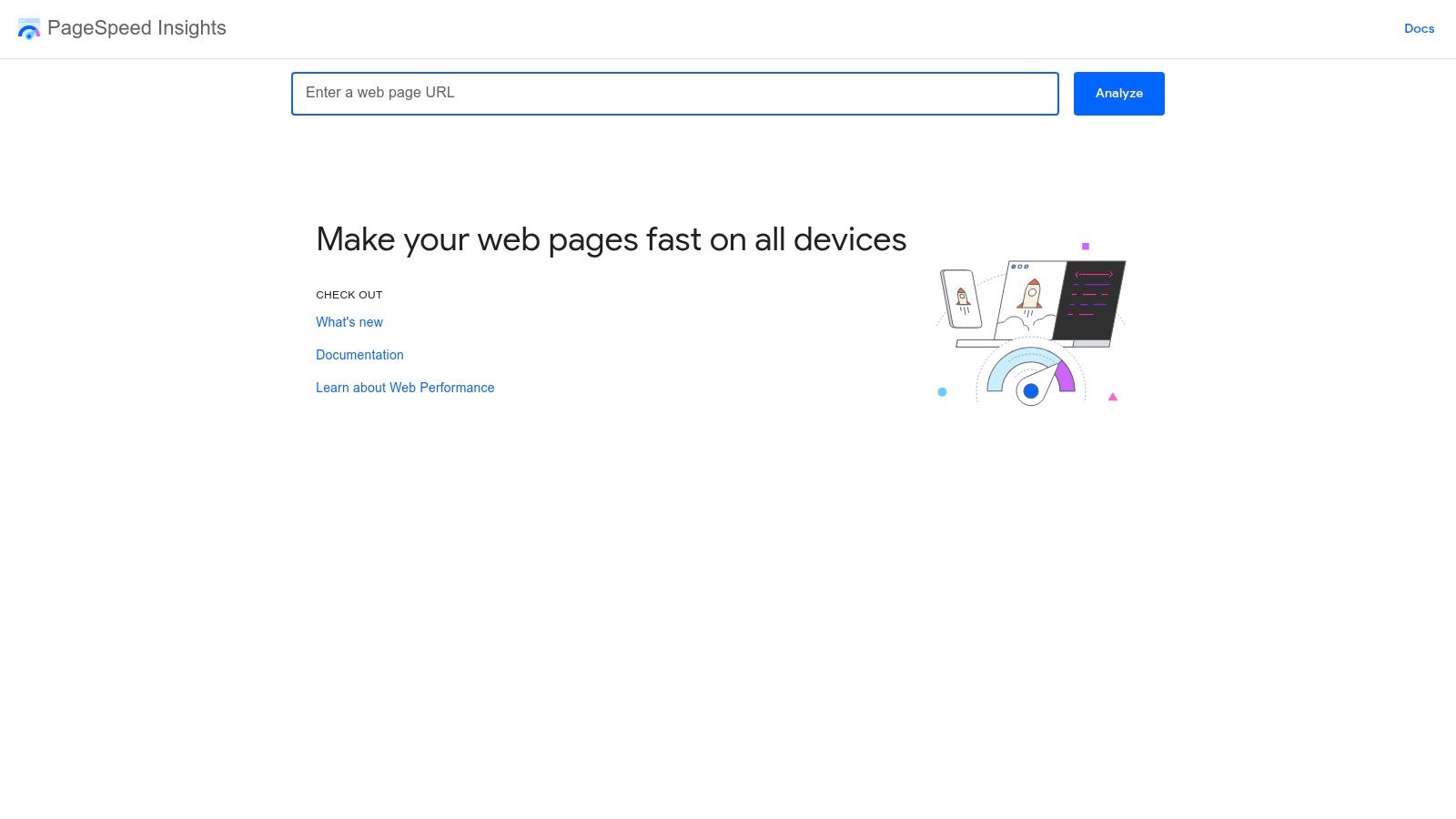
Key Ecommerce Use Cases & Features
- Core Web Vitals Assessment: Directly measures LCP, INP, and CLS to help you meet Google's user experience standards.
- Actionable Diagnostics: Delivers a prioritized list of opportunities, like "Serve images in next-gen formats" or "Reduce initial server response time," to guide developers.
- Performance Regression Checks: Ideal for running before-and-after tests when installing a new app, changing a theme, or adding heavy media to product pages.
- Mobile-First Analysis: Defaults to a mobile performance view, reinforcing the importance of optimizing for shoppers on smartphones.
Our Take: While not a comprehensive SEO suite, PageSpeed Insights is the definitive source for performance data that directly impacts rankings. Use it as a regular health check, especially after making any significant changes to your storefront's code or content.
Pricing & Implementation
- Pricing: Completely free to use.
- Pros: Official data from Google, provides both lab and real-world user metrics, clear and actionable recommendations for developers.
- Cons: Focuses exclusively on page performance, lab scores can fluctuate between tests, and some recommendations can be highly technical to implement.
Website: https://pagespeed.web.dev
Top 12 eCommerce SEO Tools Comparison
| Product | Core offering | Quality & UX (★) | Value & Price (💰) | Target audience (👥) | Unique selling points (✨) |
|---|---|---|---|---|---|
| 🏆 Rankai | AI-powered SEO agency — 20+ fully optimized pages/month; continuous rewrites until ranking | ★★★★★ — GSC-backed, weekly plain-language reports | 💰 $499/mo flat — unlimited rewrites, cancel anytime | 👥 Startups, SMBs, SaaS, e‑commerce, agencies, local businesses | ✨ Strategist‑vetted keywords + LLM-ready schema; automated rewrites & LLM visibility |
| Semrush | All‑in‑one SEO & competitive research toolkits (SEO, Ads, Local, PLA) | ★★★★☆ — deep data, steep learning curve | 💰 Tiered pricing; add‑ons can be costly | 👥 DTC brands, marketplaces, marketing teams | ✨ Integrated PPC/PLA research & local toolkits |
| Ahrefs | Backlink index, site audits, keyword research with historical data | ★★★★★ — excellent backlink & keyword DB | 💰 Expensive at high volume; free AWT for starters | 👥 SEO pros, large e‑commerce catalogs | ✨ Large crawl limits, deep backlink history & exports |
| Moz Pro | Campaign-based SEO: rank tracking, audits, link metrics, reporting | ★★★★☆ — approachable UI, transparent limits | 💰 SMB-friendly pricing; add-ons to scale | 👥 SMB e‑commerce teams | ✨ Branded reports & simple campaign workflows |
| Screaming Frog SEO Spider | Desktop crawler for deep technical audits and bulk issue exports | ★★★★☆ — fast, reliable for very large sites | 💰 Affordable license; requires local resources | 👥 Technical SEOs, large product catalogs | ✨ Bulk exports (redirects, canonicals, structured data) |
| Surfer SEO | On‑page/content optimization with AI content editor & audits | ★★★★☆ — strong editor for non‑technical marketers | 💰 Mid-tier; purchasable AI credit bundles | 👥 Content teams, category & blog owners | ✨ Content Editor, topical maps & scalable content audits |
| Yoast WooCommerce SEO | WooCommerce plugin: product schema, breadcrumbs, XML sitemaps | ★★★★☆ — seamless WP workflow | 💰 Paid plugin (value for WP stores) | 👥 WooCommerce merchants | ✨ Product schema & in‑editor real‑time SEO checks |
| Rank Math (WP/WooCommerce) | WordPress SEO plugin with advanced schema & Content AI | ★★★★☆ — feature‑rich, user tiers | 💰 Affordable annual tiers (PRO/Business/Agency) | 👥 WordPress store owners to agencies | ✨ Advanced schema, daily rank tracking & Content AI |
| Shopify App Store – SEO category | Marketplace of SEO apps (alt images, JSON‑LD, speed, metadata) | ★★★☆☆ — quality varies by app | 💰 Varies — many free tiers available | 👥 Shopify merchants seeking plug‑and‑play apps | ✨ One‑click install, curated/badged apps for Shopify |
| BigCommerce – Native SEO & Apps | Platform SEO controls (URLs, snippets, redirects) + app marketplace | ★★★★☆ — strong native technical baseline | 💰 Included features; optional paid apps | 👥 BigCommerce stores | ✨ Native microdata, automated redirects & indexing apps |
| Google Search Console | Free monitoring: performance, coverage, structured data, alerts | ★★★★★ — direct Google data, essential | 💰 Free | 👥 All site owners & SEOs | ✨ Direct Google insights, enhancement reports & alerts |
| Google PageSpeed Insights | Core Web Vitals testing (Lighthouse + CrUX) with prioritized fixes | ★★★★☆ — lab + field metrics | 💰 Free | 👥 Developers, e‑commerce & UX teams | ✨ Field (CrUX) + lab metrics and actionable optimizations |
Building Your Ecommerce SEO Stack: A Recommended Workflow
Choosing from a list of the best SEO tools for ecommerce is a crucial first step, but real growth comes from integrating them into a coherent, results-driven workflow. The right combination of tools, or "stack," can transform your online store from an invisible digital storefront into a high-traffic, conversion-generating powerhouse. This article has detailed the strengths and weaknesses of individual platforms, but now it’s time to connect the dots and build a strategy that works for your specific business.
A powerful ecommerce SEO stack isn't about collecting the most subscriptions; it’s about creating a seamless process from insight to execution. It’s a system where data from one tool informs the actions you take in another, creating a virtuous cycle of optimization and growth.
A Foundational Ecommerce SEO Workflow
For most ecommerce businesses, a successful SEO workflow follows a logical progression. Think of it as building a house: you need a solid foundation before you can put up walls and decorate.
Establish the Foundation (Monitoring & Technical Health): Your journey begins with understanding your baseline. Start with the essentials: Google Search Console and Google PageSpeed Insights. These free tools are non-negotiable for monitoring site health, indexing status, and core performance metrics. For a deeper technical dive, run regular crawls with Screaming Frog SEO Spider to catch broken links, redirect chains, and other critical issues that can undermine all your other efforts.
Develop the Blueprint (Strategy & Research): With your technical foundation secure, it's time for strategic planning. This is where all-in-one suites like Ahrefs or Semrush shine. Use them to conduct in-depth keyword research, analyzing not just volume but commercial intent. Dig into your competitors' top-ranking product and category pages to reverse-engineer their success and identify content gaps you can exploit.
Build the Structure (On-Page & Content Optimization): Now, you execute the plan. For businesses on WordPress, plugins like Yoast WooCommerce SEO or Rank Math are indispensable for managing on-page elements like titles, meta descriptions, and schema markup directly within your platform. When creating new blog posts or category page copy, a tool like Surfer SEO can provide data-driven guidance to ensure your content is perfectly optimized to compete for target keywords.
The Missing Piece: Bridging Strategy and Execution
This traditional stack is powerful, but it has a significant bottleneck: manual execution. The process of taking keyword research, creating dozens of optimized product descriptions, writing compelling blog content, and tracking performance is incredibly time-consuming and resource-intensive. This is where many ecommerce brands falter. They have the data and the strategy but lack the bandwidth to implement it at scale.
This is precisely the gap Rankai is designed to fill. Instead of just providing more data, Rankai acts as your execution engine. It takes a human-led keyword strategy and combines it with powerful AI to produce high-volume, high-quality content that is built to rank. It effectively replaces the need for separate content optimization tools and, more importantly, the immense manual labor of writing, optimizing, and monitoring.
By integrating Rankai, your workflow evolves. You still use Ahrefs or Semrush for high-level strategy and Screaming Frog for technical audits. But instead of getting bogged down in the content creation process, you hand off the execution, allowing you to focus on bigger-picture growth initiatives like link building, conversion rate optimization, and brand strategy. This model turns your tool stack from a collection of data dashboards into a streamlined engine for compounding organic growth, making it one of the most efficient solutions among the best SEO tools for ecommerce today.
Ready to stop juggling tools and start executing an SEO strategy that drives real revenue? See how Rankai can become the content and execution engine for your ecommerce brand. Visit Rankai to learn how our performance-based model can deliver scalable organic growth for your store.