When you hear “affordable SEO,” what comes to mind? If it’s just the lowest price tag, we need to reframe that thinking. An affordable SEO agency isn't the cheapest one you can find—it’s the one that squeezes the most value and return on investment (ROI) out of every single dollar you spend.
It’s about getting real, measurable growth, not just chasing vanity metrics. Think value, not just a low monthly fee.
What Affordable SEO Really Looks Like
"Affordable" is one of the most misused words in marketing. Too many business owners hear "affordable" and think "cheap." This mistake often leads them down a frustrating path of wasted money, stalled growth, and sometimes, real damage to their website's authority.
That $99-per-month SEO package looks tempting, I get it. But what you often get is a mix of automated, low-effort tactics that can do more harm than good in the long run.
I’ve seen this happen more times than I can count. A business gets lured in by a promise of guaranteed #1 rankings, only to find their site slapped with a Google penalty for using spammy link-building tactics. The cost of cleaning up that mess and the lost revenue always dwarf what they would have spent on a reputable, value-focused agency from the start.
Shifting Your Focus From Cost to Value
A genuinely affordable SEO agency doesn't try to be the cheapest option. It competes on the value it delivers. This means you have to shift your own mindset.
Stop asking, "How cheap can I get SEO?"
Instead, ask, "What's the most impactful SEO I can get for the budget I have?"
This value-first approach is all about smart prioritization. For a local bakery, an affordable plan might mean zeroing in on Google Business Profile optimization and local content to get more people through the door. For a national e-commerce brand, it could be all about technical SEO fixes and building out high-converting product category pages.
The real goal isn't just to rank higher. It's to generate more qualified leads, drive more sales, and see a positive return on your marketing spend. True affordability is measured in business growth, not a smaller monthly invoice.
Defining What's Affordable for You
What’s affordable is completely relative. A startup with a $500 monthly budget needs a vastly different game plan than an established company investing $2,500 a month. A good agency gets this and customizes their approach.
Here’s a practical way to think about what affordability means for your specific goals:
- You Need More Leads: Your priority is filling the sales pipeline. An affordable agency will focus on optimizing your service pages, building local citations, and creating content that answers your customers' most pressing questions to capture that high-intent traffic.
- You Need More E-commerce Sales: If selling products online is the goal, the strategy changes. Here, affordability means optimizing product descriptions, improving site speed to reduce cart abandonment, and strategically using internal links to pass authority to your most important category pages.
- You Need Brand Awareness: Just starting out? The goal is to get your name out there. An affordable strategy might revolve around creating top-of-funnel blog content that attracts a broad audience and positions your brand as an expert in the field.
The Dangers of "Cheap SEO"
It is absolutely critical to understand the difference between an affordable agency and a "cheap" one. Cheap SEO providers often lean on risky, outdated tactics that can get your website penalized by search engines. If you want a deeper dive, our guide on the most affordable SEO services breaks down how to spot high-impact strategies that actually work.
Be on high alert for agencies that promise things like:
- Guaranteed Rankings: No one can ethically guarantee a #1 spot on Google. It's just not possible.
- Vague Deliverables: If they can't clearly explain what they'll be doing each month, run. That’s a massive red flag.
- Bulk Link Packages: When it comes to link building, quality will always beat quantity. Always.
Finding the right affordable SEO partner is really about finding a strategic ally. You want an agency that respects your budget, truly understands your goals, and builds a sustainable plan for long-term organic growth. That’s the foundation for a partnership that actually pays off.
Setting a Realistic Budget for SEO Success
Before you even think about hiring an affordable SEO agency, you have to figure out what "affordable" actually means for your business. An SEO budget isn't a number you just pull from thin air; it's a strategic investment that should be directly tied to your growth goals. Honestly, this is the number one reason I see SEO partnerships fall apart—a total mismatch in expectations from day one.
The first step is to get out of the "how much does it cost?" mindset and start thinking about "what can I invest for a return?" A $500 monthly plan is going to have a very different set of goals and expected outcomes than a $2,500 one. Being upfront about what you can realistically invest allows you to have much more productive conversations with potential agencies and find a partner who can truly make the most of what you have.
Understanding Common SEO Pricing Models
Once you start talking to agencies, you'll run into a few common ways they charge for their work. Each has its own pros and cons, and the right one for you really depends on your specific needs and where your business is at.
- Monthly Retainer: This is the most popular model by far. You pay a set fee every month for an agreed-upon scope of work, like creating content, technical monitoring, and link building. It's perfect for building long-term, sustainable growth.
- Project-Based Fee: This is a one-time cost for a clearly defined project. Think of things like a complete technical SEO audit or getting your local SEO presence set up from scratch. It’s a great fit if you have a specific, immediate need but aren't quite ready for an ongoing commitment.
- Hourly Consulting: Some agencies or freelancers will charge by the hour for strategic advice or specific tasks. This can be a smart way to get expert guidance without a long contract, but you have to be careful—those hours can add up fast.
The image below does a great job of visualizing the different tiers of SEO investment. It separates the high-risk, low-cost "cheap" services from value-driven strategies that are actually geared for growth.
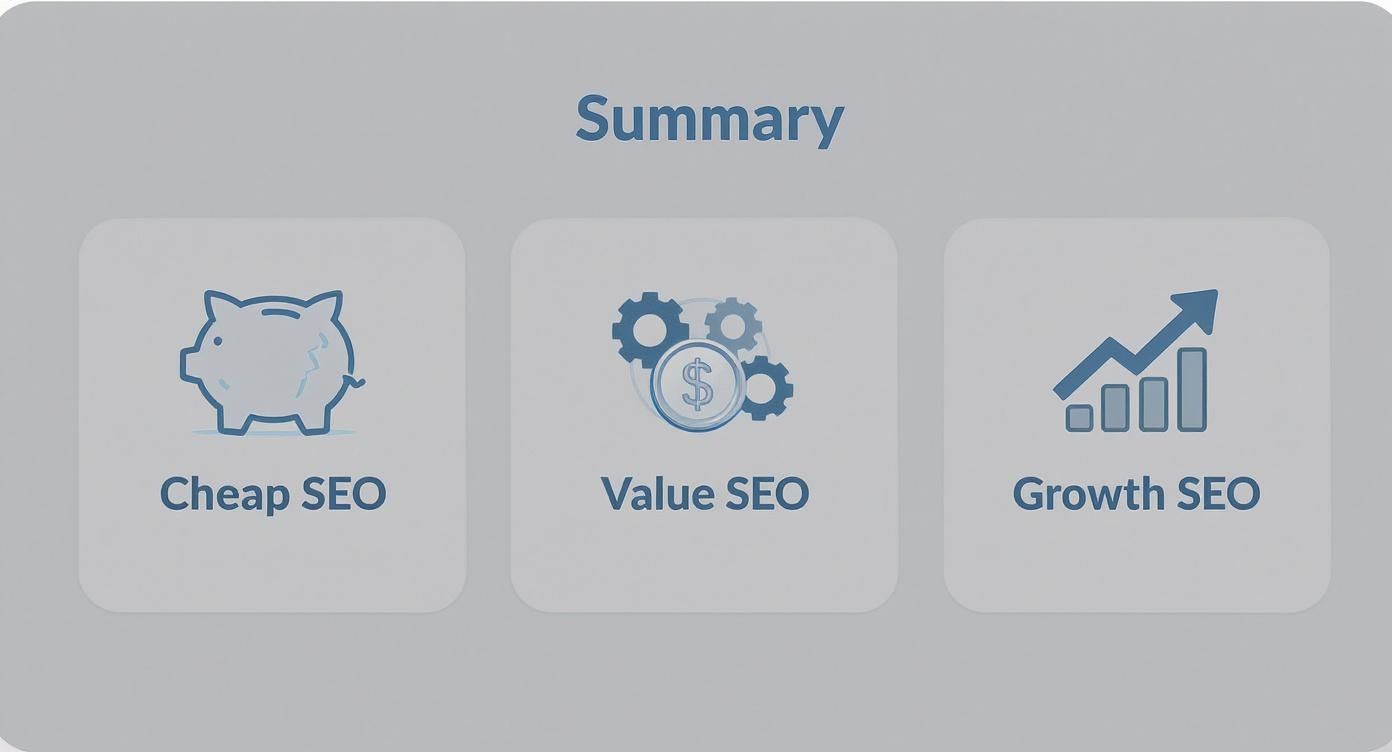
This distinction is crucial. A genuinely affordable agency isn't just cheap; it's focused on delivering value. They operate in those 'Value' and 'Growth' tiers, making sure every dollar you spend is tied to a real business result.
What to Expect at Different Budget Levels
Setting realistic expectations is everything. With a smaller budget, you have to be ruthless about prioritizing the tasks that will make the biggest impact. A larger budget, on the other hand, lets you build a more comprehensive, all-encompassing strategy.
Here in 2025, we're seeing the average starting price for local SEO services from good, affordable agencies hover around $479 per month. For businesses needing a national reach, that starting point is closer to $899 per month. These aren't random numbers; they show how agencies are creating transparent, accessible pricing for everyone from local shops to growing national brands.
To give you a clearer picture, I've put together a table that breaks down what you can generally expect at different investment levels.
Typical Monthly SEO Investment and Expected Services
This table breaks down common pricing tiers and what kind of services you can realistically expect for your money. It's a good starting point for matching your needs with your budget.
| Budget Tier (Monthly) | Typical Services Included | Best For |
|---|---|---|
| $500 - $1,000 | Foundational SEO setup, deep Google Business Profile optimization, basic keyword research, one or two new content pages or blog posts, and crucial on-page optimizations for your core service pages. | Local service businesses, startups, and companies brand new to SEO who need to build a solid foundation and start generating local leads. |
| $1,000 - $2,500 | Everything in the lower tier, plus consistent monthly content creation (4+ articles), ongoing technical SEO monitoring and fixes, some foundational backlink acquisition, and more detailed performance reporting. | Small to medium-sized businesses, e-commerce stores, and SaaS companies that are ready for steady, measurable organic growth. |
| $2,500+ | A full-blown strategy with advanced content marketing, proactive digital PR and link building, conversion rate optimization (CRO) testing, and deep-dive competitive analysis. A dedicated account manager is standard. | Established businesses in competitive markets looking to really dominate their niche and see a significant return on their investment. |
Remember, these are just general guidelines. A good agency will work with you to customize a plan, putting your budget toward the activities that will move the needle the most for your specific business goals.
Uncovering Potential Hidden Costs
Finally, a complete budget is about more than just the agency's monthly fee. When you're planning your investment, make sure you ask about other potential costs that might not be included in their standard package. For a deep dive into all the expenses you might encounter, check out our guide on outsourcing SEO.
Here are a few common "extras" to watch out for:
- Content Creation: Does the retainer cover the actual writing and production of content, or is that a separate line item?
- Technical Implementation: If they find technical problems on your site, are they responsible for fixing them, or will you need to pay your own developer to handle it?
- Premium Tools: Does their fee include the cost of specialized SEO software (like Ahrefs or Semrush), or will you need to buy your own licenses?
Getting clarity on these points right from the start means no nasty surprises down the road. It helps you build a truly realistic budget and a much healthier agency relationship.
How to Vet and Qualify Potential Agencies
You’ve got a budget and a shortlist of potential agencies. Now, the real work begins. Finding an affordable SEO partner is one thing; finding one with the chops to actually deliver is another entirely. This vetting process is your best defense against wasting money or, even worse, letting a bad actor damage your website’s reputation.
First things first, do they practice what they preach? An agency promising to get you to the top of Google should have a pretty solid organic presence themselves. Try searching for terms like "SEO services for small business" or keywords related to their specialty. If they’re buried on page ten, that’s a pretty big red flag.
Think of their website as their digital handshake. Is it fast, modern, and easy to navigate? Or does it feel clunky, outdated, and riddled with typos? That first impression tells you a ton about their attention to detail.

Critically Assess Case Studies and Testimonials
Every agency puts its best foot forward with case studies and testimonials, but your job is to dig beneath the surface. Vague claims like "we boosted their traffic" are essentially meaningless without the full story.
You need to dissect their success stories with a critical eye.
- Industry Relevance: Have they actually worked with businesses like yours? An agency that crushes it for a local plumber might be totally out of its element with a national SaaS company. Look for experience in your specific niche.
- Meaningful Metrics: Are they showing off vanity metrics (like impressions) or real business impact? The best case studies tie directly to your bottom line—think lead generation, improved conversion rates, and tangible revenue growth.
- Transparency: Do they actually explain how they got the results? A good case study will walk you through the initial challenge, the strategy they developed, and the specific tactics they used to get there.
The global market for SEO services is exploding, expected to jump from $64.44 billion in 2024 to $75.22 billion in 2025. This growth is driven by businesses just like yours, making it more critical than ever to verify an agency’s claims.
Look for Social Proof and Real Reviews
Don't just take their word for it. Step away from their polished website and see what actual clients are saying on independent platforms. This is where you'll get the unfiltered truth.
Be sure to check for reviews on sites like:
- Clutch: A B2B review platform known for its verified, in-depth client interviews. It's tough to fake it here.
- Google Business Profile: How do they handle feedback, both good and bad? Their responses (or lack thereof) are very telling.
- UpCity: Another great source for performance data and verified reviews for marketing agencies.
As you read, look for patterns. Is everyone raving about their communication and reporting? Or are there recurring complaints about missed deadlines and a lack of transparency? A single bad review can be an anomaly, but a consistent theme is a clear warning.
A great agency isn't afraid of its track record; it's proud of it. If finding genuine client feedback feels like a detective mission, it’s probably best to move on to the next candidate on your list.
Major Red Flags to Watch Out For
I’ve been in this industry long enough to spot the warning signs from a mile away. Certain promises are just too good to be true and usually indicate a low-quality or even unethical provider. If you hear any of these, run for the hills.
- "Guaranteed #1 Rankings": This is the oldest, most tired sales pitch in the book. No one can guarantee a specific rank on Google. A real SEO agent talks strategy and best practices, not impossible outcomes. For a deeper dive, you can learn more about what a professional SEO agent does and how they work in our detailed guide.
- A "Secret Sauce": True SEO isn't magic. If an agency is cagey about their methods, it’s often because they’re using risky "black-hat" techniques that could get your site penalized by Google. Transparency is non-negotiable.
- Vague Reporting: You should get regular, easy-to-understand reports that clearly connect SEO activities to your business goals. If their reports are confusing or just focus on fluff, they're not holding themselves accountable.
- High-Pressure Sales Tactics: A confident agency doesn’t need to bully you into signing a long-term contract on the first call. They should act like a consultant, taking the time to understand your business, not just like a salesperson chasing a commission.
Vetting an affordable SEO agency comes down to doing your homework. Putting in the time now to research their reputation, analyze their work, and watch for these red flags will save you a world of frustration down the road.
Key Questions to Ask Before You Sign Anything
Alright, you've checked out their reputation and seen their case studies. Now comes the real test: the discovery call. This is your chance to get past the slick sales pitch and see what's really under the hood. Coming to this conversation armed with the right questions is what separates hiring a true partner from just another vendor who sends a monthly invoice.
The point here isn't to play "gotcha." It's to genuinely understand their philosophy, their process, and what they consider a win. Their answers (or lack thereof) will tell you everything you need to know about their expertise, transparency, and whether their approach actually fits your business. Vague, canned responses are a huge red flag.
Questions About Strategy and Process
Before you even think about pricing, you need to understand how they get things done. A good affordable SEO agency should have a clear, logical plan for getting results. If they can't explain their strategy in simple terms, they probably don’t have one.
- "What would you tackle in the first 90 days?" This question cuts right to the chase. A sharp agency will point to low-hanging fruit they might have already spotted, like glaring technical issues or easy on-page optimization wins.
- "What's your philosophy on building backlinks?" This is a big one. Link building is where a lot of cheap agencies take risky shortcuts that can get you penalized. You want to hear them talk about quality over quantity, earning links through valuable content, and building relationships—not just buying links in bulk from a spreadsheet.
- "How do you handle keyword research and content strategy?" The answer you're looking for is all about user intent, not just raw search volume. A real partner will talk about mapping keywords to different stages of the buyer's journey and creating content that actually solves your customers' problems.
These questions help you see if they're just going through a checklist or if they're thinking critically about what will move the needle for your specific business.
Questions About Communication and Reporting
Bad communication sinks more agency-client relationships than anything else. You absolutely have to set clear expectations for reporting and check-ins from the very beginning.
Try asking these:
- "Can I see a sample of your monthly report?" A good report isn't just a data dump from Google Analytics. It should tell a story, connecting their work directly to your most important metrics—organic traffic, lead conversions, and, of course, keyword ranking improvements.
- "How often will we talk, and who will be my main point of contact?" Having a dedicated person to call is crucial. Regular, scheduled meetings keep everyone on the same page and prevent your campaign from drifting off course.
- "What happens when a piece of content or a strategy isn't working?" This is a great way to test their accountability. A confident agency won’t be afraid to admit when something isn't working. They'll have a process for figuring out why, pivoting, and trying a new approach.
Here’s the single most revealing question you can ask: "How do you define a successful client engagement?" If they immediately say "ranking #1 for a keyword," they're chasing vanity metrics. If they talk about increasing qualified leads, boosting your conversion rate, or lowering your customer acquisition cost, you know they're focused on what really matters—your bottom line.
Questions About Contracts and Terms
Finally, before any contract gets in front of you, you need to be crystal clear on the terms. An affordable SEO agency that’s confident in its work won’t try to trap you in a confusing, long-term agreement.
Make sure you get straight answers on these points:
- "What are your contract lengths and cancellation policies?" Flexibility is key. SEO takes time, for sure, but a 30- or 60-day notice period is far more reasonable than getting locked into a 12-month contract right out of the gate.
- "If we part ways, who owns the website, content, and data?" There's only one right answer: you do. You should always retain 100% ownership of all your digital assets. This is non-negotiable.
- "Are there any other costs I should know about, like for content creation tools or technical fixes?" Full transparency on pricing is a must. Surprise bills are a terrible way to start a partnership.
Asking these direct questions upfront saves a world of headaches later. It helps you find an agency that’s not just skilled, but also honest, accountable, and truly invested in seeing you succeed.
Measuring ROI and Understanding Reports
Once the contract is signed, the real work begins. The focus has to shift to what actually matters: tracking performance, making sense of the results, and ensuring every dollar you invest is pulling its weight. I’ve seen too many businesses get bogged down by confusing reports packed with vanity metrics that look impressive but don’t translate to actual growth.
A great partnership with an affordable SEO agency is all about transparency and accountability. This starts with a solid Service Level Agreement (SLA) and flows into monthly reports that give you genuine insights, not just a data dump. Let’s walk through what you should demand and how to measure what truly counts.

What Your Service Level Agreement Should Cover
Think of the SLA as the rulebook for your relationship, not just a formality. It’s there to protect both you and the agency by setting crystal-clear expectations. If an agency gives you a vague SLA—or worse, none at all—that’s a massive red flag.
Before you sign anything, comb through the agreement and make sure it spells out these key points:
- Scope of Work: It needs to be specific. Not just "blogging," but "creation of four 1,000-word blog posts per month." Not just "technical SEO," but "monthly technical site health checks and fixes."
- Reporting Cadence: The SLA should state exactly when you’ll get your reports (e.g., by the 5th business day of each month) and what they’ll include.
- Communication Plan: Who is your main point of contact? How often will you have check-in calls? This should be clearly defined.
- Asset Ownership: This is non-negotiable. The contract must state that you retain 100% ownership of your website, all content created for you, and any associated accounts.
Performance Metrics That Actually Move the Needle
Impressions and website traffic are nice to see, but they don't pay the bills. A smart SEO campaign looks past these surface-level stats and zooms in on the KPIs that directly impact your bottom line.
Your monthly reports should be built around metrics like these:
- Organic Conversion Rate: This is the big one. It's the percentage of visitors from organic search who actually do something valuable, like fill out a contact form or make a purchase. It’s the ultimate test of traffic quality.
- Keyword Rankings for High-Intent Terms: Yes, tracking rankings still matters, but you need to focus on the "money" keywords. These are the search terms people use when they’re ready to buy, not just browse.
- Qualified Lead Growth: How many good inquiries is your SEO bringing in? A good agency will work with you to differentiate between a spam form-fill and a genuine, high-quality lead from organic search.
A truly useful report doesn’t just show you numbers; it tells a story. It should connect the agency's activities from the past month directly to the changes—good or bad—in these core business metrics.
Calculating Your SEO Return on Investment
Figuring out the ROI on SEO can feel a bit fuzzy since it’s a long-term play, but a straightforward formula can give you a clear picture of its financial impact. This is how you justify the spend and keep your agency accountable.
You just need two numbers to get started: the cost of your SEO services and the value generated from organic traffic.
Here’s the basic formula: (Value from Organic Conversions - Cost of SEO) / Cost of SEO = SEO ROI
Let’s run the numbers for a local plumbing business:
- Monthly SEO Cost: $1,500
- New Organic Leads: 20
- Lead-to-Client Rate: 25% (they sign 5 of those leads as new clients)
- Average Lifetime Value of a Client: $800
First, calculate the revenue generated: 5 new clients x $800 = $4,000 in revenue.
Now, plug it into the ROI formula: ($4,000 - $1,500) / $1,500 = 1.67.
Multiply by 100 to get a percentage, and you have an ROI of 167%. This simple math proves that for every $1 spent on SEO, the business is getting back $2.67.
The potential here is huge. We’ve seen case studies where a smart, affordable SEO strategy led to a 77% lift in organic traffic for a realtor and an incredible 2,515% traffic increase for a furniture brand. These aren't outliers; they're examples of what happens when a focused strategy meets a modest budget. If you want to dive deeper, you can explore more data on these outcomes and discover additional insights on affordable SEO services.
Ultimately, finding an agency that lives and breathes ROI is what matters most. They should be just as obsessed with your growth as you are.
Frequently Asked Questions
How Long Until I See Results From an Affordable SEO Agency?
Let's be real: SEO is a long game, not a quick fix. Anyone who tells you otherwise is probably selling snake oil. Generally, you’ll start seeing the first green shoots of progress—like some keywords climbing up the rankings or a better site health score—within about 3 to 6 months. Any decent, affordable agency will be upfront about this.
But for the kind of results that really move the needle, like a serious jump in organic traffic that turns into actual leads, you're looking at a 6 to 12 month runway. Early indicators to watch for are things like better visibility for your core keywords and more people clicking through from the search results. If an agency promises you the top spot on Google overnight, run.
What's the Difference Between "Cheap" and "Affordable" SEO?
This is a critical distinction, and getting it wrong can cost you big time. "Cheap SEO" is a race to the bottom. It's all about finding the lowest price, which usually means they're cutting corners with risky, automated tactics or slapping a generic, one-size-fits-all strategy on your business. These methods often do more harm than good.
Affordable SEO, on the other hand, is about value and getting a real return on your investment. It means you get a smart, ethical strategy built just for you, one that's designed to hit your goals without breaking the bank. An affordable agency is cost-effective because they focus their energy on the activities that will actually make a difference.
Basically, "cheap" is obsessed with the price tag. "Affordable" is obsessed with the results.
Can't I Just Do SEO Myself and Save the Money?
You absolutely can learn the basics of SEO, but be warned: it's a massive time sink and the rules are always changing. Doing SEO right isn't just one skill; it's a whole toolbox of them.
- Technical know-how: You need to understand things like site speed, schema markup, and how search engines crawl your site.
- Content strategy: This is about knowing what to write, who you're writing for, and how to get it to rank.
- Link building: It's not just about getting links, but earning them from websites that have real authority.
- Data analysis: You have to be able to dig into the numbers and figure out what's working and what's not.
Hiring an affordable SEO agency gives you instant access to a team of people who live and breathe this stuff. For most business owners, the time you'd spend trying to master SEO is better spent actually running your business. The opportunity cost of going it alone is often far higher than the price of bringing in a pro.
Ready to see real SEO results without the agency price tag? Rankai combines expert strategy with AI-powered execution to deliver 20+ optimized content pages for you every month. Get the ROI you need with a plan you can trust. Learn more about Rankai and start growing today.
Article created using Outrank